
Through The Lens
Ransom!
By Stephanie Hagiwara · Originally published August 2017 · p. 9
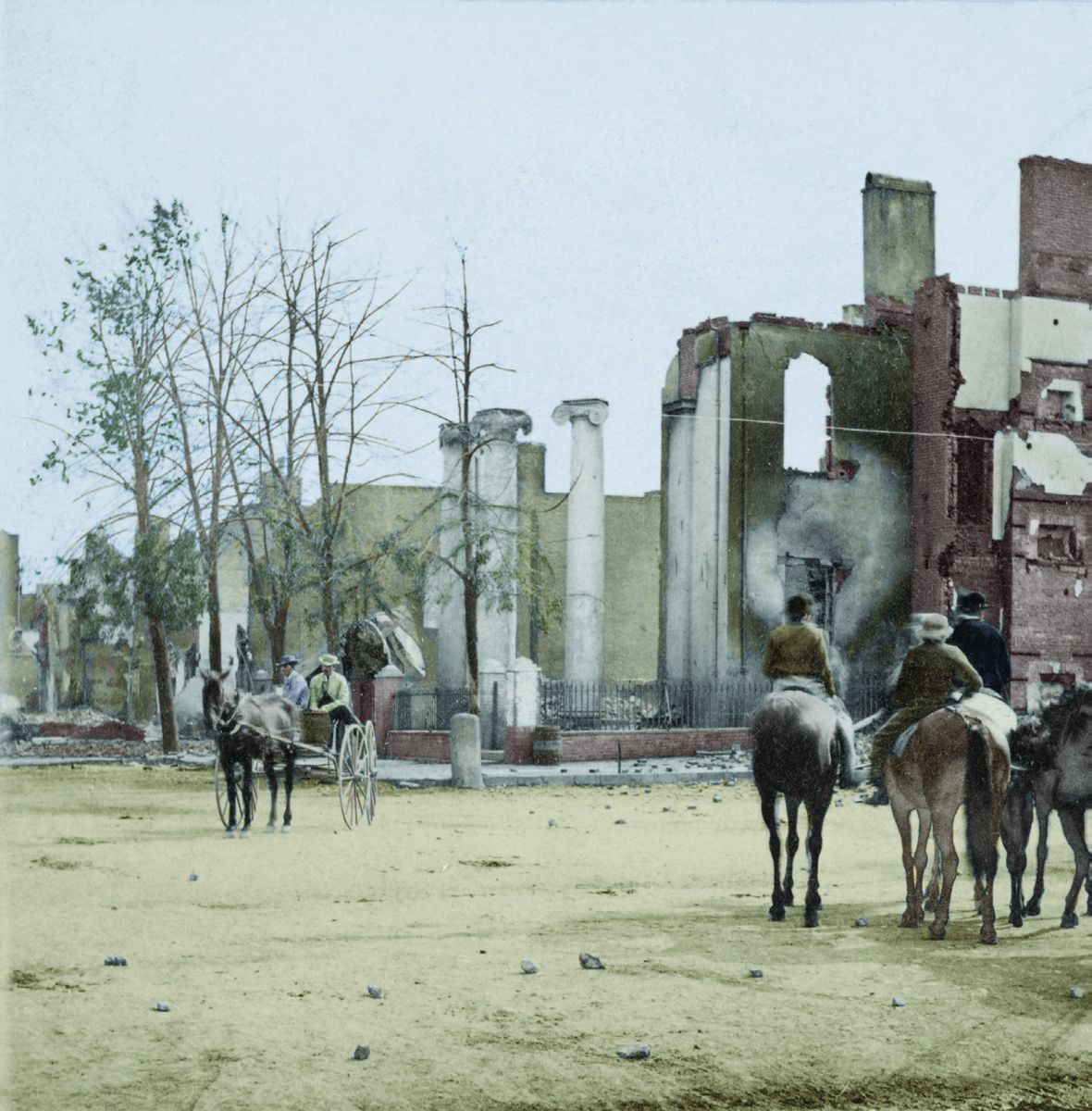
“Tall, black columns of smoke rose up to the very skies; around it were wrapped long streams of flames writhing and twisting … gigantic whirlwinds would lift clothing and light substances into the air, intermingled with … the shrieks of women and children. It was a picture that may be misrepresented, but cannot be heightened, and must remain in upon the mind of those who witnessed it” – J. Scott Moore, 14th Va. Cavalry. On July 30, 1864, C.S.A. Gen. “Tiger John” McCausland’s troops arrived in Chambersburg, Penn. Unlike previous visits in Oct. 1862 and June 1863, the Confederate mission was reprisal. U.S. Gen. David Hunter had been burning homes in the Shenandoah Valley, Va., before C.S.A. Gen. Jubal Early defeated him in battle. Early decided “it was time to open the eyes of the people of the North to this enormity, by example in the way of retaliation.” Early choose Chambersburg, as the target, “… because it was the only one of any consequence accessible to my troops, and for no other reason.” At Chambersburg, McCausland “rang the courthouse bell and called the citizens together” to inform them they would need to pay reparations of $100,000 in gold or $500,000 in Northern money, otherwise the town would be burned. To McCausland’s shock “… they simply stood and laughed at him.” McCausland and Gen. Bradley Johnson tried to convince the citizens to take the situation seriously; however, the residents knew the town’s officials left town with the bank’s money as the Confederates approached. The ransom could not be paid. “Besides the citizens did not feel like contributing to aid in the overthrow of their government.” Aware that U.S. Gen. William W. Averell’s troops were about four miles away, McCausland gave the order to “blow up the courthouse and set fire to the adjacent buildings.” Five minutes later an explosion rocked the town and flames spread from building to building. “A fearful cyclone, or funnel - shaped column” was formed. … Pillows, feather-beds, bed quilts, and other articles were carried up and fell at considerable distances. A little girl of probably four years of age was caught by the monster and lifted six or eight feet from the ground.” During the chaos, some soldiers helped residents remove the infirmed and valuables out of harm’s way. Others “howled the Streets for ‘whiskey’ and ‘greenbacks, and robbed citizens of their watches and pocketbooks.” Averell’s cavalry, spotting the smoke, rode to the rescue. “Those of us, who were in the advance, went through the burning town, bending forward upon our horses’ necks, as fast as our faithful steeds would carry us. … once started it was necessary to continue through the burning streets. Houses on fire on both sides, it was no time to turn back, and to stop was to be burned up; our poor horses were mad with fright. Each and every one of us felt relieved when we got to the outer edge of the town.” The fields and cemeteries became refuges for the residents fleeing the flames. It was later determined that 278 homes and businesses, 98 farm buildings, and 173 outbuildings were destroyed. Two thousand people were homeless. All their household goods, including 59 pianos, were destroyed. It was easy for the pursuers to determine McCausland’s route. “Strewn along the road, boots, clothing, window curtains and even infants’ shoes and little slips, and women’s dresses, that had been stolen” littered the way. At McConnellsburg, Penn., 21 miles away, McCausland’s men camped for the night. The town avoided Chambersburg’s fate by providing rations as demanded. Although Early’s orders specified Chambersburg, McCausland searched for another target to pay the reparation. At Hancock, Md., Johnson convinced McCausland that not only was the town too small to have the funds to pay; many of its residents were loyal to the South. Therefore, the men marched night and day towards a more tempting prize, Cumberland, Md. Capt. Tynes described it as “one of the most fatiguing marches I have ever endured and under one of the hottest suns I ever felt.” Another insisted, “Sleep is something that you can’t avoid,” declared a trooper of the 8th Va. Cav., “it asserts its rights and will have them.”
U.S. Gen. Benjamin Kelley sent the closest troops he had, untested “100 Days” troops with some veteran artillery to stop McCausland. In the spring of 1864, Ohio Gov. John Brough promoted the idea of wrapping up the War by having state militias serve 100 days in Federal service. The state troops would free up experienced soldiers guarding bridges, railways etc. Twelve other states also sent members of their National Guard. At 3 p.m. McCausland’s men arrived outside Cumberland at Folck’s Mill to shoot it out with Kelley’s artillery. By 8 p.m. McCausland and Johnson agreed that between the strength of their foe and the unfamiliar terrain it was time to pull back. On Aug. 2, McCausland arrived at Oldtown, Md., “in splendid order, with lines of skirmishers in front and full regiments following closely.” U.S. Col. Stough of the 153rd Ohio Inf. (a.k.a. the Ohio National Guard), had previously burned the bridges over the Chesapeake and Ohio Canal and now was blocking the way to the Potomac River. At 5 a.m. the 153rd, “arose from a reclining and covered position and gave them a well-directed volley.” A pitched battle ensued. By 9 a.m. Stough’s force fell back across the river to Green Spring Depot, W.Va., and the protection of an ironclad train with a 12-pdr. howitzer, two rifled guns and four musket-proof boxcars for riflemen. “The dull heavy boom of cannon and the whining sound of bursting shells from the iron clads was rather dispiriting to say the least of it,” wrote Capt. Tynes. “[It] is about the first time I felt like we were about to be caught.” The table was turned as C.S. Lt. John McNulty of the Baltimore Light Artillery positioned his cannon 200 yards from the train and fired. Steam burst out of the exploding engine’s boiler. His second shot disabled a gun. Realizing the train had been sighted in, and believing Stough was on board, the larger portion of the men took the ironclad train to Cumberland. For the next 90 minutes Stough and 40 men fought on, sheltering in a nearby blockhouse. Suddenly, a party of Confederates appeared waving a flag of truce with a note for Stough demanding his surrender. Stough replied that he would surrender on the following conditions only: 1. That my men and I shall be immediately paroled. 2. That our private property shall be respected. 3. That the men will be allowed to retain haversacks, canteens, and blankets. 4. That I be allowed to transport my wounded by handcar to Cumberland. McCausland agreed. After a brief discussion, both groups went their separate ways. Strategically, McCausland’s Raid had no military impact. On Aug. 31, the 100 day men were mustered out. Apprehensive that Federal troops were on his heels, McCausland gave up finding a town to pay the reparations and crossed the Potomac into W.V. To his men’s relief, on Aug. 4 McCausland rested his command. An 8th Va. cavalryman declared, “Heaven be praised for one day’s rest.”
Sources: • Scott C. Patchan, Shenandoah Summer, The 1864 Valley Campaign. • Hoke, Jacob, “The Burning of Chambersburg”, The Great Invasion of 1863. • J. Scott Moore, “A Southern Account of the Burning of Chambersburg” Richmond Dispatch, February 5, 1899.
• Christopher Armour Newcomer, Cole’s Cavalry, Or, Three Years in the Saddle in the Shenandoah Valley. • Clifton Melvin Nichols, A summer campaign in the Shenandoah Valley, in 1864: “one hundred days” of soldier life with the 152nd Regiment Ohio Volunteer Infantry. • Jim Leeke, A Hundred Days to Richmond; Ohio’s “Hundred Days” Men in the Civil War. Stephanie Hagiwara is the editor for Civil War in Color.com and Civil War in 3D.com. She also writes a weekly column for History in Full Color.com that covers stories of photographs of historical interest from the 1850’s to the present. Her articles can be found on Facebook, Tumblr and Pinterest.