
McCormick Civil War Institute Guides Transformation at Cool Spring Battlefield
By Jonathan A. Noyalas · Originally published August 2017 · p. 14
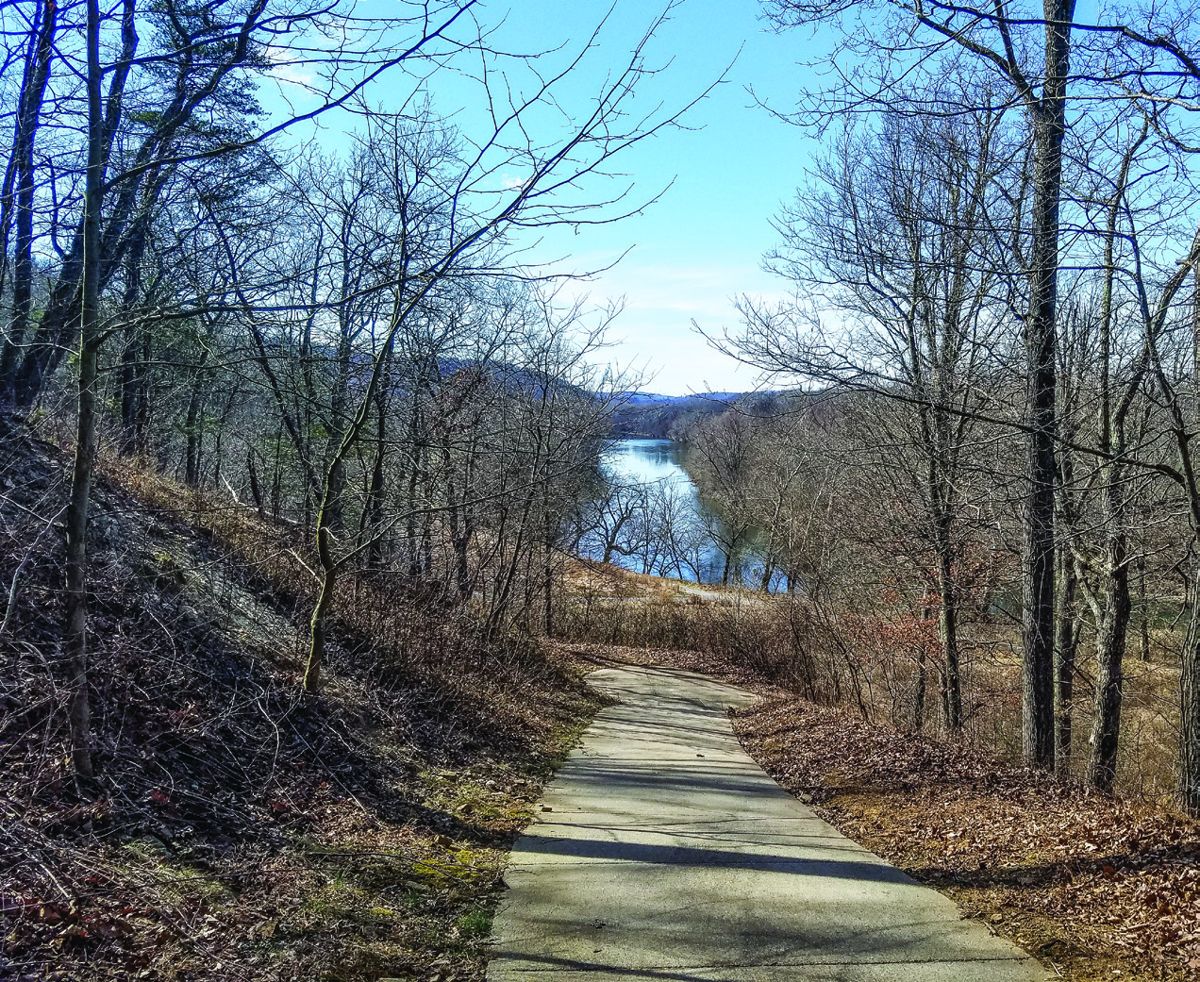
McCormick Civil War Institute Guides Transformation at Cool Spring Battlefield By Jonathan A. Noyalas BLUEMONT, Va.—Although small by Civil War standards—13,000 total troops engaged with more than 800 casualties—the Battle of Cool Spring (also referred to as Snickers Gap or Castleman’s Ferry) was among the last successes Confederates enjoyed in the Shenandoah Valley. After Confederate Gen. Jubal A. Early withdrew from his position in front of Fort Stevens, D.C., on July 12, 1864, he aimed to return to the Shenandoah Valley. On July 16 Early’s army passed through Snickers Gap in the Blue Ridge Mountains and entered the Valley. Although Early’s exhausted troops longed for rest, a Union force commanded by Gen. Horatio G. Wright pursued Early. On July 17 Union cavalry commanded by Gen. Alfred N. Duffie engaged elements of Early’s army at Castleman’s Ferry where the Berryville Pike crosses the Shenandoah River in an effort to secure the important crossing, but failed. After another attempt to seize Castleman’s Ferry on the morning of July 18, Gen. Wright and
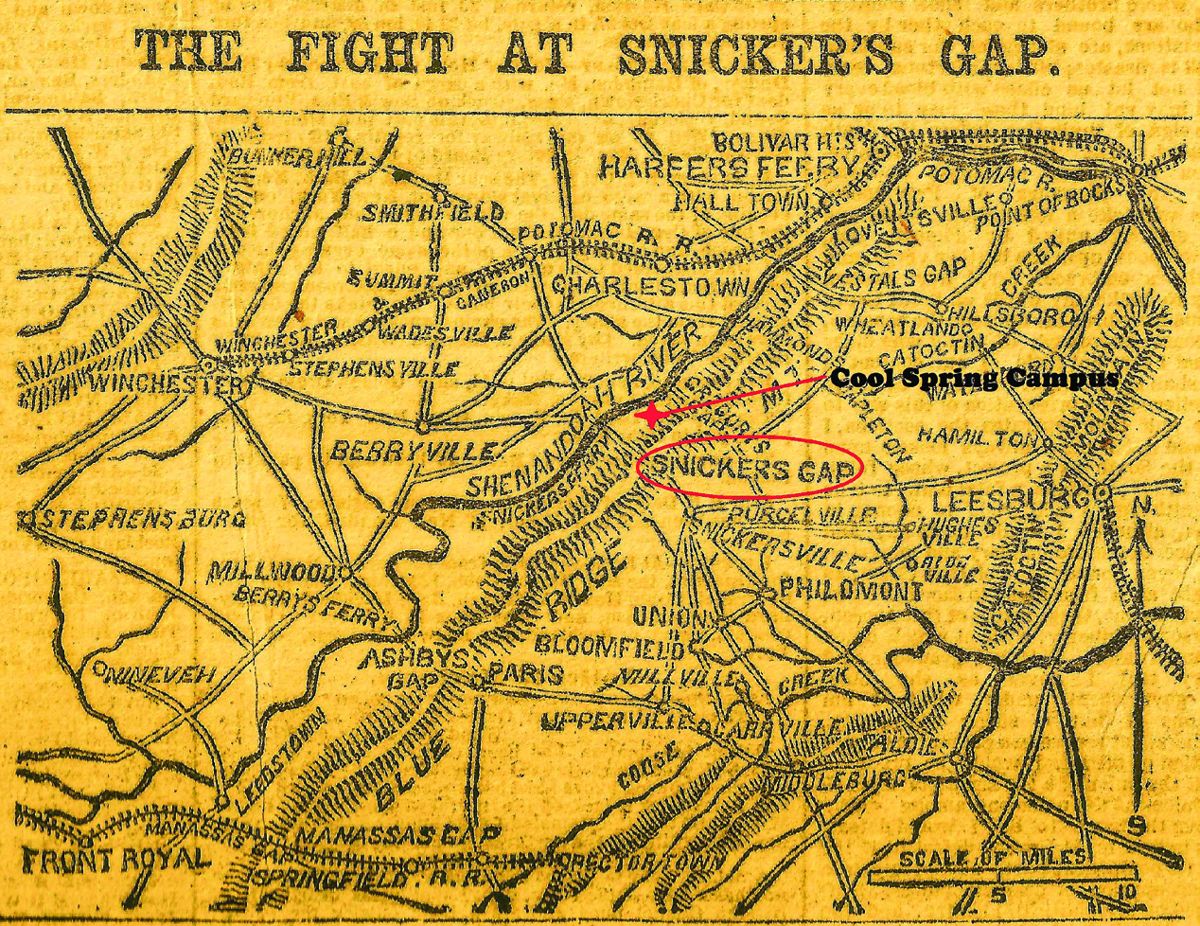
Embellished map of Snickers Gap taken from the Nov. 4, 1862, edition of The New York Herald. (Jonathan A. Noyalas private collection)
Gen. George Crook determined to flank the Confederate’s position by sending Col. Joseph Thoburn’s Division nearly two miles downstream. As Thoburn’s troops crossed the Shenandoah River at Island Ford that afternoon, the exchange of small arms fire between troops from the 42nd Va. Inf. and the lead elements of Thoburn’s Division commanded by Col. George Wells alerted Early to Wright’s plan. Early reacted swiftly and deployed three divisions under Gen. John B. Gordon, Gen. Gabriel Wharton, and Gen. Robert Rodes toward Cool Spring farm. As troops from Gordon’s and Wharton’s Divisions engaged Thoburn’s skirmishers, Rodes aimed his division at Thoburn’s right flank. Outnumbered and separated from the main Union force by the Shenandoah River, some of Thoburn’s command panicked and retreated to the Shenandoah’s eastern bank. While fear gripped some of Thoburn’s veterans, the division commander, regarded as “the coolest man on the field,” realigned his regiments as best he could to meet the attacks. As
(Gene Lewis)
the battle raged Thoburn hoped to receive support from Gen. James Ricketts’ Division, but Ricketts refused to cross the river. Believing the battle lost, both Wright and Ricketts thought sending additional troops would do nothing to alter the battle’s outcome. The Confederate victory at Cool Spring, the largest and costliest engagement in Clarke County during the Civil War, never faded from the memory of Thoburn’s “soured and chagrined veterans.” The battlefield is now being pulled from obscurity into prominence as a result of the efforts of Shenandoah University’s McCormick Civil War Institute (MCWI).
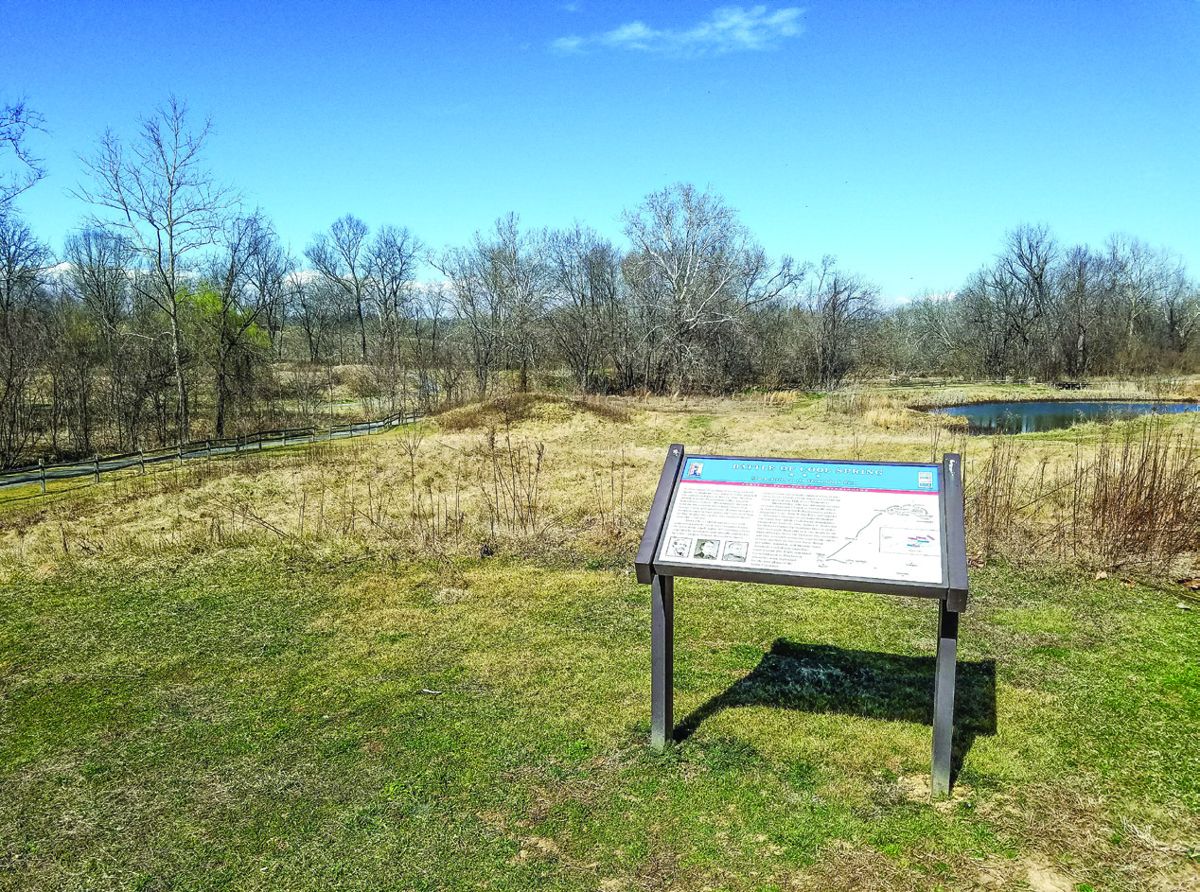
Interpretive Efforts at Cool Spring After Prof. Jonathan A Noyalas’ arrival at Shenandoah University in Jan. 2017 MCWI established an ambitious agenda to interpret the battle on Shenandoah University’s 195 acre portion of the battlefield. While a handful of interpretive markers have dotted the landscape since Shenandoah acquired the property from the Civil War Trust in 2013, MCWI has now enhanced interpretive efforts with the recent release of a nine-stop, eight-page tour guide that takes visitors over nearly two miles of walking trails. The guide, available free in printed form at the battlefield, is also available electronically at https://www.su.edu/arts/special-programs/mccormick-civil-war-institute-2/battle-of-cool-spring-tour-guide In an effort to further enrich the interpretation at the site, MCWI has secured funding from private donors as well as Dr. Robert F. Boxley’s Community Foundation to support the research, writing, and installation of an exhibition which will be housed in “The
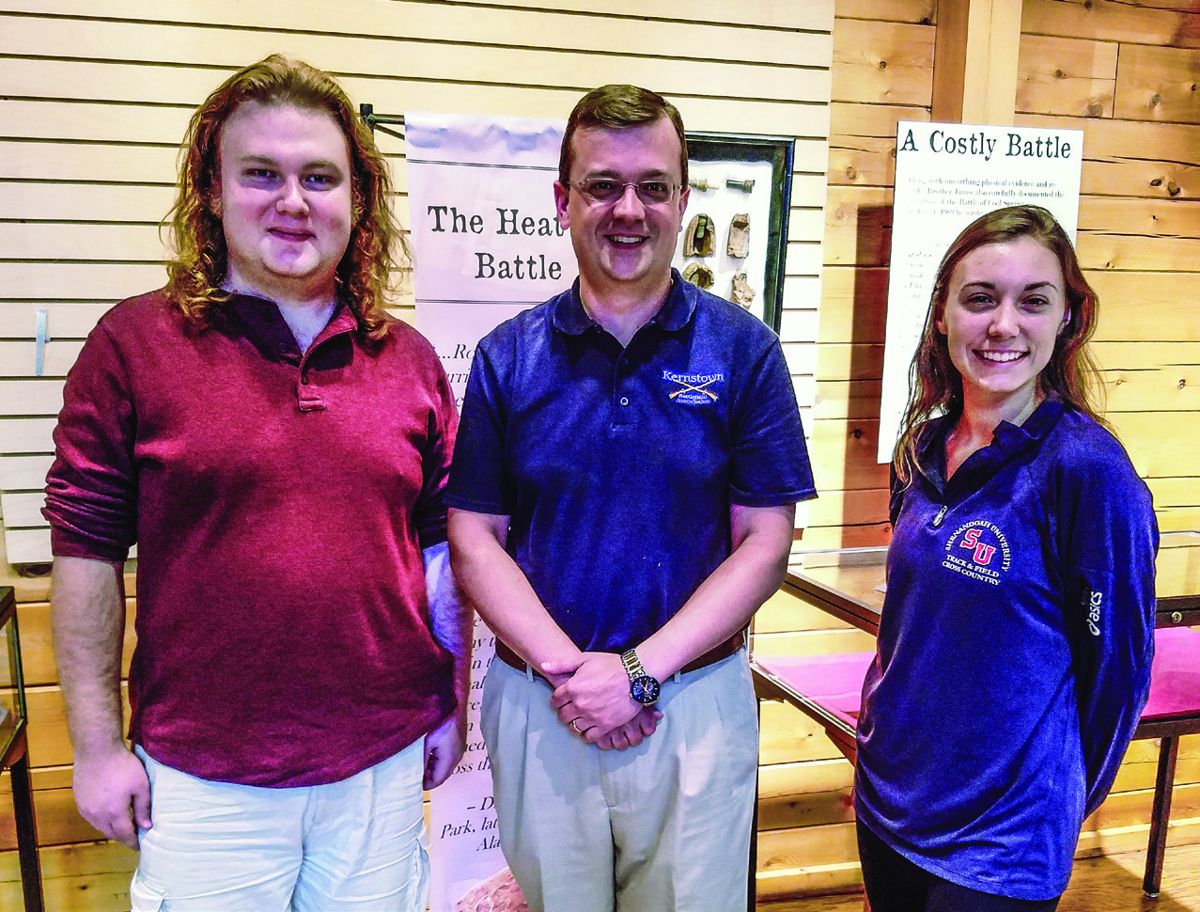
(Jonathan A. Noyalas) Lodge” (a log-cabin structure at the site owned by the University). The exhibition, slated for completion later this year, will focus not only on the Battle of Cool Spring, but the broader importance of Snickers Gap during the Civil War. As a major thoroughfare for armies of blue and gray during the conflict, the area around Snickers Gap was the scene of more than two-dozen military actions during the war. The exhibition will not only improve the overall visitor experience at the Cool Spring Battlefield, but will provide hands-on public history learning opportunities for Shenandoah University history majors who will assist MCWI’s director in its construction. Over the course of the summer of 2017, Shelby Shrader and Zachary Thompson, recipients of MCWI’s first-ever Dr. David and Mrs. Melanie Miles Summer Fellowships, will conduct research and write text for the exhibit. At the exhibit’s heart will be the stories of individuals who made the ultimate sacrifice at Cool Spring—men such as Joshua G.
Farley of the 116th Ohio Inf. who was killed at the Battle of Cool Spring. Twenty-four years old at the time of his death, Farley was hailed by one member of the regiment “as brave a soldier and as brave a patriot as ever shouldered a musket in defense of his country.” Farley, at first buried on the battlefield by his comrades, was reinterred in the Winchester National Cemetery after the conflict. His remains now rest in grave number 709. Throughout the year, in addition to self-guided tours, MCWI will hold a series of scheduled events at the site including guided tours, presentations, and living history demonstrations. Please be on the lookout for those events in the calendar section of Civil War News.
Calling all Descendants! In order for MCWI to tell as deep and rich a story as possible to all those who visit the Cool Spring Battlefield (located at 1400 Parker Lane, Bluemont, Va.) it needs the help of CWN’s readers. MCWI would love to hear from anyone who had an ancestor who fought at Cool Spring in July 1864 or any other actions at Snickers Gap during the conflict. If you are willing to share copies of images, letters, artifacts, etc. so your ancestor’s story could be shared with the broader public, please reach out to the director of the McCormick Civil War Institute via email [email protected] or postal mail: Prof. Jonathan A. Noyalas, Director, Shenandoah University’s McCormick Civil War Institute, Davis Hall 115, 1460 University Drive, Winchester, VA 22601. If you have any questions about the site or are interested in learning about other ways to help the various interpretive efforts please feel free to contact MCWI’s director.