
Letters To The Editor
Originally published August 2017 · pp. 4–22
Letters To The Editor TO THE EDITOR: I have read the interesting article, “Robert E. Lee, Gettysburg, and the Lost Cause” by Dr. Stephen Davis (July 2017, pp. 8G-9G). Regarding that subject, I note some points which may be apparent to many. Statistics demonstrate that the Union Army did have many more troops than the Confederate Army. It is possible, although not certain, that if the Army of Northern Virginia had defeated the Army of the Potomac at Gettysburg, peace would have followed and the Confederate States of America would have become more permanent. However, even though the A.N.V. did not defeat the Army of the Potomac at Gettysburg, the war did not end, and lasted for almost two more hard years, with many battles and deaths, particularly in Virginia and in Georgia. I believe President Lincoln could have ended the war at any time, but instead, at various points of the war he called for more troops to preserve the Union. People in the North could have gotten tired of the war and the numerous deaths, but in November 1864 the majority voted to re-elect President Lincoln, showing they also wanted to preserve the Union. Certainly the North had the numbers, but also had to have the perseverance, and President Lincoln was largely responsible for it, in my view. For people who like “ifs,” a big one is, “What if Booth had assassinated Lincoln prior to Appomattox, maybe even a lot earlier?” Would it have made any difference in the result of the war? Leon Basile Woburn, Mass. TO THE EDITOR: I couldn’t disagree more with John B. Sinclair in his long complaining letter in the July issue of CWN. If you only print hardcore news, you’ll only get hardcore Civil War buffs. The CWN needs a wide variety of articles to attract a wide range of readers on all levels.
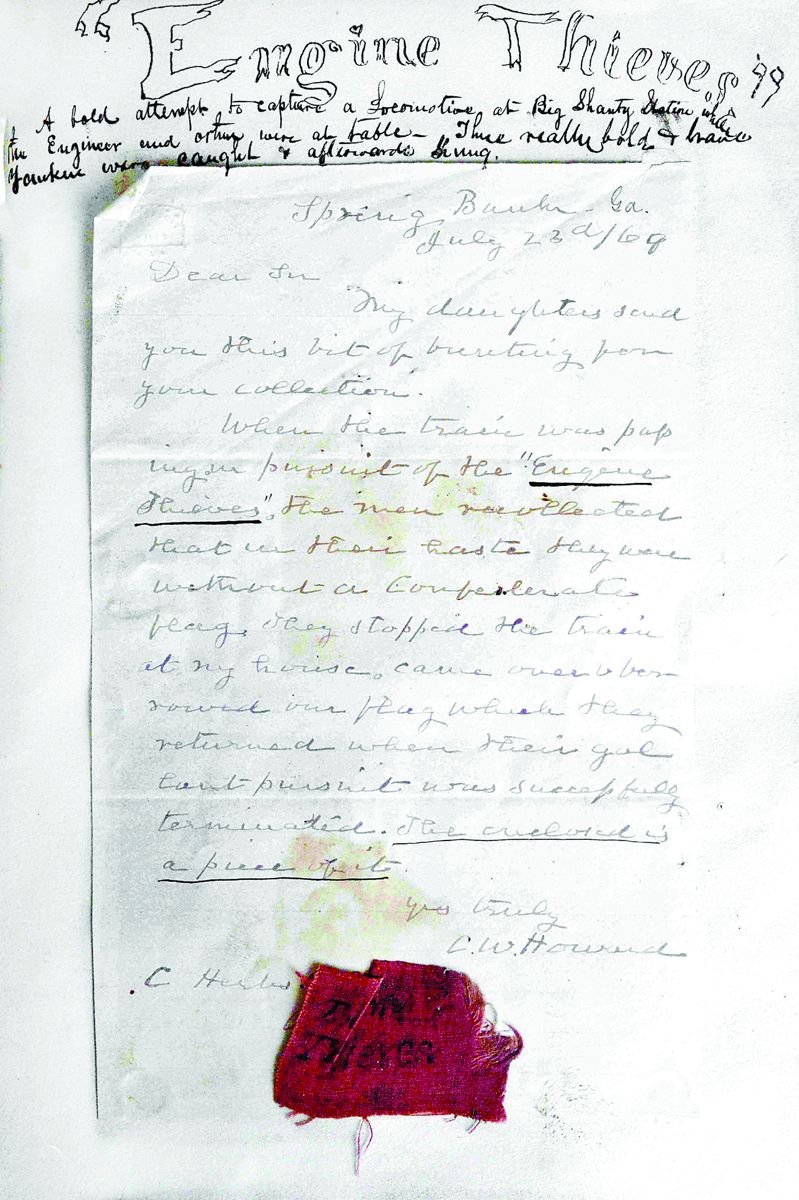
To add new subscribers the paper needs hard news, human interest stories, book reviews, and any other Civil War related material. He further mentions some articles he’d rather read in Civil War magazines. Why bother if you can read similar stories in the CWN. Joseph F. Wilson Magnolia, N.J. TO THE EDITOR: The Great Locomotive Chase— Flag Fragment of the Texas I read with interest the cover article in your July 2017 issue regarding the restored locomotive Texas being returned to Atlanta. I thought I would share an unknown piece of history regarding the Texas with your readers. Charles Herbst was a soldier in the 2nd Ky. Inf., part of the Orphan Brigade. Following the War, he moved to Georgia and was the Macon County Librarian. He was very active in removing Kentucky soldiers buried in Georgia back to Kentucky for reinterment, as well as an active participant in reunions, etc. He was an inveterate collector who maintained several scrapbooks of memorabilia given him by fellow veterans. His prized possession was a scrapbook filled with souvenired flag fragments and a number of other very historic ephemera. Charlie carried it to share at many reunions rebuffing all offers to buy it. Following his death in December, 1898 he bequeathed his scrapbooks to his sister in Louisville, Ky. In April 1900, a Confederate Veteran article stated that Charlie’s sister was selling the flag scrapbook to pay off Charlie’s debts and funeral expenses. The scrapbook then disappeared. In November 2013 Leona Mann, age 90, passed away in Louisville. While cleaning out her home, Michael Wilson, a friend of the family, found an old beat up scrapbook in the trash dumpster. He pulled it out and realized that it might be something of value. He began researching it for the family, who took it to the Franklin Civil War Show in December 2015 to have it appraised.
A number of dealers were interested but only with an eye to selling off the pieces. The family was concerned as they felt it should be kept intact. Greg Biggs, one of the country’s foremost Confederate flag experts and John Sexton, who writes “Ask the Appraiser,” a column for Civil War News, suggested that I purchase the scrapbook, which I did. Mike Hogle did a great job rebinding and conserving it for posterity. I have attached a photograph of the letter written to Herbst by C.W. Howard on July 23, 1869 presenting him with a flag fragment pertaining to the Great Locomotive Chase. The following is a transliteration of this page and letter from the Charles Herbst Scrapbook: “Engine Thieves” – A bold attempt to capture a Locomotive at Big Shanty while the engineer and others were at table. These really bold & brave Yankees were caught & afterwards hung. Letter to Herbst with flag fragment reads: Spring Banks, GA July 23d /69 Dear Sir My daughters send you this bit of bunting for your collection. When the train was passing in pursuit of the “Engine Thieves”, the men recollected that in their haste they were without a Confederate flag. They stopped the train at my house, came over to borrow our flag which they returned when their gallant pursuit was successfully terminated. The enclosed is a piece of it. Yours Truly C. W. Howard C. Herbst Spring Banks was the plantation home of Rev. Charles Wallace Howard and his family. It is located just off the Western & Atlantic Rail Road line in Bartow Co., Ga., between Kingston and Adairsville, just about where William A. Fuller, the conductor of the stolen locomotive General, commandeered the locomotive Texas in pursuit of the General and James J. Andrews and his raiders. The 1870 U.S. Census shows that Howard had four daughters living with him: Elizabeth (26), Mary (25), Francis (22) and Sarah (20). If it weren’t for the Charles Herbst Scrapbook we would never know this side note to the great story of the Andrew’s Raid, made famous as “The Great Locomotive Chase”. John Beckendorf La Qunita, Calif
Letter to Herbst with flag fragment. TO THE EDITOR: I’ve been a subscriber to your publication at least since the early 1990s. Since you assumed ownership, it has only gotten better ! I’m enjoying Stephen Davis and his column; features on Civil War collectibles, and other war-related topics. As a published author, I truly enjoy reading the book reviews as your reviewers give me an idea of what to do, and what not to do when I scrutinize my own writing projects. I’d like to see a regular column with interviews of recently published authors; and what inspired them to research and write their topic. I’d also like to see interviews conducted with Civil War book publishers such as Savas Beaty; Mercer Press; LSU Press; and others, asking them what specific topics they seeking to publish; what is hot, and what is not; and current trends in the publishing industry. Finally, perhaps a how-to column on researching a Civil War ancestor or unit; and what records might be available. Please continue the great work you and your staff are doing ! Gregory C. White Canton, Ga. TO THE EDITOR: Thank you for the Civil War News. I enjoy the paper very much. Especially the more in depth stories. I have learned a lot more about this time in our history. Keep up the good work. Wayne Johnson Benton, Pa.

TO THE EDITOR: When it comes to most things Confederate these days, some people automatically jump to the conclusion that the subject in question will be banned, erased from memory, or destroyed. A case in point is the current archaeological restoration of the CSS Hunley, the Confederate submarine recovered from the waters off Charleston Harbor in South Carolina. Comments on the restoration team’s Facebook page and related sites include remarks that, upon completion of its conservation, the sub will be banned from display due to its Confederate heritage. This seems like taking the battle flag and monument issue into a realm where it doesn’t apply. Significant artifacts, like the Hunley, don’t present the same visceral image as a flag or a monument in a public space. As the first submarine to successfully sink an enemy vessel it is an important military naval artifact. Confederate artifacts and memorials are on display in museums, public and private cemeteries, and National Military Parks. Those items don’t present a controversy now and are not likely to do so in the future. Many Confederate remains lie in National Cemeteries and on Civil War battlefields. Although most are unknown, like their Union counterparts, their graves are marked showing respect in burial. I sincerely believe that most people think these particular locations are exempt from extremes of action and thought and are best left as they are. Battlefields, cemeteries, and artifacts deserve our stewardship as in the past and into the future. Their stories must be remembered and retold free from bias and in an understanding of events that happened before, during, and after the war. These places and historical artifacts cannot occupy the same category as the Confederate battle flag and monument issue. Walter Fogle Bothell, Wash. TO THE EDITOR: Letter sent to: Governor Doug Ducey Governor of Arizona 1700 W. Washington Street Phoenix, Arizona 85007 Dear Governor Ducey: I am sure you are aware that the Mayor of New Orleans, Mitch Landrieu, and his city council removed the Confederate statues from the city of New Orleans. This was done without the vote of the citizens and was done at night to prevent any protests. Mayor Landrieu also mentioned removing the statue of Gen. Andrew Jackson because he was a slave owner despite his saving the city of New Orleans in the War of 1812 Battle of New Orleans. In 2013 Al Sharpton and the NAACP demanded that the Nathan Bedford Forrest Park in Memphis be renamed the Health Sciences Park and it was. They have suggested that Gen. Forrest’s and his wife’s bodies be disinterred and the park be disassembled. On the news, the NAACP in Phoenix were demanding that all the Confederate monuments in Arizona be removed or destroyed because, they say, the Civil War was racist [sic]. Civil War scholars are still debating States Rights vs. Retention of Slavery 155 years later. As the President of the Scottsdale Civil War Roundtable that has 417 members, I am not able to take sides and become politically involved in the argument of who was right or wrong in the Civil War. However, as a private citizen and a Civil War historian, I think rewriting American history is wrong. Our Scottsdale Civil War mission statement is: “To educate the public about the Civil War and to preserve the Civil War memory.” The retention of these monuments and battlefields is important to honor and memorialize the men and women that died to make this the great nation that it is today. Yes it was a terrible devastating war but it is impossible to rewrite history and we should study and learn from our mistakes. The Civil War transformed a loose federation of states into a unified and confident nation that launched into the 20th Century as the world’s leading economic producer and foremost democratic nation. It is important that we maintain and preserve our Civil War monuments and battlefields so that our children and grandchildren can experience an emotional empathy with the men and women who fought and died to make this a great nation. We should not be destroying monuments and battlefields but we should be coming together as one great people in one great nation and celebrating our freedom.” Name withheld on request TO THE EDITOR: In response to your request for comments on the ongoing removal of Confederate monuments, statues, and memorials, I could make a hundred logical, reasoned points on the recent trend of Confederate bashing. Since you only want comments on the former, I will try to make this as short and sweet as I can so I’ve listed my bona fides below with my name. In any event, what is happening now is nothing more than an exercise in stupidity, futility, hate, intolerance, ignorance, prejudice, discrimination, waste and hypocrisy. This is the exact antithesis of what the socalled “tolerant, inclusive and diverse” want society to be, thereby demonstrating their rank hypocrisy of “do as I say and not as I do,” so we’ll all be on the same page and one big happy family. This is not going to happen in a land of 300+ million imperfect human beings, all of whom have their own, possibly and probably differing, viewpoints. To make matters worse, our government not only cannot seem to solve the issues and problems which actually plague our society (drugs, crime, poverty, gun violence, homelessness, unemployment, crumbling infrastructure, mental health services for suicidal veterans, stocking shelves of food banks, education, health care, on ad infinitum), but it is also willing to pander to the “tolerant” and spend our hard-earned tax dollars on such symbolic, cosmetic, good-for-nothing, won’t-makea-difference acts as monument removal in spite of the more important tasks with which it was elected to deal, New Orleans being a prime example. Indeed, it ends up considering and treating many, such as myself, as hateful, intolerant and offensive second class citizens (as in the State of Maryland the recall of our SCV Battle Flag logo license plates) who, nonetheless, are loyal, lawabiding, pay taxes, vote, and serve our communities in various volunteer ways and means. One of the few things government has done well is treat certain segments of society as such. Just ask Africans, Asians and our native peoples (assuming they’re honest). Anyway, is this right? Is this fair? Is this the American way? I think not. This is currently an ugly society. It is not the country in which I grew up and certainly not the country which I formerly loved. It is not a country any longer where there are two sides to a story, any middle ground or gray area. It is, simply, “I’m right, you’re wrong, see things my way because I hold the moral high ground and know what’s best for society,” all the while refusing to practice what is preached, tolerate anything considered offensive and crying in a beer when offended by whatever comes down the sidewalk. Every day, I tolerate all kinds of things in this country (not the least of which is abortion, the 21st Century contextual, law-of-theland, morally wrong equivalent of slavery) which I may not like or offend me yet government doesn’t pander to me and I don’t cry in my beer. So, I ask, who is the tolerant one here? If you want an egalitarian society, be egalitarian. It’s bad enough that most people don’t know their history yet far too many think themselves qualified to condemn the Confederacy and its imperfections, but fail to do the same or otherwise consider the imperfections in the heritage of the United States: Native genocide and cultural cleansing, their enslavement along with Africans; outright racism against them, Africans, and Asians; all in the name of white supremacy, in spite of the noble, admirable, high-minded ideal of “all men are created equal.” Truth be told, I find myself taking more pride in my Confederate heritage than that of the United States inasmuch as the reality is nothing like the ideal (not that the United States hasn’t done many wonderful things in 240 years). I could go on and on but learn your history, practice what you preach and actually be tolerant, inclusive, and diverse, spend our tax dollars wisely, solve our mutual over-riding and overarching societal problems and then we can talk about moving rocks, statues, and memorials, at which point that won’t seem or otherwise be such a necessity. Stuart McClung Hagerstown, Md. • Master of Arts in Military History (in CW) • 2013 American Military University Community Service Award • Recognized by the Commonwealth of Virginia for Volunteer Service • Life Member, 27 Year Veteran, 21st Georgia Volunteer Infantry • Lt. Commander Battle of Sharpsburg Camp #1582 • Sons of Confederate Veterans 20 Year Member TO THE EDITOR: I personally feel that the issue of the removal of Civil War Statues in some Southern states such as Louisiana, is absolutely deplorable. It should not be tolerated by those with any sense of history. A recent New York Times article titled, “Tempers Flare Over Removal of Confederate Statues in New Orleans,” by Richard Fausset, May 7, 2017, addresses the issue relating to New Orleans, a deep southern city. The article opens by referring to Malcolm Suber, an African-American activist & organizer. He is quoted as saying that he would like to see the city leaders pass out sledgehammers and, “let everybody take a whackjust like the Berlin Wall” at the Confederate monuments. New Orleans Mayor Mitch Landrieu said, “The Confederacy was on the wrong side of humanity,” and he dismissed claims that men like Robert Lee, Jefferson Davis, and P.G.T. Beauregard were worthy of the honor of having monuments. How long, in my opinion, will it be before a movement is made to desecrate the memory of the “Father of our Country,” George Washington, or perhaps, Thomas Jefferson? Both men held slaves. Today, considered by some, deplorable! In New Orleans, the battle over race and history, as relating to the Civil War statues, seems to highlight the ugly battle that appears to be growing uglier, especially in the South. Officials in Austin, Texas, and Louisville, Ky., have voted to remove statues; highlighted by what is occurring in the City of New Orleans. A May 2017, Time magazine article titled, “New Orleans Confronts Its Confederate History,”
highlighted the fight over the removal of at least four monuments relating to prominent Confederate leaders such as Robert E. Lee, Jefferson Davis, and P.G.T. Beauregard. They, according to some, are reminders of hate! Recently, the Beauregard statue was slathered in red paint by vandals. Removal of the statues will require the use of a heavy crane leading to death threats directed at each heavy crane company in the region. Malcolm Suber, founder of Take ‘Em Down NOLA [http:// takeemdownnola.org], a group in the city, advocates the removal of 23 statues in New Orleans. Elsewhere in the South there are attempts to remove similar symbols of the old South. As an example, the Confederate flag was recently removed from South Carolina’s capitol. David Goldfield, a history professor at the University of North Carolina-Charlotte, was quoted recently when he said, “The constituency for these monuments has diluted significantly.” Changing demographics are reflected in such statements. Yet there are those such as Pierre McGraw, president of the Monumental Task Committee, who says keeping the memorials is about preserving history. He said, “When we trash our historic cultural artifacts, that doesn’t serve a common good.” To him, “New Orleans has lost her soul” I certainly, as well as others interested in preserving those Civil War monuments, would agree. Most certainly, there are hundreds of Civil War monuments across the Southern landscape as well in the North; Gettysburg and Sharpsburg (the Antietam battlefield), are two examples For years, the focus was on the Confederate battleflag which has largely disappeared from public spaces, a reflection of changing attitudes, good or bad. How do you, the reader of this article, feel? Is the preservation of the monuments a brutal reminder of slavery and a symbol of the historic oppression of black people? I think not, they are a part of our historical past and should remain as they are! I agree with some who feel that the statue removal in New Orleans will create a slippery slope? Where will it end? There isn’t any question the city was one of America’s largest slave markets, a port where thousands of blacks were brought to this country, then sold and shipped up the Mississippi River to live the remainder of their lives as slave labor. One should ask the question, why, then, are there no monuments that serve as a reminder to us, today, of that horrible misery? Of course, times have changed. We can acknowledge that the three men honored with monuments did not fight for the United States of America, as we know it today, they fought against it. They may have been warriors for a Confederacy that was defeated and we are better for it! In June 2015, Dylan Roof committed a hate crime when he murdered nine black parishioners at the Emanuel AME Church in Charleston, S.C. That heinous crime prompted many communities across the United States to debate the presence of monuments to the Confederacy in public places. The question was raised; where do we, as a nation, go from here? Surely, there are questions that could be raised about statues paying tribute to other persons or events in our history since the Civil War! How about the Civil Rights Movement of recent history? Should more monuments be placed in public squares paying tribute to Martin Luther King and the Civil Rights issue, our late President John Kennedy, or the Vietnam War? There are many economic, social, and political issues to consider regarding each.Let the statues that are now in place, remain! As a great nation with other more serious issues address them and move on! Willis R. Kocher Mechanicsburg, Penn.
This topic will continue in the next issue.