
Through The Lens
Welcome Home Col. Burnside
By Stephanie Hagiwara · Originally published April 2017 · pp. 6–7
Through The Lens By Stephanie Hagiwara
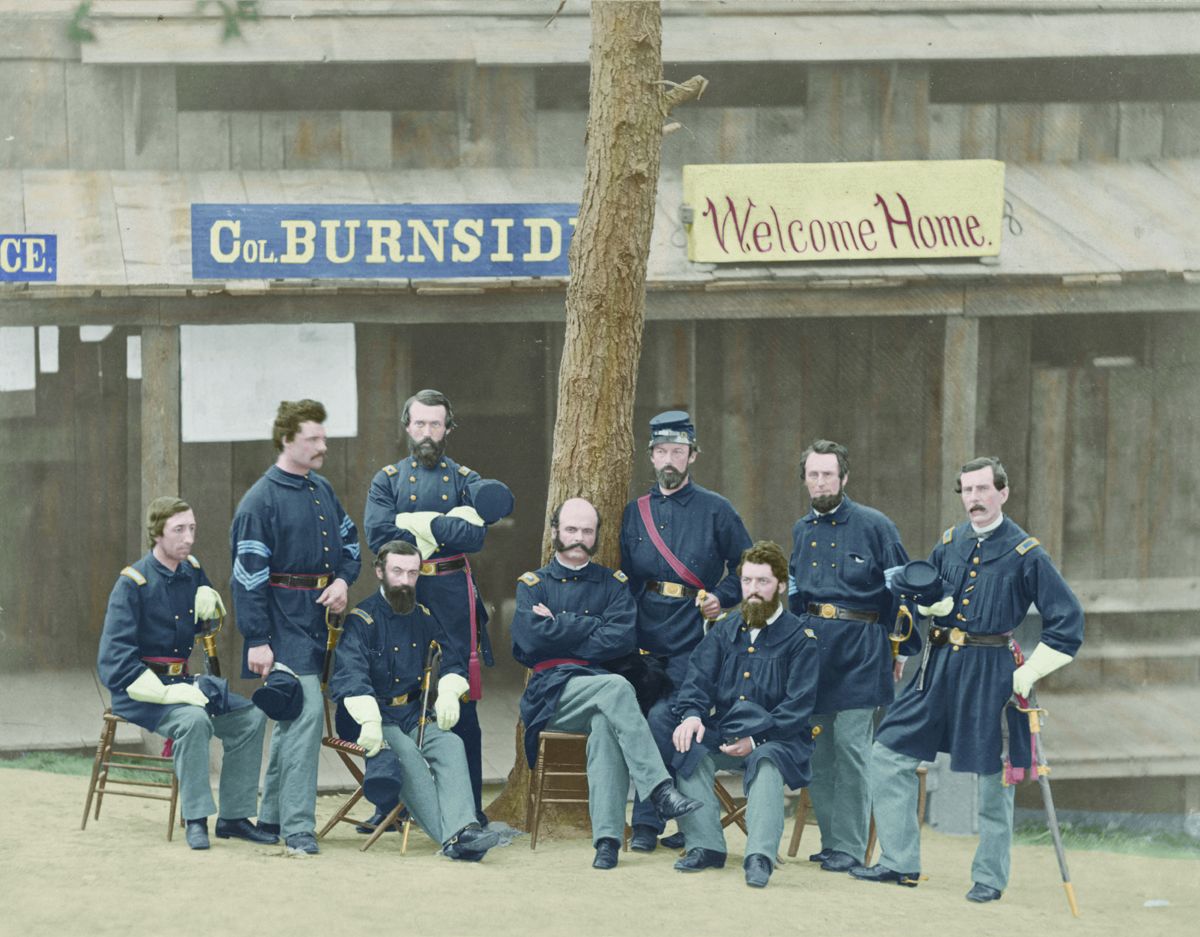
Welcome Home Col. Burnside “You entirely mistake the character of the Northern people. … Not only will the North fight, but she will also triumph. The experiment of secession will fail, and the South, in ruin and desolation, will bitterly repent the day when she attempted to overthrow a wise and beneficent government.” – Ambrose Burnside In 1861, Ambrose Burnside was employed with the Illinois Railroad. While in New Orleans, La., on business, the conversation turned to politics. “There will be no war,” predicted his friends. “Northern men will not fight. The South will separate herself from the Union, will set up an independent government, and will draw to her the Middle and Western States. We shall do whatever we please, and give laws and government to the continent. The North will not fight, and the South will have an easy triumph.” Burnside knew the North would prove them wrong. On April 15, 1861, the same day President Lincoln called for 75,000 volunteers to serve for three months, the youngest governor in the Union, 30-year-old William Sprague telegraphed Burnside in New York City, “A regiment of Rhode Island troops will go to Washington this week. How soon can you come on and take command?” Burnside replied, “At once.” Having recently recovered financially from a failed business venture, West Point graduate Burnside could have avoided returning to the U.S. Army. Instead, Burnside traveled to Providence, R.I., to organize the regiment. By Thursday, April 18, a light battery of six rifled guns, horses and 150 men boarded a steamer for Washington via New York. On Saturday, 544 men followed. At noon, on April 26, the men entered the Capital. Sprague led the regiment on a magnificent white horse with a jaunty yellow feather in his black hat. George E. Smith recalled, “Our orders were to march over a route that would take us past the White House, and we were surprised to see the President and Gen. [Winfield] Scott standing at the curb. Great cheers greeted them and the two leaders answered by waving their hands. We were quartered in the Patent Office, and every day was taken up with drill and instruction in army life.” The remainder of the unit arrived the following week. Twelve hundred Rhode Islanders had heeded the call to defend the Capital. The company was comprised of a cross-section of society including some of Rhode Island’s wealthiest men. It was nicknamed the “million dollar regiment.” Lincoln’s secretary John Hay wrote that, “There was enough of breeding and honor to retone the society of the Gulf and wealth enough to purchase the entire state of Florida.” When Burnside was instructed to requisition supplies for his men, he replied loftily, “We need nothing; Sir, from the government; Rhode Island and her governor will attend to their wants.” Sprague had donated 96 horses to accompany the artillery battery and loaned $100,000 to outfit the volunteers. Soon, the regiment settled in Camp Sprague, two miles from the center of the city on a farm. The location is now the intersection of Florida Ave., New York Ave., and 1st street. It is speculated that the signs, “Col Burnside” and “Welcome Home” refer to Burnside’s recent return to the army after resigning his commission in 1853. Troops poured into the Capital from around the country. It seems the volunteer soldiers were willing to participate in parades but not latrine duty. On the other hand, Camp Sprague became known for its: “comfort, the cleanliness, the fine bearing, the excellent discipline of the Rhode Island troops were themes for commendation upon every tongue. Their dress parade at sunset was one of the acknowledged ‘sights’ of Washington. Hundreds of spectators, among whom were not infrequently President Lincoln, the members of the Cabinet, and the most distinguished men of the country, daily assembled to witness the parade and to participate in the religious services that usually concluded it.” As the troops marched about the Capital, northern newspapers were demanding the army march south. U.S. Gen Irvin McDowell, commander of the Army insisted the men were not ready to fight, but the clock was ticking. The first 90 day enlistments were almost up. Lincoln insisted the army attack the Confederate forces 30 miles away at Manassas, Va. The 1st Rhode Island Infantry was ordered to join the fight. On July 16, they collected their salt pork and hardtack rations. As bands played “Dixie,” they marched over the Long Bridge across the Potomac. As the first man to enter Virginia, Burnside was bedecked with flowers. The men ate all their rations before arriving at Manassas, forcing McDowell to dawdle at Centerville, Va., as he sent for more. He knew that it was hard to fight on an empty stomach. Serving in Col. David Hunter’s Division, at Manassas, Burnside commanded a brigade consisting of the 1st R.I. Inf., 2nd R.I. Inf. with a battery of light artillery commanded by Col. John Slocum, the 2nd New H. Inf. and the 71st N.Y. Inf.. On Sunday, July 21, Burnside’s Brigade led the flanking action toward Sudley’s Ford. When Hunter was wounded soon after crossing Bull Run, Burnside was ordered to take command. His brigade fought to hold off the brunt of the C.S. Col.
William Sprague; Colorization © 2017 civilwarincolor.com courtesy civilwarincolor.com/ cwn (Library of Congress) Nathan Evans’s attack. Sprague was sent up front with the artillery. He recalled, “I took special charge of the [artillery] battery. The men, detached and separated, were a little confused; some stood firm. Horses were struck down; men laid down and died; for ten minutes I supplied the guns with cartridges and ammunition to give confidence to the line. I kept my horse during the fight; the bullets scratched me and made holes in my loose blouse.” The brigade was faltering. Col. Slocum was shot and killed along with two captains. Sprague’s white horse was killed underneath him. Burnside raced to ask U.S. Col. Andrew Porter for use of his regulars. As C.S. Gen. Barnard Bee arrived to reinforce the Confederate line, Porter’s regulars arrived on Burnside’s right. U.S. Col. Samuel Heintzelman’s 1st Minn. Inf. was sent to extend
Burnside’s left. The Confederates were pushed back towards Warrenton Turnpike, up the slope of Henry House Hill. The Union forces followed. Burnside’s brigade was running out of ammunition. During the battle, it spent the longest time in close combat of the Union brigades. McDowell directed Burnside to replenish his cartridge boxes. While they were occupied, the battle turned and the Federal line collapsed. Union forces swarmed back down the Henry House Hill. With fresh ammunition, Burnside’s men slowed the Confederates’ pursuit at Sudley Road. Sprague, remounted, tried to rally the men. At Centerville, the men regrouped; Sprague settled down for a nap, believing reinforcements would be sent. Instead a retreat was ordered. Burnside proceeded to accompany his men back to Camp Sprague. At 2 a.m. Sprague woke up all alone; in the haste to return to Washington, he had been forgotten and left behind. As clouds created shadows in the moonlit night, Sprague rode to Washington and checked into the Willard Hotel. With their 90 day enlistment up, the 1st R.I. offered to continue guarding the Capital. The War Department declined. It was decided to send all 90 day enlistees home (presumably to re-enlist) as part of the Army’s reorganization. Burnside accepted a promotion to general. Sprague decided the military was not for him. He felt he could better serve the Union providing troops and supplies as Governor. On July 25, the 1st R.I. Inf. left Washington. A crowd greeted the regiment on arrival in Providence, R.I., with speeches and accolades. On Aug. 2, the “million dollar regiment” disbanded. Stephanie Hagiwara is the editor for Civil War in Color.com and Civil War in 3D.com. She also writes a weekly column for History in Full Color.com that covers stories of photographs of historical interest from the 1850’s to the present. Her articles can be found on Facebook, Tumblr and Pinterest. Sources: • Major General Ambrose E. Burnside and the Ninth Army Corps., A Narrative in North Carolina, Maryland, Virginia, Ohio, Mississippi and Tennessee, During the War for the Preservation of the Republic by August Woodbury • Rhode Island Officers in the Civil War by John Russell Bartlett • Burnside by William Marvel • Ambrose Burnside & the 1st R.I. at Camp Sprague (near Washington, D.C.), 1861 by National Portrait Gallery, Smithsonian Institution https://www.youtube.com/ watch?v=vjR_6fVjHN4 • So Fell the Angels by Thomas Graham Belden and Marva Robins Belden • Rare Personal Accounts of Abraham Lincoln by John E. Boos, edited by William R. Feeheley & Bill Snack, p. 204.