
Elmira, N.Y., Civil War Prisoner Camp
By John A Punola · Originally published April 2017 · p. 15
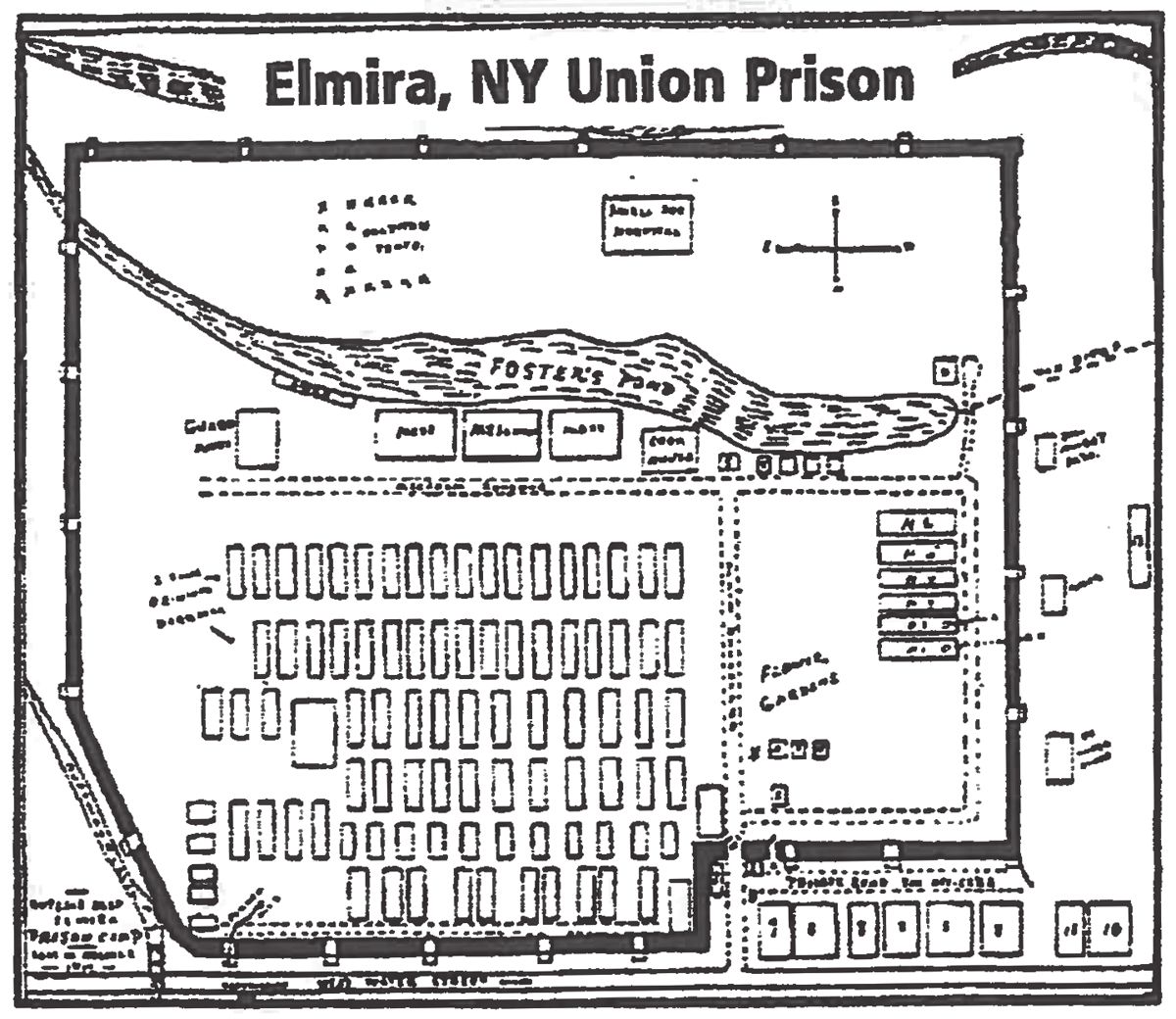
In 1864 rising prisoner figures prompted the Union to open a series of smaller prisoner-ofwar camps; One of them was on the outskirts of Elmira, N.Y., where a military post used to assemble and process new Union recruits was quickly converted to hold Confederate prisoners. A stockade fence and barracks to accommodate about 4,000 prisoners were added. Elmira POW camp consisted of 30 acres; the stockade fence was 12 foot high with a walkway near its top on the outside wall. About every 100 ft. there was a shelter to protect the guards from the bad weather. The Elmira facility opened in early July 1864, and the first consignment of 399 prisoners arrived on July 11, followed by 250 arrivals on July 14,502 arrivals on July 15, plus some train wreck victims on July 17. As an interesting footnote to the prisoners who arrived on July 14, one Confederate was a local resident who went South to fight in the army of Gen. Robert E. Lee. Later prisoner arrivals contained other N.Y. residents who fought for the South; their exact names are not known. There were 35 barracks built to accommodate 4,000 men, but the total swelled to 10,000 plus. Thousands died during the severe winter of 1864-1865, due to overcrowding, continued exposure to a harsh winter weather, disease from poor sanitary conditions, lack of medical aid, and reduced rations plus the lack of heat. The local population was kind to the Confederates and generously gave food, clothing and tobacco to the prisoners on the occasions when the camp permitted civilian visits. Civilians could not enter the camp itself so items were given to the guards for distribution. The camp commander in 1864 was Col. William Hoffman, who had been a prisoner earlier in the war but was released by the Confederates during the prisoner exchange period. After several months as camp commander, he returned to regular duty and finished the war serving with Gen. Meade’s army. The prisoners arrived via the Erie Railroad and, after leaving the train, marched in perfect step, four abreast, to Camp Elmira one mile away on the edge of town. Large crowds of curious onlookers were on hand to view the unloading and transfer to the camp. Local folks marched along with the Rebels until they entered the camp. It was a large and curious crowd who were sympathetic to the Confederates now facing time as prisoners, especially teenage soldiers. One newspaper account observed the prisoners were either very young or very old. They exuded pride and marched smartly, seeming to enjoy showing off to the onlookers. Things changed with the arrival of fall and winter weather. The prisoners were still clad in summer uniforms and suffered badly without warm clothing. The worst thing to happen was the reduction of rations ordered by then Secretary of War Edward Stanton. This was in retaliation for reported bad treatment of Union troops in Southern prisons. These factors combined with the harsh living conditions at the camp resulted in 2,963 deaths during the unusually cold winter of 1864-65. Relief to the overcrowding came in late 1864. The U.S. House of Representatives reached out to the Confederacy for a limited prisoner release / exchange. Finally, on Feb. 4, 1865, orders Historic marker on West Water Street, Elmira, N.Y. were received to transfer 3,000 prisoners to an exchange point. In groups of 500, the prisoners began the journey to return to the South. President Lincoln felt the war had turned decidedly in the Union’s favor and the prisoners, even if they rejoined the Confederate Army, would not be a factor in the war. With the surrender of Gen. Robert E. Lee and his army in mid April 1865, preparations quickly began for the release of the remaining prisoners. The final contingent of 256 prisoners left Elmira on July 11, and the camp was closed. The Elmira POW Camp was the Union response to the South’s Andersonville, Ga. The retaliation to reported conditions at Andersonville by the Union government was swift with rations reduced to starvation levels, plus denial of clothing and protection from the weather. The harsh treatment was unjustified since the Elmira area was rich in agriculture and food was plentiful. The lasting name for the Elmira POW camp was “Hellmira.” All that remains is the mass graveyard of Confederate prisoners. A former slave who arrived via the underground railway, John W. Jones, was placed in charge of the burial duties. He faithfully recorded the name and information of every deceased soldier these are the only records that existed. Mr. Jones did not want the soldiers buried and forgotten in nameless graves. Eventually a Confederate monument was erected at the burial sites in Woodlawn National Cemetery, Elmira, N.Y. When the Confederates were released they received railroad passes and a small sum of money to return to their homes down South. The last prisoner to be released from Elmira departed on Sept. 27, 1865. The camp was burned leaving no evidence of its existence. The site of the camp is now a residential area but indicated by a roadside sign plus a small stone marker. You can contact the town of Elmira, N.Y., (607-737-5644) for information on the famous Elmira POW Camp.