
Inspection, ARMS!
Tranter Revolvers & Their Southern Service
By Tim Prince · Originally published September 2016 · p. 13
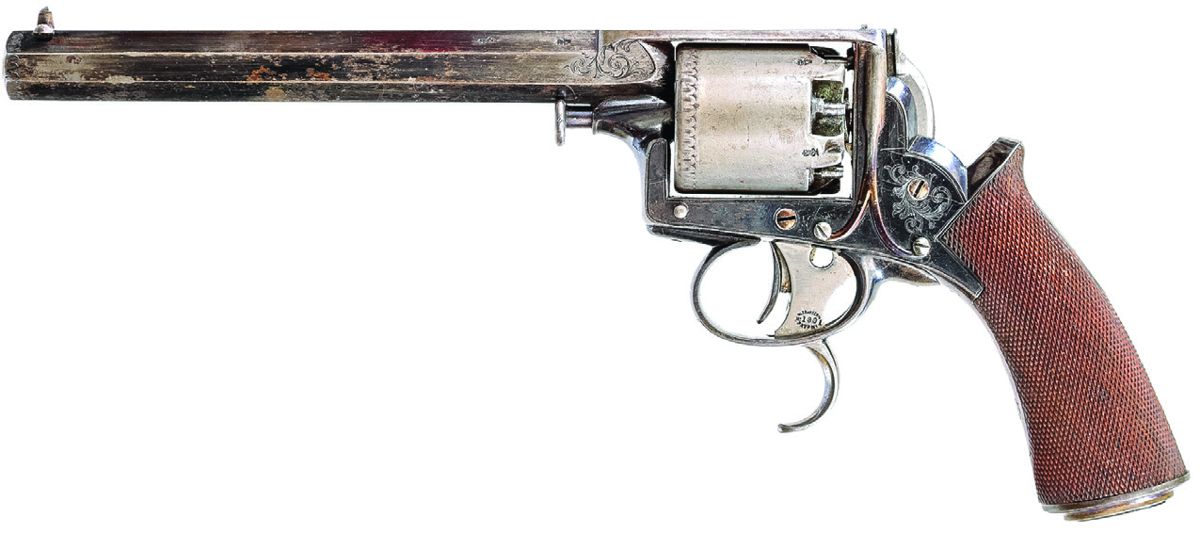
Their Southern Service Inspection, ARMS is a new addition to the monthly columns in Civil War News. Authored by antique military arms dealer & collector Tim Prince of College Hill Arsenal, the series will focus on the small arms used by all branches of service during the American Civil War, both North and South. As much has been written about the more commonly encountered muskets, rifles & handguns of the era, Tim will try to cover the somewhat less well-known and more obscure arms to see service during the conflict, particularly English and European imports arms which have always been the primary focus of his collecting and research. If you have ideas for potential article topics or have a particular type of weapon that you want to see featured in an upcoming article, suggestions may be submitted to the publisher via email at [email protected]. The revolvers produced by English gunmaker William Tranter were some of the most advanced and modern handgun designs to see use by the Confederacy during the course of the American Civil War. Tranter was born in 1816 and died in 1890, and during his working life, he was one of the most prominent Gun, Rifle & Pistol Makers in the Birmingham (England) gun trade. He went into business for himself circa 1840, after completing his apprenticeship with Hollis Brothers & Co, which he had begun in 1830. Tranter continued in the trade until 1885, just five years before his death. In 1840, after spending a decade learning the gun trade at Hollis Bros & Co (later Hollis & Sheath), Tranter bought the established gun making business of Robert Dugard at 29 ½ Whitehall Street. Over the next decade, he worked for himself and was also involved in joint ventures with his old employers John & Isaac Hollis as well as with Isaac Sheath. By 1850, he had located his primary business at 50 Loveday Street, where he was listed in a period directory as having “shops, sheds, steam machinery, yard & premises.” Tranter secured his first British patent related to firearms in October of 1849 when he registered a “pepperbox mechanism and lever catch for pistol locks.” In January 1853 he registered British Patent Number 212 (1853) for a pair of “self-cocking” pistol mechanisms and a safety mechanism. In December of the same year, he registered designs for a double-action revolver mechanism, lubricated bullets and wadding, and a breech loading mechanism, all of which were covered by British Patent Number 2921 (1853). In August of 1856 he registered the designs for a “double trigger revolver mechanism,”
along with several other designs, all of which were covered by British Patent Number 1913 (1856). Tranter continued patenting firearm designs as late as 1887, even though he was no longer directly active in the gun trade. Tranter’s most successful series of arms were his “self-cocking” revolvers, which were initially introduced in 1853. The earliest revolvers utilized Robert Adams’ patent for a solid, one-piece frame and barrel that were machined from a single forging. Tranter’s initial production run of revolvers included both Adams 1851 Patent lock works, and Tranter’s own patented lock works. The original “Tranter” type revolvers, known to collectors as 1st Model Tranter revolvers had no provision for a fixed loading lever. The lever swiveled on a stud that projected from the left side of the frame, which had no provision to retain the lever when it was mounted on the revolver. The lever was intended to be stored in a case or carried in the pocket; hardly a practical solution if the user had to reload the revolver in the field. Most of these guns were manufactured on Adams Patent frames and have Adams Patent serial numbers (really patent tracking numbers to pay royalties to Adams) and these numbers are followed by a Y suffix. The 2nd Model Tranter revolvers also had a pin on the frame that allowed the attachment of a removable loading lever, but the pin had a small projection that allowed the lever to remain attached to the gun unless a notch in the lever was aligned with the stud projection to remove it. The later examples of these guns, manufactured after about 1856, have Tranter Patent serial numbers and end with a T-suffix. These guns not only include Tranter Patent lock works, but also a newly improved version of the Adams solid frame, which was patented by Tranter in 1856. At this point, Tranter revolvers rarely have Adams serial numbers. The 3rd Model Tranter revolvers had a more permanently attached loading lever, which was secured by a screw. The 3rd Models appear to have all been produced in the T suffix Tranter serial number range. All three of these models were based on his “double-trigger” system (initially referred to as his “hesitating mechanism” on the early production guns), which utilized a second “trigger” under the trigger guard to rotate the cylinder and cock the hammer. The trigger inside the trigger guard was used to trip the sear and release the hammer to fire the revolver. The 4th Model Tranter revolvers (which were introduced in 1856 and are all in the Tranter T-suffix series) used a single trigger and utilized a lock work that would be referred to as a conventional
1st Model Tranter
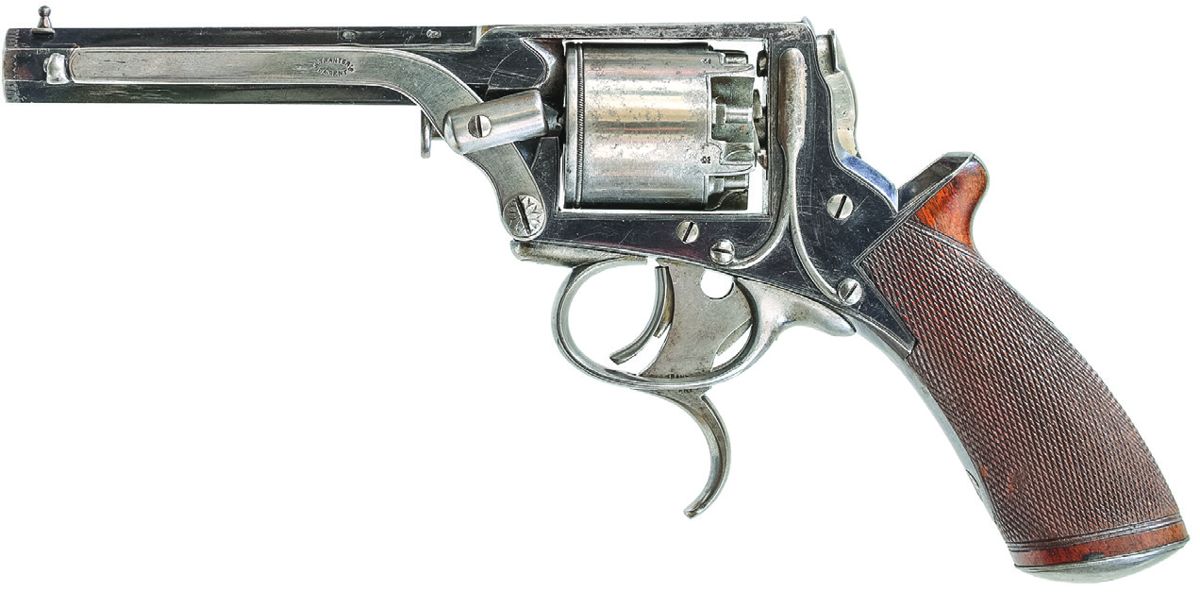
3rd Model Tranter
4th Model Tranter
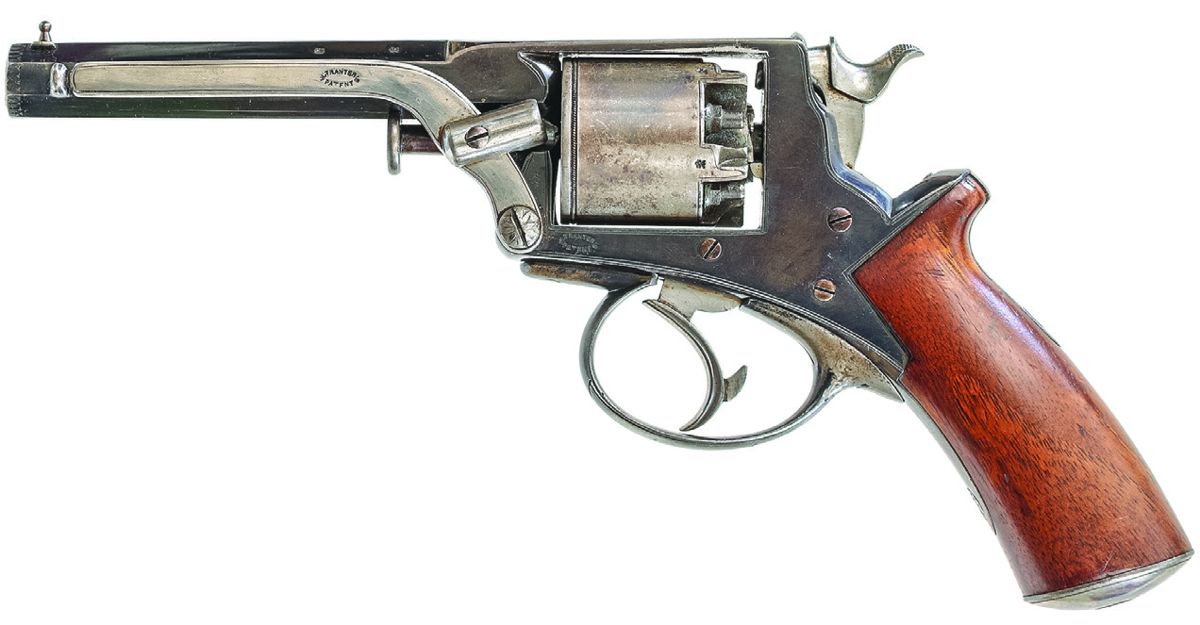
“double action” mechanism today. All of the Tranter revolver patterns were produced in a variety of calibers, with 54-Bore (.442) “Holster Size” and 120-Bore (.338) “Pocket Size” revolvers being the most commonly encountered calibers and frame sizes, and the mid-sized 80-Bore (.387) “Belt Size” being less often encountered. Some of the guns were also produced in the exceptionally large and powerful 36 and 38 bore sizes, which were larger versions of the holster size guns, and were about .50 caliber! Barrel lengths varied as well, with the larger caliber arms typically having longer barrels and the smaller caliber guns having shorter barrels. All of the guns were 5-shot percussion revolvers, and typically featured checkered one-piece walnut grips, although smooth wooden grips and other grip materials are known to have been used on a special order basis. The Tranter patent revolver was the primary competitor with the Adams and Adams-Beaumont patent revolvers in England and was also exported widely. Pre-Civil War Tranter revolvers are known with U.S. retailer marks, indicating that his designs were at least somewhat successful in the United States. The majority of the retailer marked guns are from the southern states, with the largest majority of them being marked by New Orleans retailers. Based upon extant examples, the firm of Hyde & Goodrich (later Thomas, Griswold & Co) appears to have been the primary importer of Tranter Patent revolvers into the southern United States. Most of these retailer marked guns were sold cased with accessories, although some guns were certainly sold without the expensive casings and accouterments. During the American Civil War, it appears that the importation of Tranter revolvers was somewhat limited, at least regarding Confederate central government purchases. However, period advertisements in the south and extant examples with southern provenance make it clear that the guns were imported by blockade-runners as speculative items for sale in the south. Such famous Confederates as General John Hunt Morgan (3rd Model #3758T), General J.E.B. Stuart (4th Model #8673T), General John Magruder and Colonel Dabney H. Maury (3rd Model #7993T), who served on the staff of General Earl Van Dorn, all owned documented 54-Bore Tranter revolvers. The famous “Pratt Roll”, which lists the revolvers in the possession of Lt. Julian Pratt’s squad of troopers in Company H of the 18th Virginia Cavalry in July of 1864, lists two Tranter revolvers, with the serial numbers 15,465 and 15,476. This indicates that Tranter revolvers in the mid 15,XXX serial number range were in use by southern forces, and in the field by that time. While models are not listed in the list, it is assumed that these guns were either 3rd of 4th model revolvers and were likely 54-Bore. Other Tranter revolvers with southern provenance include guns which are retailer marked by T.W. Radcliffe of Columbia, S.C. Additionally, a March 10, 1863, advertisement in the Richmond Times-Dis- 3rd Model Tranter “Double Trigger” Revolver, 80-Bore, with Tranter patent “T-suffix” serial number, retailer marked by T.W. Radcliffe of Columbia, S.C. patch for H. E. Nichols of Columbia, S.C. read in part: “Fine English Revolvers. Just received from England, six Tranter’s fine revolving pistols, 80 and 120 bore. Price $220 each”. All of this evidence indicates that at least some of the Tranter revolvers produced during (as well as prior to) the Civil War, saw Confederate use. Dating Tranter revolvers based upon their serial numbers is somewhat problematic, as frames were sometimes produced in advance and the guns completed at a later date. What we do know is that the “T” serial number suffix came into use around serial number 2200, sometime between 1854 and 1856. We also know that Tranter produced revolvers using Adams patent serial numbers and a “Y” suffix from about 1853 through about 1856. These guns appear in several serial number ranges, as assigned by Adams, including the 2X,XXX range. All “Y” suffix guns predate the Civil War by at least four or five years. From extant examples of Tranters with specific dates, presentations and usage associated with them, it appears that those Tranter revolvers with serial numbers through about the 20,XXX range (and possibly some of the early guns in the 21,XXX range) with T suffixes appear to have been produced prior to the end of 1865, making them “Civil War era”. Post-Civil War Southern retailer marks begin to appear in the 21,XXX range, suggesting that these guns are likely