
Lighthouse Keeper At Point Lookout
By Carl Sell · Originally published September 2016 · p. 17
In recent years, many people who have lived in or visited the keeper’s quarters at the Point Lookout lighthouse in Scotland, Md. swear they have heard movements and the voices of those who served long ago. Imagine if you could hear the stories of the spirit of Pamelia (sic) Edwards, the female keeper during the Civil War. She could tell of the rapid buildup of first a large Union hospital in 1862 and then an even larger prison camp the following year just north of the lighthouse. Then, she could tell of the quick destruction of the hospital and the prison camp soon after the war ended. Soon after, there was nothing left except the lighthouse and one small building. Miss Edwards served as lighthouse keeper from April 7, 1855, until she apparently was replaced on June 4, 1869, by the new administration of President Ulysses S. Grant. Her father, Richard Edwards, had been appointed keeper in April 1853 but died three months later. His daughter, Martha, assumed the duties after a replacement nominee had withdrawn. Two years later, Martha apparently got married and passed the torch, so to speak, to her sister, Pamelia. The 1860 census listed Permelia Edwards, 44, as the lighthouse keeper and her brother, Elkanah, 23, as the assistant keeper. The Point Lookout lighthouse was built to warn ships of nearby shoals and mark the location where the Potomac River meets the Chesapeake Bay. The government bought the land for $1,150 and awarded a contract worth $3,350 for the construction. It took a little over five years from the approval of the project until the opening of the lighthouse on
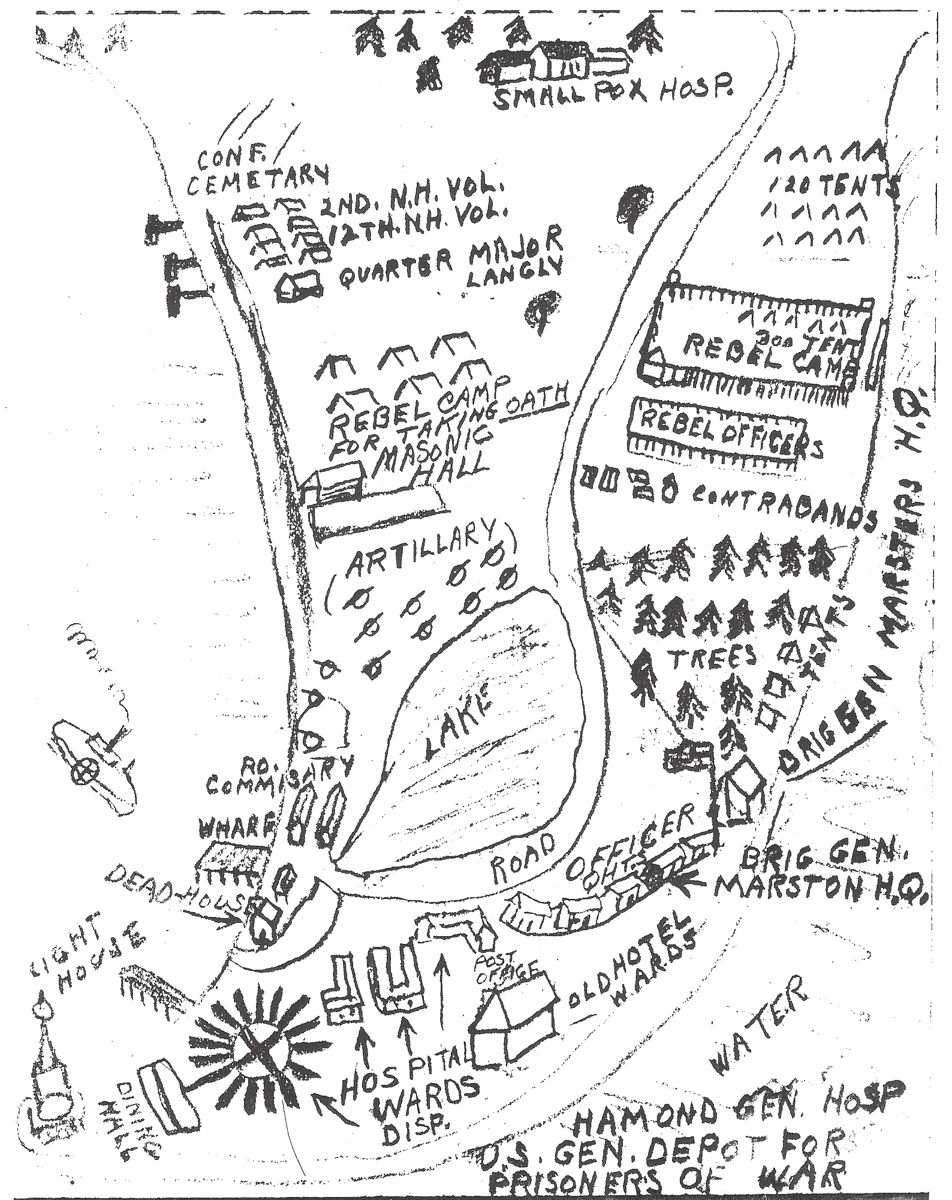
The map apparently was done by either a prison official, guard or inmate. It depicts Massachusetts units on site, and they were there only for a few months after the prison opened before being replaced by U.S. Colored Troops.
September 30, 1830. James Davis was the first lighthouse keeper. His daughter, Ann, took over in December of 1830 and served for 17 years. She lived at Point Lookout with her large family was well regarded by ship’s captains. William Wood served from 1847 to 1849 and William P. Baxter, from April 22, 1849, until Richard Edwards took over in 1853. During her time at Point Lookout, Pamelia Edwards would witness first the construction of a huge hospital for Union troops wounded during the Civil War and then the even bigger prison camp for tens of thousands of captured Confederates. Throughout it all, she kept the light burning as a beacon for the large number of ships delivering supplies, wounded, prisoners or passing by on their way to the Union port at City Point on the James River, which entered the Bay further south. Previously, Point Lookout had been a popular summer resort with a hotel and cottages. In 1862, the federal government leased land near the lighthouse to build a hospital for troops wounded in the Civil War. Hammond Hospital, named after the new Surgeon General of the United States, William Alexander Hammond, opened on August 17, 1862. It was built like the spokes of a wheel and initially included room for a small number of prisoners, mostly residents of the area accused of aiding the Confederacy. After Gettysburg, the Union established a prison north of the hospital, capable of handling 10,000 Confederates. By December, 9,000 captives were living in old army tents under deplorable conditions, as described by a representative of the Federal Sanitary Commission.
When completed the prison and the hospital consisted of 50 buildings, including the lighthouse. More than 4,000 prisoners died there before the war ended. Because of a fire in 1921 that destroyed records, little is known about Pamelia’s 14 years as the lighthouse keeper at Point Lookout. There apparently was an incident on January 6, 1862, involving “certain acts savoring of disloyalty on the part of the keeper reported.” Miss Edwards, no doubt, was exonerated as her term continued. Other later entries show her ordering supplies and repairs. After the war, the prisoners were paroled and released; the hospital was closed and the property abandoned. Plans were advanced for a mass grave and monument for those who died at the prison. Bodies were reinterred at the site, and names were engraved on the monument. In recent years, a separate memorial has been maintained by the Sons of Confederate Veterans. There also is a Descendants of Point Lookout POW Organization. After the war, some areas returned to a resort with the opening of the large hotel that stood on the site, but it burned down in 1878. The lighthouse remained in operation and underwent numerous changes, including the installation of a turbine powered by a windmill to provide electricity for the light, the first of its kind in the continental United States. Today, huge windmills are being proposed in the Atlantic Ocean to provide electricity for the energy-hungry eastern Seaboard. Previously, the light was an open lamp fueled by whale oil that was reflected by the use of lenses. The property was transferred to the Coast Guard in 1939. The light went out after 135 years on January 11, 1966. Today, it sits on the southernmost water’s edge of Point Lookout State Park and is owned by the Maryland Department of Natural Resources. The Point Lookout Lighthouse Preservation Society was formed in 2006 to assist in the restoration of the facility. In the 1970s, the lighthouse became a rental property, and that is when strange sounds and voices began to be heard. Several séances produced stories of footsteps, singing, talking and other noises that were attributed to the spirits of the keepers. Some of the voices were said to be female, including one singing “Living in the Lighthouse.” Pamelia Edwards remains a mystery. Although records of All Faith Episcopal Church in Charlotte Hall list her as being buried there, her gravesite can’t be found. Her date of death is listed as March 28, 1893, at age 76. If you would like to support the Point Lookout Lighthouse Preservation Society, send a check to PLLPS, Inc., PO Box 135, Saint Leonard, MD 20685. The Lighthouse is open once a month from April to November. Email the Society at info@ PLLPS.org. or call 301-684-3704. Robert Hall is the President and is the source of the information that the location of Pamelia’s gravesite is unknown.