
Book Reviews
Book Reviews — September 2016
Originally published September 2016 · pp. 27–36
– Reviews of Civil War Books –
Vol. II Adds Material On Army Of Cumberland Cavalry In Detail British Suppliers To CSA Suppliers to the Confederacy: More British Imported Arms and Accoutrements. Vol. II. By Craig L. Barry and David C. Burt. Illustrated, photographs, appendices, bibliography, 304 pp., 2016, Schiffer, www.schifferbooks.com, $39.99.
This work is part of a two-volume set designed to be the definitive reference on British arms and accoutrements used by the Confederacy. It is an expanded version of a work we reviewed and strongly recommended in 2014. Building on their solid foundation of detailed research, Craig Barry and David Burt have made a good reference even better. This volume includes a variety of new supplies and some previously unpublished histories of several gunmakers.
Civil War News book reviews provide our readers with timely analysis of the latest and most significant Civil War research and scholarship. Stephen Davis, Civil War News Book Review Editor. Email: [email protected]
Knapsacks, snake buckles and waist belts are among the new personal items discussed. Additional information is included for ammunition bags, sword frogs, oil bottles and bayonet scabbards. Perhaps the most interesting addition is the inclusion of various gunmakers like London Armoury Company, King and Phillips, C.W. James, and Pryse and Redman. New photographs further enhance the work by providing detailed illustrations of some of the more unusual accoutrements. The new chapters follow the same format as those in the previous work, making it easy to understand the new material. They further enhance readers’ ability to understand the logistical challenges the Confederacy faced in attempting to negotiate with European firms. The book is exceptionally well priced. It continues to be a wonderful reference tool for those interested in quartermaster functions, general mercantile operations and foreign support of the American Civil War. It receives my strongest recommendation. Reviewer Richard J. Blumberg has a master’s degree with honors in Civil War studies. He is past president of the Houston Civil War Round Table and is a speaker for that group and the Society of Women in the Civil War. He also reviews books for the Blue and Gray Education Society.
The Cavalry of the Army of the Cumberland. By Dennis W. Belcher. Illustrated, photos, maps, appendices, notes, bibliography, index, 356 pp., 2016, McFarland, www.mcfarlandpub.com, $45 softcover.
Following up and expanding on his 2014 biography of David S. Stanley, Maj. Gen. William S. Rosecrans’s cavalry commander, Dennis Belcher examines the Army of the Cumberland’s cavalry. His desire is “to compile and analyze the actions, successes, failures and sacrifices of this cavalry ‘corps,’ which has been neglected for far too long.” In accomplishing this objective, Belcher has constructed a compendium of events from a cavalry perspective from the Battle of Stones River in December 1862 through the Atlanta Campaign ending in October 1864. After an overview of Stanley and his role as the army’s cavalry commander, the story progresses to subsequent commands under Brig. Gen. Robert B. Mitchell and Brig. Gen. Washington Lafayette Elliott. Neither of the latter two enjoyed the success attributed to Stanley, who receives credit for nurturing the expansion and development of an effective cavalry organization. The growth and maturity of the cavalry in Rosecrans’s Western army required considerable dedication and effort by him and his cavalry commanders. The Army of the Cumberland suffered from an “out of sight, out of mind” syndrome on the part of authorities in Washington, including General-in-Chief Henry W. Halleck and Secretary of War Edwin M. Stanton, regarding assignment of qualified personnel and logistical support. Belcher describes relationships that helped forge a cohesive approach to cavalry operations. He contrasts them with those that caused friction and disrupted sound strategy and tactics. Among the latter was the tendency to subordinate cavalry to infantry commands rather than allowing them to function as independent arms of the service. This practice led to confusion and lack of success on the battlefield. The author gives Rosecrans high marks for his focus on expanding the size and enhancing the firepower of the cavalry. He is critcized, however, for ineffectual use of cavalry that undermined specific operations and generated high casualty rates. Rosecrans stifled the cavalry’s initiative because he tended “to give directions rather than missions.” Rosecrans’s unpopularity with powerful military and political figures led to his removal as Army of the Cumberland commander after he lost at Chickamauga in September 1863. When Stanton appointed Maj. Gen. Ulysses S. Grant to command the Union armies in the West, Grant replaced Rosecrans with Maj. Gen. George Thomas. Soon thereafter, the cavalry was reorganized. Brig. Gen. Washington L. Elliott was in overall command, and the First, Second, Third and Fourth divisions served under Brig. Gens. Edward M. McCook, Kenner Garrard, Hugh Judson Kilpatrick and Alvan C. Gillem respectively. Two years of enhancement and restructuring created a corps totaling 23,000 cavalrymen. It was augmented by another 4,600 Army of the Ohio troopers. This organization was superior to the Rebels’ at that stage of the war. Confederate Western cavalry commander Maj. Gen. Joseph Wheeler had difficulty replacing losses sustained during continual raids behind enemy lines and engagements against the powerful Union army. This book contains a rigorous review of reconnaissances, raids, attacks and skirmishes involving the Army of the Cumberland cavalry over a three-year period. It thus serves as a reference document concerning its commanders, strategy, tactics, successes and failures. Although a number of maps are included, readers will probably need other maps due to the vast geographic area covered by the text. This study emphasizes the combat role of cavalry rather than its traditional reconnaissance and screening duty. While the author addresses this anomaly and the army commanders’ frequent misuse of the cavalry, the message should still be that the cavalry’s primary role remains intelligence gathering and it secondarily serves as a combat arm. The general reader may find this study a bit daunting. However, the specialist will relish owning a copy of what undoubtedly will be considered the standard on this subject.
Reviewer Thomas J. Ryan is the author of Spies, Scouts, and Secrets in the Gettysburg Campaign: How the Critical Role of Intelligence Impacted the Outcome of Lee’s Invasion of the North, June-July 1863. His website is www.tomryan-civilwar.com.
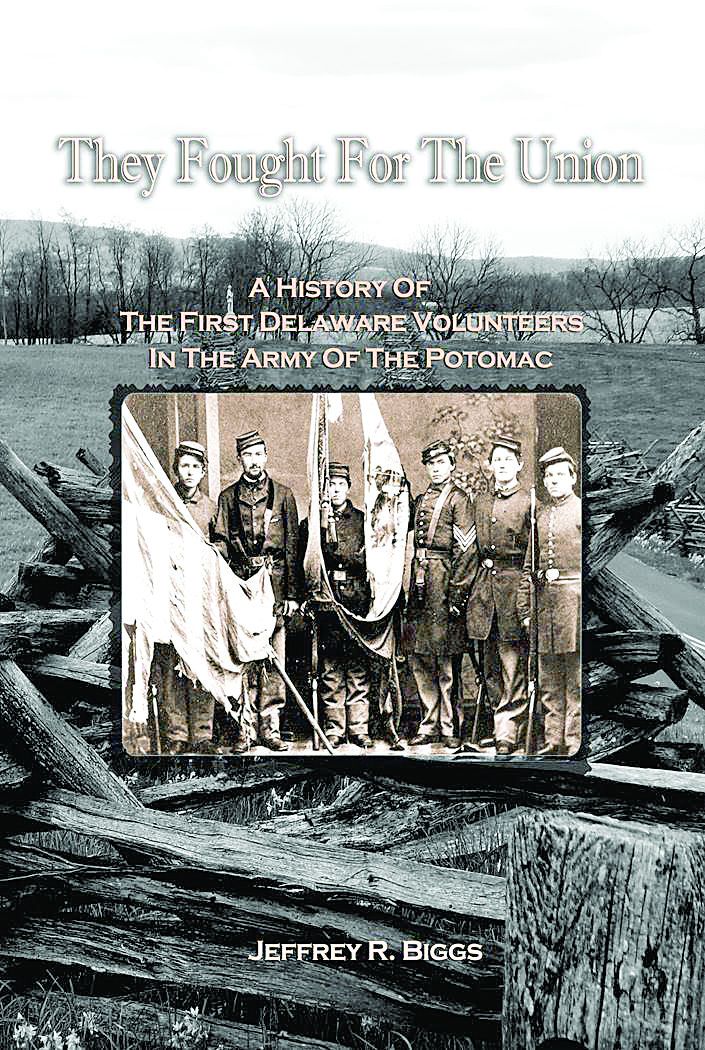
Well Researched Book On 1st Delaware, Army Of The Potomac They Fought for the Union: A History of the First Delaware Volunteers in the Army of the Potomac. By Jeffrey R. Biggs. Illustrated, photos, maps, bibliography, index, notes, 526 pp., 2016, Belli Civilis Press, www.bellicivilis.com, $19.99.
The 1st Delaware was one of the “fighting” infantry regiments in the Army of the Potomac that played a prominent role in all of that army’s engagements from Antietam until the end of the Civil War. The 1st’s contribution was unique because it hailed from a slave state yet suffered grievous casualties in defense of the Union. It is surprising that until now this unit has not been the subject of a modern study. Jeffrey Biggs’ self-published book ably fills that void. While his volume exhibits in abundance some of the flaws common to the self-published genre, it is nonetheless a fine example of a readable, thoroughly-researched, and important regimental history. The 1st was raised in 1861 but spent more than a year without experiencing combat. Eventually assigned to Fort Monroe at the tip of the Virginia Peninsula, the regiment had no role in McClellan’s Peninsula Campaign. Instead, it underwent steady drilling at its encampment, eventually taking part in the relatively bloodless capture of Norfolk during a brief and unique “campaign” under the command of Secretary of the Treasury Salmon P. Chase. The regiment finally was assigned to the Army of the Potomac in September 1862, enduring forced marching to join up with that army’s Second Corps on the eve of the Battle of Antietam. There the 1st took part in the attack on the Confederate position at the Sunken Road, suffering a costly repulse. The 1st remained with the vaunted Second Corps for the duration and seems to have had a “nose” for desperate fighting. Biggs recounts the regiment’s bloody assault on the Confederate defense at Marye’s Heights during the Battle of Fredericksburg; its part in the January 1863 “mud march,” and the ensuing revival of the army’s low morale by Maj. Gen. Joseph Hooker. He also describes the unit’s self-extrication from a trap during the Battle of Chancellorsville on May 3, 1863; its role in the backand-forth fighting around the Bliss Farm at Gettysburg on July 2, 1863, when it was repeatedly abandoned by its commanding officer; and its involvement in repelling Pickett’s Charge the next day. Biggs follows the regiment’s participation in the Federal defense at Bristoe Station in October 1863; its actions at the Wilderness and then in the May 12, 1864, attack on the Mule Shoe Salient at Spotsylvania, and the regiment’s part in the bloody repulse at Cold Harbor.
Finally, he relates its involvement in the various offensives by the Second Corps outside Petersburg, including the debacle at Reams’ Station, and its experience in the war’s final campaign in April 1865, when its long-time regimental and brigade commander Thomas Smyth became one of the Army’s last officer fatalities. Delaware was a slave state, although its population of slaves was only about 10 percent the size of its population of 20,000 freed blacks. Biggs details the persistently fervent Unionism of the unit’s soldiers despite strain from the state’s strong political opposition to the Lincoln administration throughout much of the war. It refused to provide enlistment bonuses and opposed emancipation. Biggs has done a thorough job of finding and using primary sources in the form of soldiers’ letters to families and local newspapers, the regiment’s order book, and its morning/ present for duty reports. He also has made selective and judicious use of the unit’s 1884 official history written by Lt. William Seville, which typically presented things in a uniformly glowing fashion. Biggs pointedly adds information about the dirtier side of war from which this regiment was not immune — the cowardice or unsuitability of several officers, desertion, drunkenness, the unreliability of bounty-induced draft substitutes, and at least one instance of self-wounding to avoid combat. Biggs also has used sources from members of other regiments brigaded with the 1st to flesh out accounts of its combats. These primary sources are supplemented with reliable secondary sources by authors such as Stephen Sears, Marion Armstrong, Frank O’Reilly and Gordon Rhea.
Thorough endnotes document the author’s research. Modern unit histories often contain a substantial component focused on social, cultural and demographic characteristics of members. Biggs follows a more traditional approach, but much is revealed about these soldiers in the brief biographical backgrounds he interjects when recounting specific exploits and casualties. Biggs’s narrative style is a particular strong point. His accounts of the regiment’s fights are smoothly written and easily followed, with the important addition of clear terrain descriptions. Biggs also achieves something often overlooked by writers of unit histories. He seamlessly ties the 1st’s localized fighting to the larger brigade, division, corps and even army contexts so that even a casual reader can comprehend the “bigger picture.” The maps generally are adequate, consisting of battle maps borrowed from a site by well-regarded Civil War cartographer Hal Jespersen or from other sources at the campaign level. A nice addition consists of five maps by the author showing details of the 1st’s movements during the fighting at Antietam, Fredericksburg, Chancellorsville and Gettysburg. Self-published books lack the input of an editor, and that reality is fully apparent here. There are numerous instances — at stretches on every page — of typographical errors, missing words or erroneous punctuation. For example, one of the 1st’s officers killed at Antietam, Capt. James Rickards, is twice labeled James “Ricketts” (a Union general who had no connection to the unit). In the endnotes author Marion Armstrong becomes “Anderson.” The index is simply missing certain names, including the man who commanded the Second Corps at Antietam and Fredericksburg, Maj. Gen. Edwin V. Sumner. Ordinarily, such flaws would largely offset a book’s substantive value. Not so here, however. This is an excellent history of an important Union regiment that should find a place in the library of every student of the Union’s most famous army. Reviewer John Foskett is a practicing attorney in Boston, Mass., and has a life-long interest in the Civil War.
Good Collection Of Blackford Writings Speeches, Documents Are Sharpshooter: The Selected Letters and Papers of Maj. Eugene Blackford, C.S.A. Vol. I. Edited by Fred L. Ray. Illustrated, photos, maps, appendix, bibliography, notes, index, 250 pp., 2015, CFS press, www.cfspress.com, $39.95.
SHARPSHOOTER
The Selected Letters and Papers of Maj. Eugene Blackford, C.S.A. VOLUME I
Fred L. Ray, Ed.
Fred Ray is known for his groundbreaking study of the Army of Northern Virginia sharpshooters, Shock Troops of the Confederacy. One of the most significant figures in that book was Eugene Blackford, who, under orders from his brigade commander Gen. Robert Rodes, formed the first brigade sharpshooter detachment in that army. Blackford, as we discover in this book containing selected correspondence and other papers edited by Ray, was a fascinating character in his own right. War stories often characterize people as heroes and villains, disregarding the complexity of most humans, and Blackford was certainly complicated. I am a firm believer that where a person is living at the outbreak of a l conflict is as much, if not more, of a determinant of what side he fights on than ideology. It was certainly so in Blackford’s case. Born into a Virginia family that did not believe in secession or slavery, Blackford, a University of Virginia graduate, was working as a teacher in Alabama in 1861. He was a vocal Unionist who was openly appalled at the secession movement in what he referred to as “Cottondom” and even received threats from locals. But Blackford still raised a company of infantry and borrowed friends’ slaves for his personal servants. With prior militia service, he was commissioned a captain in the 5th Alabama Infantry. The reluctant secessionist led his company though the Peninsula Campaign and was eventually promoted to major. In early 1863 Captain Blackford was instructed by his brigade commander and personal friend General Rodes to form a sharpshooter detachment of soldiers from the brigade’s various units. These men were to be more or less permanent skirmishers, leading the brigade’s advance and covering it in retreat. They also targeted enemy officers and artillery batteries. The unit Blackford formed turned out to be a model. Copying his example, similar organizations were created in the army’s other brigades, with varying success. Blackford was the scion of a literary family that included four brothers who served the Confederacy and remarkably survived the war. He left a rich personal history documented in his correspondence and papers, many of which have fortuitously survived. Fred Ray has been searching them out in a number of collections since he finished his previous work on sharpshooters. The letters and documents reproduced in this book, the first of a three-volume series, tell a detailed tale of war and tactics, as well as personal life as a junior officer in the Confederate army. That role was not always pleasant for Blackford. A Virginia aristocrat, he had problems dealing with his unit’s “rough mannered” Alabamans. Following the death of General Rodes, his fellow Virginian and mentor, Blackford was court-martialed on rather dubious charges apparently resulting from political squabbling within his regiment. Going through the more than 300,000 surviving words penned by Blackford proved a Herculean task for Ray. Blackford was a university graduate and teacher, tossed in occasional quotes in Italian and French in his correspondence, and wrote at least one passage in classical Greek. But he also used some creative spelling, which Ray let stand with the addition of “[sic].” This volume provides wonderful detail, far more than most soldiers’ letters, on campaigns, battles, camp life, and interpersonal and family relations of a junior officer in the Army of Northern Virginia. It deserves a place on the bookshelf of any serious student of the Civil War. I highly recommend it and look forward to publication of the final two volumes in the series. Reviewer Joseph G. Bilby is a member of the New Jersey Civil War Sesquicentennial Committee and an award-winning author and editor of books on the Civil War, firearms and New Jersey history. His most recent works are Small Arms at Gettysburg, Monmouth Court House: The Battle that Made the American Army and Freedom to All: New Jersey’s AfricanAmerican Civil War Soldiers.
Printed In Original Format
The Civil War: Great Speeches and Documents. Edited by Bob Blaisdell. Bibliography, 220 pp., 2016, Dover Publications, www.doverpublications.com, $6 softcover.
This book presents, in their original and unedited formats, numerous significant Civil War documents. Included are battlefield reports from First Manassas, the battle between the Monitor and Virginia, and the Fort Pillow massacre. Political documents include Abraham Lincoln’s first and second inaugural addresses, the Emancipation Proclamation and the Gettysburg Address. From the Southern perspective, editor Bob Blaisdell’s selections range from an address to the people of South Carolina justifying secession to recruitment difficulties encountered by Gen. Jeff Thompson. For the human slant, he includes Gen. Robert E. Lee’s proclamation to the people of Maryland and Gen. P.G.T. Beauregard’s plea for more sacrifice by the Southern populace. Additional selections focus on important technological achievements during the Civil War. The Morse telegraph, new metal smelting techniques, and balloon reconnaissance are included. Sobering reminders of war’s cruelty appear in reports of burying the dead at Antietam, the horrors of prison life at Andersonville, and the scarcity of food and medicine in everyday camp life. Finally, official correspondence is included from Gens. James Longstreet, Joseph Hooker, Henry Halleck, Benjamin Butler and John H. Morgan. Their personal thoughts, motives and fears are clearly evident. They all desire an end to the bloodshed yet do their duty as they see it. Primary-source material is always valuable for Civil War historians who desire to bypass historical interpretation and bias. While this book presents unedited primary source material, it misses the chance to be more valuable because it frequently presents only one side of an argument, often with a pro-Union bias. A more balanced approach, set in an interpretive context, would have been more valuable. There are a number of grammatical errors that more careful editing would have eliminated. I found only one historical error: Gen. Philip St. George Cocke died in 1861, not 1895. This book is recommended as a quick reference, at an inexpensive price, for novice Civil War enthusiasts. Reviewer Wayne L. Wolf is Professor Emeritus at South Suburban College and the author of numerous Civil War books and articles including “Gen. John Corson Smith and the Fighting 96th Illinois” and “The Last Confederate Scout.” He is past president of the Lincoln-Davis Civil War Roundtable.
Photos Tell Gettysburg Park Press Reports On Slavery, 1791-1859 History Since World War II Gettysburg National Military Park. By Jared Frederick. Photos, 96 pp., 2016, Arcadia, www.arcadiapublishing.com, $22.99 softcover.
Roughly three million visitors per year tour the Gettysburg National Military Park. The magnificent new visitor center, opened in 2008, houses thousands of battle-related artifacts, interactive displays and movies, along with a gift shop. Every day visitors drive on smooth paved roads from landmark to landmark and park rangers offer guided tours. Families and Boy Scout troops reenact Pickett’s Charge, shouting and making the nearly mile long run up to Cemetery Ridge. Anyone who has visited it will tell you the park is a national treasure. As Abraham Lincoln eloquently stated in the Gettysburg Address, “The world … can never forget what they did here.” Jared Frederick, a former ranger at the park, has produced a photographic collection of recent park history. His emphasis is on the park since World War II. This was the era of the American highway system, long-distance travel and tourism in its early stages. These allowed people to go places that previously they had only read about or studied in school. As the decades passed and America changed, Frederick explains, the park played a role as a site for Americans of all backgrounds and races to come together and share the experience of the nation’s most important battle. This book does not tell the story of the battle of Gettysburg from a military perspective. The photos are all modern, not the 150-year-old pictures by the famous Matthew Brady or Alexander Gardner. But the modern focus of Frederick’s book does bring to light some interesting facts about the park and its place in recent American culture. Several photographs feature President Dwight Eisenhower, who bought a farm near the battlefield in 1950. Ike was a frequent visitor and brought international dignitaries to Gettysburg for private tours. They included French President Charles de Gaulle and British Gen. Bernard Montgomery. Richard Nixon, while vice president, laid a wreath at the tomb of his great-grandfather George Nixon, 73rd Ohio Infantry, who was killed at Gettysburg. President John F. Kennedy and his wife Jackie visited Gettysburg eight months before Kennedy’s assassination in 1963. Frederick claims the battlefield’s Eternal Light Peace Memorial inspired the John F. Kennedy eternal flame memorial at his gravesite in Arlington National Cemetery. On many occasions in the 1960s, during the civil rights and Vietnam era struggles, Gettysburg was a focal point for unity of men and women of different political persuasions. Most of the book is about the Gettysburg National Park today. It pays homage to the dedicated men and women who work on park upkeep, visitors coming to learn, and ever-present and colorful Civil War reenactors. Some beautiful pictures of the sun shining over the Gettysburg National Cemetery, early morning fog lifting over Little Round Top, and the stark, bare image of pristine snow on Cemetery Hill are included. This is a nice slim book packed with some stunning photos. While not a tour guide book or a history of the great battle, Frederick’s Gettysburg National Military Park provides a unique perspective on one of our nation’s great memorials. Reviewer David A. Galli is a private practice physician in St. Louis, Mo., and Instructor of Medicine at St. Louis University Medical School. He has a degree in history from St. Louis University and a long-time interest in the Civil War.
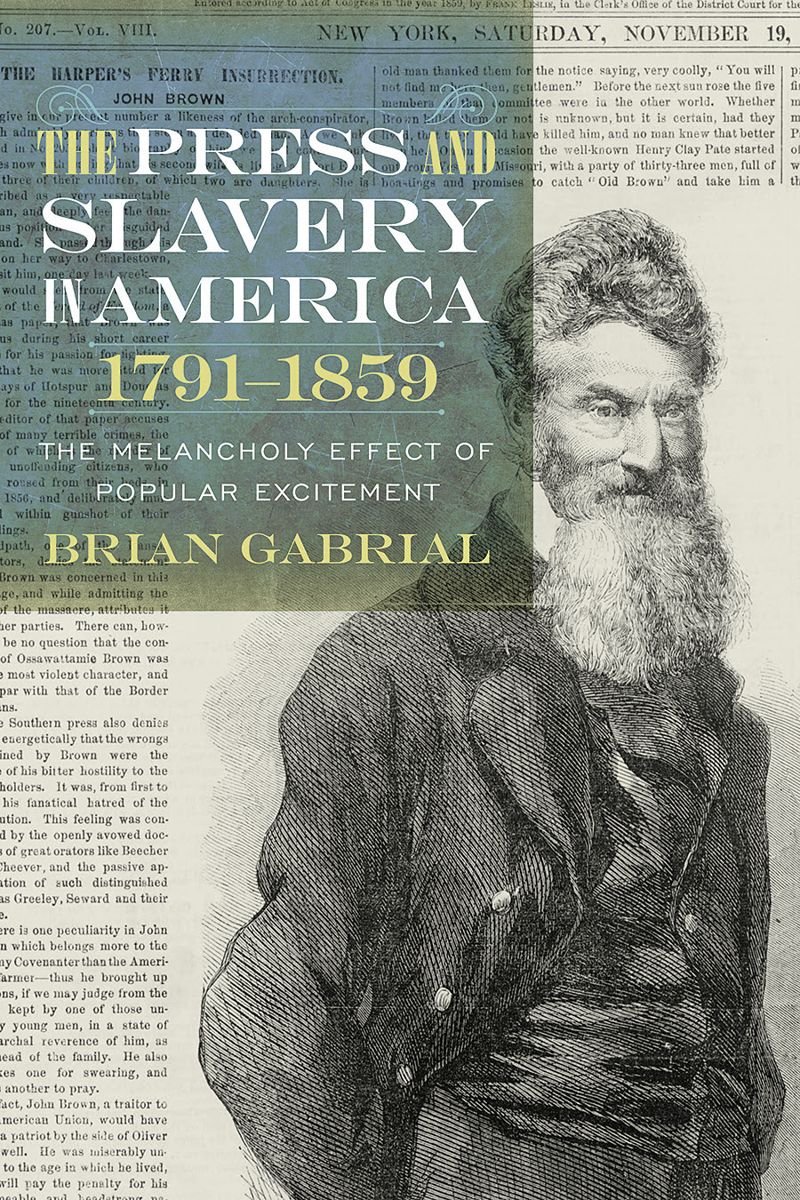
The Press and Slavery in America, 1791-1859: The Melancholy Effect of Popular Excitement. By Brian Gabrial. Maps, photo, notes, bibliography, index, 256 pp., 2016, South Carolina, www.uscpress.com, $49.99.
This book examines press coverage, both North and South, of slave revolts and alleged slave conspiracies in Haiti and the antebellum South. By creatively choosing those times of elevated tensions, Brian Gabrial provides insights into the institution of slavery and Americans’ perceptions of it. He focuses on press coverage of the Haitian (St. Dominique or Santo Domingo) revolt against the French in 1791; Gabriel Prosser’s 1800 conspiracy in Henrico County, Virginia; the 1811 armed uprising on Louisiana’s “German Coast”; the alleged Denmark Vesey 1822 conspiracy in Charleston, S.C.; Nat Turner’s 1831 revolt in Southampton, Va., and John Brown’s 1859 raid in Harpers Ferry, Va.
Gabrial begins with a brief description of slavery’s cruelties, its symbiotic relationship with racism, and the rationales and restrictions intended to perpetuate it. He notes that some blacks tried to forcefully obtain their freedom, but that “powerful forces abetted by America’s strong racist belief in blacks’ inferiority would not permit this and would counter with swift, brutal measures to suppress them while ensuring slavery’s survival.” The Haitian revolt lasted from 1791 to 1804. It resulted in the slaughter of many French whites and ultimately in Haitian independence and the end of slavery there. Its horrors had a lasting impact on Americans’ fears of slave revolts. Prosser’s planned revolt was discovered and resulted in the hanging of Prosser and 36 other conspirators. The little-known Louisiana revolt involved 300 to 500 white slaves, the death of a white man, suppression by Federal militia and the execution of over a hundred slaves. Vesey’s alleged conspiracy never got off the ground, but coerced slave testimony in closed trials resulted in 35 executions and 37 exiles. Nat Turner’s revolt was an actual uprising that killed about 60 whites and resulted in responsive atrocities that killed some 200 blacks, many of whom were not involved with Turner. The last antebellum revolt was John Brown’s unsuccessful attack at Harpers Ferry. That 1859 incident exacerbated the already accelerating national crisis over slavery. In tracing newspaper treatment of these events, Gabrial concludes that through 1831 there was common agreement on the evils of slavery. Southern papers were apologetic about the institution while Northern papers supported a quick response to any slave uprisings. Thereafter, however, the nation and its press became increasingly divided on the slavery issue. Increasingly, says Gabrial, slavery destroyed the civil liberties of blacks, next destroyed the civil liberties of whites, and eventually destroyed freedom of the press. In the midst of demonstrating the poisonous effect of slavery in the U.S., the author inexplicably says, “In general terms, the discourse of slavery as a threat to the nation revealed the ongoing struggle between the nation’s two dominant political strands: the conservative view of limited government and states’ rights; and the liberal view that supported a larger governmental role in the lives of Americans.” This 21st-century description is not supported by Gabrial’s evidence. His numerous newspaper quotations reveal a dispute about slavery, not states’ rights. One of the few press quotes he cites on the states’ right issue is from a Virginia judge, who opined, “the right to hold slaves … is a constitutional provision, which no law of any state can abrogate.” That is not a defense of states’ rights but of slavery. Despite my disagreement with Gabrial on this point, I highly recommend this thoughtful and enlightening study of American slavery and the press’s approach to it. As Gabrial concludes, “It must be said that while slavery’s lasting effects on race in America have diminished, they have not disappeared and seem largely ignored in mainstream society.” Reviewer Edward Bonekemper is former Civil War News Book Review Editor and author of several Civil War books.
I’m of two minds about The Confederacy at Flood Tide. I liked it, but it was not the book I was expecting based on the subtitle: The Political and Military Ascension, June to December 1862. I was expecting a detailed analysis of how the Confederacy had turned the defeats of the Seven Days’ battles in June, the clear victory and lost opportunities at Second Manassas and Chantilly in August, the standoff at Sharpsburg in September, and the strategic defeat at Perryville in October into opportunities to win the war at home and international recognition abroad. What readers will get is a relatively short account of how those battles were viewed in Europe and how the wins and losses affected strategy in both Eastern and Western theaters of operation. When I started reading Flood Tide, I was reminded of the tried-and-true, still popular A Short History of the Civil War by Fletcher Pratt, a 1955 book that many consider the best short history of the war ever published. Philip Leigh’s concise, informative style reminds me of the way Pratt used an economy of words to describe four years of conflict without giving too many details of specific troop movements or generals’ personalities. That said, I was expecting a lot more analysis than what Leigh provides. Based purely on the sub-title, I was expecting a lot more information on how Great Britain and France were monitoring and evaluating the war’s progress to see if they should intervene on the Confederacy’s side. Leigh does include some of those political discussions. He says some high-ranking British politicians believed talk of emancipating the slaves was designed to incite a slave revolt. This could have led to wide-scale desertion of Confederate troops rushing home to defend their families. The newly suspicious English had believed Abraham Lincoln when he said early in the war that his goal was preserving the Union. At one time, the French foreign minister in Washington floated the idea that the North and South become two “confederated Confederacies.” That idea was rejected by Secretary of State William Seward, who replied that there could be no “other government than this Union just as it constitutionally exists and has always been.” Leigh does produce some little-known details of what was happening in Great Britain. He writes that the Confederacy convinced the British government to allow it to order the construction of two ironclad vessels from an English shipyard. These vessels, with turrets turning on ball bearings rather than the clunky teeth of the Monitor, would have been dominant. Had those ocean-crossing ironclads been completed, Leigh quotes U.S. assistant secretary of the Navy Gustavus Fox as believing they would have been superior to anything the U.S. Navy could have put up against them. Because the analysis portion of the book is so short, I found the pages detailing France’s lust for Mexico to be dizzying with so many names and plans mentioned. For instance, one detailed paragraph contains a raft of names, nationalities and schemes to absorb. Leigh does a fine job addressing the war in both the Eastern and Western theaters, but I would have preferred he separate the theaters by chapters. For instance, I found it jarring that in one paragraph he is writing about Lincoln’s cabinet considering the Emancipation Proclamation, and in the next paragraph he is writing about the positions of the Union and Confederate armies in the West in August 1862. All that separates the two completely different narratives is a wide space in the page. One minor problem I had was that the reader is asked midway through the book to refer back to a map at the beginning of the book. The rest of the maps were closer to the narratives. The overall strategic maps are adequate, but the tactical maps of specific battles are inadequate to compensate for the too-short battle narratives. Readers will not learn much about the personalities of the generals fighting the battles since there is no space for that analysis in a 200-page book covering six months of war in two theaters and across the ocean. Still, I did pick up a few nuggets, such as how Confederate Gen. Leonidas Polk tried his best to undermine Gen. Braxton Bragg in hopes his friend Jefferson Davis would select him as the Army of Tennessee’s commander. One wonders how that might have worked out since Polk is generally considered one of the few generals with a worse reputation than Bragg. This is a very readable short history of six months of the war. Get it. Reviewer Clint Johnson has written 10 Civil War history books.
Hess Fleshes Out Real Braxton Bragg The Confederacy The Confederacy at Flood Tide: The Political and Military Ascension, June to December 1862. By Philip Leigh. Photos, maps, notes, bibliography, index, 240 pp., 2016, Westholme, www.westholmepublishing.com, $28.
Braxton Bragg: The Most Hated Man of the Confederacy. By Earl J. Hess. Illustrated, photos, maps, notes, bibliography, index, 364 pp., 2016, North Carolina, uncpress.unc. edu, $35.
“Braxton Bragg has always been a controversial figure,” opines author Earl J. Hess in the opening words of his magnificent new study. “His contemporaries began the process of making him into a hero, a fool, a bloodthirsty disciplinarian, and an old-fashioned scapegoat, all wrapped up in one package. Historians have tended to do similar things, followed by a legion of Civil War enthusiasts who seem to delight in making Bragg the Confederacy’s chief whipping boy.” That single pithy paragraph frames the entirety of the Bragg myth, which Hess puts to the test in this significant book. The prominent Confederate general is best known for leading the primary Confederate Western field army to a string of primarily strategic defeats until he resigned following the disaster atop Missionary Ridge in November 1863. Thereafter, Bragg assisted Jefferson Davis in Richmond and saw final service in North Carolina. He lived out the few years he had left in an impoverished state, unwilling to write his own memoirs while hoping history would offer a fair critique of his record. Braxton Bragg unfolds in chronological fashion, with just enough prewar material to understand the man as the Civil War started, and just enough postwar coverage to better appreciate the man who dropped dead on a street in Galveston, Texas, in 1876. Coverage of his campaigns and battles is sufficient to understand the playing field upon which Hess excels: piecing together the evidence to flesh out the real Braxton Bragg. Hess’s study is more of a critical evaluation of both the man and his controversial service, and the literature addressing both, than pure biography. It reads much like a long scholarly article, and one whose pages I happily turned with deep satisfaction. One of the strengths of this study is the full treatment Hess allots to the deep and loving relationship shared by Bragg and his wife Elise. No other Bragg study comes close, and it is impossible to understand the man without appreciating their close relationship. Hess goes where the evidence takes him. Bragg could be quarrelsome, he notes, but the well-known and devastating story about Bragg arguing with himself in the pre-Civil War Army has no basis in fact. It originated in U.S. Grant’s Personal Memoirs, where he admitted it was “an old army anecdote” and nothing more. Hess also makes it clear that, contrary to popular belief, Bragg did not owe his long tenure at the head of an army to any friendship with President Davis because the two were not close. Bragg was a fighter and Davis respected that. He also knew Bragg had difficult subordinates in important positions, and he believed there was no one else who could do a better job. Hess’s exploration of Bragg’s relationships with other officers, his own men, the press and civilians offers satisfying insight. Gen. Joe Johnston, argues the author, “admired the way Bragg handled his command, in part because it offered such a contrast to his own command style.” Bragg had few friends in the press, and its constant carping affected the mercurial officer. Bragg’s fractious association with Brig. Gen. Randall Gibson damaged the effectiveness of both, as did the increasingly estranged nature of the army commander’s relationship with Gens. Leonidas Polk, D.H. Hill, Benjamin Cheatham and Simon Buckner. The breakdown in these relationships led to the open refusal of some of Bragg’s lieutenants to execute his orders at such places as Stones River, McLemore’s Cove and Chickamauga. It also divided the army internally, hamstringing his ability to wage effective war. Bragg, notes Hess, bears responsibility for the breakdown along with his officers. Hess deftly compares Bragg’s record against other generals’ with an eye on how the public came to view the events. Bragg’s tactical attack on the first day at Stones River looks masterful when weighed against Johnston’s bungled mess outside Richmond at Seven Pines. Gen. Robert E. Lee’s 1862 invasion of Maryland was “a bloody failure” as was Bragg’s 1862 Kentucky offensive. But Lee lost more than 10,000 men in one battle, and his army was in poor condition when he returned. Bragg marched substantially farther, lost 3,400 at Perryville, and returned his command in better condition. “Yet nothing resembling the criticism heaped upon Bragg descended on Lee.” According to Hess, it was because Lee had already won spectacular victories, and “it was Bragg’s misfortune to fail in his first campaign and many refused to forgive him for it.” Perryville, writes Hess, “was the beginning of a persistent phenomenon in his military career — winning tactical victories from which his men and the public expected great things that never materialized.” Stones River and Chickamauga bear that out. This exhaustively researched and trenchantly reasoned study humanizes Bragg and effectively transforms the flawed and largely misunderstood general into a flesh-and-blood character. The endnotes and bibliography are extensive, the writing is smooth and rich, and we are treated to a pair of previously unseen postwar images of the general. I hesitate to quibble with this fine effort, but two issues are worth mentioning. First, there are only two maps in the entire book; both are small and neither is particularly helpful. Detailed cartography on Bragg’s attacks, maneuvering, and intentions would have been welcome in a study of this nature. Second, much of the coverage relating to John Bell Hood and many aspects of the Chickamauga campaign seems to rely upon outdated studies and not the latest books or the rich available source materials recently unearthed. Hess is a prolific author whose work never fails to satisfy. This latest effort sets a new standard against which all others will be measured. “Bragg,” he concludes, “was a fascinating mixture of good and bad qualities; his impact on Confederate history was enormous, and we are still grappling with it.” The former “hero” “fool,” “bloodthirsty disciplinarian,” “scapegoat,” and “Confederacy’s chief whipping boy” had to wait a long time for a balanced account of his service. One is inclined to believe that if he could read Hess’s Braxton Bragg, the prickly old fellow would at least crack a smile — and hold off ordering up that firing squad. Reviewer Theodore P. Savas is the owner and managing director of Savas Beatie Publishing, an independent military and general history press. A former litigator, he taught college classes in business, law, and history for two decades, and is the author or editor of more than a dozen books in eight languages. He lives in El Dorado Hills, Calif. He can be reached at [email protected].
Historical Novel Tells 4 U.S. Generals’ Wives With Influence Mary Lee, Slave Story Mrs. Lee and Mrs. Gray. By Dorothy Love. Novel. 390 pp., 2016, Thomas Nelson, www.thomasnelson.com, $15.99 softcover.
This novel is based on newly discovered letters from the Custis Lee estate. Dorothy Love explores the relationship between Mary Anna Custis Lee, the great-granddaughter of Martha Washington and wife of Confederate Gen. Robert E. Lee, and Selina Norris Gray, a slave on the Lees’ Arlington plantation. Encompassing the years 1827-1873, the lives of these two remarkable women are characterized by their different social standings contrasted with their common bond of struggle, separation and tragedy. Selina, despite being born into slavery, was taught to read and write by Mary, a fervent member of the American Colonization Society. She subsequently became Mary’s housekeeper, friend and confidante. Through their early years they showed how friendship can transcend racial and cultural differences. Yet, Selina never forgot she was not free and her home could never truly be Arlington. Eventually she married Thornton Gray, also an Arlington slave, gave birth to eight children, and was destined to play a critical role during the Civil War. It was Selina who confronted Union soldiers at Arlington and was responsible for saving many of
George Washington’s artifacts from plunder. After the war, though in her own home with her husband and eight children, she maintained contact with Mary until the latter’s death in 1873. Mary, while living most of her life in the shadow of her husband, was accomplished in her own right. She knew four languages, edited her father’s memoirs, and was a talented author and painter. Often separated from Robert E. Lee during his army postings, she nonetheless raised seven children, managed the Arlington estate, and suffered the cruelties that the Civil War brought to all Southerners. The remarkable strengths and achievements of both women, along with their disappointments and sacrifices, forged a lifelong friendship. History rarely gives her due to Mary as a woman ahead of her times who prepared slaves for freedom, pressured her husband to manumit all of their slaves, and did this from a genuine affection for her slaves. Her friendship with Selina was real, caring and enduring. Mrs. Lee and Mrs. Gray is an exceptionally well written novel. It combines historical fact with dialogue and fictional additions to create a story where only historical fragments previously existed. It portrays two exceptional 19th-century women. Dorothy Love gives Mary Anna Lee appropriate credit as an accomplished woman while simultaneously revealing the friendship between mistress and slave that reflected antebellum America in a different light than the abolitionist press provided. This novel is highly recommended for readers who appreciate historical fiction that reads like real life. The writing is superb, the images created realistic and compelling, and the emotion riveting and genuine. Reviewer Wayne L. Wolf is Professor Emeritus at South Suburban College and the author of numerous Civil War books. He is past president of the LincolnDavis Civil War Roundtable.
Lincoln’s Generals’ Wives: Four Women Who Influenced the Civil War – for Better or Worse. By Candice Shy Hooper. Photos, illustrations, maps, notes, bibliography, index, 429 pp., 2016, Kent State University Press, www.kentstateuniversitypress.com, $39.95. The Civil War offers a wide variety of topics, such as battles, generals and regiments, that authors can write about. Breaking the usual mold is Candice Hooper’s unique profile of the wives of four Union generals. They are: Jessie Benton Frémont, wife of Gen. John C. Frémont; Mary Ellen Marcy McClellan, wife of Gen. George B. McClellan; Eleanor Ewing Sherman, wife of Gen. William T. Sherman, and Julia Dent Grant, wife of Ulysses S. Grant. One common thread of these extraordinary ladies is that they all married West Point graduates. Each had a unique relationship with her husband general. Jessie Benton was born into the upper class. Her father, Sen. Thomas Benton, was a powerful Missouri politician. She married John C. Frémont, known as the “Pathfinder” due to his Western expeditions. Their marriage saw a number of political ups and downs as Frémont moved from California senator to the first Republican presidential candidate in 1856. Jessie was prominently featured in the campaign. Although Benton lost the election, he became even more famous. After meeting with both Frémonts, Abraham Lincoln appointed Frémont commander of the Western Department. Believing he had carte blanche to act, Frémont declared martial law and emancipated Missouri’s slaves. When Lincoln asked Frémont to rescind his emancipation action, Frémont refused and Jessie traveled to Washington to plead her husband’s case. After a tense meeting, Lincoln did not yield. Upon Jessie’s departure, he referred to her as “…quite a female politician.” After Frémont was removed from command, the family’s fortunes declined. Mary Ellen Marcy was one of the most beautiful ladies of her time. Daughter of legendary Western explorer Randolph Marcy, she was born in Wisconsin at an army post. Randolph moved his family back East to improve “Nelly’s” chances for success.
When McClellan fell in love with her and proposed, she refused. She declined about eight different marriage proposals. Over her parents’ objections, she became engaged to later Confederate general Ambrose Powell Hill. Rumors of Hill’s venereal disease ended that engagement. Then, after McClellan resigned from the army and succeeded in business, Nelly and he married in 1860. In 1861 McClellan was appointed commander of the Army of the Potomac and then general-in-chief. Nelly threw many parties and earned the nickname of “Flora McFlimsey,” a fictional character who owned hundreds of dresses but declared she had nothing to wear. Her wearing a red-and-white gown (secession colors) to Lincoln’s inauguration ball caused a stir. Little evidence exists that Nelly supported the Union war effort. After leaving the army, McClellan opposed Lincoln in the 1864 presidential election. After his loss, he served as New Jersey’s governor and otherwise lived a quiet civilian life. Following McClellan’s death in 1885, Nelly foolishly permitted publication of McClellan’s wartime letters, which severely damaged the general’s legacy. Eleanor Ewing Sherman also hailed from an upper middle class family. Her father, Thomas Ewing, was a powerful senator from Ohio. When William T. Sherman became the foster son of Senator Ewing, Eleanor Boyle Ewing became his stepsister. Growing up together, Sherman and “Ellen” became playmates and developed a strong affection for each other. Married in 1850, they would spend the next 38 years in a marriage Ellen described “… as high or low tide with us ever.” She was strongly Catholic and spent most of her life trying unsuccessfully to convert Sherman; this issue caused them much friction. They were devoted to each other. While Ellen disagreed with Sherman on some issues, she always supported him. When Sherman was accused of being mentally unstable early in the war, she interceded with Halleck and then Lincoln to save his career. Her successful efforts sharply contrasted with Jessie Frémont’s confrontational visit with the president. Ellen’s forceful but appropriate support earned her husband a second chance. Sherman was restored to command and played a key role at Shiloh. They were devastated when their son Willy suddenly died, but Sherman focused on the war while Ellen was occupied raising their six other children. After his marches through Georgia and the Carolinas, Sherman gave generous terms to Confederate Gen. Joseph Johnston. For that he was widely criticized and then chastised by Secretary of War Edwin Stanton. During this trying period, Ellen wrote him a clear, succinct and touching letter of support. Hooper demonstrates that the Shermans had an enduring love. Julia B. Dent was the daughter of a slave owner from Missouri.
Though not a great beauty, she was a wholesome lady devoted to her husband. When they first met, Grant was smitten by Julia, who wasn’t terribly impressed at first. They were married in 1848 after a four-year separation due to the Mexican War. Sensitive, romantic and well written, Grant’s letters to Julia during that time reveal a different Grant than usually portrayed by historians. Julia was not used to running a household by herself but eventually developed the skills necessary to live at a level affordable with a lieutenant’s low pay. Their long-term separation when Grant was assigned to the West Coast caused his 1854 resignation from the army. In the late 1850s, they faced a difficult life as Grant struggled to provide a living for Julia and their four children. After moving in 1860 to Galena, Ill., the family enjoyed a good life until war erupted. Although Grant achieved success throughout the war, he was constantly dogged by drinking allegations. Julia supported him with letters and personal visits, involving perhaps 10,000 travel miles. After his promotion to generalin-chief, Julia went to Washington and supported him through Sanitary Commission activities. For the last few months of the war, Julia and youngest son Jesse were with Grant at City Point, Va., providing the stable family life Grant needed. Because of Julia’s desire to avoid the first lady, the Grants missed being present at Ford’s Theatre when Lincoln was shot. They went on to live eight years in the White House and travel the world before cancer ended Grant’s life. Three of the wives featured (Frémont, McClellan and Grant) saw their husbands run for president; only Grant was elected. Two wives (Sherman and Grant) had life-long medical problems. Three (Frémont, McClellan and Sherman) had powerful political connections through their families. This volume provides an interesting inside look at Lincoln’s generals through their wives. I highly recommend this book and hope that Hooper will write a book about Jefferson Davis’s generals’ wives. Reviewer Connie Clowers of Gettysburg is a professional interpreter of Julia Dent Grant.
Georgia Letters Tell Of Book On War Dead Relevant Today Homefront, Soldier Life A Just and Holy Cause?: The Civil War Letters of Marcus Bethune Ely and Martha Frances Ely. Edited by Linda S. McCardle. Illustrated, photos, map, notes, biographies, bibliography, index, 224 pp., 2016, Mercer, www.mupress.org, $35.
In May 1862 Marcus Ely, a 30-year-old schoolteacher in Columbus, Ga., joined the Russell Guards, a company being raised by his step-uncle. For the next three years he corresponded with his wife Martha primarily to discuss personal matters and express his love for her and their children. Many Civil War enthusiasts, interested in understanding the battlefield experiences of soldiers, value letters that offer stirring, eyewitness descriptions of combat. These letters, in contrast, primarily provide insights into social history. They reveal a couple who attempted to enjoy the familiar comforts of daily life and to maintain their traditional relational structures in the midst of war’s disruption. Attached to the 54th Georgia Volunteers, the Russell Guards spent nearly two years in the vicinity of Savannah, protecting a key Southern city far from the battlefront. Six months into his service Ely candidly declared, “We do nothing but frolic around. No Yankees to fight[,] nothing to do but eat beef & enjoy ourselves generally.” Ely frequently mentioned food in his letters, shipping rice or oranges home and receiving butter and eggs from Martha. He had the luxury of fishing on several occasions and gathering oysters to eat or sell. His financial situation seemed prosperous before the war, and as second lieutenant and regimental clerk he enjoyed a monthly salary of $71. Inflated war prices didn’t seem to bother him. On one occasion he offered to spend $60 to buy Martha “a nice gingham dress.” Ely’s affluence is revealed most tellingly by how frequently he and Martha discussed their slaves. In her first letter she asked for advice on how to handle a disciplinary matter regarding Mary, whom they eventually hired out to cook at a Savannah hospital. On another occasion Martha brought up the possibility of needing to “sell the old woman I bought from the Estate, but I much prefer we could keep her.” Some slaves mentioned in these letters technically may have belonged to Marcus’s father Osborn Ely, who owned 37 individuals according to the 1860 census. Marcus nevertheless possessed a pecuniary stake in their servitude, for he referred to a potential transaction involving John, whom he contemplated selling and splitting the profit — with his father’s consent. It comes as little surprise, then, that Ely described the Union army as “abolition hordes.” He regarded the North’s arming African-American soldiers as “desperation and madness … which demonstrates conclusively that they have lost confidence in their white troops.” From the outset Ely considered the Confederate cause to be a struggle for “independence” from a government “in terrible earnest … to enslave us.” He implicitly believed God to be supporting the South and claimed that Northerners were “infatuated by the devil” and therefore irredeemable “in this world.” Ely’s almost idyllic stay in the vicinity of Savannah abruptly ended in May 1864 as the 54th Georgia moved north to Dalton and finally saw action during the Confederate defense of Atlanta. For the next year he experienced the brutalities of war — hard fighting, long marches, food shortages, and hospitalization in Alabama. Throughout this year he never revealed his innermost thoughts on Confederate defeat or the destruction of slavery. Instead, he reserved his indignation for deserters and craven shirkers who refused to risk their lives with “a large Yankee Army at our very door.” He seemingly never lost faith in the South or questioned its objectives, inscribing in his Bible that he risked his life for “a just and holy cause.” Great-great-granddaughter, Linda McCardle, of Marcus and Martha Ely, apparently inserted the question mark into the title of this edited volume. Despite her affection for her forbears and desire to perpetuate their memory, she confesses that she sometimes found their thinking “baffling.” She nevertheless strikes a commendable balance by honoring her ancestors without ignoring their blind spots. McCardle has appended biographical summaries of members of the Russell Guards, making this book useful to anyone interested in this particular company or Georgia soldiers in general. Overall, these letters remind all students of the Civil War that love, family, and life beyond the battlefield never drifted far from any soldier’s mind. Reviewer Sean A. Scott is Assistant Professor of History at The Indiana Academy for Science, Mathematics, and Humanities.
Honoring the Civil War Dead: Commemoration and the Problem of Reconciliation. By John R. Neff. Illustrated, photos, tables, figures, appendices, notes, bibliography, index, 342 pp., 2016, Kansas, www.kansaspress.ku.edu, $26.95 softcover.
The softcover release of this significant study is a boon for anyone interested in the origins, effects or memories of the Civil War. It explores issues surrounding burial of Civil War soldiers to reveal racial, political and sectional divisions related to the war and its memory. John Neff’s book unsurprisingly reveals that civilians were astounded by the number of wartime deaths and that both sides treated their own dead with much greater respect than the enemy’s. Enemy soldiers were more likely to be buried in mass graves — and only after all “our” troops were properly buried in marked graves whenever possible. He expands his perspective from the soldiers’ deaths that affected relatives and friends to the death of Abraham Lincoln at the hands of a Confederate sympathizer. The assassination caused Northerners to mourn en masse, question the Divine nature of the war, and ponder “whether union was possible with a people who could commit such a dastardly act.” It also brought about a temporary increase in Northern nationalism — an American nationalism that excluded the South in many ways. Part of this increased Northern nationalism was a reaction to the South’s prompt return, with great assistance from President Andrew Johnson, to a defiant anti-black society — led by unpunished and unreconstructed ex-Confederate leaders. The result, in Neff’s words, was Northern dominance in the commemoration of the dead. This approach could be seen in the creation of Union-only national cemeteries, such as those at Gettysburg and Antietam, and a Federal focus on proper interment of Union dead. Reciprocally, Southern efforts to commemorate their dead were generally personal and local. The under-studied Northern Myth of the Cause Victorious flourished at that time. It held that the nation had been unified by Confederate defeat and that consequent benevolent Federal government actions had resulted in “a ubiquitous and sincere national allegiance among all Americans.” How naïve that was. Ironically, in order to preserve this Northern myth and fully reintegrate the South into the nation, Northerners yielded to the Myth of the Lost Cause. They came to ignore the slavery- and race-based causes of the war and replaced them with a reconciliatory approach that pushed aside recognition of or concern for black Americans. Neff astoundingly reveals how this Northern racist approach, both during and after the war, affected the deaths and burials of black Union soldiers. They were put in half-sized, underpowered regiments that left them vulnerable to higher casualties. They were placed in more disease-prone geographic areas. One in seven of them died of disease while only one in 15 of their white counterparts did. Cited as a prime example of prejudice is the all-black 25th Corps. In June 1865, Henry Halleck formed it by breaking up an integrated corps and shipped it from the relative comfort of Virginia to the Texas coast. It was assigned to the malaria-inducing coast while an all-white corps was stationed safely inland. Its rations were inferior. Its death rate soared. The numerous deaths among black troops created issues concerning their burials. From Texas to Arlington, Va., and almost everywhere in between, they were buried separately from their white comrades. Often they were buried in unmarked graves, in black civilian (often pauper) sections of cemeteries, or both. Surprising to me, the generally respected Union Quartermaster Montgomery Meigs was a leading proponent and implementer of these discriminatory burials (hardly commemorations). He started and continued this practice at Arlington National Cemetery. In his concluding two chapters, Neff provides some thought-provoking insights. He says that “the gestures toward a genuine reunification were largely predicated on the attempt to forget the underlying political and social tensions that had led to war.” His analysis, relevant for today, includes: “The struggle to establish an inclusive, nonsectional nationalism following the most horrendous civil war of the nineteenth century … was … hindered by the reluctance on the part of both North and South to extend that assertion of nationalism to all, especially African Americans. This brief review cannot do justice to Neff’s brilliant and lucid analysis of a myriad of complex issues growing out of the Civil War. Every American needs to read it. As Neff concludes, “Until we have reached an understanding of that war’s place within our national identity, we, like Americans a century ago, will remain hopelessly, willingly, and reverently among the congregation of the dead.” Reviewer Edward Bonekemper is former Civil War News Book Review Editor.
Young Southern Woman’s 2 Brothers’ Letters Give War Details War Adventures In Novel Losing Lincoln. By Stephenia McGee. Juvenile Novel. 355 pp., 2016, Stephenia McGee, www.stepheniamcgee.com, $14.99 softcover.
As expected, this middle book of a trilogy by Stephenia McGee picks up where her first ended. Leveraging Lincoln was reviewed by Civil War News last month. The third book, Labeling Lincoln, is to be published in early 2017. The first book introduced the protagonist, Annabelle Ross, a 20-yearold Mississippian trying to hold on to her family’s small plantation late in the Civil war. She escaped from a Confederate army camp after being mistaken for a Yankee spy; joined wounded Confederate Capt. Mathew Daniels, who was trying to find his captured brother George; rode to Washington with Daniels and a small band of Confederates who planned to kidnap President Abraham Lincoln; and then foiled the attempt. This second book begins with Annabelle and Daniels renting a horse and wagon in Washington to travel to New York State, where they rescued George Daniels from the hellhole known as Elmira prison camp. George joined them as they continued across the state to call on Annabelle’s grandmother, from whom she was virtually estranged. The wealthy dowager was initially hostile toward Annabelle until she learned what a harsh life the young woman had been living during the war. They bonded so strongly that, when Mathew Daniels returned to Washington to warn the president about a serious threat on his life, they followed him. Both ladies were in Ford’s Theatre the night John Wilkes Booth assassinated the president. Annabelle and the captain found each other near the theater the next morning. And the volume ends with a tender, romantic touch. I will not be surprised if, in the third volume, Daniels is involved in the killing of Booth, helps Annabelle find her missing uncle, and they all return to Mississippi to live happily ever after. Because the author of this trilogy seems to know her young female audience very well, they will find themselves reading about more unforeseen adventures and predicaments facing Annabelle and her companions. Reviewer J. Lee Bailey is a veteran journalist now trying to write a novel based on the true adventures of Confederate cavalry from Kentucky.
Voices from the Attic: The Williamstown Boys in the Civil War. By Carleton Young. Illustrated, photos, bibliography, appendix, 372 pp., 2015, William James Morris Inc., www.martinletters.com, $19.95 softcover.
Carleton Young’s family possessed a treasure trove of Civil War letters penned by two ancestors from Williamstown, Vt. So Young sought to find out who they were, what part they played in the war, and how they lived through the terror of battle and the rigors of army life. The book is a story of two brothers, William Henry Martin, 2nd Lt., Vermont Volunteers, Co. A, and Francis Smith Martin, Private, 2nd Vermont Infantry. William enlisted in the “Old Vermont Brigade” before the draft was instituted. Francis enlisted as a paid substitute only later in the war because he feared his weak constitution could not withstand the hardships of army life. The vast majority of letters were written by the brothers to their parents, a few close friends, and the Vermont Watchman newspaper (under the alias Conscript). These letters provided vivid accounts of camp life, the horror of battle, the condition of the rebels, and soldiers’ opinions of their commanding officers. They encompassed some of the most important battles of the war, including the Peninsula Campaign, Lee’s Mills, Gaines’ Mill, Savage Station, Malvern Hill, White Oak Swamp, Antietam, Fredericksburg, Gettysburg, the Wilderness and Cedar Creek. While the earliest letters stressed the patriotism that motivated their enlistments, as the war progressed the brutality of conflict became a topic described in vivid terms, e.g., “A shower of brains,” “war turned to slaughter,” and “soldiers are a small cog in a wheel and little missed.” Gen. George McClellan, an early idol of the brothers, became a “traitorous pet” whose timidity prolonged the war. They evaluated every Army of the Potomac commander on his willingness to fight to preserve the Union. Finally, in Gen. Ulysses S. Grant they believed they had found a fighter who would end the rebellion. Unfortunately the war was almost over for both brothers. William was shot in the chest on the Orange Plank Road at the Wilderness and died three days later. During the Battle of Cedar Creek, Francis was struck by a bullet that shattered his left leg, which had to be amputated. Tragically, Francis returned home only to be killed in a farm accident in October l865.
These letters describe the conditions of camp life, local economy, medical care and battlefield maneuvers. They reflect the horrors of war and the changing perspective of soldiers as the conflict dragged on. They are a valuable addition to understanding the plight of the common soldier. They are further enhanced by the substantial background research that places each letter in its historical context. The editorial commentary is readable, chronological and generally accurate. Only a few minor statements in the letters need correction. Edwin Stoughton was not the youngest general in the Civil War. That distinction belongs to Galusha Pennypacker. Also the brothers’ wildly exaggerated totals of rebels killed and captured in battle with their units need to be noted and corrected. This information is readily available in reference texts. Aside from these minor editorial suggestions, the book is a substantial contribution to the genre of first-person Civil War accounts becoming so popular today. For its reasonable price, it would make a worthwhile addition to any Civil War student’s bookshelf. Reviewer Wayne L. Wolf is Professor Emeritus at South Suburban College and the author of numerous Civil War books and articles including “Gen. John Corson Smith and the Fighting 96th Illinois” and “The Last Confederate Scout.” He is past president of the Lincoln-Davis Civil War Roundtable.
Novel Follows Six Illinois Book Refutes Ragged CS Soldier Truth Friends During War Years Friends of the Wigwam: A Civil War Story. By John William Huelskamp. Historical novel, illustrated, photos, notes, 372pp., 2016, Barrington, www.barringtongrouppublications.com, $16.95 softcover.
To bring the Western Theater of the Civil War to its deserved prominence, the author crafts a story that combines the innocence of youth and the pride of adulthood with the horrors of war and personal loss. Beginning on the banks of the Pecatonica River in Western Illinois, this novel takes six friends who find an old Winnebago Indian cave, naming it the Wigwam (an allegorical reference to Abraham Lincoln’s convention site), and traces their lives from 1857 to 1865. The cave and river represent the innocent playground of the friends’ youth. Here the six friends — Allie (AKA Jennie Hodgers), Will Ervin, Jenny Putnam, Aaron Dunbar, T.J. Lockwood, and Patrick Kane — fish, hunt, share romantic dreams and youthful secrets. Yet all of them will eventually be touched by the Civil War and have their innocence shattered by the brutality of battle. All of the friends of the Wigwam (except Jenny Putnam) enlist in the 93rd and 95th Illinois Infantry Regiments. Allie becomes Albert Cashier, the only woman to serve throughout the war without being exposed as female. Will is killed assaulting Missionary Ridge. T.J. Lockwood is permanently blinded at Champion Hill, where Patrick Kane is also severely wounded. Aaron returns home and is instrumental in compiling the 93rd Illinois Infantry’s history.
Antique Ordnance Publishers
Contact us for a catalog sheet. Drawings with dimensions of carriages, limbers, ammunition chests and more.
Jenny loses her father at Missionary Ridge. Allie survives the war and keeps her secret for decades. All of these losses are symbolic of the sacrifices of Illinois’ young men and women that the author wishes to highlight. All go from a youthful carefree life to bear the scars of war, both physically and mentally. Interspersed with the story of the friends, the reader is treated to a series of punctuating historical events. The death of Elmer E. Ellsworth, the Union’s first officer to die, begins the sequence of losses. This is followed by the death of Jenny’s father, Col. Holden Putnam, the humanity displayed by Gen. John E. Smith, the cowardice of Col. John M. Loomis, the perseverance of Gen. Ulysses S. Grant, the political lobbying of Rep. Elihu Washburne, and the courage of the town in hiding two runaway slaves. All of these events are intertwined to show the war in a broader context and yet personalize it to the youth of Western Illinois. The dialogue is expertly presented to tell this engaging story. The author displays a wealth of historical research save for three small errors. He refers to a copper Indian Head penny given to one of the friends in 1857. Yet these were not minted until 1864. In March 1863 he refers to it being two years since Shiloh when it had only been 11 months. General Hooker’s first name was Joseph not John. Aside from these few lapses, the story is exceptionally well told, engaging, and highlights not only the tragedy of war but the human kindness and friendships that sustain families and acquaintances caught up in life’s ordeals. This book is highly recommended for Civil War enthusiasts who wish to see the personal side of the war, the loss of innocence, and the heroic deeds that ordinary people achieve when motivated by patriotism, friendship and love. Reviewer Wayne L. Wolf is Professor Emeritus at South Suburban College and the author of numerous Civil War books and articles including “Gen. John Corson Smith and the Fighting 96th Illinois” and “The Last Confederate Scout.” He is past president of the Lincoln-Davis Civil War Roundtable.
Never in Rags. Volume 1. The East 1863. By Jeff Dugdale. Illustrated, photos, tables, 1,030 pp., 2015, Military Press Publishing, www.militarybookpublishing.org.uk, £65.
This work is the first of a multi-volume project examining the Confederate Quartermaster Department’s ability to supply Confederate units. Jeff Dugdale apparently chose the title as a provocative way of getting readers’ attention. While it is attention-getting, its “never” language requires him to show that at no time during 1863 was there ever an Eastern unit or Confederate soldier inadequately outfitted. Dugdale states that historian Bell Wiley performed a great disservice by perpetuating a myth that all Confederate soldiers were dressed in rags. Dugdale’s work attempts to demonstrate that Wiley’s assertion is false. He says, “If one is looking for irrefutable evidence to support the well dressed Reb, these [quartermaster] tables present conclusive proof.” He then adds: “So there you have it. The Confederate Soldier was well clothed. There were shortages at times, but nothing deadly serious, and certainly no more than all soldiers have endured throughout history, yet for some reason ’Johnny Reb’ has been singled out to become the epitome of the ‘Ragged Soldier’. I hope this work will help in some way to change that stagnant image.” His research provides a great reference base for determining how well the Confederate supply and distribution systems worked. He relies on four different types of data: (1) requisition forms, (2) quartermaster records, (3) quotes from soldiers and (4) photographic plates and narrated illustrations. From them, he tries to show that in 1863 all Eastern Theater Confederate soldiers were well supplied and units began to have matching uniforms. Although the right tools were available and used, Dugdale does not completely prove his argument. The author provides a short narrative for each chapter, which represents one of the four quarters of 1863. After the narrative, the various types of data are simply grouped into the rest of the chapter. No additional summaries or comparative analyses are provided. The soldiers’ quotes, the requisition forms and the photographic plates and illustrations do provide fairly conclusive evidence that the Confederate supply and distribution system worked and that great advancements were achieved in providing more durable cloth and sturdier clothing. However, the quartermaster records, comprising about 75 percent of the work, do not prove that all soldiers in all units were properly outfitted. The main component missing in the analysis is whether or not the right items were provided to the right units at the right place and time. Several of the tables showed infantry units from the same state with the same number of companies, yet the items supplied were vastly different. In order to answer this question, one must compare the unit’s requisition form with the quartermaster record of what was received. This proves whether or not the supply system provided each unit with exactly what was requested. Unfortunately, many of the requisition forms provided in this work are not very legible. Dugdale also fails to analyze the functional differences between the various branches of service. Infantry, artillery and cavalry perform very different functions. This work offers no discussion regarding whether or not one unit was involved in heavier combat than others. It also ignores the fact that fewer resupply options were available for cavalry units due to the vast distances they covered at great speed. Artillery units also require certain items more quickly than other units. This incomplete analysis does not fully eliminate the possibility some units were resupplied with certain items that weren’t really needed at the expense of other units who might really have needed them. Despite these criticisms, this book has considerable merit. As a reference tool, this book is well worth the cost. It is easy to read and has some of the best graphics I have seen. I recommend this work to those researching Civil War logistics. Reviewer Richard J. Blumberg has a master’s degree with honors in Civil War studies. He is past president of the Houston Civil War Round Table and is a speaker for that group and the Society of Women in the Civil War. He also reviews books for the Blue and Gray Education Society.
A Want of Vigilance: The Bristoe Station Campaign, October 9-19, 1863. By Bill Backus and Robert Orrison. Illustrated, photos, maps, appendices, notes, order of battle, 192 pp., 2015, Savas Beatie, www.savas beatie.com, $14.95 softcover.
In many Civil War students’ minds, there was virtually no military action in the Eastern Theater between Lee’s retreat from Gettysburg in July 1863 to the Overland Campaign in May 1865. However, this is hardly the case. The Army of the Potomac and the Army of Northern Virginia engaged in a series of maneuvers vying for advantage along what Donald Sutherland has called the “Dare-Mark” line of the Rappahannock River. These movements resulted in several sharp engagements adding more casualties to the war’s burgeoning losses and reinforcing the tactical stalemate in the East. Bill Backus and Robert Orrison examine one of these clashes, the two-week Bristoe Station campaign of October 1863. They relate Robert E. Lee’s efforts to turn the weakened Army of the Potomac out of its advanced positions and drive it back on the Washington defenses. These authors are both intimately familiar with the Bristoe campaign and have been instrumental in developing the modern interpretation of the conflict area. Utilizing the successful Savas Beatie “Emerging Civil War” format, they examine the strategic situation in Northern Virginia and the opposing commanders’ varying reactions to the movements of their opponents. They describe the fighting at Auburn, Bristoe Station and Buckland Mills. Numerous period and modern photographs of the sites, as well as photographs of participants and several well-done maps of the action, accompany the text. Because this is an overview, there are regrettably no footnotes or endnotes. The appendices are quite enjoyable. They contain short articles by other authors on additional aspects of this campaign. One looks at the controversial statement supposedly by Lee to A.P. Hill to “Bury those Poor Men,” a rebuke at the casualties suffered by the Confederate Third Corps at Bristoe Station. Others discuss the first Battle of Bristoe in 1862, cavalry actions, and the efforts to preserve the Bristoe Station battlefield. The excellent driving tours appended to each chapter allow tracing the campaign within the limits of modern conditions. An order of battle and a suggested reading list are included, but regrettably there is no index. Want of Vigilance is an excellent short summary of a complex but often overlooked period of the Civil War. The tactical stalemates of Bristoe and later Mine Run led to the reorganization of the Union war effort in the East and the subsequent Overland campaign of the spring and summer of 1864.
Reviewer Kenneth D. Williams is associated with the Western Pennsylvania Conservancy. He continues to research Civil War topics in southwestern Pennsylvania with particular emphasis on the 11th Pennsylvania Infantry.
Labor Day Weekend GETTYSBURG, Pa.—This Labor Day weekend, a very unique event is coming to the Gettysburg area. Unusual, as it does not focus on the Battle of Gettysburg, “East Meets West at Gettysburg,” will examine both theaters of America’s Civil War. Living History presenters will portray a wide variety of Generals including Grant, Lee, Sherman, Armistead, Forrest, Johnson, Ewell, McPherson, Grierson and many others, along with soldiers like Albert Cashier, who was really “Jennie Hodgers.” Jim Bordwine from the Mountain Men TV series will be on hand to demonstrate saltmaking. There’ll be other demonstrations from the era such as blacksmithing. Household chores done in the style of the 1860’s will also be shown. Visitors may speak with the Living History Presenters at their locations around the Farm’s house and barns. There will also be a speaker’s tent where the focus will be on contrasting both theaters of the Civil War. The hours are 10 a.m. until 4 p.m. on Saturday and Sunday, September 3rd and 4th. A rededication of the Illinois State Monuments on the Gettysburg National Military Park will also take place at the 8th Illinois Cavalry monument on Reynolds Avenue. That will be at 5 p.m., Saturday, September 3rd. The event is presented by the Illiana Civil War Historical Society and the Ward Hill Lamon Civil War Roundtable. Contact Larry Weatherford at lar1863@ comcast.net. The local contact is Daniel Lady Farm manager Suzie Cheeks at 240-575-4502.