
A Tale Of Two Famous War Horses
By Bob Ruegsegger · Originally published September 2016 · p. 11
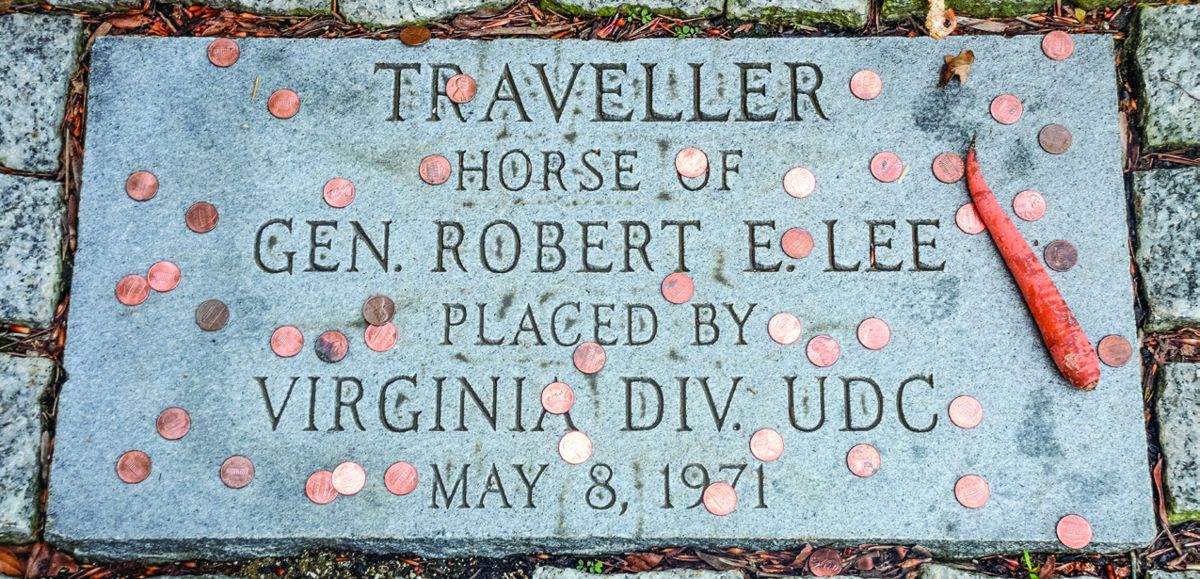
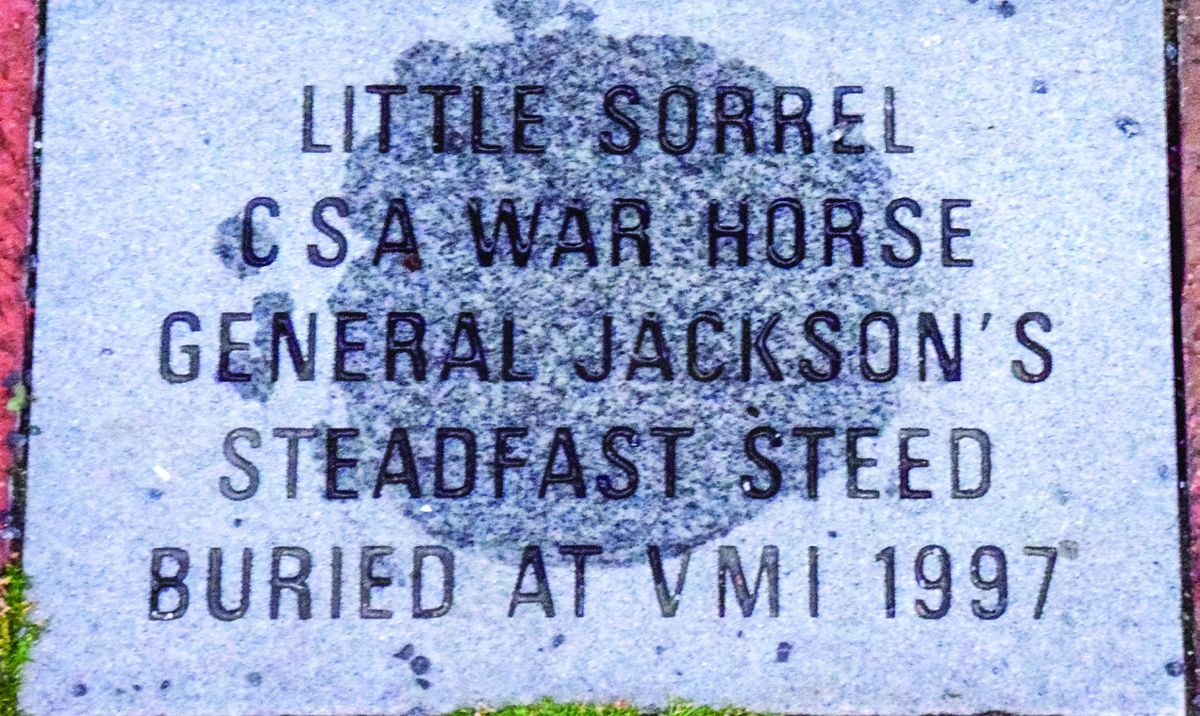
Lexington, Virginia, has all that remains of General Robert E. Lee. He is sealed in the crypt below Lee Chapel. Lexington also has most of what remains of General Stonewall Jackson – all but his arm – interred in Stonewall Jackson Memorial Cemetery. The remains of the Confederate generals’ favorite war horses also rest peacefully in Lexington. The bones of General Lee’s stalwart war horse, Traveller, are interred a few yards from his master’s crypt outside of Lee Chapel on the campus of Washington and Lee University. General Jackson’s war horse, Little Sorrel, has been immortalized on post at Virginia Military Institute. Little Sorrel’s cremated bones rest below the parade field and his mounted hide is on exhibit in the VMI Museum.
Little Sorrel’s head has been preserved and exhibited on a mold in the VMI Museum, not far from where the cremated ashes from his bones are buried on the parade ground at VMI. Both Lee Chapel and VMI average 40,000 to 45,000 visitors annually. While admirers of Lee and Jackson certainly account for the vast majority of the visitors, many callers also come to pay their respects to Traveller and Little Sorrel. There are a lot of queries from Lee Chapel visitors as to where Traveller is buried. Visitors don’t have to go far to satisfy their curiosity. “Traveller’s gravesite is right outside Lee Chapel’s museum doors,” said Margaret Samdahl, a former museum shop co-supervisor. “We have General Lee in the crypt and just a few feet away is his favorite warhorse, Traveller.” Traveller died the year after General Lee died. While romantics may love to think that Traveller, having lost his beloved master, died of a broken heart, that’s not the case.
This historic paver in downtown Lexington commemorates General Jackson’s horse – Little Sorrel. Originally, the gelding was named Fancy. (All phtoos Bob Ruegsegger)
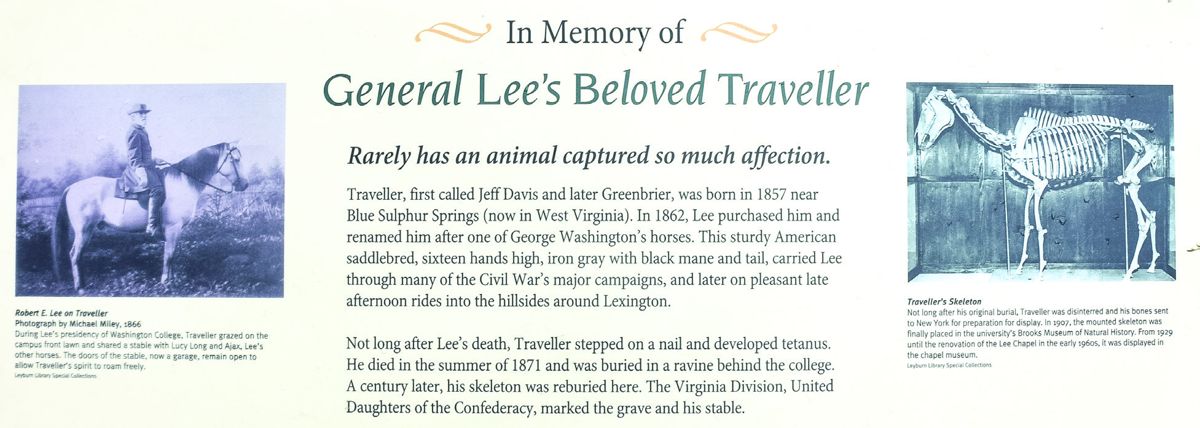
“Traveller, unfortunately, stepped on a rusty nail which caused what they said was lockjaw,” said Samdahl. “It is now known as tetanus.” Folks who visit often place a coin on Traveller’s grave – usually a penny. They place the coin on the grave and make a wish. Tradition has it that Washington and Lee students put a penny on Traveller’s grave for good luck on their exams. “One student came down just the other day and put a penny on Traveller’s grave. He said came down every day to put a penny on Traveller’s grave,” said Samdahl. “One year – I didn’t get a photo of this – a bride put her bouquet on Traveller’s grave. So Traveller’s very popular.” Often visitors leave treats on Traveller’s granite marker – apples, carrots, sugar cubes, peppermints. “Traveller is very generous because he shares his apples and carrots with the squirrels outside.,” observed Samdahl. “On the Lee family coat of arms, the crest is a squirrel, so we like to say that Traveller is sharing his bounty with the Lee squirrels.” When the Lee House was built, what now serves as the garage was originally Traveller’s stable. There was a covered walkway from the house to the stable. General Lee was fond of noting that he and Traveller were under one roof. According to local tradition, Traveller’s ghost was sighted running about the Washington College campus soon after he died. The stable doors – even today – are always left open – in case Traveller’s spirit wants to come back. Traveller was initially buried on school grounds. His remains were disinterred, and his skeleton was placed on exhibition. Students carved their initials in the skeleton for good luck. Traveller’s bones were so defaced with students’ initials that bones were placed in a protective case. “When he deteriorated further, they decided that he would be buried right where he is now. He’s right next to General Lee,” said Samdahl. “I like to say that Rome has Trevi Fountain, but we have Traveller’s grave.” Little Sorrel attracts his share of visitors on the parade field at VMI and in the VMI Museum on the lower levels of Jackson Memorial Hall. “It’s appropriate that Little Sorrel in his afterlife should return to VMI and be on exhibit in the VMI Museum,” said Colonel Keith Gibson, executive director of the VMI Museum System. “He lived at VMI during his lifetime in the postwar years after Jackson’s death.” Little Sorrell was returned to General Jackson’s widow. For a while, he lived near Charlotte, North Carolina and toured the country for a brief period. He also lived out on the VMI parade ground. Ultimately, Little Sorrell passed away at the Old Soldier’s Home, appropriately, in Richmond. “The process of mounting his hide would begin immediately by an eminent practitioner of that trade at the time – Frederick Webber,” said Gibson. “Little Sorrell would remain at the Old Soldiers Home until in fact it was discontinued right after World War II,” he noted. With the closing of the Old Soldiers Home, Little Sorrel needed a new home. VMI immediately came to mind. The relics of Jackson’s steed were brought to Lexington from Richmond and are enshrined at VMI since the 1940’s. “The connection between Little Sorrell and Stonewall Jackson and the museum goes back even before the Civil War,” said Colonel Gibson.
“The VMI Museum is the oldest public museum in Virginia, dating back to 1845,” he said. “Major Thomas Jackson himself was a visitor to the VMI Museum.” General Thomas “Stonewall” Jackson has become an integral part of the VMI Museum through items given by his family to VMI over the past century. Little Sorrel, the horse on which Jackson was mounted the night that he was critically wounded, is an important relic in the museum’s collection. Thousands of visitors make the pilgrimage to Lexington annually.
They solemnly visit the final resting places of Confederate heroes General Robert E. Lee and General Thomas “Stonewall” Jackson. It’s comforting for horse lovers to learn that Lexington has not forgotten the revered generals’ beloved equine companions. Note: For more information regarding Lee Chapel and Museum, see www.wlu.edu/lee-chapel-and-museum. For additional information regarding VMI and the VMI Museum System see www.vmi.edu/museum-and-archives.