1864 Confederate Disaster In Pennsylvania
By John A. Punola · Originally published September 2016 · pp. 20–21
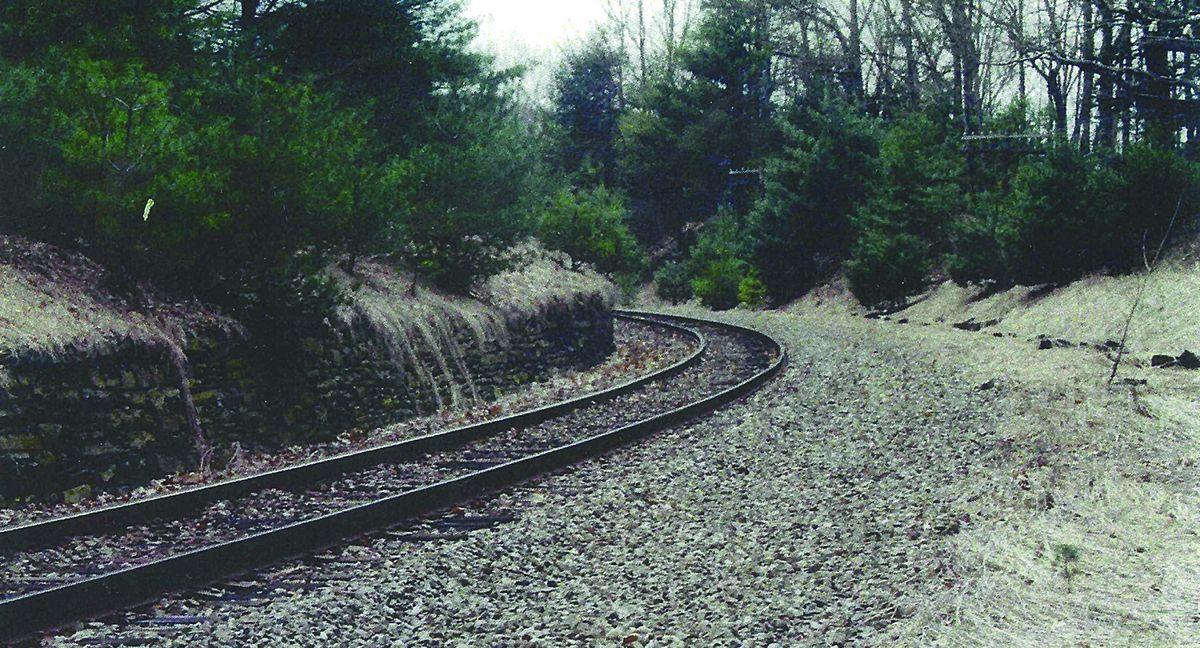
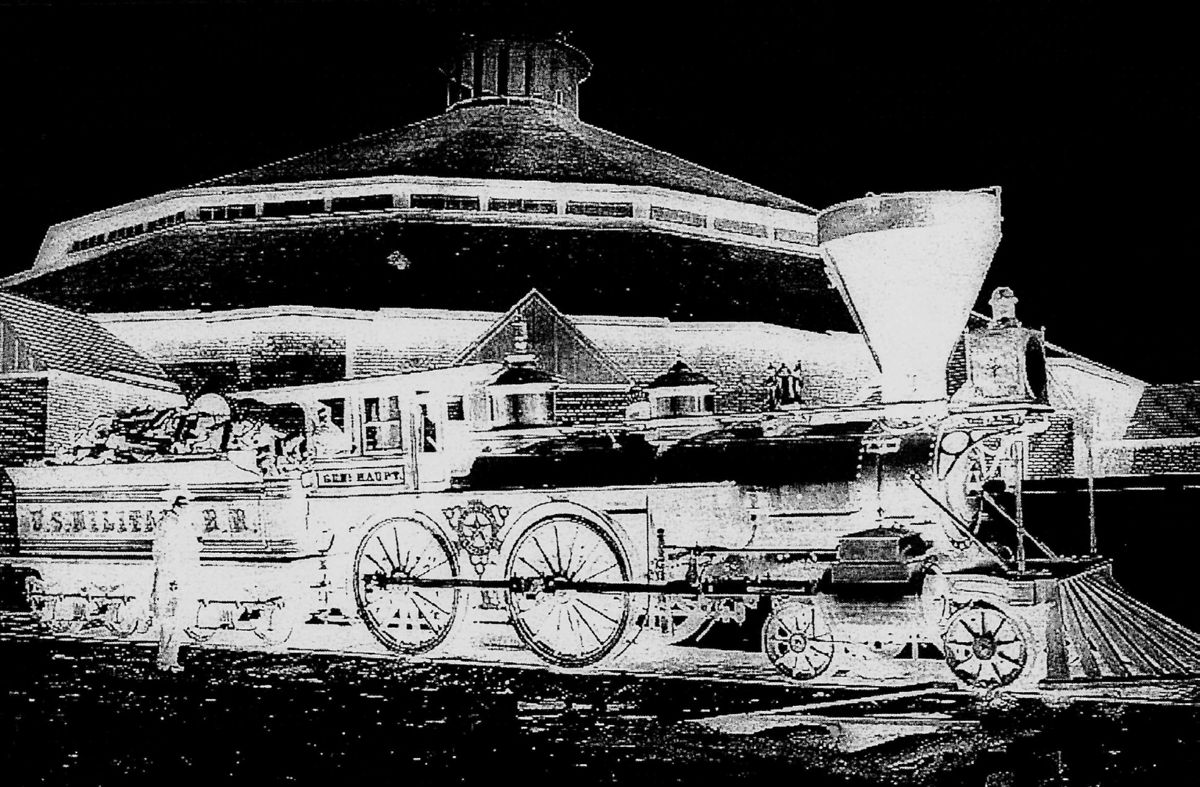
On July 15, 1864, a prisoner-of-war train destined the Union camp at Elmira, N.Y., was involved in a fatal head-on crash near the sleepy town of Shohola, Pa. The Collision on the Erie Railroad along the bank of the Delaware River was little noted but resulted in the deaths of a large number of Confederate prisoners and Union guards. A historian and writer from New Jersey learned of this tragic event and visited the site. It was then he found out about the two Confederate lads who died in the crash and were buried in a quiet, peaceful nearby cemetery. With a great deal of research, the facts were uncovered, and the long-hidden graves were found. As a result, the train wreck became a personal story about the two Johnsons, one from Anson County, North Carolina, and the other from Petersburg, Va. Both soldiers served in N.C. regiments, the 8th, and 31st. Once the Johnsons gravesites were located, my wife, Nancy and I assumed the role of caretakers and faithfully placed the Confederate flag on the grave sites before the July 15 anniversary date. The story begins in 1862, when it became apparent the war was going to last longer than anticipated, both sides were faced with the same problems, housing the increased number of prisoners. The Union and South decided to work out a prisoner exchange plan since neither Union or Southern officials expected a long war, and neither side had facilities to hold the large groups of men who surrendered. Prisoners were assembled, and as soon as possible, then the sides agreed on exchange arrangements. Prisoners who were exchanged were to return to their homes to became civilians. On July 22, 1862, Union Colonel John Dix met with Confederate Colonel Daniel Hill at Haxalls Landing, Va. After the meeting, they signed the prisoner exchange called the Dix-Hill Cartel. Under the terms, the exchanges would take place after a battle and could involve the transport of prisoners to a temporary holding camp. The Agreement stipulated the exchanged troops would be pardoned and eventually sent home, but they were not supposed to return to duty with their former units. From the beginning the agreement was flawed. Southern troops upon release, promptly headed back to join their units, while Union troops languished in local holding camps awaiting paperwork to send them home. The Union troops were content to sit out the war at home, whereas the Confederates remained loyal to their military obligations and were eager to serve. It was evident the idea of prisoner exchanges was eventually going to be terminated. The Dix-Hill Cartel remained in effect until April 17, 1863, when President Lincoln under the advice of Secretary of War, Edwin Stanton, canceled the plan. It was felt the war could end sooner if the Dix-Hill Cartel was rescinded, and it was terminated on that date. The end of prisoner exchanges signaled the beginning of severe overcrowding in both Union and Confederate camps. For the South, it posed a severe problem of feeding and caring for the large number of prisoners now coming in from recent battles. Andersonville, Ga. had the biggest problems. General Grant felt by holding large numbers of Confederates it would create a problem for General Lee to replace them. The Union promptly began a war of attrition. Grant felt the Union could afford to lose more men as casualties and prisoners than the South. Thus, the plan would hasten the end of the war. General Grant was correct that his war of attrition did indeed shorten the war, but at a terrible cost of killed, wounded and captured men. Lincoln also believed the South would not be able to sustain the duty of caring for and feeding the Union prisoners. Grant and Lincoln proved to be correct. As the war continued, the Confederacy made repeated pleas to reinstate the prisoner exchange, but Lincoln steadfastly refused. In the end, the total war concept did hasten the end of the war, but at a horrible cost in human lives, both military and civilian. During 1864 the Union army under General Grant went on a major offensive and waged a war of attrition in hopes of shortening the war. This action resulted in a high casualty rate plus a large number of prisoners taken by both armies. Neither side had sufficient prisoner camps to handle the high volume of prisoners. Despite constant requests by the South to resume the exchanges, the Union politely declined. The Union camp at Elmira, N.Y. had been converted from a former induction center and the flow of Confederate prisoners began to that camp commenced in July 1864. Recent heavy fighting at the battle of Cold Harbor, Va. killed a huge number of Union soldiers, but a large number of Confederates were taken prisoner. The Confederates, mostly new recruits, were destined for delivery to the new Elmira, N.Y. camp, traveling via rail from Maryland to Harrisburg, Pa., then to Jersey City, N.J. and finally to Elmira, N.Y. The prisoner of war train arrived Jersey City, the morning, July 15, 1864, where they were transferred to the Erie Railroad, destined Port Jervis, N.Y., the final stop, Elmira, N.Y. Because of a faulty drawbridge, there was a four-hour delay in departure, and the train was four hours behind schedule when it arrived in Port Jervis, N.Y. On that sunny day of July 15, 1864, the locomotive 171 departed at 1 P.M. to deliver the prisoners to the camp at Elmira, N.Y. This train consisted of 17 cars, a mix of passenger and freight cars, plus locomotive and caboose. Union guards were stationed at each end of the cars. It appeared to be a routine trip. Locomotive 171 moved along at an average speed of 20 MPH along the single track and was designated as a special extra, running behind the regular Train 23 which displayed warning flags giving the right of way to Locomotive 171 and its load of Confederates. Every detail was planned and it looked like a typical, steady ride to Elmira, N.Y. The single trackage contained sharp curves and ran along the Delaware River. Ahead at Lackawaxen, Pa. there was a junction with the Hawley branch, a spur line connection to Honesdale, Pa. At this junction was a telegraph operator named Douglas “Duff” Kent. Kent noted West 23 train passing by, headed west with the warning flags indicating an extra train was following close behind, which was standard procedure. At approximately 2:30 P.M., coal train Erie 237, arrived at the Lackawaxen Junction pulling 50 cars laden with coal from Hawley, Pa, destined Jersey City, NJ. Kent mistakenly gave the all clear sign and the switch was thrown. The Erie coal train then sped Eastward for its fateful head on collision with the trainload of Confederate prisoners. The trains collided at the “King and Fuller’s Cut”. This section of track followed a blind curve where only 50 ft. of forward visibility was possible. The collision was a scene of horror, death and destruction. Union guards and Confederates alike died, and both groups were hastily buried on the spot in a shallow grave between the Erie track and the Delaware River. The Confederates were buried four per casket, which were crudely constructed with wood from the wreckage. Coffins arrived the following morning, one casket for each 17 dead Union guards. Overall, 48 Confederates perished in the wreck. The remaining prisoners were taken to Shohola, Pa. and housed in local railroad buildings. The wounded were taken to homes of local citizens for care and medical attention. Two of the prisoners, John Johnson and Michael Johnson (no relation) were taken in by the
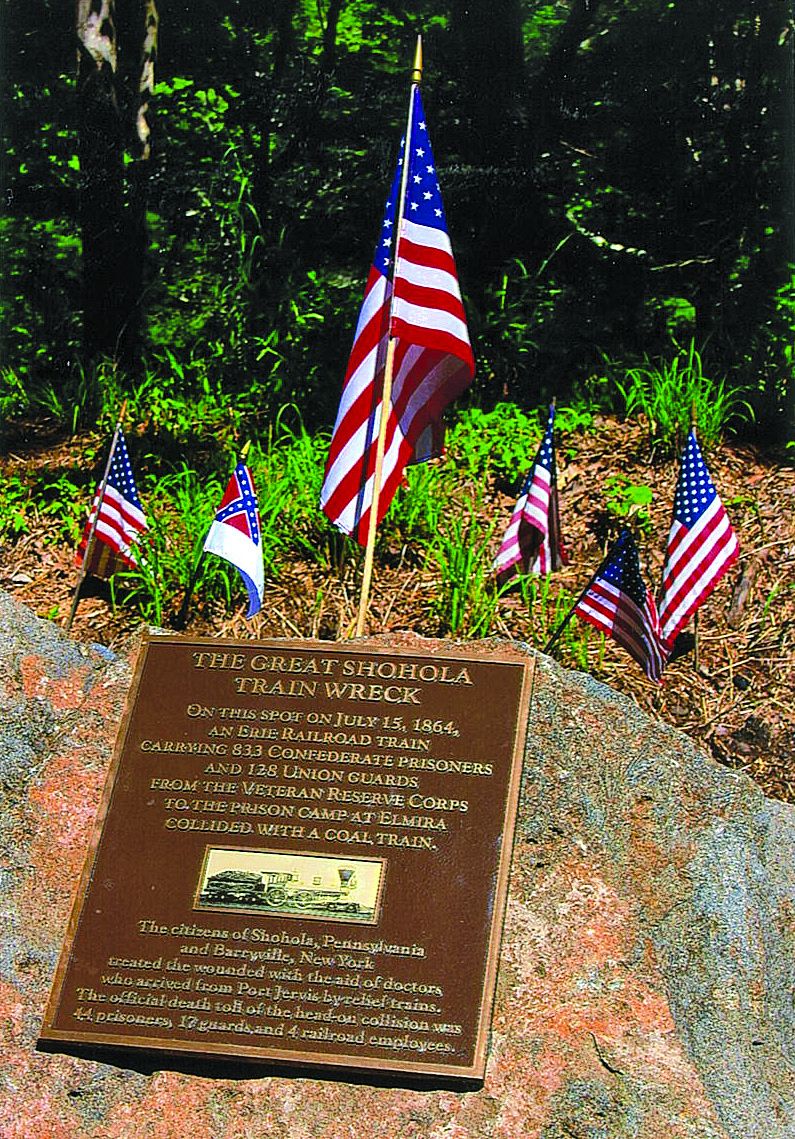
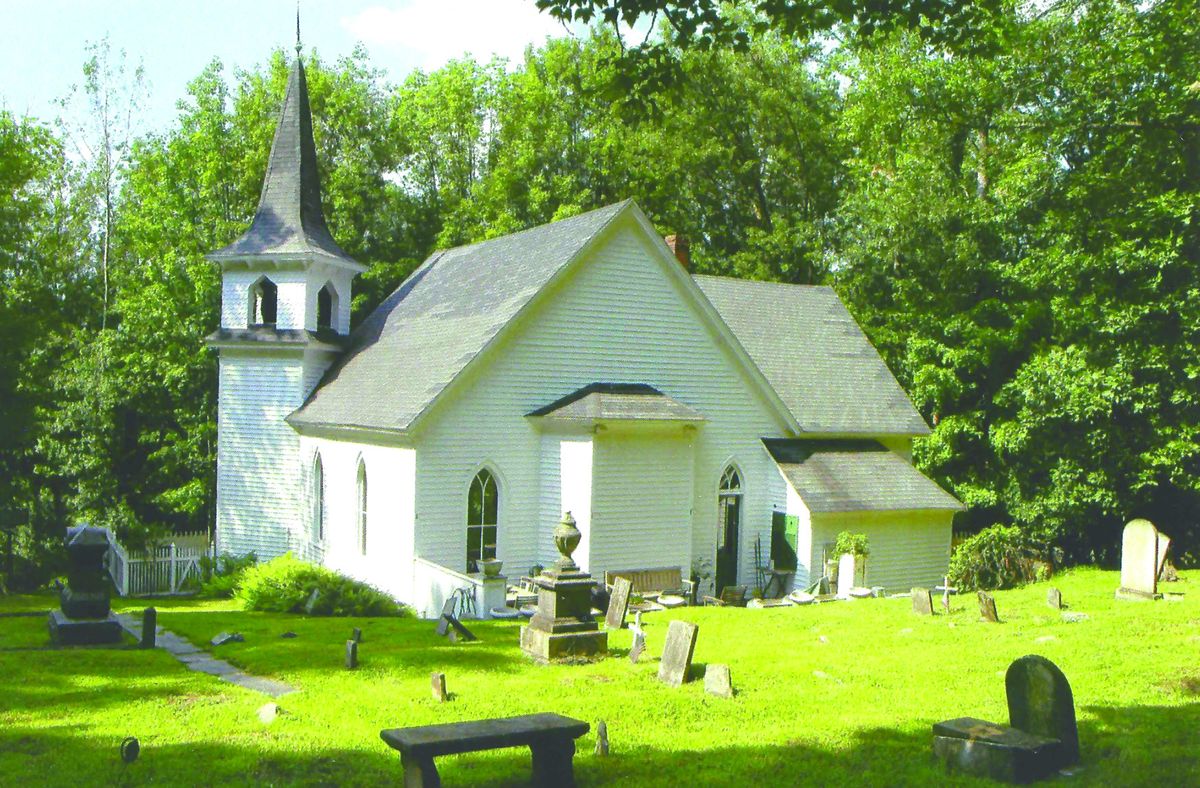
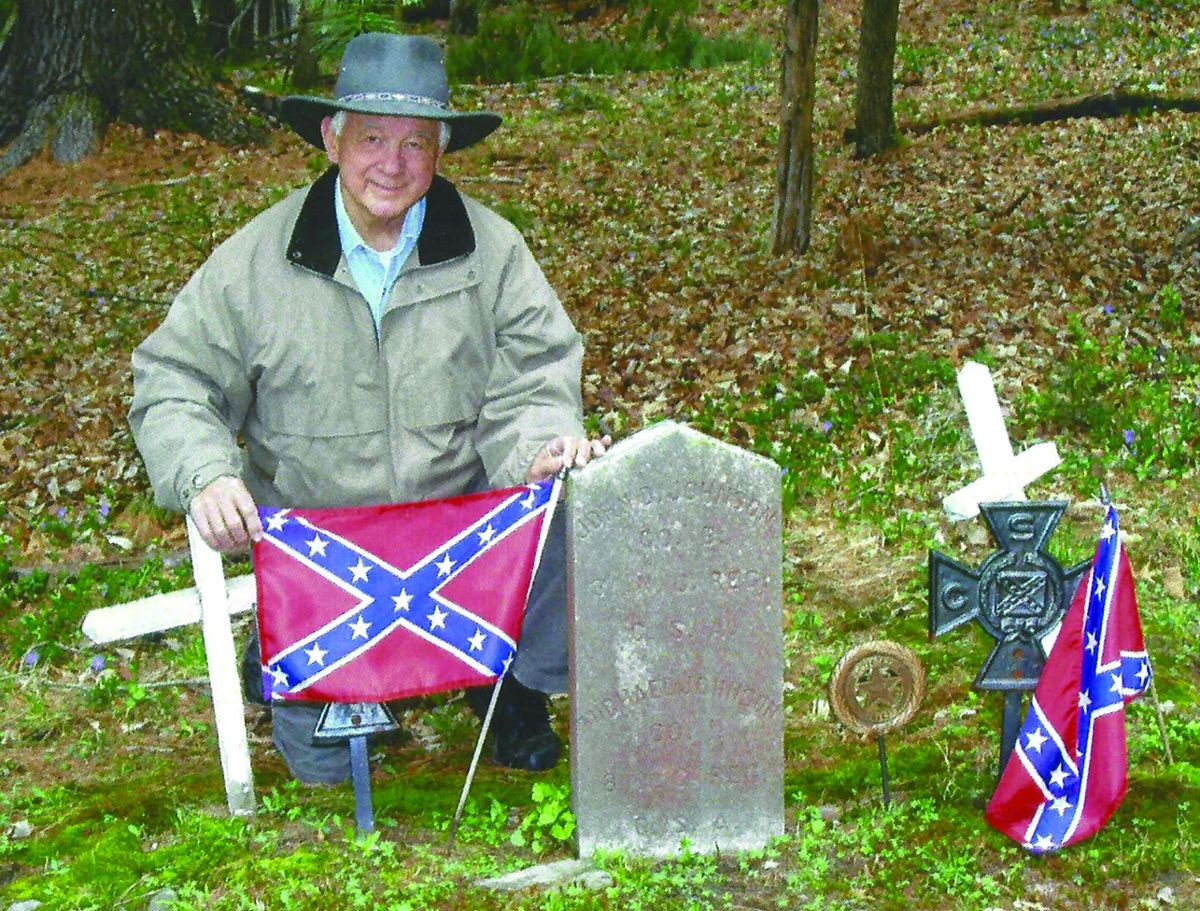
Hickock family. Although both soldiers were well cared for, both died overnight from severe wounds. It was said that the Hickocks likened the young Confederate soldiers to their sons in the Union army, and decided to give them a Christian burial. The two bodies were taken across the Delaware River to the Congregational Church in Barryville, N.Y. They were buried in unmarked graves so the Union guards would not find them. Later when Union officers came to take the Johnsons, they demanded to know the location of the graves and the Hickocks refused to divulge the burial site. Despite many years of visits from Union officials, the Hickocks never revealed the location of the graves. Once the persistent Union officers stopped their inquiry, a single stone grave marker was erected, which is still in good condition today. Five Confederate prisoners managed to escape during the early hours of the wreck. Despite extensive time spent to hunt them down, they were never found having simply melted into the countryside. It is assumed they split, quickly departing the scene, and probably found jobs in nearby factories or coal mines. There were rumors of occasional sightings of strangers in the area, although none were ever apprehended or turned in by the locals. On June 11, 1911, the guards and prisoners buried at the scene of the crash were disinterred and taken to the cemetery at Elmira Woodlawn National Cemetery. A single monument marks the burial site, and the single monument contains two bronze plaques, one facing North for the Union troops and one facing South for the Confederates. Regarding the two Johnsons still buried at the small cemetery at Barryville, N.Y., they are visited each year on or close to the July 15 anniversary date. There is a brief ceremony at the gravesites with both Union and Confederate reenactors present, and occasionally, ancestors of the Johnson boys have journeyed from North Carolina to participate in the yearly ceremonies, but not every year. Except for the Confederate invasion of Southeastern Pennsylvania by General Robert E. Lee in late June 1863, the entire war between the states was fought in Southern territory. The train wreck location in the tiny town of Shohola, Pa. is a site of A nice monument was placed at Shohola, Pa., marking the location of the train wreck on Erie Railroad that killed a large number of Confederate prisoners, Union guards and railroad employees, back on July 15, 1864, compliments of Norfolk Southern Railway, who currently is the owner of the trackage. historical importance, located deep in Union territory, and is a Civil War war event location handy to visitors and historians. When we learned about the two young Confederates buried in the nearby country cemetery, we set out to find the exact locations. This proved to be a real challenge since the original Congregational Church had been abandoned for decades. In fact, the Barryville, N.Y. post office could not tell us its location. Finally, we visited with the very old United Methodist Church in Barryville, N.Y. While talking to some ladies there we asked about their knowledge of the former, old, Congregational Church, and one of them told pointed to a structure hidden behind trees on a gentle hill. We walked to the old building and right behind it was the old cemetery. After a close search of the grounds, we found the Johnsons buried under shade trees along the North edge of the cemetery. My wife Nancy suggested we pay respect to the young Confederates and decided to mark the gravesite with Confederate battle flags. A single marker placed by a Southern veterans group was the identity marker that led us to the graves. After the end of the Civil War, it was the policy of the South to return all soldiers buried in the North to their home state. The descendants of the Johnsons chose to let the two soldiers rest in peace in far away Barryville, N.Y. satisfied they received Christian burials. Days later, we purchased a dozen Confederate flags and placed two of them at the gravesite. We kept the remaining flags in reserve and every time we are in the area we plant new flags. We have been doing this for the past eight years and will continue to honored caretakers of the gravesites as long as possible. I am pleased to say no person has taken or damaged the flags, and on several visits, we were happy to see that an American flag was also placed alongside the Confederate flags. As for the location of the crash site, the Erie Railroad is only a footnote in history, the present railroad is owned and operated by the Norfolk Southern Railroad, of Norfolk, Va. The crash site is on private property belonging to Robert & Patricia Jeffer and is one mile west of the town of Shohola, Penn. The Jeffer family say a Norfolk Southern Railroad official recently visited the crash site and a short time later, without ceremony or fanfare, a monument was erected marking the impact site. This monument was a welcome gesture and peacefully closes the final chapter of the historic Civil War event that happened in the peaceful town of Shohola, Pa. When you look down from the crash site, your eyes will follow the flow of the Delaware River. The site itself is enchanting and tranquil, and the townspeople are charming. Every July there is a lavish Civil War gathering at the old cemetery to honor the two Johnson boys, plus other Civil War soldiers. The tiny cemetery contains graves of Union soldiers plus graves honoring soldiers who died in local battles of wars waged along the Delaware River. You can contact the Shohola, Pa. Historical Society for time and date of the event. There is always a good number of reenactors and soldiers are at the gathering. The Shohola Historical Society will also help you with directions, etc. You can find out more information at http:// shoholatwp.org/event/shohola-railroad-historical-society-meeting