Inspection, ARMS!
The Confederate Kerr Revolver
By Tim Prince · Originally published October 2016 · pp. 12–13
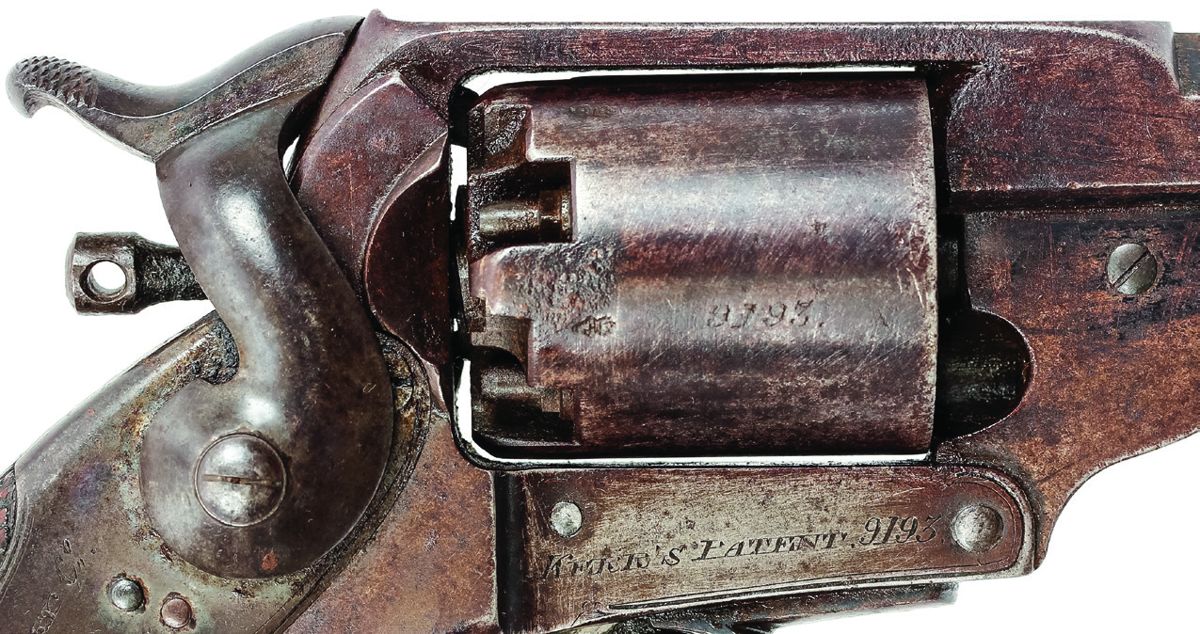
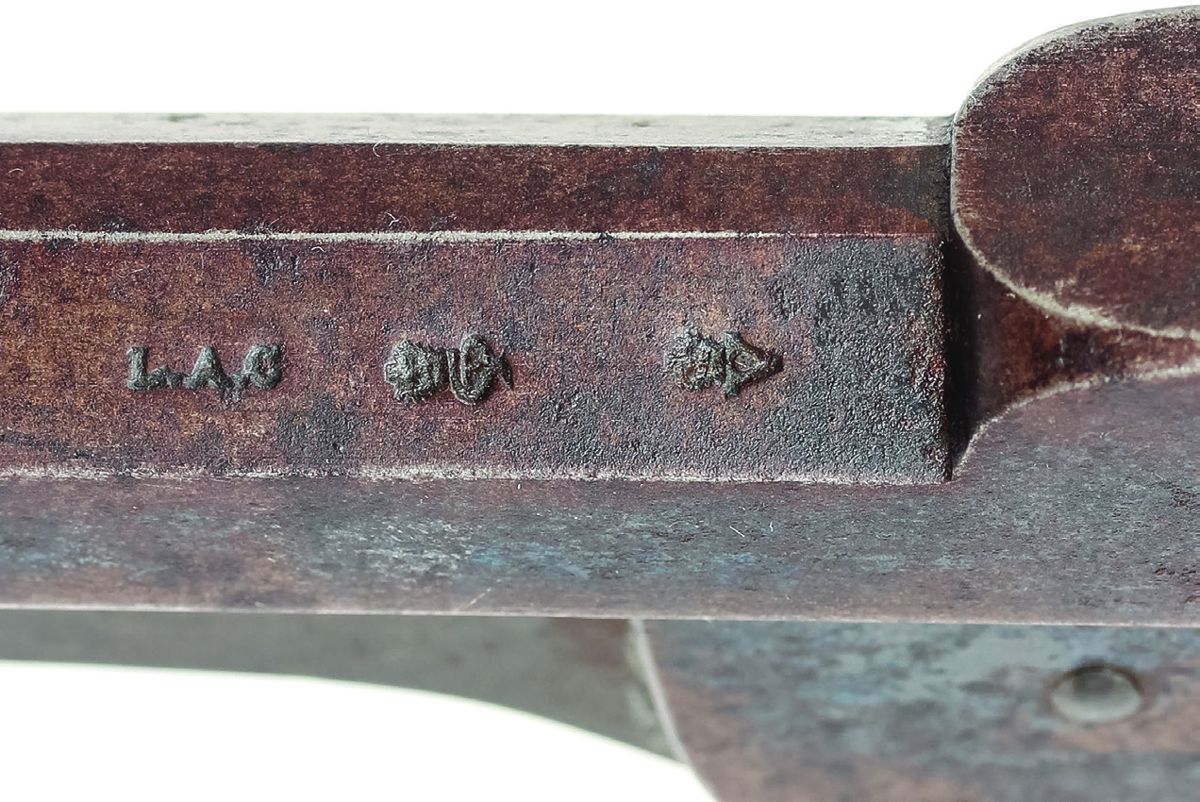
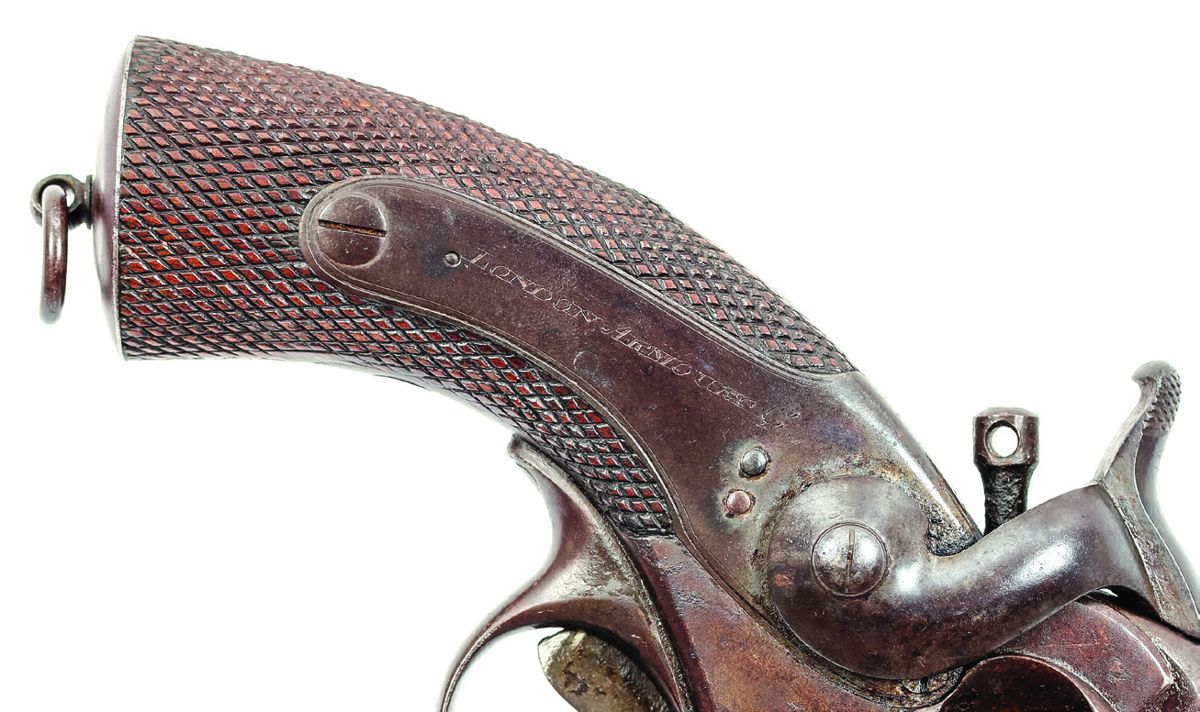
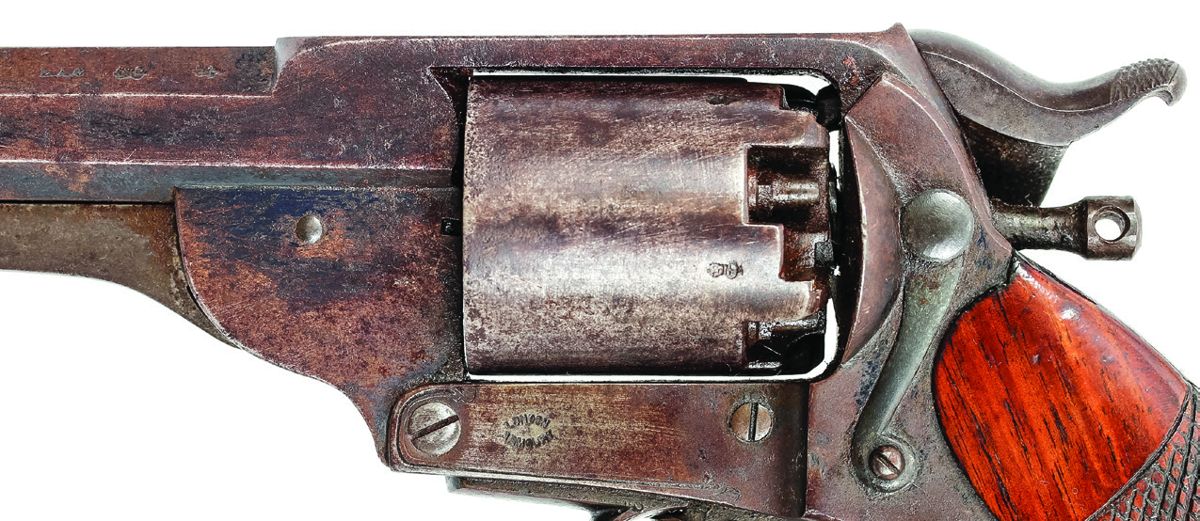
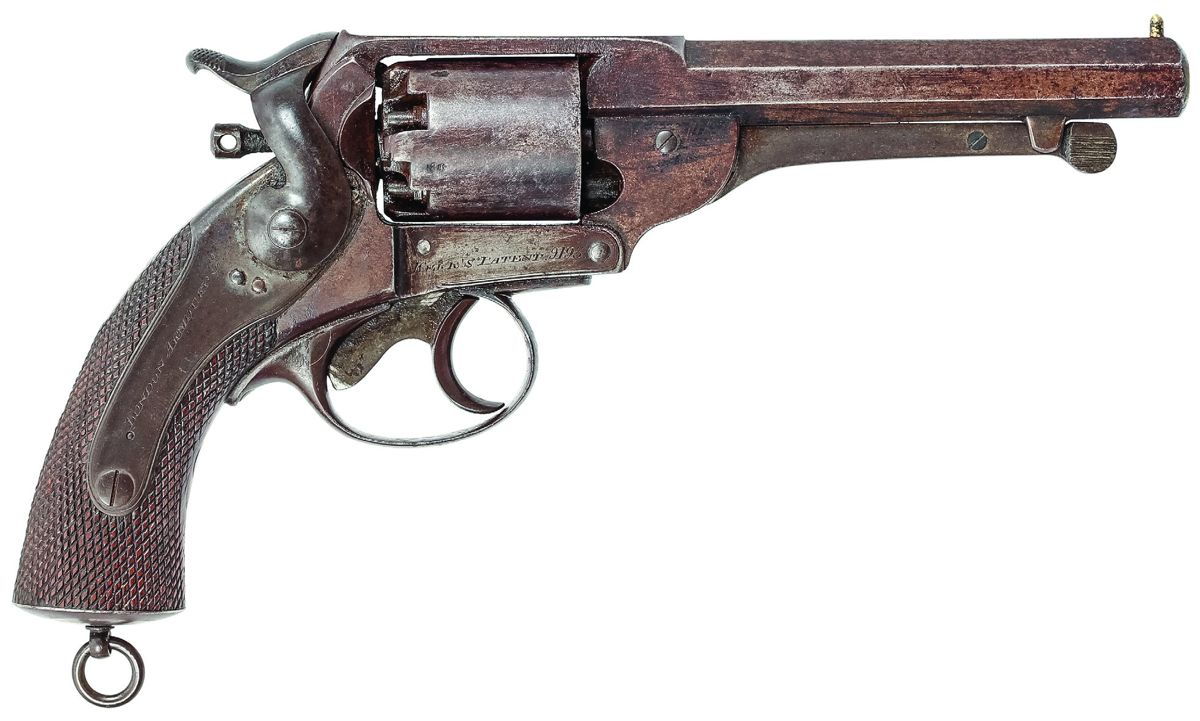
Last month we discussed the Confederate use of English made Tranter revolvers, this month we turn our attention to the English revolver that was most used by the Confederacy. The Kerr’s Patent Revolver, as produced by the London Armoury Company, is one of the most distinctive and recognizable of all Civil War era handguns. The side mounted hammer and removable side plate were not common features in large bore handguns of the era and the result is a unique and easily identifiable silhouette. The design also made the revolver easy for gunsmiths and armorers to work on in the field. The Kerr patent revolver was invented by James Kerr, who was awarded two patents for improvements to Roberts Adams earlier revolver design. Kerr had been a founding member of the London Armoury Company, which was established on February 9, 1856, and of which Robert Adams was the Managing Director during the late 1850s. It is interesting to note that Kerr was Adams’ cousin and had previously worked with him at Deane, Adams & Deane during the early days of Adams and Beaumont-Adams revolver production. Initially the London Armoury Company (LAC) had focused on producing Model 1854 Beaumont-Adams patent revolvers with an eye towards obtaining lucrative English military contracts. However, when significant orders were not forthcoming, the company shifted its focus to the manufacture of British Pattern 1853 “Enfield” rifle muskets for both the English government and private sale. This caused a rift within the company management that culminated with the departure of Adams from L.A.C. and the elevation of Kerr to the position of factory superintendent. With the departure of Adams, and the perceived need to continue to offer some form of revolver for sale, the company purchased the rights to Kerr’s design. Production commenced in the first quarter of 1859, with the first pistol completed in March of that year. The gun was subsequently tested at the Royal Small Arms Factory at Enfield Lock on April 25, 1859. The pistol was typical of large bore English percussion handguns of the era, in that it the standard offering was 54-Bore (about .442 caliber), and had a 5-shot cylinder. The gun was manufactured with an octagonal barrel that was nominally about 5 ½” in length. However, based upon examination of numerous extant examples, the barrels appear to have varied slightly lengths from about 5 5/8” to 5 ¾”. Although the large majority of the pistols produced were in 54Bore, a small number of very early and very late production pistols were manufactured in 80-Bore (approximately .387 caliber). The majority of the pistols used a single action mechanism, not a double action mechanism as the trigger position would lead the casual observer to believe. The hammer could only be cocked by pulling it back manually, but pulling the trigger could rotate the cylinder. This was a byproduct of the cylinder locking system, which relied upon a pivoting arm that was actuated by the trigger. This arm locked the cylinder in place when the gun was fired. This was very different from the standard spring-loaded cylinder stop found in the frames of most American made revolvers of the period. This system also eliminated the need to machine stop slots in the side of the cylinder, as the rear face of cylinder was where the arm locked it into position. Only a handful of Kerr revolvers were manufactured as “self-cocking” (double action) revolvers, and they are very rare today. The Kerr also featured a unique, frame mounted cylinder arbor that was removed from the rear of the pistol, much like the arbor pin used on the Colt side hammer (aka “Root” designs). Most revolver designs of the era utilized a fixed cylinder arbor, or an arbor pin that was withdrawn from the front of the frame. The rear mounted arbor pin made the pistol easier and safer to manipulate when the cylinder had to be removed from the pistol. The early production Kerr revolvers had a small setscrew on the left side of the frame, forward of the cylinder that prevented the cylinder arbor pin from being withdrawn from the rear of the frame. The later production revolvers had a frame mounted spring on the lefts side, similar in appearance to the M-1851 Adams patent safety, which retained the arbor pin. Early production revolvers had a wide groove machined in the topstrap, while the later production guns had a flat topstrap without a groove. The early guns also had a loading lever that pivoted on a screw located at the lower front edge of the frame, under the barrel. The later production guns moved this pivot point higher and closer to the cylinder, making it somewhat stronger and allowing more torque to be applied to the lever when loading tight fitting ammunition. Most of these early features are phased out in the upper 2,XXX to middle 3,XXX serial number range, although some of the features appear somewhat randomly through about the middle of revolver production, suggesting that sometimes older parts were used to complete orders when time was of the essence. Standard markings were “Kerr’s Patent” on the lower right side of the frame, followed by a serial number. The same number was engraved on the cylinder as well. Separate assembly numbers (not related to the patent tracking serial number) were usually stamped on the various parts, including the inside of the frame, the rear face of the cylinder, inside the trigger guard, etc. The lock plate was engraved either “LONDON ARMOURY” or “LONDON ARMOURY Co”, with the former being more commonly encountered on guns in the first third of production and the latter more commonly found in the last two-thirds of production. The lower left side of the frame was also stamped with a arched, two line “cartouche” that read “LONDON / ARMORY”. The upper left angled
Pattern 1853 Enfield Rifle Muskets during the same time frame. The estimate regarding revolver production is based upon the extant examples with Confederate provenance or acceptance marks, which tend to exist primarily in the 1,500 to about the 10,000 serial number range (although a handful of legitimate CS inspected Kerr’s do exist in the 7XX to 1,5XX range). To date, at least three separate Confederate government contracts have been identified for the purchase of Kerr revolvers. Two were army contracts, and one was a 1,000-gun contract for the Confederate Navy. The Naval contract was quite early, as reference to the purchase of Kerr revolvers by Confederate States Navy Commander James D. Bulloch was made in a diary entry by Confederate purchasing agent Major Edward Anderson dated August 6, 1861. Many of the army contract Kerr revolvers were financed through the Charleston, SC based firm of Fraser, Trenholm & Company and delivered by their subsidiary John Fraser & Company. A minimum of 3,160 Kerr revolvers were delivered directly to Confederate arsenals by Fraser. In addition to these three government contracts that have been positively identified, an unknown number of Kerr’s Patent revolvers were acquired speculatively for sale privately and to the Confederate military once they reached the south. This may account for the number of Kerr revolvers that exist
Confederate inspected Kerr revolver serial number 9193, less than 100 number from the lowest numbered Kerr on the Pratt Roll. flat of the barrel was stamped with London commercial proof and view marks (a Crown/GP and Crown/V) and usually with the initials of the London Armory Company, L.A.C. London commercial view and proof marks were also stamped on the cylinder between the chambers. Although the design was reliable and fairly robust, the London Armoury Company did not find any British military contracts forthcoming for their pistol. Between the introduction of the Kerr revolver in early 1859, and the beginning of the American Civil War in 1861, only about 1,000-1,500 of the revolvers were manufactured, and even fewer were sold. Most of these pistols were sold commercially (both in Great Britain and in the U.S.), with about 100 of them being purchased by an English Volunteer unit; The 1st Sussex Artillery Volunteers. With the outbreak of the American Civil War, Caleb Huse (the South’s primary purchasing agent in England) engaged the London Armory Company to produce all of the Kerr’s Patent revolvers that they could for delivery to the Confederacy. It is believed that nearly all of the L.A.C.’s output of Kerr revolvers from April of 1861 through the close of the Civil War were produced under various Confederate contracts, with about 9,000 pistols produced and shipped to the south during that time. It is also estimated that the London Armoury Company produced about 70,000
Lock marking on Kerr #9391, with the later style LONDON ARMOURY Co marking.