
Farrell’s Civil War Veteran’s Listings Of Suffolk County
By Bill Bleyer · Originally published October 2016 · p. 20
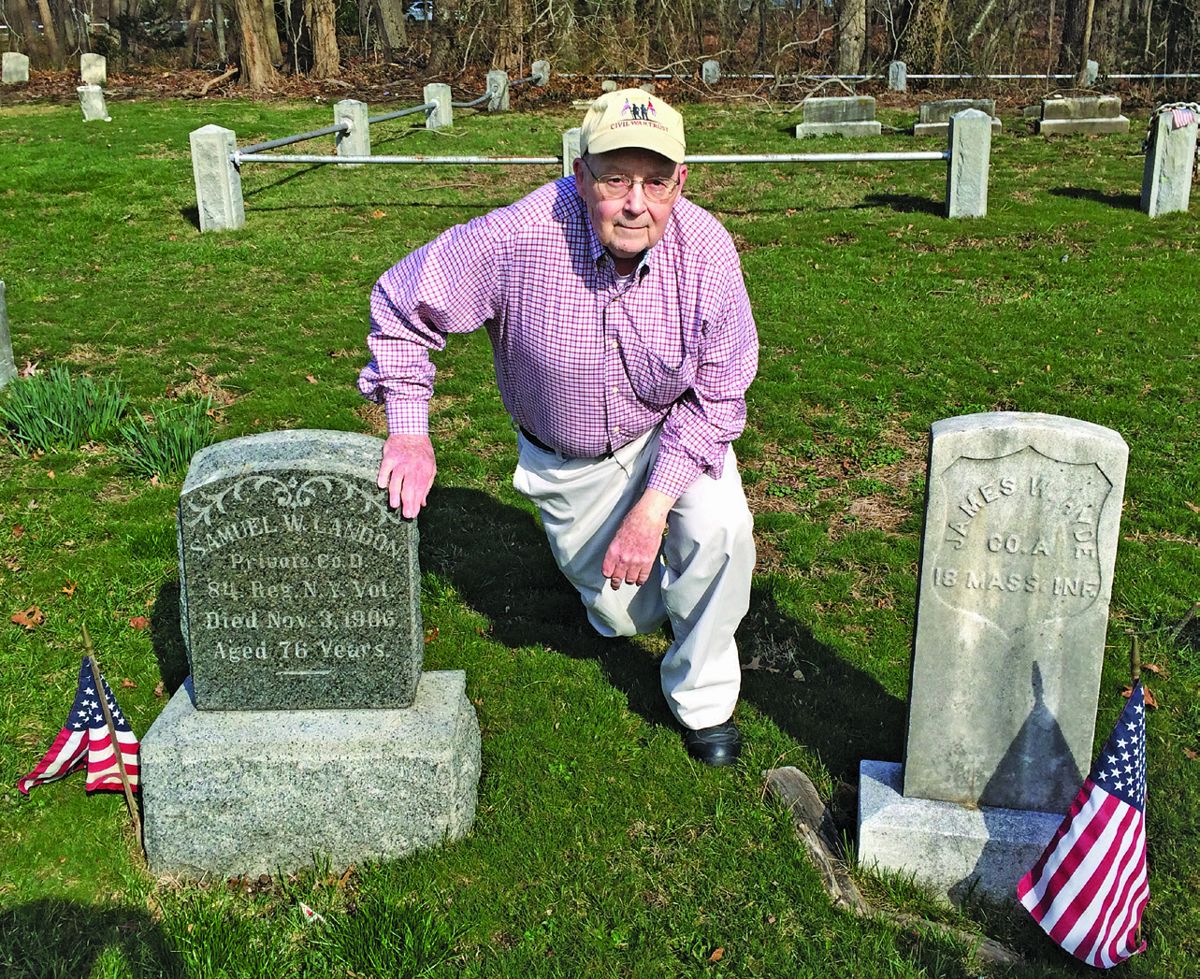
Because retired aerospace executive Robert Farrell was bored in retirement, historians and genealogists are getting what they have long coveted: a list of all the Civil War soldiers with a Long Island connection. Farrell started the project on a limited basis in 2004, thinking it would only take a short time. But he has expanded the scope twice, so he’s still at work a dozen years later. The 81-year-old resident of Huntington, Long Island, was a Grumman Aerospace Corp. subcontract manager for 26 years before retiring two decades ago. “When I retired I did all the things that people usually do when they’re first retired,” he said. “I don’t play golf. I was just getting bored doing nothing.” So Farrell decided to list all of the Civil War veterans who had lived in his town, Huntington, which at the time included what is now Babylon, the town to the south, or were buried there. When he finished that, boredom returned so he decided to expand his list of all of Suffolk County. Having finished that task last year, he has now undertaken Nassau. So far he has identified more than 5,500 soldiers.
“It’s a tremendous resource for military historians and genealogists and all sorts of other uses,” said Courtney Burns, director of military history at the New York State Military Museum and Veterans Research Center in Saratoga Springs. Farrell’s endeavor had its roots when he was traveling to visit his son in college in Emmitsburg, Maryland, six miles south of Gettysburg. “Every time we would go to visit him we would end up taking the battlefield tours,” he said. That led to reading books about the war, and “I started to understand it and realize just how important it was to American history.” “I find that the Civil War hasn’t ended,” he continued. “I’m interested in people. Other people search the Civil War for this battle or that battle. I’m interested in the people. It’s the people who did the fighting; it’s the people who made the country. I want to honor the ordinary soldier, because I was an ordinary soldier myself.” He was a private first class in the Army from 1955 to 1957 serving with an anti-aircraft battery at Fort Wadsworth in Staten Island. Farrell’s growing interest in the seminal conflict led him to join the
North Shore Civil War Roundtable, which presents monthly speakers. A 2004 Roundtable lecture by James Haas, author of “The Gunner at His Piece,” about the Civil War soldiers from College Point, Queens, proved to be an inspiration for the bored retiree. “I said to myself ‘Maybe I’ll do the same thing.’ I was looking for a hobby. And I had picked up a good number of skills doing a family genealogy, and I realized they were the same set of skills I would need to search for the Civil War veterans. It ballooned and ballooned to the point where I found 1,500 people between Huntington and what is now Babylon, which was part of Huntington until 1873.” Farrell published the results in a 2007 paperback book: Our Veterans Brave and Noble. While researching the Huntington and Babylon veterans Farrell came across many others who lived elsewhere in Suffolk. “I continued to just make a list of them,” he said. “I came up with almost 3,500 people in Suffolk County. I got bored again and decided ‘I’ll do Nassau’ because I had picked up a few people from Nassau because I found Suffolk guys buried in Nassau. So far I’ve got (Bill Bleyer) more than 2,000 people from Nassau using the same type of resources.” The researcher relies on post-Civil War books, websites like findagrave. com and data sheets from the state Archives. He also has friends go through cemeteries jotting down the name on any grave that indicates Civil War service for Farrell to research. Many of the soldiers Farrell identified are buried locally, but he tracked one to Anaheim Cemetery in California and another in a national cemetery in Milwaukee. Farrell’s approach can lead to overestimation of Long Islanders’ contribution to the war, he and Civil War historian Harrison Hunt agree. Hunt, a former supervisor with the Nassau County Museum system who has studied the Civil War on the Island for more than two decades, said while “a master list [of soldiers from Long Island] is something that Civil War buffs and local historians have been asking about for years, the approach that he is taking is very broad.” He pointed out some of the men included by Farrell were carried on town records to meet enlistment quotas but were residents of Brooklyn or other areas who had been paid a bounty to serve as substitutes. Hunt estimates the actual number of Long Islanders who fought to be between 3,000 and 3,500. In his research, Farrell said he has found some “somewhat famous people nobody knows about.” These include Charles A. Abbey, who served with the Revenue Marine, the predecessor of the Coast Guard, and was in charge of all the life-saving stations in the country after the war. Then there is Regis deTrobriand, the only French general in the war. He lived in Bayport and is buried in the cemetery of St. Ann’s Episcopal Church in Sayville. Farrell’s favorite Long Islander in the war is Fred Mather, who served in the Seventh New York Heavy Artillery Regiment before becoming an officer with the 24th United States Colored Troops Regiment, an all-black unit with white officers formed after the Emancipation
Proclamation. “At the siege of Petersburg, Fred gets captured and they take his sword away, and he knows his sword is given to Brewster Foster of a Mississippi regiment. In 1889, Brewster Foster dies and he reads about. He writes a letter to the widow expressing his condolences. And sometime later she sends him back to the sword with a note that basically says ‘I never wanted that damn Yankee sword in my house.’ He wears it in the 1890 Memorial Day parade in Huntington.” Mather was the first superintendent of the Cold Spring Harbor Fish Hatchery and introduced brown trout to American fishing streams after getting the roe from a German baron, he said. “There are all kinds of people that we never think of it never knew about,” Farrell continued. “Jacqueline Kennedy Onassis’ grandfather, John Vernon Bouvier, is buried out in the Hamptons.” Bouvier served as a captain in the 80th New York Infantry. He died January 2, 1926, and is buried in Most Holy Trinity Cemetery in East Hampton. Farrell says he devotes up to 20 hours a week on his project. Most of the time he works in his office filled with files and books on the second floor of the home he shares with his wife of 54 years, Barbara, on Sherman Street. It’s named after Civil War Gen. William T. Sherman. While his favorite is George Thomas, who saved the Union Army from disaster at Chickamauga in Georgia, “Sherman is a close second,” he said. The results of Farrell’s research are already available on two genealogy websites: Italiangen.org and Germangenealogygroup.com. By year’s end, his listings will also be on the state military museum and North Shore Civil War Roundtable websites. He also uses the material he finds to write a “Long Island Veterans Remembered” column in the Drumroll, the newsletter of the North Shore Civil War Roundtable. When he finishes Nassau in the coming months, Farrell said his research won’t end. “I’ll probably go back to doing my own family tree genealogy, which needs some more work.”