
Through The Lens
Telegraph Men
By Stephanie Hagiwara · Originally published November 2016 · p. 5
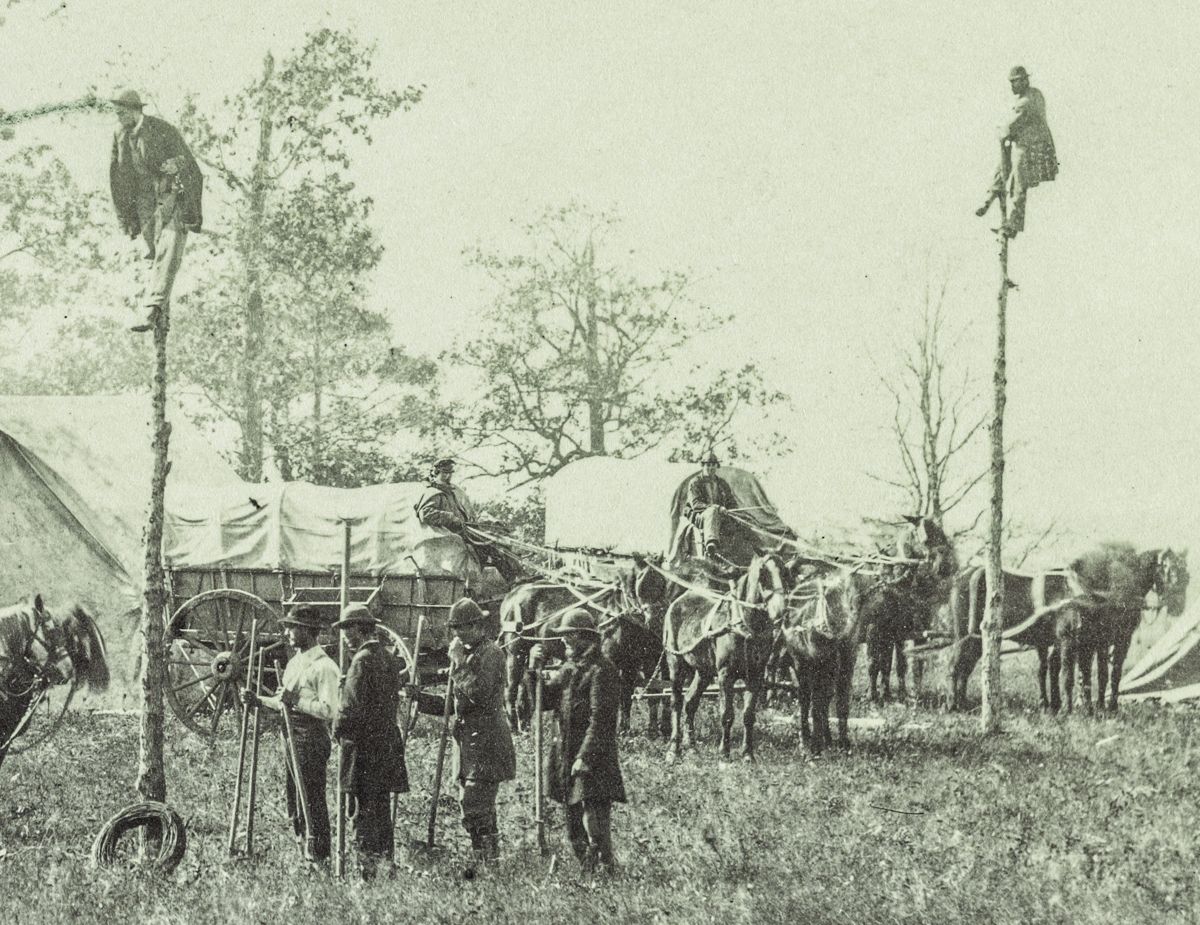
Let the telegraphers through; They’ll get us into a fight, And out of it, too.” Soldiers rhyme Both Abraham Lincoln and Jefferson Davis shared the problem of how to influence battle strategy. Before the Civil War, due to slow communication over distance, generals had a free hand to fight battles as they saw fit. Real-time communication via the telegraph was a game changer. Secretary of War Edwin Stanton referred to the military telegraph as his “right arm.” Gen. Ulysses Grant recalled that he “held frequent conversations over the wires” sometimes lasting two hours with Stanton. Lincoln would spend his days in the War Department reading all the messages, keeping on top of what was happening around the country, both on and off the battlefield. In the last half of 1861, Lincoln sent 13 telegrams. By May of 1862, he would be sending to various generals “from one to a dozen on nearly every succeeding day for months.” Early in the War, the joint military/ civilian hybrid, U.S. Military Telegraph Corps (USMT) was created to supply telegraph operators and to build lines into the battle zone. “From May 1, 1861, to June 30, 1865, the USMT handled some 6.5 million messages at a total cost (for construction, repair, and operation of the network) of $2,655, 000”. Along with using civilian lines, the USMT built 15,000 miles of line, sometimes under enemy fire. The telegraph construction “corps was composed of about one hundred and fifty men, with an outfit of wagons, tents, pack-mules, and paraphernalia. … “The large wire was wound on reels and placed in wagons, which drove along the route where the wire was to be erected. The men followed, putting up the wire as rapidly as it was unreeled. So expert were the linemen that the work seldom became disarranged. … As it was intended only for temporary use, the poles were not required to be very substantial, and could usually be found in the wooded Virginia country near the proposed route. The immense labor required in such construction led to the adoption of insulated wire, which could be strung very quickly. A coil of the latter was placed on a mule’s back and the animal led straight forward without halting. While the wire unreeled, two men followed and hung up the line on the fences and bushes, where it would not be run over.” In the field, “no orders had to be given to establish the telegraph,” wrote Grant. “The moment troops were in position to go into camp, the men would put up their wires.” In the midst of battle, telegrams were not only sent to Washington. The generals would be giving real-time updates to each other via telegraph.
Gen. George McClellan sent telegrams during the Battle of Antietam, Md., to resupply his troops with bullets and shells. USMT operator Luther Rose, sent word to Gen. George Meade that Gen. Winfield Hancock’s 2nd Corps were under a heavy Confederate counterattack during the Battle of Spotsylvania, Va. Ten minutes later, “the 6th Corps was thundering away and Hancock held his own.” The heavy shelling frequently broke the telegraph wire. Before venturing out to splice the breaks, Rose and his companion telegraph operator would remark, “If I stop a shell, send my things home.” Both sides would wiretap the enemy’s lines. The Union had three levels of messages - straight text, messages sent backwards and a “Route System Code” that required a key for the cipher. As part of their failed effort to crack the Code, ciphered messages were published in Southern newspapers with the request that the readers try their hand at decryption. Confederate C. A. Gaston was the most successful at wiretapping. In 1864, he spent six weeks near City Point, Va. reading all of the messages on Grant’s wire. He caught a plain text message that reported cattle were being transferred. Using his information, Gen. Wade Hampton’s troops captured 2,468 cattle during the Beefsteak Raid. Between repairing the lines, wiretapping and the battles themselves, it was dangerous being a telegraph operator. “About one in twelve of the operators engaged in the service were killed, wounded, captured, or died in the service from exposure.” Assistant Secretary of War Charles Dana relates that as the Union lines were collapsing during the Battle of Missionary Ridge, Tenn., the USMT operators “kept at their post until the Confederates swept them out of the house. When they had to run, they went instruments and tools in hand, and as soon as out of reach of the enemy set up shop on a stump.” According to USMT operator David Bates, “Dana’s reports by telegraph were generally full, and the cipher-operators during that period had occasion to consult the dictionary many times for the meaning of words new and strange to our ears. It was an education for us, particularly when errors occurred in transmission and words like ‘truculent’ and ‘hibernating’ had to be dug out of telegraphic chaos.” “In our cipher-codes, there were arbitrary words representing proper names; for instance, for Jefferson Davis, Hosanna and Husband; for Robert E. Lee, Hunter and Happy. Whenever Lincoln would reach these names in a dispatch he was reading he would invariably say ‘Jeffy D’ or ‘Bobby Lee.’ … He would seldom or never pronounce their full names.” Many of the stories we have about
Lincoln’s leadership style comes from his telegrams. For example, on June 5, 1863, Gen. Joseph Hooker, commander of the Army of the Potomac, sent a telegram to Lincoln suggesting that he attack Gen. Robert E. Lee from the rear. Lincoln responded, “Yours of today received an hour ago…I have but one idea which I think worth suggesting to you, and that is in case you find Lee coming to the North of the Rappahannock, I would by no means cross to the South of it…In one word, I would not take any risk of being entangled upon the river, like an ox jumped half over a fence, and liable to be torn by dogs, front and rear, without a fair chance to gore one way and kick the other.” On June 10th, Hooker came up with another proposal, this time, to attack the Confederate capital. Lincoln again pointed out the Army’s target, “If left to me, I would not go South of the Rappahannock, upon Lee’s moving North of it…I think Lee’s Army, and not Richmond, is your true objective point.” The telegraph had a huge impact on the War. For example, both sides used it for rapid troop movement by rail. However, Lincoln’s expertise in the use of the telegraph is still felt today. At the time, the President generally did not make speeches. Consequently, Lincoln seized the opportunity to speak at the dedication of the Soldiers’ National Cemetery at Gettysburg, Pa. He wanted to articulate why we needed to continue to fight a War that did not have an end in sight by alluding to our country’s core values. To avoid the newspapers misconstruing anything he said, Lincoln wanted his speech to be clear and precise. Lincoln turned to his mastery at writing telegrams. Although delivered as a speech, the Gettysburg Address was written as if it were a telegram, that was sent to the nation and heard around the world. Sources: • Photographic History of the Civil War, Volume IV, article by A. W. Greely, Major-General, United States Army also by David Homer Bates, of the USMT author of Lincoln in the telegraph office • Lincoln In The Telegraph Office by David Homer Bates • The Telegraph in America, 1832– 1920 by David Hochfelder • Mr. Lincoln’s T-Mails: How Abraham Lincoln Used the Telegraph to Win the Civil War by Tom Wheeler • Recollections of the Civil War / With the Leaders at Washington and in the Field in the Sixties by Charles A. Dana • The Military Telegraph During the Civil War in the United States by William R. Plum Stephanie Hagiwara provides the trivia and photo info for the 2017 Civil War in Color War calendar. She also writes a weekly column for History in Full Color.com that covers stories of photographs of historical interest from the 1850’s to the present. Her articles can be found on Facebook, Tumblr and Pinterest.