Taps Anniversary Commemorated At Berkeley Plantation
By Bob Ruegsegger · Originally published November 2016 · p. 13
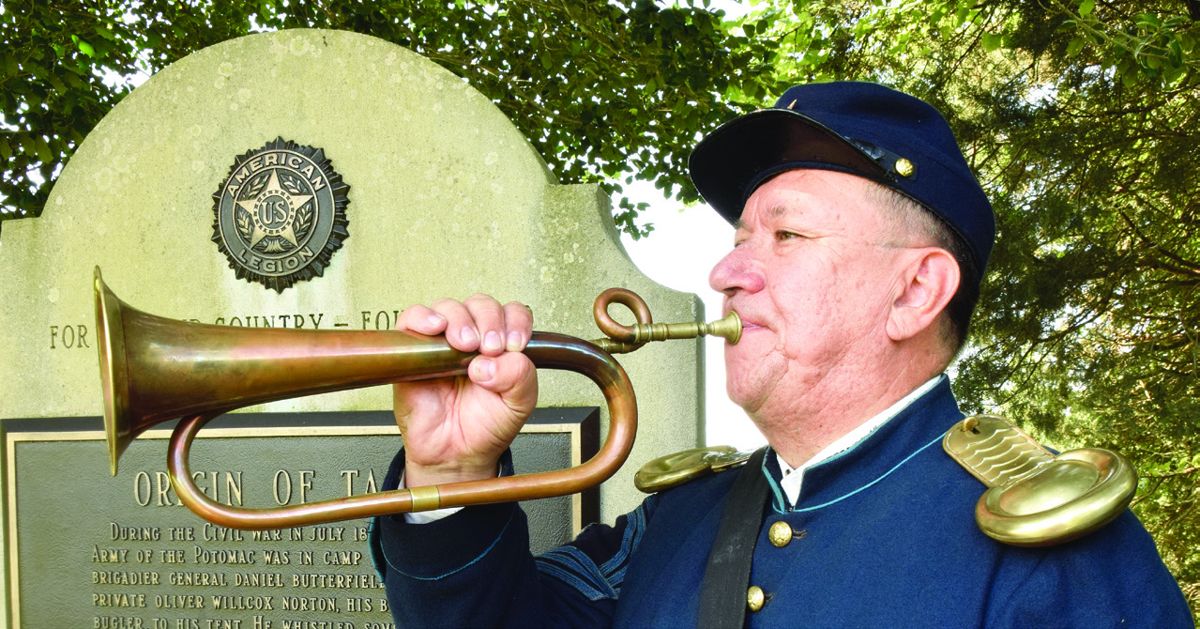
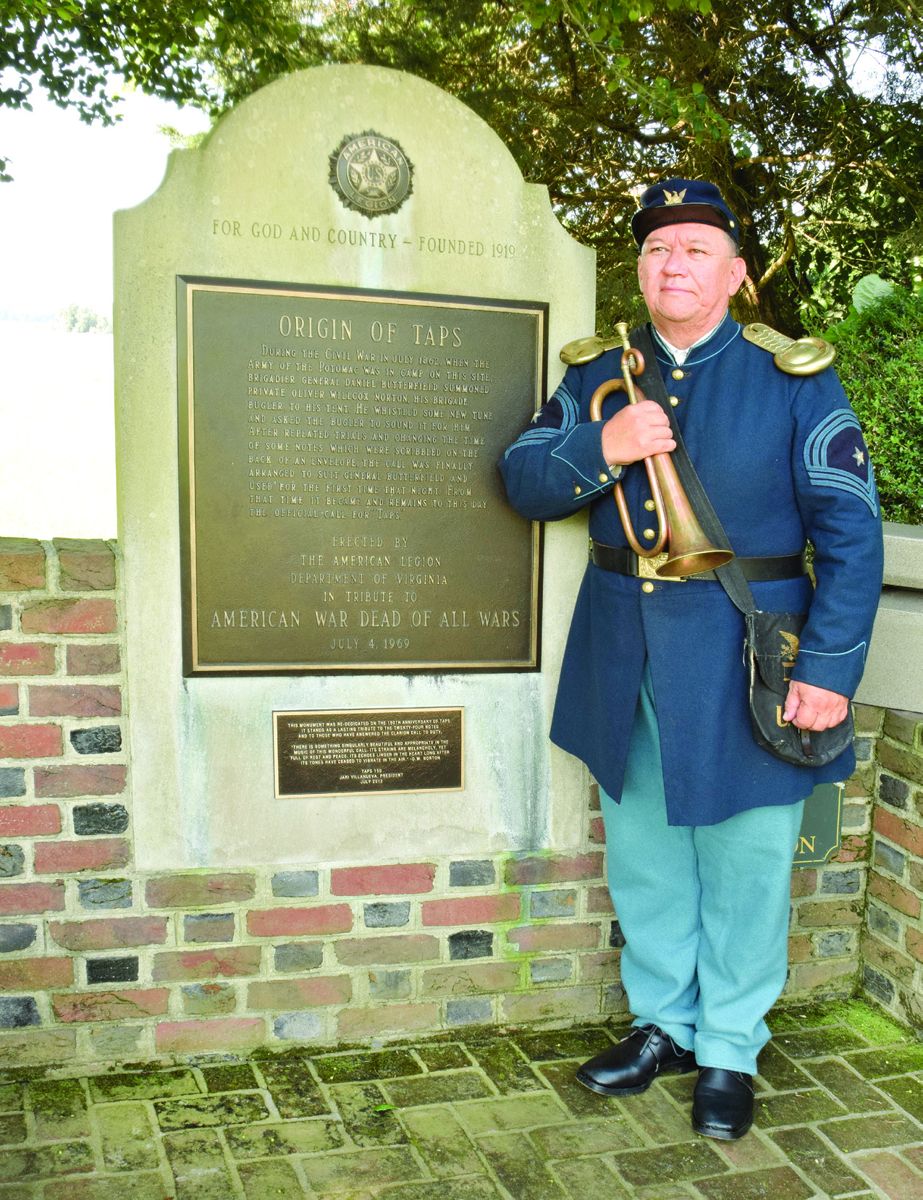
For 60 seconds during every military funeral, time seems to stand still while the bugler sounds the 24 haunting notes of Taps. “It is so full of emotion, especially when you hear it in the evening,” observed Master Sergeant Jari Villanueva, director of the Maryland National Guard Honor Guard, an organization that helps to secure final military honors for over 300 veterans a month. “When the soldiers back during the Civil War heard Taps being sounded, it was the call to go to sleep,” said Villanueva. “It also meant that things were safe for the evening, that the pickets were out and that pretty much things were secure.” Taps has become a traditional musical element in any American military funeral. Each note seems packed with emotion. Taps has become a recognized element that is respected in military and civilian circles. The simple, elegant bugle call has become as much a part of American culture as Old Glory, the Declaration of Independence, and apple pie. Taps, as we know it today, was born on the banks of the James River at Berkeley Plantation during the Civil War. “Berkeley Plantation is the birthplace of Taps. This is ground zero. This is where it happened,” said Master Sergeant Jari Villanueva, USAF Retired. “I just wish that more people would come here, not only to see the birthplace of Taps but also the site of the First Thanksgiving,” said Villanueva “This is the place where McClellan had his headquarters. It’s the resting place of the Harrisons who were here - signers of the Declaration of Independence.” Villanueva served as a master sergeant in the United States Air Force Band. His assignment was in Washington, D.C. Master Sergeant Villanueva was a ceremonial trumpeter. He has sounded Taps at thousands of funerals in Arlington National Cemetery and at thousands of military occasions from change of command to arrival and retirement ceremonies. Sergeant Major Villanueva has literally written the book on the history of Taps. Twenty-four Notes that Tap Deep Emotions tells the story of America’s most famous bugle call. Villanueva believes that his most enduring legacy as an Air Force musician is an arrangement called Going Home that he wrote for the Air Force Band. Following the bloody Seven Days Battles in early July of 1862, General McClellan and his Army of the Potomac withdrew from the battlefield at Malvern Hill to Harrison’s Landing / Berkeley Plantation under the protection of Union gunboats. President Lincoln came to Berkeley in mid-July to “encourage” General McClellan to resume campaigning. McClellan set up his headquarters in the mansion. Over 200,000 Union soldiers were encamped at Berkeley. General Daniel Butterfield and his regimental bugler Oliver Willcox Norton were among them. General Daniel Butterfield, commander of the Third Brigade, 1st Division, 5th Army Corps, Army of the Potomac sent for his young bugler and showed him some notes on a staff written in pencil on the back of an envelope. Butterfield asked Norton to sound them on the bugle. Norton played it several times, “playing it as the music was written.” Butterfield modified the original version somewhat by lengthening some notes and shortening others but retaining the original melody. When Butterfield was satisfied with the arrangement of the composition, he directed Norton to sound the new arrangement in the evening for Taps in lieu of the regulation call. The next morning other buglers came and asked Norton about it. He furnished the music and pretty soon everyone was playing this call as the new lights out call. Later on in the war, it came into use at military funerals. Taps was derived from a longer bugle call – Tattoo – that was used in the U.S. Military prior to the Civil War. Today the call of Tattoo is sounded by armies all over the world. Tattoo is the next to the last call in the evening. It means that everyone should be in for the evening. A little later on Taps is sounded to actually end the day. “It’s the only bugle call in the manual that played slowly. It’s a call that’s open to a bit of interpretation by each performer. It’s a call easily recognized by anyone in the world,” Villanueva observed. “All you have to do is play the first three notes and people will automatically recognize that call,” he said. “It’s a call that should be played on a bugle, but it can also be played on a trumpet or coronet.” Taps is a bugle call that also has words to it. During the Civil War, soldiers put words to bugle calls all the time – such as with Reveille - “I can’t get them up. I can’t get them up. I can’t get them up in the morning.” “When the call of Taps was first played and sounded at camps, soldiers started putting words to it,” said Villanueva. “Oliver Willcox Norton, the young bugler who first sounded the call, also wrote the first words that were written to it,” he said. “The first words were ‘go to sleep, go to sleep, go to sleep, go to sleep, put out the lights, go to sleep.’ Not very creative, but that’s what the call meant.” Four years ago Berkeley Plantation hosted a huge weekend event to commemorate the 150th anniversary of Taps – Taps 150. Dozens and dozens of buglers from all over the country came to commemorate the occasion. The Federal City Brass Band founded by Jari Villanueva performed during that weekend. The FCBB recreated the sound and appearance of a regular U.S. Army regimental brass band of the 1860’s. Reenactors came and set up camp along the James River as Union soldiers did 150 years before. In the evening Taps was sounded as it would have been sounded in Butterfield’s regiment at the time. Buglers who were sent out across the plantation echoed the call in the evening. “It was wonderful,” recalled Villanueva. “This all led up to the big ceremony of rededicating the Taps monument that was located here at Berkeley.” The Taps monument had been erected at Berkeley Plantation in 1969 by the American Legion to commemorate its 50th anniversary. The monument included a bronze plaque and the story of Taps at Berkeley Plantation. Over the years, the bronze plaque had weathered, turned green with age, and the recording no longer functioned. “Our idea at the 150th anniversary was to commemorate the event and also to raise money to restore the monument,” said Villanueva. “We had it professionally cleaned and we also had landscaping down,” he explained. “We were sponsored by the organization back then was called Taps 150. That organization morphed into a non-profit organization called Taps for Veterans.” Taps for Veterans is one of many organizations throughout the United States that helps get live buglers for military funerals. With the downsizing of the military and military bands, there are fewer active duty buglers available to sound Taps at veterans’ funerals. Taps for Veterans helps to arrange for volunteer buglers to provide that service to the families of veterans. “They’re sponsoring me to be here today along with Berkeley Plantation,” said Villanueva. “I’ve brought my bugle collection down here. I’ll talk about Berkeley’s connection with Taps, how taps was born, and show off some of the bugles.” Berkeley Plantation has been in the Jamieson family for generations. John Jamieson first came to Berkeley Plantation as a drummer boy in the Union army. When he learned that the Plantation was up for sale just after the turn of the century, he bought it. It has been in the Jamieson family ever since. Malcolm “Jamie” Jamieson, the current owner of the 1,000-acre plantation, has been amazed at the number and quality of the projects Jari Villanueva has helped to put together at Berkeley. From the Taps 150 celebration that drew over 1,000 visitors to the site to the creation in the Coach House Museum on the premises, Villanueva’s projects have generated interest in Berkeley and its remarkable history. “It’s a wonderful big plus for us and our tourists who come here,” said Jamieson. “Many of our tourists are interested in Civil War history. Many are military and ex-military and very interested in Taps,” he explained. “Jari’s really helped us. He’s practically a member of the family. We appreciate so much what he has done.”
Richard Stoud, a retired Coast Guard lieutenant commander, was among those who came for Master Sergeant Villanueva’s commemorative Taps program. Stoud is also a member of Taps for Veterans. “I was asked to come back to Berkeley on July 4th and sound Taps over the grave of Benjamin Harrison who signed the Declaration of Independence,” said Stoud. “Jari Villanueva asked me to do that. I’m thrilled. I never sounded Taps over the grave of a Founding Father before.