
East Cemetery Hill: A Night Fight
By Paul E. Bretzger · Originally published November 2016 · pp. 10–11
Major General Winfield Scott Hancock had spent the late afternoon and early evening of July 2, 1863, moving mountains to keep Cemetery Ridge out of Confederate hands. As darkness fell, it seemed his work for the day was done. But as he reconnoitered at the right end of his line near Ziegler’s Grove, he heard the sound of combat coming from East Cemetery Hill. Hancock’s report described the events in his typical clear manner: It was nearly dark. Proceeding to the right of the Second Corps, near Cemetery Hill, and hearing a heavy engagement on General Howard’s front, the firing seeming to come nearer and nearer, I directed General Gibbon to send Colonel Carroll’s brigade, Third Division, to that point, to report to General Howard at once.
Major General Winfield Scott Hancock showed great vigilance and a superb tactical sense when he sent Carroll’s brigade to East Cemetery Hill on the evening of July 2, 1863. Carroll’s brigade consisted of the 14th Indiana, 4th Ohio, 8th Ohio and 7th West Virginia. The 8th Ohio did not participate in the expedition to East Cemetery Hill. Hancock’s dispatch of Carroll to that point proved timely. While it highlights Hancock’s tactical awareness, it also raises questions about Major General Oliver Otis Howard’s lack thereof.
Colonel Samuel S. Carroll skillfully led his brigade to East Cemetery Hill, driving away the Confederates who had reached the batteries on top of the hill. He is pictured in his General’s uniform.
Hancock seems to have noticed the crisis no later than Howard, whose own corps was the target of the assault. Howard himself, without apology or explanation, later admitted not noticing the attack until Confederates were almost in his batteries: It was after seven o’clock when the first cry, shrill and ominous, was heard in front of Ames’ division. The Louisiana men, well named “Louisiana Tigers,” came on with a rush, broke through the front of Von Gilsa’s brigade and other points on my curved front, and almost before I could tell where the assault was made, our men and the Confederates came tumbling back together. Quickly they were in front of the intrenched batteries of Major Osborn, whose fire was intended strongly to support that bastioned front of the cemetery. Schurz and I were standing near, side by side.
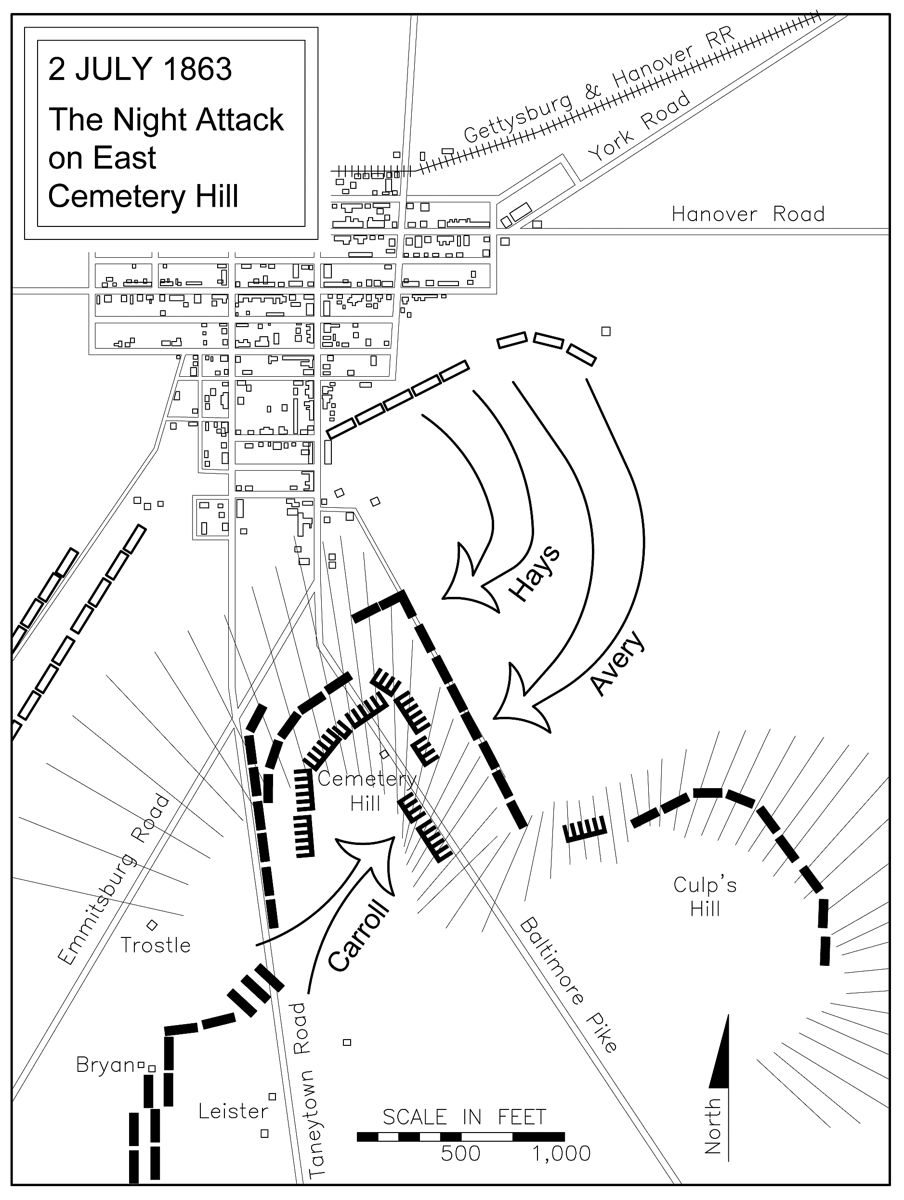
Major General Oliver Otis Howard strangely did not detect the attack on his line until it was almost in his batteries. Schurz echoed this strange surprise: General Howard and I were standing together in conversation when the uproar surprised us. There could be no doubt of its meaning. The enemy was attacking the batteries on our right… Although the time of its occurrence, dusk, was unusual, it was by no means a sneak attack. Lieutenant Edward Whittier, who ascended to command of Battery E, 5th Maine Light when Captain Greenleaf T. Stevens was wounded, wrote that the attack had been particularly slow in developing: Delayed by the twilight obscuring the ground to their front; by the difficult passage over rolling farm lands and fields shut in by stone walls which broke up their alignments; by loading and firing as they advanced; delayed perhaps by the fire of sixteen guns directly in their front, on the plateau of East Cemetery Hill, and the fire of the six light twelves on Culp’s Hill on their flank, nearly an hour was consumed in passing over the seven hundred yards between their starting point and the short range of our infantry posted behind the walls at the base of East Cemetery Hill. Regardless of whether or not Whittier was accurate about how slowly the charge developed, it is hard to explain how Howard and Schurz failed to notice it until it was almost in their batteries on top of East Cemetery Hill. When Howard and Schurz seemed to have focused their eyes elsewhere, Hancock, several hundred yards away on the west slope of Cemetery Hill, detected the threat with his ears. Hancock had toiled on East Cemetery Hill the previous afternoon, rallying the fugitives of the battle’s first day. He had placed the Maine battery of Stevens/Whittier in such a way that it enfiladed the eastern approach to East Cemetery Hill. Otherwise, the steepness of the slope rendered it untouchable by artillery on top of the hill. Whittier opined: …the “dead angle” made by the abrupt slopes of Cemetery Hill had been changed, by the act of General Hancock, who placed the 5th Maine light twelves on the side of the salient created by the north face of Culp’s Hill, into a most deadly angle; Hence, Hancock had transformed what was potentially a place of refuge for attackers into a deadly field of fire. The ground on which the battery stood came to be known as “Stevens’ Knoll.” Considering the details of the attack plan, the placement of the battery was especially deadly to the attackers. Hays’ and Hoke’s brigades (Colonel Isaac Avery commanded “Hoke’s Brigade” at the time) of Early’s Division were to form southeast of town and attack the hill, which rose south of town. This meant marching south first and then, when their right flank reached the base of East Cemetery Hill, wheeling right to swing the whole force up the steep eastern slope. This would be a difficult maneuver for two full brigades to perform on a parade ground. With the 5th Maine Light commanding the base of the hill from its knoll, the maneuver was almost suicidal. From the knoll, Whittier might have had the best possible view of the grand Confederate maneuvers. Their initial southward march had been directly at his battery, but they were now wheeling across his front toward East Cemetery Hill on his left.
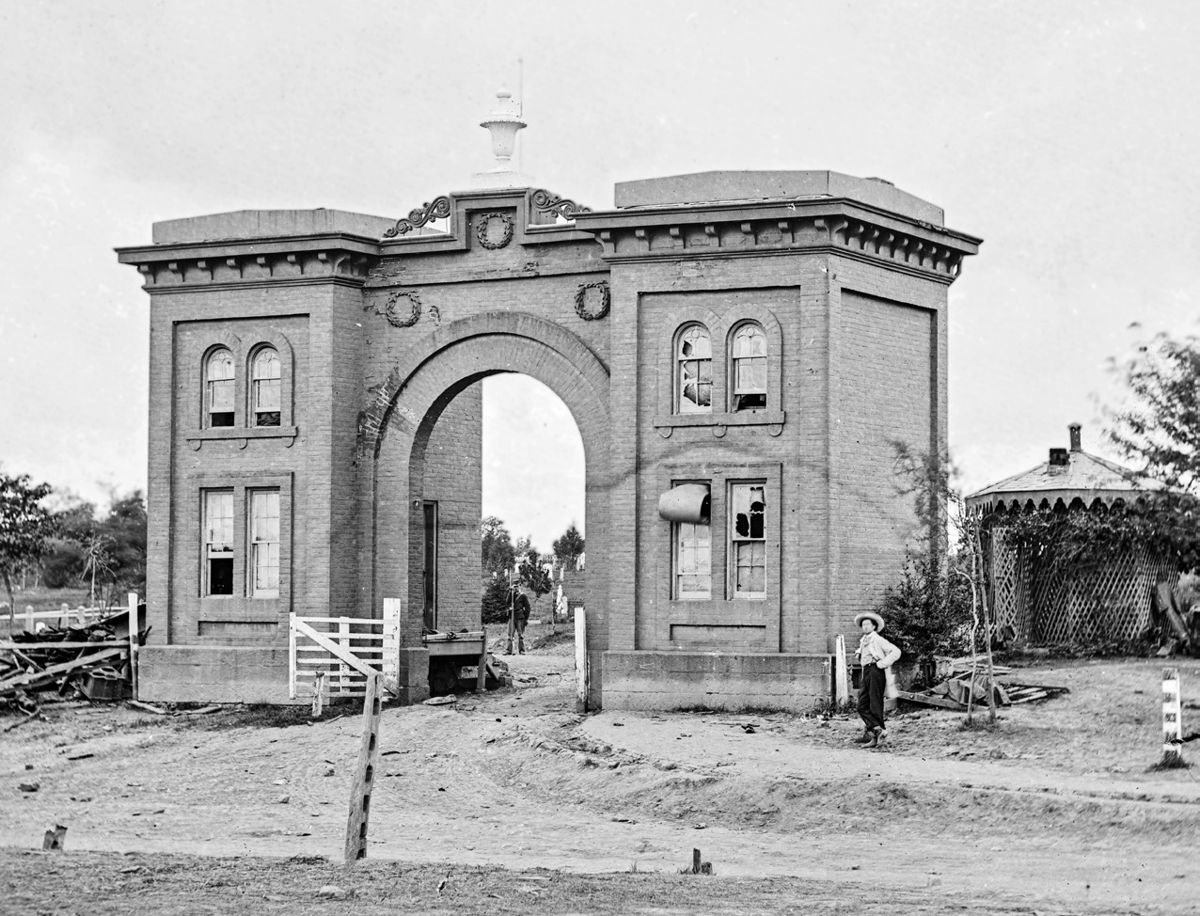
On East Cemetery Hill, the 4th Ohio monument proudly displays the name of the brigade it belonged to. The equestrian statue of Gen. Hancock is in the background. (Photo by author) Whittier contended that the carnage might have been more severe had the gathering darkness not given them some protection: General Hays, in his report to General Early, writes “The enemy’s artillery, now within canister range, opened upon us, but owing to the darkness of the evening verging into the night, and the deep obscurity afforded by the smoke of the firing, our exact locality could not be discovered by the enemy’s gunners, and thus we escaped what, in the full light of day, could have been nothing else but horrible slaughter.” Regarding the infantry: as usual, Eleventh Corps units containing large German contingents attracted severe criticism. Whittier’s statement was mild compared to others: “Von Gilsa’s brigade, Eleventh Corps, behind the stone walls at the base of East Cemetery Hill, broke and left its front open.” So with determination and discipline, surviving attackers made it to the hilltop where Howard’s batteries were. Whittier’s narrative continues: Weidrich’s and Ricketts’ batteries were overrun and the guns seized, the left piece of Ricketts’ was spiked, but the cannoneers fought the enemy hand to hand with trail handspikes, rammers, and what few pistols they had, and succeeded in checking them for a moment… This was when Hancock’s intuition paid off, according to Whittier: …Carroll’s brigade, sent unasked, by General Hancock’s happy inspiration, advancing by front of a single regiment, charged across the small space, drove the enemy from our guns and down the slopes. The position was saved. But it had not been that simple. William Kepler was a private in the 4th Regiment Ohio, 1st Brigade, 3rd Division, 2nd Corps. Colonel Samuel S. Carroll commanded the brigade. Kepler later recalled details of the brigade’s expedition through darkness to the latest point of crisis. …word was received that part of the Eleventh Corps, being taken in front and flank, was compelled to fall back from their support of two batteries on Cemetery Hill [there were actually three batteries in danger]. “Attention! Right face – Double Quick – March!” was instantly obeyed… we hurried by gravestones struck by the spiteful minie ball – toward the cannon’s vivid flash and thundering roar; Baltimore Turnpike was crossed, the position of the rebels determined only by their fire; There is very little space on the plateau of East Cemetery Hill between its steep east slope and the gatehouse of the Evergreen Cemetery. The fact that it was a salient, whose defense required guns facing both its north and east sides, along with their horse teams, caissons and other supporting elements, made it a very crowded place. Navigating a brigade across it in broad daylight without enemy fire would have been difficult enough. But the darkness of night and chaos of combat must have required well-drilled veterans. Carroll’s report echoed Kepler’s description and explained more of the difficulties: Owing to the artillery fire from our own guns, it was impossible to advance by a longer front than that of a regiment, and it being perfectly dark, and with no guide, I had to find the enemy’s line entirely by their fire. Not restricted by the conventions of an official report, Kepler’s description is more dramatic than Carroll’s, though not to the point of seeming inaccurate: …hastening toward them, now by the left flank of the brigade, through tanglements of retreating men, caissons and horses, up and along a slope, where maddened gunners of captured batteries raved and swore, or cried in very madness, vowing death to meet rather than give up their guns, striking the rebels with fist, rammer ammunition and stones; General Schurz wrote: In Weidrich’s battery, manned by Germans from Buffalo, a rebel officer, brandishing his sword, cried out: “This battery is ours!” Whereupon a sturdy artilleryman responded: “No dis battery is unser,” and felled him to the ground with a sponge-staff. Kepler boasted that when the brigade reached the batteries: Bayonets and butts of guns at once joined the efforts of the heroic gunners, then infantry and gunner in a general melee, with flanks of regiments overlaping [sic] and every-man-in-
This map illustrates the routes the two Confederate brigades took and that of Union Colonel Carroll’s response, by order of General Hancock. (Map by author) as-you-can sort of way, drove the enemy from unhitching horses and spiking guns, down over the hill, under the crossfire of Stevens’ battery on our right, and captured a number of prisoners. Weiderick’s [sic] and Rickett’s batteries were recaptured. Company G of our Seventh West Virginia made sad havoc with their old rebel neighbors. Major William Houghton recalled: Being in the center of the 14th Indiana, I recollect I passed to the left of the cemetery gate; the most of the brigade passed to the right. We met Ricketts, who was frantically imploring us to save his guns. The musketry was very heavy, and the blaze seemed to be almost in our faces. It was middling hot for a minute, but it couldn’t last. We came in good style; a cheer, a volley, a charge, and the hill was ours, the guns retaken and the rebels whooped across the stone wall below. Carroll’s charge had been decisive. But it was not the only reinforcement of East Cemetery Hill. Schurz explained what happened when he and Howard finally recognized the attack: With the consent of General Howard I took the two regiments nearest to me, ordered them to fix bayonets, and, headed by Colonel Kryzanowski, they hurried to the threatened point at a double-quick. I accompanied them with my whole staff. Soon we found ourselves surrounded by a rushing crowd of stragglers from the already broken lines. We did our best, sword in hand, to drive them back as we went. Arrived at the batteries, we found an indescribable scene of melee… Our infantry made a vigorous rush on the invaders, and after a short but spirited hand-to-hand scuffle tumbled them down the embankment. Then, Carroll explained, they solidified the lines: The firing continued until about 10.20, when they fell back out of range, and skirmishers were advanced in our front. General Ames’ division then made connections with me on our right and left.
There, Carroll’s brigade stayed for the rest of the battle. Hancock was a crucial part of its repulse even though he was not present to see it. General Henry Hunt, Chief of Artillery of the Army of the Potomac, shared Whittier’s description of Hancock’s dispatch as “a happy inspiration.” It speaks volumes of Hancock’s genius for tactical analysis and deft handling of resources. His official report boasted: I was gratified to hear subsequently, from General Howard in person, that it arrived at a very critical time, and that this unexpected re-enforcement materially assisted him in driving the enemy from his front. As for Carroll, he and his westerners acquitted themselves beautifully in a dark, unfamiliar and crowded place to work.