
Book Reviews
Book Reviews — November 2016
Originally published November 2016 · pp. 26–37
A Civil War Captain and His Lady: Love, Courtship, and Combat From Fort Donelson Through the Vicksburg Campaign. Edited by Gene Barr. Illustrated, photos, map, notes, appendix, bibliography, index, 360 pp., 2016, Savas Beatie, www.savasbeatie.com, $32.95 hardcover.
Diaries and love letters are fairly commonplace in Civil War literature. Therefore one might ask, why another work on this topic? The answer lies in Gene Barr’s edition of these letters, which provides valuable insight into three important aspects of the human experience. First, A Civil War Captain and His Lady focuses on the fact that communication is a continuously evolving art. Through their correspondence, Josiah Moore and Jennie Lindsay give readers an appreciation for the culture, manners, etiquette and conversation of days gone by. Josiah was a 27-year-old Irish immigrant when he met 19-yearold Jennie, the daughter of one of Peoria, Illinois’s most prominent families. Their differences in upbringing remind us of how we experience life today: morals and values are continually tested; political beliefs are challenged. For those enjoying a good love story, the cliché “Absence makes the heart grow fonder” is alive and well. Not only were Josiah and Jennie separated during his three-year service enlistment from 1861-1864, but they were again separated shortly after their marriage for nearly three more years so Josiah could attend seminary. Their letters reveal many aspects of uncertainty, young love and courtship that aren’t too different from what young adults experience today. The third area where Barr’s work provides insight is in the soldier’s daily life, both in camp and on the battlefields of some of the biggest engagements of the Western Theater. Barr addresses this subject nicely. He has done an excellent job editing and transcribing the letters while maintaining the original content. Maps and photographs bring Josiah’s and Jennie’s world alive to today’s readers. Barr’s work is reasonably priced and is an excellent resource regarding soldier life. I hope to encounter more of his works in the future. Richard Blumberg is past president of the Houston Civil War Round Table.
Captaining the Corps d’Afrique: The Civil War Diaries and Letters of John Newton Chamberlin. By John Newton Chamberlin. Edited by John Bisbee. Illustrations, photos, maps, appendices, notes, bibliography, index, 212 pp., 2016, McFarland & Co., www.mcfarlandpub.com, $29.95 softcover.
In recent years, many first-person recollections have been published about Civil War participants. This particular history is unique in that it is an account of life amongst AfricanAmerican soldiers. It is told through the eyes of one of its commanders, Capt. John N. Chamberlin, 3rd Regt., Corps d’Afrique engineers.
In spite of the fact that it is relatively short in text (175 pp.) it is a very detailed account of their activities, including 11 appendices. Our protagonist enlisted as a private in September 1861 in the 75th New York Volunteer Infantry. The first several chapters regale us with his journey with the army, eventually landing in New Orleans and participating in several battles to gain control of the Mississippi River in late 1862. He was promoted through the ranks to captain. In 1864 Chamberlin was given command of Co. E, 3rd Regt., Corps d’Afrique. Later that year they were merged into the 97th U.S. Colored Troops. There he remained till his discharge in 1866. All this is presented in his letters to various persons, his diary, and references to the Official Records. Included between letters is commentary of a historical note by editor John Bisbee to keep us informed on happenings in the particular theater of operations. Captain Chamberlin was a teacher before the war so his writings are extremely literate and thought-provoking. He described life in vivid detail, often showing how cruel and disheartening Union soldier treatment of their African-American comrades was. At times the language is politically incorrect, but one must take into account that this is 19th century sentiment. Overall, Chamberlin was most respectful to his men and did much to improve their lot in life. There are also accounts of cruelty towards Union soldiers by civilians. Some lighter moments are included as we are presented with several love letters to his future wife. The final chapter tells of life after the war and the fate of Chamberlin and his family. Overall this is a well presented and excellent portrayal of a little discussed aspect of Civil War history. The reader will gain much insight into a common man serving in an obscure unit, in a remote region, whose service is largely unheralded, despite the fact that their performance was a vital part of Union efforts. I highly recommend this book. Joe Truglio of Manchester, NJ is president of the Phil Kearny Civil War Round Table.
Civil War Alabama. By Christopher Lyle McIlwain, Sr. Maps, photos, notes, bibliography, index, 435 pp., 2016, University of Alabama Press, www.uapress.ua.edu, $59.95.
On January 11, 1861, Alabama’s secession convention, by a vote of sixty-one to thirty-nine delegates, declared independence from the Union. It was a fateful decision for the state’s 964,201 people (including 33,730 slaveholders who owned 437,271 slaves) and even more impactful on the “military population” of 100,000 men. Civil War Alabama by Christopher McIlwain provides a detailed chronological narrative of the state’s role in the four years of conflict. The work is not strictly a military narrative, though the major events and battles are covered adequately. Instead, the author seeks to show how the military situation influenced the “critically important social, political, and economic components of the story in Alabama.” One of the book’s main strengths is that it sheds light on important aspects of wartime Alabama, such as political history, scope of pro-Union sentiment, economic factors and the morale of soldiers and civilians. McIlwain strives to remove the layers of “myth” surrounding Alabama’s involvement in the conflict and to answer fundamental questions. How and why was Alabama’s secession accomplished? Who were its main proponents and opponents? Did Alabamians generally support secession and permanent independence? Who started the war and why? Were Alabamians emotionally and economically prepared for war? Who came forward to fight and who did not? Was there wartime dissent in Alabama, and was it countenanced? McIlwain consistently demonstrates that a large amount of Union sentiment remained in Alabama during the war. In fact, the reviewer is hard pressed to find anybody in Alabama, besides newspaper editors, who had anything positive to say about the Confederacy. Which leads to the question, if all these citizens were dissenters, then who supported the Confederacy? Did the Alabama press keep the public adequately and accurately informed? McIlwain utilizes a compare-and-contrast method to show how the pro-war/government newspapers reported events and how the common citizens and soldiers negatively perceived the same events. What was the true role of slavery? The author emphasizes slavery as the sole cause of the war and the only reason that Alabama left the Union. He argues further that the tens of thousands of non-slaveholding men who willingly joined the ranks were duped by propaganda and politicians. In the reviewer’s estimation, this contention is at least arguable. The author cites over 200 newspapers in the bibliography alone. The footnotes and bibliography comprise more than a third of the book. (Kudos to the University of Alabama Press for devoting the space.) McIlwain has spent over twenty years researching and writing Civil War Alabama. Not since Walter L. Fleming’s 1905 Civil War and Reconstruction in Alabama has someone attempted a work of this magnitude. From the beginning, the reader can tell that this book is a labor of love. For those seeking an update to Fleming’s century-old work, this book serves the purpose.
Matt Atkinson is a National Park Service Ranger at Gettysburg, and an experienced tour leader.
John Surratt: Rebel, Lincoln Conspirator, Fugitive. By Frederick Hatch. Photos, notes, bibliography, index, 210 pp., 2016, McFarland, www.mcfarlandpub.com, $35.
Frederick Hatch has studied and written about Lincoln’s assassination for several decades. This detailed biography of John Surratt illuminates how and why he escaped death when other accomplices, including his mother, were executed. From the war’s outset Surratt’s sympathy for the South motivated him to aid the Confederacy. After dropping out of St. Charles College in Baltimore he secured a postmaster position that enabled him to send information to Southern operatives. The family’s tavern, located about 10 miles from Washington, was a key meeting place in the Confederate communication line from Maryland to Virginia. Near the end of 1864 Surratt’s locus of activity shifted to his mother’s boarding house in Washington, and at some point in early 1865 he met John Wilkes Booth and collaborated in the plot to capture Lincoln. During this time he became an active courier for the Confederacy. He not only visited Richmond but received $200 from secretary of war Judah Benjamin. Hatch speculates that Southern leaders likely knew about and approved of Booth’s kidnapping scheme. Surratt carried messages to Confederate spies in Canada and was scouting a potential prisoner of war break in Elmira, N.Y., when Booth murdered Lincoln. He fled to Canada, and with the help of Catholic priests and Confederate money made his way first to Liverpool and then to Rome. With a price on his head, he joined the Papal Zouaves and managed to avoid capture until November 1866. After escaping from prison and sailing to Egypt, he was arrested again and brought to the U.S. for trial. Unlike the Lincoln conspirators, who in 1865 had been tried by military commission, Surratt received a civil trial. Charged with aiding in Lincoln’s assassination, the prosecution failed to prove that Surratt was present in Washington on April 14. Neither convicted nor acquitted by the divided jury, he remained imprisoned until early 1869. In late 1870 Surratt delivered a few lectures about his flight from authorities. However, numerous citizens recoiled at the spectacle of a notorious fugitive trying to capitalize on his shady past, so the speaking engagements were cut short. Shortly thereafter he married and worked productively in Baltimore until his death in 1916, never again revealing much about his wartime activities. Surratt’s story inevitably contains many gaps, and Hatch judiciously alerts readers when he “delves into areas of uncertainty.” He underscores the importance of Surratt’s onetime friend Louis Weichmann, whose dubious testimony was crucial to Mary Surratt’s conviction. Hatch ultimately concludes that John Surratt was guilty of conspiring with Booth to capture Lincoln but took no part in the president’s murder. Hatch’s extensive research is clearly manifest throughout the book. He provides detailed background information for numerous characters who comprise this drama, although in some cases succinctness may have been preferable to depth. He also includes large chunks of primary sources throughout the text, especially letters and trial transcripts. Readers desiring to examine sizeable passages of unfiltered evidence might appreciate this format, but others might prefer that he summarize this material in order to produce a more flowing narrative. Whatever one’s taste, this is a fine book that will appeal to all students of the assassination.
Dr. Scott is Assistant Professor of History at the Indiana Academy for Science, Mathematics, and Humanities in Muncie.
Gettysburg and Lee’s Escape to Virginia. By Donald S. Lowry. Maps, endnotes, order of battle, bibliography, index. 797 pp., 2016, Create Space Publishing Platform, www.amazon.com, $28.95, softcover.
There is certainly no shortage of books about the Battle of Gettysburg, especially those that cover the entire engagement. For buffs who never tire of reading each and every one of them, Lowry’s offering can be described as a masterful combination of factual information and an easy to read action-packed narrative. What makes this rendition unique is that it adds a detailed description of Robert E. Lee’s retreat along with concurrent events at Vicksburg, Miss., and the subsequent draft riots in New York City. This volume essentially portrays the entire experience of the country during those uncertain days in July 1863. Lowry, following up on his earlier volume dealing with Lee’s march to Gettysburg, immediately starts with the battle on July 1 there. His coverage is comprehensive throughout the three days of fighting, but the details do not get in the way of the story. Scattered throughout are brief human interest asides and discussions of familiar controversial issues that are woven into the narrative without being intrusive. In his assessment of George G. Meade’s performance at the end of the book, Lowry goes with the majority opinion, with some qualification, that Meade was dilatory in his pursuit of Lee’s army. In addition, Lowry’s study of the battle convinced him that Lee’s point of attack in the battle was Cemetery Hill. In that regard, he adopts the thesis of Troy D. Harman whose book Lee’s Real Plan at Gettysburg (a revision of his earlier Cemetery Hill: The General Plan Was Unchanged) contended that Lee’s objective on July 2 was an en echelon attack on Cemetery Hill which was also to be replicated the following day by the charge of Generals Pickett, Pettigrew and Trimble. This, of course, deviates from the traditional conception that on July 3, Lee’s objective was the Union center. But in dealing with this issue, Lowry does not make it a point in the narrative itself, preferring to do so in the Prologue and let the facts speak for themselves in describing the action. Structurally, the book contains some general overall maps at the beginning, but there are no maps throughout the text depicting the various phases of the battle. The endnotes rely principally on the Official Records and reputable secondary sources. There are also a few references to well-established primary sources that were published by participants after the war. I was surprised at how few citations were listed for the prodigious amount of information in the narrative. I can only opine that while he used large sections of those limited sources, Lowry also recited facts that he considered sufficiently well known to not require citation. The index only lists names of individuals. There are no references to units, places or topics to allow readers to find that specific information. Even though this volume will not supplant existing scholarship on the battle, it presents an accurate rendition that will appeal to many readers looking for a readable and factual depiction of events in July 1863 with particular emphasis on the Battle of Gettysburg. Frank Piatek practices law in New Castle, PA. He is the author of Cannoneers, To Your Posts!: James H. Cooper’s Battery B, First Pennsylvania Light Artillery at Gettysburg (Chicora PA, 2006).
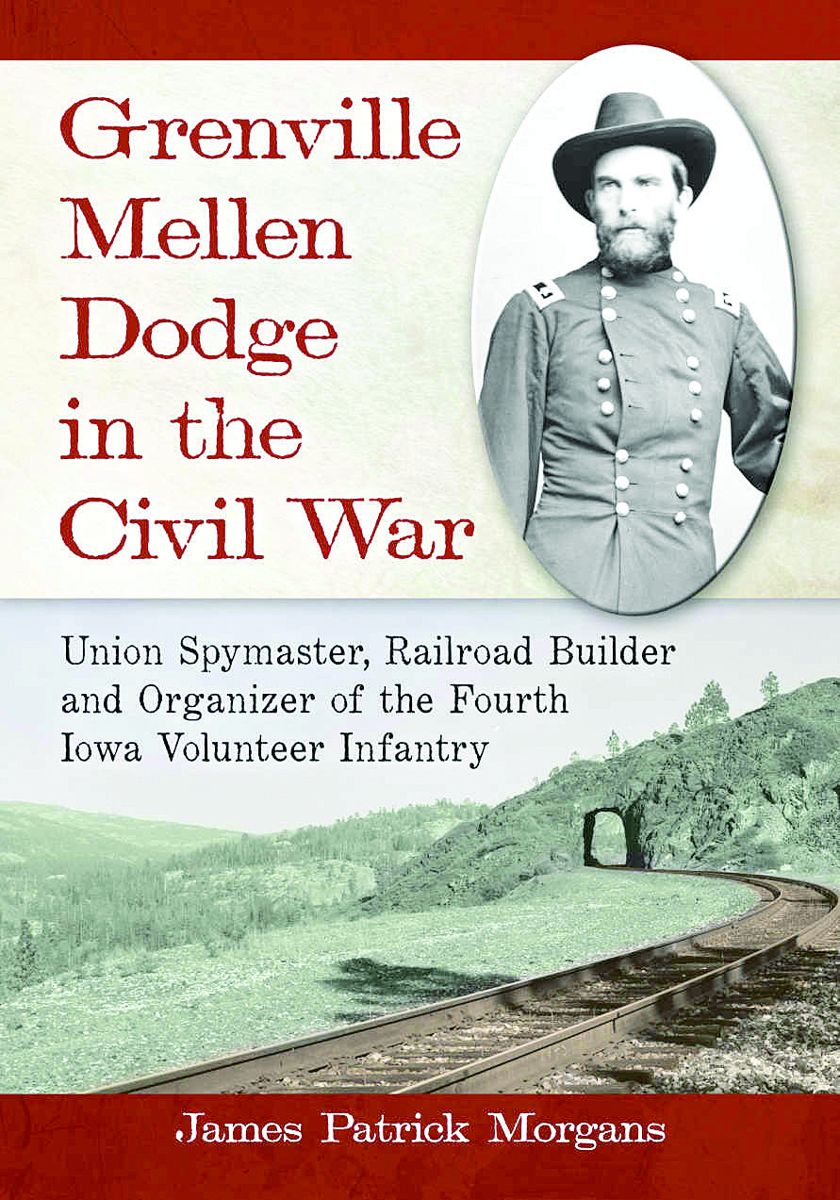
Grenville Mellen Dodge in the Civil War: Union Spymaster, Railroad Builder and Organizer of the Fourth Iowa Volunteer Infantry. By James Patrick Morgans. Photos, notes, bibliography, index, 204 pp., 2016, McFarland, www.mcfarlandpub.com, $29.95 softcover.
Born in Massachusetts in 1831, Grenville Dodge graduated from Norwich University where he studied civil and military engineering. After graduation (1851), he went west and eventually to Iowa. There he got into the booming railroad business. He also met Abraham Lincoln and became active in Republican Party politics. In April 1861 he received an appointment as colonel and soon organized the 4th Iowa Infantry Regiment, which he commanded for a short time. Promoted to brigadier in March 1862, Dodge fought in Missouri and then with the Army of the Tennessee. Intelligence work interested him, and he received some renown for the corps of scouts and spies he created. By 1864 he commanded the “Left Wing, XVI Army Corps,”
campaigning with the Union forces in Georgia. In June 1864 he became a major general and soon after received a serious wound. Upon returning to duty, he took command in Missouri. In 1866 he resigned from the army and spent most of the rest of his life building railroads. Grenville Dodge certainly merits a good modern biography. Unfortunately, this work is not it. Three major flaws mar the book. First, it does not tell us very much about Dodge as a man. Second, it is not focused. Much of the text is a history of the 4th Iowa Regiment, covering the doings of the unit after Dodge went on to higher command. Morgans also fills many of the pages with irrelevant material. What does a discussion of the trial of Henry Wirz (commandant of the prisoner of war camp at Andersonville) or of PTSD have to do with Dodge? Third, the book is badly written; most of it consists of one short, simple sentence after another. Most readers would do better to turn to Stanley P. Hirshson’s 1967 Grenville M. Dodge: Soldier, Politician, Railroad Builder.
Dr. Richard McMurry of Dalton, Ga. is author, among other works, of Atlanta 1864: Last Chance for the Confederacy (University of Nebraska Press, 2000).
Second Winchester Battle
Reviewed by Jeffry D. Wert The Second Battle of Winchester: The Confederate Victory that Opened the Door to Gettysburg. By Eric J. Wittenberg and Scott L. Mingus Sr. Illustrated, photos, appendices, notes, bibliography, index, 528 pp., 2016, Savas Beatie, www.savasbeatie.com, $32.95.
In the six-week long Gettysburg Campaign, Confederate arms achieved no greater victory than at Winchester, Va., on June 14 and 15, 1863. In the so-called Second Battle of Winchester, the Rebels routed a Union force, captured more than 4,000 enemy troops, and seized a trove of arms, equipment and supplies. The Second Battle of Winchester was arguably an engagement that should never have occurred. Responsibility for the utter defeat rested with Union Maj. Gen. Robert H. Milroy, who had commanded the Federal garrison in Winchester since the previous December. Despite the signs of an approaching major Confederate force, Milroy chose to make a stand with his outnumbered troops. Coming from the south and east were the veteran soldiers of the Second Corps, Army of Northern Virginia, led by Lt. Gen. Richard S. Ewell.
but were eventually overwhelmed and routed north of the town. In the aftermath of the debacle, Union authorities convened a court of inquiry. The court absolved Milroy of blame, arguing that he had not received a direct order to abandon Winchester before the Confederates arrived. Nevertheless, the defeat at Winchester clung to Milroy for the rest of his life. Studies of the Gettysburg Campaign have invariably included descriptions of the two-day action at Winchester in mid-June. Numerous articles in modern magazines and a 1989 monograph have covered the engagement. This new work by veteran Civil War historians Eric J. Wittenberg and Scott L. Mingus Sr. will be the standard book on Second Winchester for a long time. The research is impeccable, and the narrative is well-written. The study examines both the civilian and military aspects of the Union occupation and of the battle. The book is loaded with quotes from participants. In fact, there are so many first-hand accounts that the narrative, at times, seems to bog down as one quote contradicts a previous one. This is a minor criticism as these quotes give an immediacy and human-touch to the narrative. The authors have included a driving tour of sites in and around Winchester. As noted previously, this is the most detailed and finest study of the June 1863 engagement at Winchester. It is highly recommended.
“The Bloody Fifth”: The 5th Texas Infantry Regiment, Hood’s Texas Brigade, Army of Northern Virginia: Volume 1: Secession to the Suffolk Campaign. By John F. Schmutz. Maps, photos, notes, index, 336 pp., 2016, Savas Beatie, www.savasbeatie.com. $32.95.
Military history is replete with famous combat units: the 300-man Spartan body guard of Leonidas; the Theban Sacred Band; Rome’s 10th Legion; Napoleon’s Old Guard; the British Guards regiments and so forth. Few American Civil War units have the reputation and literature of the famous Texas Brigade of the Confederate Army of Northern Virginia. This recent study of one of its component regiments adds to this history in a wonderful manner. Author John Schmutz has left few stones unturned in seeking out resources for the first volume of his unit study. He has wisely split his work into two volumes, the first of which covers the formation of the regiment and Texas Brigade through the campaigns that made their reputation, most notably the Seven Days and Sharpsburg. The second volume will cover the rest of their war career post-Suffolk. Schmutz writes his history in the manner of older unit histories; that is, not going into percentages of what members owned slaves, how much property they had, or even what their prewar careers were, although a bit of this can be found in the appendix of notable members of the regiment. Thus, Schmutz is able to keep the focus on the private soldiers and officers and teach us what it took to form the regiment as well as equip it. This is very refreshing to this reviewer. Coming from Texas, a state with nascent industry at the time, equipping the troops was very problematic. The author goes into great detail on how they coped. Odd uniforms gathered from here and there with the home front chipping in to help as they could indicates what it took to raise and equip a new regiment. Schmutz also delves into their training camps as the men slowly became “not unwilling servants of Uncle Jeff.” The recruits’ travel to Virginia and the things that gave them joy along the way offer a wonderful addition to how new soldiers think and act. Distractions such as impressing food and livestock along routes of march (much to the detriment of the locals) and their time in New Orleans certainly took the sting out of marching through swamps. The Texas troops’ skill at impressment would soon become legendary. Finally in Virginia, Schmutz moves into the 5th Texas’s battle history. Early battles along the Potomac River, such as Freestone Point and Eltham’s Landing, gave the men their baptism of fire. Indeed, their motivation was “the deeds of the illustrious heroes of the Alamo, Goliad and San Jacinto.” The legend of the Texas Brigade began at the Seven Days, in particular their charge at Gaines’s Mill. In describing their plight in this and other battles, Schmutz shines as a writer. You are there as the men moved into the Boatswain’s Creek valley and then charged up its opposite bank into Federal fortifications and broke the line. The battle was not yet won as the Texans moved across the hilltop to deal with new Union units. One of Ewell’s staff officers tried to intervene in the 5th Texas command and was told, in no uncertain terms by Maj. John Upton, “Leave here you damn coward. These are my men, these are Texans, and they don’t know how to run.…” The battle over, the legend of the Texas Brigade — which at the time included Hampton’s South Carolina Legion and the 18th Georgia Infantry—was secure. But more was to come. The Second Manassas Campaign followed by Sharpsburg—and the biggest losses that the Texas Brigade would suffer in the war there—lay ahead. Schmutz covers all in great detail, weaving into his narrative wonderful quotes of the men in the ranks, including those of the Federals who faced them. The men tell of heroism, sadness, joy, comedy and more. The Texas Brigade and the 5th Texas, commanded by Col. Jerome B. Robertson, emerged from this blood-letting with such a reputation that soon a public cry arose to raise a full division of Texans for Lee’s army. This did not happen, although one was raised in the TransMississippi. The book ends with the Suffolk Campaign where James Longstreet’s Corps was sent to scour the countryside for food and other supplies while keeping a large Union garrison in the town occupied. Numerous skirmishes and the building of small forts along the Nansemond River against Union gunboats occupied the 5th Texas while hundreds upon hundreds of wagons hauled goods back to Richmond. It was here that one of the regiment’s “rising stars,” Capt. Isaac Newton Turner, was mortally wounded while commanding several companies at Fort Huger. As he lay dying, he begged his comrades, “Men, if you can, please take me home to my mother, for I fear that she will worry so about me.” Schmutz has done a fine job telling the story of this famous regiment. He does not neglect the time between the battles when men recovered from wounds, buried their dead and dealt with disease. Their lack of good clothing (one mention of the unit having no seats in their pants is quite humorous) and the ever-present need for shoes fills many of the pages. Equipment buffs will enjoy the good descriptions of flags, uniforms and weapons. The biographies of noted 5th Texas members as well as detailed company histories conclude the volume. A bit of tighter editing is needed. Chantilly, for example, is mentioned in the same manner twice within a few pages. The lack of a bibliography is also frustrating; this will hopefully be in the second volume. This is one of the best unit histories this reviewer has ever read. It has it all and belongs on your Civil War bookshelf. Looking forward to Volume Two. Greg Biggs of Clarksville, Tenn., is an expert on Civil War flags and speaks widely also on logistics in the Western Theater.
Chronology of the Civil War in Fairfax County: Part I. By Edward T. Wenzel. Photos, maps, notes, index, 586 pp., 2015, Bull Run Civil War Roundtable, bullruncwrt.org, $30.
Today Fairfax County, Virginia, is a paved parking lot. Traffic is found on all of its roads, be they interstates or community boulevards. It is also a landscape covered by extensive, sprawling commercial and residential real estate. Only a few lonely state historic markers dot its byways, telling tales of what transpired there during the Civil War. The pristine landscape that was found during the Civil War is hardly discernable anymore. Between 1861and 1865 this same landscape, now dotted with high-rise buildings, numerous shopping malls, and community pools was a veritable no man’s land which saw the awful ravaging effects of the Civil War. Situated just south and west from Washington, D.C., part of it is bounded by the Potomac River, while its center is attached to the town (now County) of Arlington. In this exhaustive and comprehensive survey of Fairfax County’s role in the Civil War, Edward T. Wenzel provides a glimpse into a landscape that only saw one major battle— Chantilly or Ox Hill during the Second Manassas Campaign — but was nevertheless ravaged by war and crisscrossed by men in both blue and butternut. Troops from both sides trekked across Fairfax during some of the seminal campaigns of the Eastern Theater, including First Manassas,
Second Manassas, Antietam, Fredericksburg and Gettysburg. The book opens with a terrific introduction by John P. McAnaw, a retired infantry officer in the United States Army and past president of the Bull Run Civil War Roundtable. What is most striking about this volume is its copious use of archival photography, period illustrations and maps which provide readers with a kind of “then and now” reading experience. Wenzel’s chronology in this volume, dubbed Part I, covers from May 24, 1861 (the day Union troops occupied the county) to Dec. 31, 1862. Chronology of the Civil War in Fairfax County offers readers a glimpse not only of the combat and skirmishing which took place in Fairfax County, but also of the daily life of soldiering. For example, a grim tale is told about the work of Union surgeons operating in Centreville on wounded troops after the Second Battle of Manassas: “August 30, evening – September 2: Wounded soldiers pour into Centreville. Union surgeons work day and night removing shattered arms and legs. Severed limbs are piled high outside the Stone Church and other hospitals. The wounded and maimed, many dying from loss of blood, lay by the hundreds in the yards and along the walkways and are crowded into the houses and outbuildings.” With his text and index the author has done a real service to Civil War scholarship. The chronology is central to the book, offering a veritable day-by-day account of one community’s place and struggle during the Civil War. However, this is not a book for the general Civil War enthusiast, better suited for an archive or library. It is a researcher’s gold mine of information regarding dates, time of day, personalities, patrol reports, picket accounts and troop deployment. Anyone seeking a slice of the war from one geographic locale will not be disappointed with Wenzel’s important contribution to Civil War literature. Jim Percoco of Lorton, Va., is Teacher-in-Residence for the Journey Through Hallowed Ground Partnership, a nonprofit initiative to raise historical
Lincoln’s Greatest Journey: Sixteen Days that Changed a Presidency, March 24-April 8, 1865 by Noah Andre Trudeau. Notes, bibliography, index, 337 pp., 2016, Savas Beatie LLC, www.savasbeatie.com, $32.95.
In the unofficial tradition established by his predecessors, Abraham Lincoln rarely left Washington during his administration. So perhaps it is not surprising that those precious few occasions when he did escape the bustle of the nation’s capital—from vexing visits with George McClellan to a November overnight in Gettysburg—have assumed pride of place among the most iconic moments of his presidency. In his latest effort, historian Noah
Detailed, Compact Account Of Important Brandy Station Battle Reviewed by Thomas J. Ryan Out Flew the Sabres: The Battle of Brandy Station, June 9, 1863. By Eric J. Wittenberg and Daniel T. Davis. Illustrated, photos, maps, appendices, 168 pp., 2016, Savas Beatie, www.savasbeatie.com, $14.95 softcover.
Gen. Robert E. Lee, commander of the Army of Northern Virginia, designated June 9, 1863, as the date to begin an expedition into the North from an operational base near Culpeper, Va. Maj. Gen. Joseph Hooker, commander of the Army of the Potomac, preempted this movement in the early hours of June 9 by sending his cavalry corps, reinforced by some 3,000 infantry, across the Rappahannock River to break up what he believed to be a planned Rebel cavalry raid. This action resulted in the largest cavalry battle of the Civil War in the vicinity of Brandy Station, a stop on the Orange & Alexandria Railroad. The battle at Brandy Station has taken on iconic stature, primarily because it featured roughly 18,000 cavalrymen clashing over a 14-hour period and witnessed the emergence of the Union cavalry as a viable opponent for their Rebel counterparts. Out Flew the Sabres, part of Savas Beatie’s Emerging Civil War Series, relates how the battle unfolded, and includes a tour guide of eight locations where the maneuvering and fighting took place. Noted Civil War cavalry expert Eric J. Wittenberg along with Daniel T. Davis, co-author of other books in this series, combine their talents in a succinct, 100-page description of this crucial confrontation. Kristopher D. White’s foreword sets the stage, labeling Brandy Station as a turning point during the Civil War with the Federal cavalry coming of age during this encounter. The price was steep, given Union casualties exceeded 850 killed, wounded and missing. While the Union cavalry had the element of surprise on their side during the battle’s opening phase, quick reaction on the part of the Rebels stemmed what could have turned into a disaster for Maj. Gen. James Ewell Brown “Jeb” Stuart’s cavalry forces. Union division commander Brig. Gen. John Buford led his cavalry into the fray with skill and determination after fighting his way across the Rappahannock River via Beverly Ford. Opportunity for victory went awry when corps commander Brig. Gen. Alfred Pleasonton hesitated in committing reinforcements at critical junctures, and the divisions of Col. Alfred Duffié and Brig. Gen. David M. Gregg delayed crossing the river at Kelly’s Ford because Duffié had taken a wrong road in his march to the river. Stuart and his subordinate officers recovered from the initial surprise and shock of the unexpected attack, and rallied to fend off stubborn Union thrusts throughout the day. Fortunately for Stuart, the ineptness of Brig. Gen. Beverly Robertson, whom he considered a most troublesome officer, was offset by Duffié’s ineffectiveness and poor judgment. Though not gaining a victory, and withdrawing from the field as darkness neared, Yankee cavalrymen took solace, given that they had competed well against the previously dominant Rebel horse soldiers. Brandy Station set a pattern for future competitive engagements between these forces.
Andre Trudeau, whose prolific pen has produced essential works on the Civil War’s final year—including careful studies of both the Overland and Petersburg campaigns and a very fine treatment of African American soldiers—turns his attention to the remarkable story of Lincoln’s longest (and, as it turned out, last) presidential sojourn. From March 24 to April 8, 1865, the president, quartered on a spacious side-wheel steamer docked at Ulysses S. Grant’s humming Petersburg headquarters, took a curious reprieve from the onerous demands of Washington, D.C., by experiencing firsthand the twilight of the war in Virginia. Written in the author’s characteristic, page-turning prose, Lincoln’s Greatest Journey keenly captures the dynamics of the war’s end, offering the richest account to date of these 16 vital days—as well as the first serious treatment of Lincoln’s trip since historian Donald C. Pfanz’s contribution to H.E. Howard’s venerable “Virginia Civil War Battles and Leaders” series, Abraham Lincoln at City Point (1989). Though brimming with meticulous, painstaking detail, Trudeau’s narrative never loses momentum— expertly alternating between Lincoln’s itinerary and ongoing military events, both in the trenches coiled around Petersburg and on the breathless road to Appomattox. Throughout, a number sub-plots are developed: most notably the spectacle of an irascible Mary Todd Lincoln, all too quick to discern personal affronts in the actions of Julia Dent Grant (and many others). Also worthy of note are Secretary of State William Seward’s anxious curiosity about Lincoln’s lengthy visit and the telegraphic banter between the president and Secretary of War Edwin Stanton. Lincoln’s Greatest Journey depicts a drawn, haggard president, steeled for the many challenges of his threeweek-old second term by the sights, sounds, and sentiments of the Richmond-Petersburg front—a front that he was loath to leave until Robert E. Lee’s Army of Northern Virginia had finally capitulated to his boys in blue. Lincoln arrived in time for the last major Confederate assault at Petersburg, heard the rattle of musketry along Petersburg’s western front, and walked the streets of Richmond after its evacuation. Throughout it all, he yearned for the war to be over. Indeed, Trudeau argues that Lincoln’s layover at City Point marked him indelibly. During his extended visit, the president reviewed both white and black soldiers; eyed knots of threadbare Confederate prisoners; paced the deck of the River Queen as cannon belched forth their fire in the distance; marveled at civilian homes pocked by shells and a landscape littered with human debris; peppered generals, both with questions and his folksy yarns; clicked battlefield dispatches off to Washington; and, finally, took a sobering stroll through the wards of the Depot Field Hospital, where men mangled and maimed at Fort Stedman, White Oak Road, and Five Forks felt his comforting grip. Serious readers will relish the “Sources Casebook,” a 23page appendix revealing, chapter by chapter, both the author’s interpretive decisions (Trudeau’s account corrects a number of errors in the chronology of the trip, slaying several enduring myths along the way) and his indefatigable research in recondite sources. The book is also handsomely illustrated, not only by period photographs, but also by a number of original maps that retrace Lincoln’s steps and track the progress of the armies. Trudeau makes an airtight case that Lincoln’s trip was significant, but did it change Lincoln’s presidency, as the author so boldly announces in the subtitle? Or was it the case that the trip merely confirmed Lincoln’s convictions? The president had, after all, toured battlefields, visited hospitals, reviewed troops, encountered African Americans, and come close to combat (at Fort Stevens, on the fringe of Washington) before the River Queen docked at City Point. Lincoln unveiled his blueprints for reconstruction in December 1863, tussled with the radicals of his own party, and eloquently looked toward the peace— including postwar care for veterans, widows, and orphans—in the lyrical words of his Second Inaugural. The answers to these questions, I suppose, depend upon how literally one interprets Lincoln’s April 1864 avowal to Kentucky newspaperman
A postscript titled “The Road to Gettysburg” states Hooker “remained largely blind” and “unsure of what awaited him” after his army began crossing the Potomac on June 25 at Edward’s Ferry. However, prior to ordering his army across, Hooker learned from observation posts atop Maryland Heights and agents operating in the vicinity of South Mountain that Lee’s army was crossing the Potomac into Maryland and “moving in force into Pennsylvania….” In other words, Hooker’s intelligence assets kept him informed where Lee was, and where he was heading. Appendices cover “The Four Battles of Brandy Station” by Wittenberg, “The Winter Encampment” by Mike Block, and “The Battle of Kelly’s Ford” by Davis. In an afterword, Civil War Trust President O. James Lighthizer relates the prolonged struggle to save the battlefield in “The Fight to Preserve Brandy Station,” particularly the dedication and persistence of Clark “Bud” Hall. Hal Jespersen’s maps and numerous battlefield photographs are additional resources in learning about Brandy Station. An order of battle for both Union and Confederate cavalry is included. This compact study presents a detailed description of the many encounters that collectively comprise the Battle of Brandy Station. It provides a scholarly analysis of the conflict, and will serve as a welcome resource for anyone planning to visit the battlefield. Thomas J. Ryan of Bethany Beach DE is author of Spies, Scouts and Secrets in the Gettysburg Campaign (Savas Beatie, 2015).
Albert Hodges (Trudeau quotes the letter early in the book) that he “had not controlled events.” Those who believe that Lincoln was a “man of ideas,” firmly in control of both his principles and the progress of the war, will discern herein less change and more continuity. Still, it is difficult to deny that this was a poignant and emotional episode in the life of Abraham Lincoln and his divided nation. And we cannot resist the urge, perhaps, to parse it as we ponder that perennial question: what if Lincoln had lived? A few minor errors, typographical and otherwise, appear in the text. William Tod Otto, for example, is incorrectly identified as Secretary of the Interior (he merely worked for the department), and Elihu Washburne represented Illinois in the United States House of Representatives, not the Senate. Nonetheless, Trudeau has made another sterling contribution to the literature, expertly recasting the final days of the rebellion as rising—not falling—action. As such, this fine book deserves both the wide-ranging readership it will attract and the acclaim it will undoubtedly garner. I devoured it in two sittings. Dr. Jordan is Assistant Professor of History at Sam Houston State University in Huntsville, Texas. He is author of Marching Home: Union Veterans and Their Unending Civil War (Liveright Publishing, New York, 2015).
The Red River Campaign and Its Toll: 69 Bloody Days in Louisiana, March-May 1864. By Henry O. Robertson. Photos, maps, appendices, notes, bibliography, index, 209 pp., 2016, McFarland, www.mcfarlandpub.com, $29.95 softcover.
The invasion of northwestern Louisiana by Federal forces in the spring of 1864 was launched with several different objectives. From capturing the Confederate headquarters of the Department of the Trans-Mississippi in Shreveport, to serving as a launching point for a further invasion of Texas, the campaign ultimately failed. But while several works examine the military impact of the campaign, the social history that the war had on the area during this period has never been explored. The relationships between civilians and the military are an untapped resources Robertson explores in this work.
Maj. Gen. Nathaniel Banks. (Library of Congres)
The Red River Campaign was part of a two pronged invasion in the Confederate Trans-Mississippi. The southern portion of the attack moved up the Red River from southeastern Louisiana in an effort to take Shreveport. A Federal army under the command of Maj. Gen. Nathaniel Banks was accompanied by a flotilla of ironclads and other warships under the command of Rear Adm. David Dixon Porter. These forces were opposed by Confederate troops under the command of Gen. Edmund Kirby Smith, with field command in Louisiana taken by Lt. Gen. Richard Taylor. Union forces slowly moved up the river while the Confederate forces retreated in the face of the advance. Some small-scale engagements took place but major actions were avoided. Eventually Taylor attacked the Federals at Mansfield, in spite of an order from Smith to avoid a major engagement. The battle was a major Confederate victory, stopping the Union advance and forcing the Federal troops to retreat to the small town of Pleasant Hill. The Confederates launched more attacks the next day, but Banks was able to repulse these efforts. Deciding not to continue the advance to Shreveport, Banks began to lead his army back down the Red River. The naval force was temporarily trapped near Alexandria due to low water but the boats were able to escape. Robertson, a professor of history at Louisiana College in Pineville, does an admirable job relating campaign events to readers. Written after years of research, the work utilizes many primary sources in an effort to bring the voice of common soldiers to the reader. The major problem with this work is the fact that it focuses on the social history of the campaign while including information about the military aspects. This makes the title a bit misleading, especially for readers who expect a work focused on the campaign’s military history. Those readers would be better served by picking up another title that explores the Red River Campaign. This title would be a perfect selection for readers who are unfamiliar with the Red River Campaign and need an overview of the events as they transpired, as well as the social history of the area. David Sesser is Collections Librarian at the Huie Library, Henderson State University, Arkadelphia, Ark.
Reviewed by Jonathan A. Noyalas The Last Road North: A Guide to the Gettysburg Campaign, 1863. By Robert Orrison and Dan Welch. Illustrated, photos, maps, 192 pp., 2016, Savas Beatie, www.savasbeatie.com, $14.95 softcover.
In September 1958 Dr. James I. Robertson Jr. (who was also my graduate professor at Virginia Tech) observed in Civil War History that the Civil War “lives on with vitality through many pens and presses.” Although Robertson’s observation is as true today as it was on the eve of the Civil War centennial, nothing makes the Civil War more tangible than visiting the places where soldiers of blue and gray once trod, fought, camped and sacrificed. While millions visit Civil War sites each year, no single place is more popular than Gettysburg. Visitors to Gettysburg have a plethora of sources available to guide them over those hallowed fields, but what they did not have—until the release of this fine book—was a succinct and comprehensive guide that offered access to the many places through which the Army of Northern Virginia and Army of the Potomac marched, skirmished and camped en route to Gettysburg and the places those armies passed through during the Confederate retreat from Pennsylvania. Authors Rob Orrison and Dan Welch, both of whom possess significant experience in public history and education, have produced a firstrate guide book. The authors organize the guide into five main chapters, four of which contain tours. The first chapter covers the Confederate advance into Pennsylvania and begins in Culpeper, Va., and ends at Gettysburg. The second chapter follows the path of the Union armies into the Keystone State starting at Chatham in Fredericksburg, Va. In the third chapter Orrison and Welch trace the route of Gen. J.E.B. Stuart’s exploits from the Battle of Aldie Mill to his arrival at Gen. Robert E. Lee’s Headquarters on July 2, 1863. After offering a brief overview of the Battle of Gettysburg in the fourth chapter, Welch and Orrison examine the retreat from Gettysburg, starting in Fairfield, Pa., and terminating in Williamsport, Md., in the guide’s final chapter. Throughout the guide, which includes a total of 87 stops, the authors offer succinct summaries of the significance of each site, detailed driving directions and GPS coordinates. Seventeen maps by the incomparable Hal Jespersen dramatically enhance the volume. Additionally, the authors do an excellent job of succinctly contextualizing the campaign’s origins and consequences. However, this guidebook does much more than provide context and offer a litany of stops tracking the movement of troops from one point to the next. The authors’ use of primary accounts throughout the book allows readers to connect with Union and Confederate soldiers and understand what they felt at various points in the campaign. Furthermore, the authors offer insight into the ways in which Union and Confederate soldiers interacted with civilian populations during the campaign. Orrison and Welch’s volume is a first-rate guidebook that is an essential addition to the mammoth amount of literature on the Gettysburg Campaign. There is no doubt that this book will assume its place alongside J. David Petruzzi’s The Complete Gettysburg Guide (2009) and Carol Reardon and Tom Vossler’s A Field Guide to Gettysburg (2013) as an essential tool for studying one of the Civil War’s most iconic campaigns. Dr. Jonathan Noyalas is author, most recently, of Civil War Legacy in the Shenandoah: Remembrance, Reunion, and Reconciliation (History Press, 2015).
Renegade, Texas Confederate & Union Surgeon, Dr. William R. Robinson. By Duane Helweg. Photos, illustrations, notes, bibliography, index. 136 pp., 2016, Rimrock Writings, www.RimrockWritings.com, $18.95, softcover.
Company A, Nineteenth Texas Infantry, A History of a Small Town Fighting Unit. By David J. Williams. Photos, notes, bibliography, index, 146 pp., 2016, Heritage Books Inc., www.HeritageBooks.com, $19, softcover. These two books focus on individuals from Texas who participated in the Civil War—a doctor and an infantry unit. The first concentrates on one individual, Dr. William R. Robinson. Born in the Northeast, Robinson was admitted to West Point in the Class of 1848 but resigned shortly thereafter due to academic deficiency. He attained an M.D. degree from the University of New York in 1857.
With this review we welcome to our Book Section Lawrence K. Peterson of Denver, author of Confederate Combat Commander: The Remarkable Life of Brigadier General Alfred Jefferson Vaughan Jr. (University of Tennessee Press, 2013). A retired airline pilot, he is president of the Rocky Mountain Civil War Round Table.
The Chickamauga Campaign: A Mad Irregular Battle: From the Crossing of the Tennessee River Through the Second Day, August 22-September 19, 1863. By David A. Powell. Illustrated, photos, maps, index, 696 pp., 2016, Savas Beatie, www.savasbeatie.com, $22.95 softcover. This is an exhaustively researched, detailed paperback issue of the hardback published in 2014 detailing
He moved to Texas in 1860 and was practicing medicine in Port Sullivan. He joined the Confederacy as an Acting Assistant Surgeon (a contract position), and then became Assistant Surgeon and Principal Director of the Confederate hospital at Columbus, Texas. Then things became very interesting. Apparently in 1863 Robinson was to be court-martialed, although the author has been unable to establish for what charge(s), or that this ever occurred. In 1864 he was sent to Mexico or perhaps moved there under the auspices of the Confederate government. When he returned he was found to be on orders from the United States as a contract surgeon for the Union prison at Ship Island, Mississippi. Thus he served on both sides. What perhaps makes this a less controversial action is that in 1862 Gen. Robert E. Lee and Maj. Gen. George B. McClellan signed an agreement considering medical officers as non-combatants, possibly keeping Robinson from being labeled a traitor. It was common during the war for doctors to remain with their wounded and to be captured by the other side. Both sides, to their credit, typically treated their patients the same regardless of which side doctors and patients were on. Helweg also provides an interesting look at some Civil War medical practices. Now to Williams’s study of a small Confederate unit. Company A of the 19th Texas Infantry was formed largely by men in and near Jefferson, a major port some 200 miles inland from the Gulf of Mexico. There was impetus to join a company in early 1862 as the threat of conscription by the Confederate authorities was becoming evident and many men desired to avoid the epithet of “draftee.” The 19th Texas became part of Maj. Gen. John J. Walker’s Texas division, the only Confederate division made up exclusively of Texas men. They fought at Perkins’ Landing, Milliken’s Bend, Fort DeRussy, Mansfield, Pleasant Hill and Jenkins’ Ferry. The real value of this short book is the investigative detail the author performed as he analyzes this company’s makeup. Williams investigates the backgrounds of each of the 78 Co. A recruits, looking at them from many aspects. He follows the men through the war, especially describing how illness affected the company, and covers desertion as well. Overall, he ascribes this company as an exceptional one. Finally, the author follows up the events of the Civil War years with a detailed examination of what happened to Co. A soldiers after the war, providing some closure there. Together, Helweg’s examination of Dr. Robinson and William’s analysis of Co. A, 19th Texas, provide a glimpse into men who fought in the Civil War. Both provide documented notes. For those interested in the human interest side of that war, these books provide a tantalizing up-close and personal view of some Texans so involved.
both the month-long maneuvers known as the Tullahoma Campaign, and the first day of the two-day battle of Chickamauga. Like any good novel in a series, it ends with a cliffhanger at the end of the day of Sept. 19, 1863. The writer did such a good job on the details that I have purchased the second volume of this two-volume history of the battle just to find out what happens because I had not noticed the publication of the hardback version of this book. No, this book is not a novel, and we know how Chickamauga turned out, but Civil War readers who like details, details, details, will find this paperback version of A Mad Irregular Battle engrossing. If readers do not already have it, they should buy the following hardback volume, Glory or The Grave: The Breakthrough, the Union Collapse, and the Defense of Horseshoe Ridge, September 20, 1863. That hardback came out in 2015. If you buy this paperback and the hardback, it will run you $68, but for those who like to know everything about a battle, it will be worth the cost. In fact, readers will likely want to buy yet a third David Powell book,
The Maps of Chickamauga (2009 from Savas Beatie) for $40 for a total outlay of $108 just to fully comprehend what Powell writes. That book features 126 maps. If A Mad Irregular Battle lacks anything that the reader could use, it would be more strategic maps at the beginning of the book. Powell gives the reader almost daily accounts of how the two armies slowly but surely slipped towards one another, but only a handful of maps up front are available to understand those movements. I found myself reading about towns visited by both armies and wondering where and how close they were to each other. Once the battle starts, Powell includes plenty of maps; 26 in the entire volume. In an age when publishers push writers to limit their books to 75,000 words, Savas Beatie apparently told writer Powell to tell the whole story in however many words he needed and it would publish his work in two stand-alone but connected volumes. Even at that, this paperback book is thick and readers should note not to lay the open book face down to prevent its binding from being stressed. Powell uses all of these words to show two plodding armies led by two plodding generals, William
Rosecrans and Braxton Bragg, who eventually decided to fight each other after weeks of marching around the backwoods of Tennessee. Both men were under pressure from their own commanders to: “Do something, for God’s sake!” Powell even finds common soldier accounts where the men who would be in the most danger are wishing both their generals would finally get them into a fight. What I found particularly entertaining is the economy of words Powell used in a massive volume to give a rich idea of the personality traits of just about every ranking officer on both sides. While so many names get jumbled in the reader’s head, Powell makes sure the reader knows whom the officers got along with and whom they hated and how their personalities worked on the battlefield. Some details will be surprising. I had always thought that President Jefferson Davis kept Bragg in a command role because they were friends, but Powell makes the case that the two men knew each other from Mexican War service, but were hardly friends. Powell even makes Bragg seem more competent than other writers have made him out to be. Bragg is still Bragg, of course, but maybe not as bad as some readers have come to think of him. Another appealing thing that readers will take away is that they may be able to find their ancestors’ regiments mentioned when other, shorter, single volume histories of this battle go into no more detail than listing brigades. I had several Confederate ancestors in this battle and was able to track the movements of their regiments. Notes sending readers to sources are at the bottom of the page, rather than the back of the book. This shows another accommodation to the reader who wants even more detail than Powell offers. Incredibly, Powell writes in the foreword that he needs yet another volume to truly finish the story of the Chickamauga Campaign. He spent 15 years collecting the material for these three books. I’ll be buying that fourth volume too which covers the Union occupation of Chattanooga through Sept. 23, 1863. Clint Johnson and his wife Barbara live in western North Carolina. He is author of Pursuit: The Chase, Capture, Persecution & Release of Jefferson Davis (2008).
The Chickamauga Campaign— Glory or the Grave: The Breakthrough, the Union Collapse, and the Defense of Horseshoe Ridge, September 20, 1863. By David A. Powell. Maps, photos, notes, index, 725 pp., 2015, Savas Beatie, www.savasbeatie.com, $39.95.
For years I’ve been writing about the ability of Civil War historians of the Eastern Theater to describe their battles and campaigns with surgical dissection—“eastern theatricality,” I call it. Gettysburg, of course, is the case in point: in numerous books, the three-day engagement has been divided into days, hours, flanks, railroad cuts, farms, et al. Well, Gettysburg, meet your Chickamauga. Or, put another way, Harry Pfanz, meet your Dave Powell. For the past decade or so, this Chicago native has been writing about the three-day (I’m adopting his count) battle, fought in north Georgia in September 1863. Like its counterpart in the East, Chickamauga was the biggest battle in the western theater. But unlike Gettysburg, Chickamauga was a huge Confederate victory, of Gen. Braxton Bragg’s Army of Tennessee over Maj. Gen. William S. Rosecrans’ Army of the Cumberland—the kind that Rebels could only dream about for the rest of the war. Powell has warmed to his subject in three volumes previous to this one. (All are published by Savas Beatie.) The Maps of Chickamauga: An Atlas of the Chickamauga Campaign, Including the Tullahoma Operations, June 22-September 23, 1863 (2009) presents 126 original, full-color maps by David Friedrichs, with accompanying text by Powell. Failure in the Saddle: Nathan Bedford Forrest, Joseph Wheeler, and the Confederate Cavalry in the Chickamauga Campaign (2010)
explores “the staggering number of miscues,” such as reconnaissance failures, committed by the Southerners’ mounted arm. The Chickamauga Campaign–A Mad Irregular Battle: From the Crossing of the Tennessee River Through the Second Day, August 22,-September 19, 1863, was published last year. As Richard McMurry noted in his review in Civil War News (April 2015), this is the first volume of a Chickamauga trilogy; A Mad Irregular Battle covers the first two days’ fighting (September 1819). The battle of the 19th featured charges and countercharges by both sides in open fields, with no lasting advantage gained by either side. At the end of the day, the opposing lines stood much as they had that morning. Here is where Powell’s Glory or the Grave (volume two) picks up the story. General Bragg planned to break the deadlock early on September 20 with a big attack delivered from his right and continued down his line. The Southern assault on the Union left, held by Maj. Gen. George Thomas’ troops, started late and was disjointed. But the Rebels exerted enough pressure that Thomas called on Rosecrans for help. The Union commander began shifting troops to the left. His real blunder was ordering an infantry division, Brig. Gen. Thomas J. Wood’s, from the center of the line (which was not yet under attack) to withdraw and hurry to help Thomas. General Wood already knew there were Rebels massed in his front, but he obeyed the order anyway. The resultant gap in Rosecrans’ center occurred just as Lt. Gen. James Longstreet, newly arrived from Virginia with two divisions from Lee’s army, was massing 17,000 troops for a gigantic charge. As Civil Warriors know, Longstreet’s attack punched through the Yankee line and precipitated a rout that sent General Rosecrans himself fleeing for Chattanooga. When he addressed the Atlanta Civil War Round Table last September 13, David Powell began by acknowledging he was very aware that he was writing about a battle already “covered” by Glenn Tucker (Chickamauga, 1961) and Peter Cozzens (This Terrible Sound, 1992). So I turned to these venerable volumes for their views on what General Wood should have done when he received Rosecrans’ fateful order to withdraw. Tucker absolves the division commander. “Peremptory orders sent to the battle line should be obeyed”; “there can be little doubt that Wood acted in good faith”; and, besides, Rosecrans should have gone to Wood’s front, a five-minute ride from his HQ, to check on things before issuing the order. Cozzens takes the different view: “Wood unquestionably should have held his position until he was able to clarify the order. A true professional would have considered [a] reprimand a small price to pay where so much was at stake.” In his treatment of the momentous episode (pages 193-204), Powell notes Wood’s “deep misgivings” about obeying the order, but adds that his superior, XX Corps commander Maj. Gen. Alexander McCook, told him to do so, promising that he’d bring up a division to fill the gap left by Wood’s withdrawal. Wood, in other words, did exactly as he should have. “The real problem,” he concludes, “was that in the space of a quarter of an hour, General Rosecrans set virtually the entire Union right wing in motion.” For battle buffs, the value of Powell’s multi-volume history of Chickamauga lies in its tactical detail. Here’s just one example. After Maj. Gen. John B. Hood took command of Longstreet’s corps, Brig. Gen. Evander Law succeeded him as division commander. Both Tucker and Cozzens state that Col. James Sheffield then took charge of Law’s brigade. Powell bores deeper, and finds that Sheffield had fallen from his horse, so Col. William Perry took charge. It’s, therefore, Perry’s brigade (not Sheffield’s) throughout Glory or the Grave. The trilogy may be a bit more interlocking than some readers will find convenient. From this book, we have to return to A Mad Irregular Battle for an order of battle. Similarly, to see the author’s bibliography, one must purchase the third book, The Chickamauga Campaign—Barren Victory: The Retreat into Chattanooga, the Confederate Pursuit, and the Aftermath of the Battle, Sept. 21-Oct. 20, 1863. It was just being released at the time of my writing. This may be a small price to pay indeed for what will surely be the comprehensive history of Chickamauga. Powell’s two tomes covering September 18-20 contain more than 1,100 pages. That’s a lot of battle to read, but therein lies the point. No one, so far as I know, has worried a great deal about reading Harry Pfanz’s three books on Gettysburg (The First Day, The Second Day, and Culp’s Hill & Cemetery Hill), which combined also pack a whopping 1,100-plus pages. The point is that in the years to come, students who want to know what happened at Chickamauga will always turn to David A. Powell’s magnum opus. I can’t imagine any future scholar even attempting to equal its research and exposition.