‘A Means Of Saving My Soul’: The Thomas Cox Bible
By Chris Sniezek and Kelly Henderson · Originally published November 2016 · p. 20
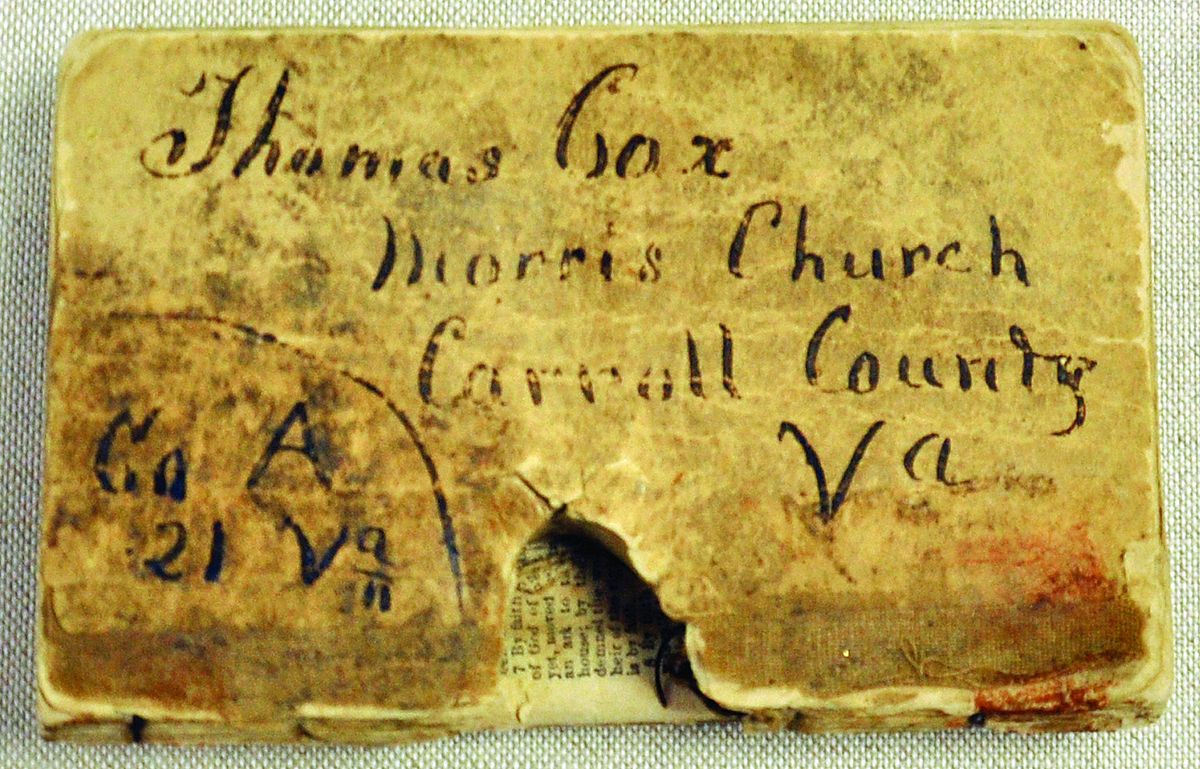
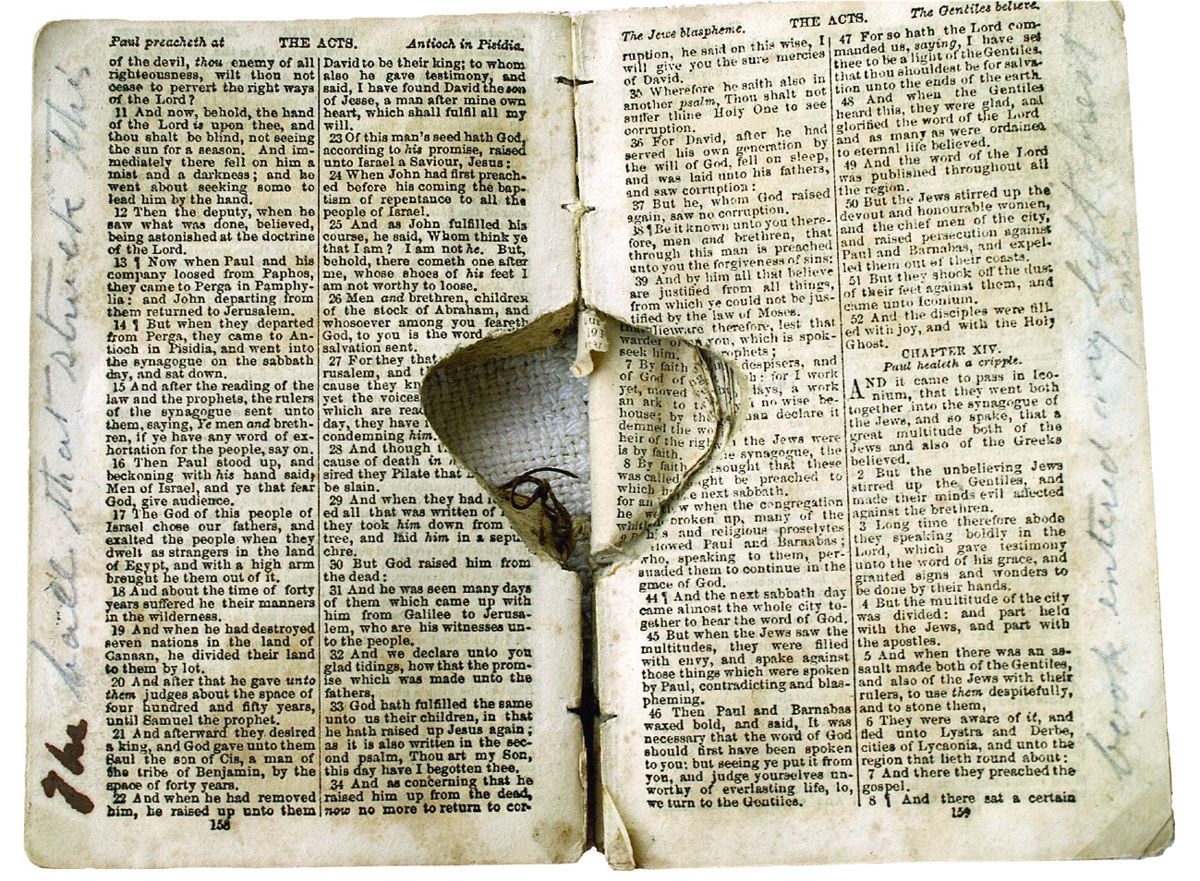
On July 9, 1864, Private Thomas Cox prepared for battle near the banks of the Monocacy River not knowing this battle would be his last. Prior to the Civil War, Cox worked as a small farmer in Carroll County, Virginia, where he lived with his wife and two children. Although Cox enlisted in the 21st Virginia Volunteer Infantry Regiment in 1861, he spent most of the war close to home and was able to return to his farm multiple times, even fathering two more children. While Cox was no stranger to the woes of war by 1864, a mortal wound sustained during the Battle of Monocacy took him from his family forever. Over 150 years after his death, Monocacy National Battlefield was able to purchase Thomas Cox’ small New Testament. This artifact is providing the park new insight into his last days. Before Cox carried the New Testament in his front left coat pocket, the Confederacy faced many hurdles in selling and distributing Bibles. Cox’ Bible was printed in 1862 by Wood, Hanletter, Rice & Company of Atlanta, Georgia for the Confederate States Bible Society based in Augusta, Georgia. Prior to the Civil War, Bibles were mostly printed and distributed by the American Bible Society based in New York. When the war broke out, the American Bible Society decided to continue distributing Bibles to Confederate soldiers, but a Union blockade soon left the South in a severe shortage. Faced with this shortage, the Confederate States Bible Society was established to print and distribute new Confederate Bibles. Using the printing plates from a previous printing attempt in Nashville, Tennessee, the Confederate States Bible Society ordered 50,000 Bibles to be printed by Wood, Hanletter, Rice & Company. Cox’s Bible comes from this printing, being one of the few editions published with the Psalms before a fire forced the bibles to be printed by a different company. The situation that prompted its publishing is just one aspect of the Bible’s unique history. Another aspect is the personalization of the Bible by several soldiers. One example of this is the inscription citing Thomas Cox’s name, hometown, and company on the cover. Other markings on its pages detail the origin of a hole on the spine of the book and the birth and marriage dates of fellow soldiers. To those interested in religion or the Civil War, this Bible offers a unique piece of history. To Cox, however, this Bible offered a bit of peace or entertainment in a long and wearisome war. As Cox joined the third Confederate invasion into the North, marching with General Jubal Early’s men toward Washington, D.C., the Bible stayed with him, tucked in his jacket pocket.
Bringing big battles and unkown stories to life…
On the march toward Washington, Early’s men were delayed by a Union force under the command of Union General Lew Wallace. Wallace stationed his men along the east side of the Monocacy River, attempting to delay the Confederate advance on the National Capital. General John McCausland’s Calvary Brigade and later General John Gordon’s division, including Thomas Cox and consolidated regiments of the famed “Stonewall Brigade,” forded the river at the Worthington Farm. Here, they formed a battle line and prepared to assault Union General James Ricketts’ men positioned on the Thomas Farm. According to Sergeant John Worsham, the men in the 21st Virginia tore down a fence railing and, with three years of hardened experience behind them, rushed forward in a charge against Union positions without orders from their officers. Somewhere in this rush and exchange of small arms fire, a minié ball suddenly pierced Private Cox’s chest. The minié ball glanced off the spine of his Bible, entered his left breast and exited his right breast. He lay wounded on the battlefield until he was captured by Union soldiers. Unable to move, he was picked up by the soldiers and sent to the General Hospital in the city of Frederick, Maryland. Cox remained there until July 14th when he was sent to Baltimore for further treatment.
Cox was placed in the U.S. General Hospital, West’s Buildings by the Union Docks in southeast Baltimore City. He faced the southern window towards the Baltimore Harbor and Union Docks according to ward master Henry S. Shepherd, a Confederate soldier from the 2nd Virginia Volunteer Infantry Regiment captured at Gettysburg. For four weeks, Cox lay in his hospital bed scribing notes in the Bible; a habit Shepherd continued when Cox was unable or unwilling to write. One message reads, “The ball that struck this book entered my left brest (sic) and came out of right – it saved instant death & will be the means of of (sic) saving my soul. Thomas Cox. Blessed are the dead that die in the Lord.” When his wound became infected, Thomas’ prospects looked bleak. Before succumbing to his injury, Thomas asked Shepherd to remove his wedding ring and send it home to his wife, as detailed in the Bible. On August 15th, 1864, over a month after the Battle of Monocacy, Thomas Cox died. A final entry in his Bible reads, “I was with Thos. Cox when he died __ he was willing __ & appear (sic) ready to leave this world for a better one to come. H.S. Shepherd.” Private Thomas Cox of the 21st Virginia, Company A, was buried in Loudon Park Cemetery in Baltimore, Maryland. Following his death, the Bible, along with his other belongings were shipped back to his wife where it remained in the family for several generations before being sold to a private collector in 1995. The Bible was recently purchased by Monocacy National Battlefield, becoming the first Confederate artifact in the park’s collection that is linked to a specific individual. The Bible is currently undergoing conservation to preserve it for years to come. The park has an on-going research project focused on learning more about Thomas Cox’s life, his descendants, and the Confederate States Bible Society. Currently, researchers are looking for photographs of Thomas Cox and investigating the two other soldiers mentioned in the Bible, Matthew C. Wells and Christopher Columbus Harry Wood. This research will be used in a new exhibit which will display the Bible and share Thomas Cox’s story. This exhibit is scheduled to open sometime in 2017. Christopher Sniezek is the Gettysburg College Civil War Institute, 2016 Brian C. Pohanka Intern for Monocacy National Battlefield and is a Senior at Gettysburg College where he majors in History and has a concentration in the Civil War Era. Kelly Henderson is a Park Ranger at Monocacy National Battlefield and graduate student in Museum Studies at the Columbian College of Arts and Sciences, George Washington University. For more information on Monocacy National Battlefield, go to nps.gov/mono.