
Book Reviews
Book Reviews — May 2016
Originally published May 2016 · pp. 20–31
– Reviews of Civil War Books –
Pricey, Graphic Books About Douglass’s Visit To Ireland Plantation Violence, Slavery Slave Against Slave: Plantation Violence in the Old South. By Jeff Forret. Notes, charts, bibliography, index, 530 pp., 2015, LSU Press, www.lsu.edu, $65.
You have to really be interested in slavery to appreciate this book. Besides having that appreciation, you had better be prepared to pay $65 to show that appreciation. Be prepared for some pretty graphic depictions of violence. Be aware that author Jeff Forret will also question if slaves committing violence against each other has anything to do with black-on-black crime today. And finally, readers will have to be prepared to suffer some eye strain to read the text. I don’t think most people will enjoy this book. If they do, they must have sadistic tendencies because the writer cites hundreds of incidents in minute detail of slaves hitting, stabbing, maiming and often killing other slaves. He also details some particularly gruesome treatments of slaves by their owners. In one case an owner branded a slave who was loosely bound to a tree in order to punish him for the crime of visiting his slave “wife” on another plantation without the owner’s permission. The slave scraped himself bloody against the tree trying to evade the owner’s hot branding iron. I admire the writer’s diligence in tracking down and publishing these slave stories, mostly found in court records, but the book quickly gets repetitive. One only needs to read about a few murders before getting the picture. There are some interesting tidbits Forret turns up, such as white-onwhite crime occurring much more often in the Old South than blackon-black crime. And (spoiler alert!) many of the crimes slaves committed against each other happened when they had been drinking and gambling. They were kind of like white folks in that respect. From a practical reading standpoint, the heavy serifs of the typeface seem small and hard to read. Forret also does not like paragraphs much; two paragraphs often take up an entire page. The overall effect is that the pages seem to dazzle one’s eyes. A larger typeface and more paragraphs creating some white space might have lessened that effect. But the book is already 395 densely packed pages of copy, and the publisher may have chosen to pack in as many words in as few pages as possible to keep the price down. I consider the $65 price tag for such a specialty market book to be too high. If the details of slavery interest you, you may buy the book. If you are looking for a Civil War book, you won’t. Reviewer Clint Johnson has written 12 Civil War and American Revolution history and historical travel books.
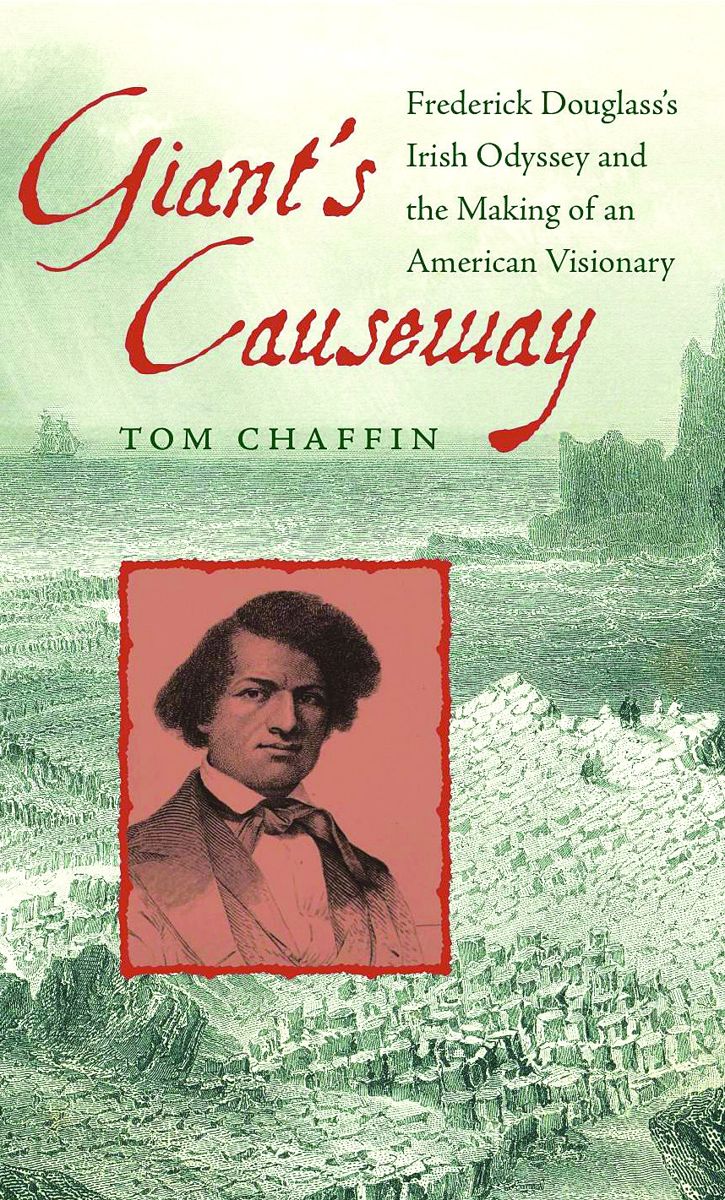
Affected Abolitionist Views Giant’s Causeway: Frederick Douglass’s Irish Odyssey and the Making of an American Visionary. By Tom Chaffin. Illustrated, photos, map, 328 pp., 2014, Virginia, www.upress.virginia.edu, $29.95. Even though the vast majority of the book investigates his European tour, the last two sections explain how the tour impacted Douglass, his politics in America and the world at large.
SHARPSHOOTER
The Selected Letters and Papers of Maj. Eugene Blackford, C.S.A.
Maturity is one major theme that Tom Chaffin develops throughout all five sections. This maturity grows on two different levels: Douglass’s personal maturity and his development as a politician who cares about and advocates to rectify social and political inequality on a global scale. Chaffin makes excellent use of primary sources, including Douglass’s personal correspondence. He skillfully weaves in quotations to prove his ideas and help familiarize readers with Douglass’s unique perspective and political voice. The author includes a chronology to parallel the major events of Douglass’s life with the salient contemporary events and conditions in America and Europe. The book’s copious citations are another great strength. Since he uses endnotes, his voluminous citations do not slow down the narrative. Instead, the endnotes serve as an excellent research tool to help readers find the necessary sources for deeper investigation. The graphics are extremely helpful as they create a visual context to better understand Douglass and his time period. The many types of graphics include political cartoons, lithographs, photographs, illustrations and portraits. One of the most haunting images shows poverty-stricken Irish peasants vying for admittance into a workhouse. As if the image isn’t striking enough, the caption explains the dismal conditions Irish endured
VOLUME 1
Fred L. Ray, Ed.
witness of a sort “thatA historians rarely encounter.
while living in these British-operated facilities. By connecting the plight of the Irish to that of African-American slaves, Chaffin provides a much more complete understanding of how Ireland and the struggle of its people impacted Douglass’s abolitionist politics. These images connect seamlessly with Douglass’s letters describing the crushing poverty he witnessed in Ireland. This book is enthusiastically recommended for readers who enjoy detailed biographies. Although connections to the American Civil War are mostly made through social and political comparison and commentary regarding Douglass’s European tour, readers interested in how one of the most famous abolitionists developed and honed his views overseas will greatly appreciate Giant’s Causeway.
Reviewer Evan McLaughlin, a Muhlenberg College graduate, is a member of Phi Beta Kappa and a social studies teacher at Mountain View Middle School in Mendham, N.J.
Soldier Letters Small Part Henry Clay Was Greatest Statesman Of Book With Poor Essays So Much Blood: The Civil War Letters of CSA Private William Wallace Beard 1861-1865. Edited by Virginia Cornue and William R. Trotter. Illustrated, photos, bibliography, 529 pp., 2015, Creative Books, www.somuchblood:civilwarletters.com, $23.95 softcover.
Born in Mecklenburg County, N.C., in 1836, William Beard moved to Mississippi. When war came he enlisted in Co. G of the 18th Mississippi Infantry Regiment. Beard served with the regiment throughout the war, but he was often on the sick list. Captured in May 1863, he missed Gettysburg. In April 1865 the Yankees again took him prisoner during the retreat from Richmond. After his release the following June, he returned to Mississippi, where he lived until his death in July 1900. The letters and other documents in this collection contain a fair amount of useful information on Beard’s army life, including his time as a prisoner. Some of these documents were published in a local newspaper in the 1970s. The 33 documents make up only about one-fourth of the book. The remainder consists of essays by Virginia Cornue and William Trotter on different topics, few of which relate to Beard and many of which are marred by glaring errors. Jefferson Davis and Braxton Bragg were not West Point classmates; Stonewall Jackson’s first name was not “Joseph”; a clash of mounted units near the Pamunkey River on May 28, 1864, was not “what may well have been the largest cavalry-versus-cavalry battle ever fought in Virginia,” and so on. A photograph of dead soldiers on “Spotsylvania Court House Battlefield” shows some of the dead at Gettysburg. A simple check of a few sources would have shown that Gen. Robert Hoke’s division went to Wilmington, N.C., in December 1864. Instead, the editors confess their inability to determine if Beard’s Hoke Division reference was to North Carolina or Delaware. (A full Confederate division roaming around far behind Union lines in December 1864!) The tiny maps are almost useless. The editors’ writing is frequently ridiculous (to be kind about it): “Bobby Lee” defeated Joseph Hooker, who was “almost feverishly randy for the White House.” Gen. William J. Sherman “didn’t give a rat’s ass how many barns his troops burned.” Read the book for Beard’s letters. Reviewer Richard M. McMurry, an independent scholar in Dalton, Ga., is working on a study of Joseph E. Johnston’s role in the Confederate military history.
Shop at C. Clayton Thompson - Bookseller 584 Briarwood Lane, Boone, N.C. 28607
A full-time bookseller with an open shop - In business for over 20 years! Offering the largest selection of Civil War and military books on the Internet! Visit our Civil War and World War II unit history pages. Maps, DVDs, Repro Swords, Hats, Pistols & Belt Buckles. Find your ancestors - Over 15,000 genealogy books & CDs
Find us on Google Earth and come visit! Call us for directions or to order by phone. Shop online at:
www.civilwarmall.com/bookseller/main.htm (828) 265-4970 • E-mail: [email protected]
Want To Advertise Your Book In Civil War News? Email [email protected] Call 800-777-1862 For more information and rate sheet visit: http://www.civilwarnews.com
STOP PAYING FULL PRICE FOR MILITARY BOOKS
Henry Clay: America’s Greatest Statesman. By Harlow Giles Unger. Illustrations, appendices, notes, index, 318 pp., 2015, Da Capo Press, www.dacapopress.com, $25.99.
Many readers know of the American Presidents series (Henry Holt and Company), a string of concise volumes about the nation’s chief executives edited by the late Arthur M. Schlesinger Jr. Henry Clay, a five-time presidential aspirant, never gained the nation’s highest office. Had Clay attained his lifelong goal, Harlow Giles Unger’s superlative biography of the Kentucky statesman would have made a perfect addition to the series since it offers what other biographers do not, an economically-sized volume of one of the nation’s central political actors. Unger, a retired journalist and historian, knows the revolutionary, early national and antebellum periods well. He has written biographies of a number of the Founders as well as other giants who shared the American political stage with Clay, such as John Quincy Adams and John Marshall. That Unger believes Clay to have been a figure of enormous importance is made obvious in the subtitle. Indeed, in reading through the short introduction, I feared that Unger’s treatment of Clay’s life would succumb to hagiography, a fate common to many biographers. Such worries were soon dispelled, as the author, making generous use of Lincoln’s eulogy of Clay, demonstrates time and again why Kentucky’s adopted son came to be known deservedly as the “Star of the West” or “Henry of the West.” Other able biographers, most recently David and Jeanne Heidler, needed weighty volumes to chronicle Clay’s remarkable rise and career. Though their book and those of others offer much, many will welcome Unger’s compact study of the Kentuckian’s life from his birth in Hanover County, Virginia, to his death 75 years later in June 1852. Fittingly, Clay’s end came in his suite in the National Hotel, just blocks from the White House and within sight of the Capitol, which housed a chamber that he changed and where his body would lay in state. Like his nemesis Andrew Jackson, to whom he was a full decade junior, Clay had indelible memories of the Revolutionary War that included British pillaging of the family’s flourishing farmstead and despoiling of his father’s grave. In recounting his youth years later, Clay offered a pitiful tale of his abandonment by his stepfather and mother, although, in truth, he had been placed with a court in nearby Richmond under the tutelage of Judge George Wythe, one of the Declaration of Independence signers. That relationship, more than any other, formed and guided the development of Clay’s social temperament, law career and political sensibilities. Wythe had also mentored Thomas Jefferson. Clay often supported the president, such as when Jefferson convinced congress in 1807 to embargo trade in a bid to force the belligerent powers France and Great Britain to respect the neutrality of American shipping. The measure shut the ports in seaport cities, thereby ruining eastern commerce and only served to delay, rather than prevent, America’s conflict with Great Britain. Later, as Speaker of the House, the youngest ever to serve, Kentuckian Clay led the congressional “War Hawks.” This faction sought war with Britain and the seizure of Canada. In words that Jefferson would soon echo, Clay told members of congress that the conquest of Canada would require a military force no larger than “the militia of Kentucky… [to place the British possession] at your feet.” However ill-considered the embargo, Kentucky itself benefited economically, even as its militia suffered severe losses in the military struggle with Great Britain. From the conflict Clay, who helped negotiate the end of the War of 1812, learned how well the fighting had exposed the limitations of the nation’s finances and infrastructure. The war transformed Clay and many others into nationalists. “Harry of the West” would take on the second of his three identities and became known as “The Father of the American System.” With ports more or less closed to British industrial goods from 1807 until 1815, Kentucky’s shop
ACE p yro production grew. Throwing his support to a tariff after the war, Clay sought to protect his state’s nascent manufacturing enterprises. Such duties, combined with rechartering the Bank of the United States and federally funding internal improvements, lay at the heart of Clay’s American System. Though he realized parts of his legislative program, Clay’s bid for federal support for internal improvements, similar to his two-decade long quest for the presidency, was never realized in his lifetime. Federally funded infrastructure would not draw closer until after his death and the coming of the Civil War. Avoiding that fratricide for better than 30 years is what gave Clay his final soubriquet: “The Great Compromiser.” Of his three monikers, it is the nickname that continues to define his historical legacy. Had his wunderkind achievements in congress even once failed to maintain the sectional peace throughout the Missouri Crisis (1819-1821), the Nullification Crisis (1832-33), and the Compromise of 1850, it is highly probable that the country would have descended earlier into what Clay feared the most: “[a] civil war [producing]….streams of American blood shed by American arms.” Had the sectional clash come a decade sooner than it did, the results may have been quite different. The book is almost devoid of error with the sole mistake being the date that Clay’s death was reported to the nation. The author intended to write June, not July, 29. This review cannot begin to touch on all the rich facets of Clay’s extraordinary public life or the many sorrows that he suffered in his private one. Readers seeking a complete, yet crisp, account of one of the nation’s most important leaders will be rewarded by reading this fine book. Highly recommended. Reviewer Thomas M. Grace is an adjunct professor of history at Erie Community College whose work has appeared in Blue and Gray and America’s Civil War. His article, “The 1862 Invasion of Kentucky: A Movement Too Far?” will appear this year in The Register of the Kentucky Historical Society
Book Tells How Dead Georgia Banned Slavery For 17 Years Of Battle Dealt With The Aftermath of Battle: The Burial of the Civil War Dead. By Meg Groeling. Illustrated, photos, 189 pp., 2015, Savas Beatie, www.savasbeatie.com, $14.95 softcover.
Many of our readers may be familiar with Savas Beatie’s Emerging Civil War Series, which lets readers gain a basic level of knowledge about specific topics or battles without reading a detailed and expensive analysis of the subject. An objective of the series is to whet readers’ appetites to visit a site or consult additional references for more in-depth study. Meg Groeling does a good job meeting this series objective. Her book contains multiple chapters related to major Civil War battles and how the dead from those battlefields were handled. Each chapter ends with a list of things to see at the specific battlefield. Common threads of all chapters are the hardships families faced when their loved ones died far from home, the growth of embalming as a new industry, and the logistical issues in transporting deceased remains over long distances. Numerous appendices provide background information on well-known soldier monuments and memorials. The credibility of this work is degraded by the lack of a bibliography and specific detailed information about the research processes involved. Although the book advises readers that footnotes are available at a specific website, those notes are inadequately connected to the text material or do not adequately support the specific referenced text. For example, there is no support for the statements that City of Memphis was the only certified hospital boat or that “Taps” was first played for the whole nation at John F. Kennedy’s funeral. The conventional methods of footnoting appear not to have been followed. There are no footnote number references, and readers have to switch from the footnotes back to the pages in the book to understand the citations. Since no bibliography is provided with the books in this series, readers must rely on the footnotes to determine the sources used. In addition to the problems noted above, a quick review of these notes also reveals that a significant number are from secondary sources. This means the reader not only faces confusing information from vague source citations but must also wonder if this is new material or a rehash of already published information with little or no new analysis. If readers can get past these issues, this work has a nice collection of illustrations and accompanying descriptions. It is obvious Groeling conducted a lot of research. She also organized and presented her topics in a manner that was fun to read and easy to understand. This is a relatively inexpensive book and contains many facts. However, this work is not as comprehensive as other works on this topic that are available. Reviewer Richard J. Blumberg has a master’s degree with honors in Civil War studies. He is past president of the Houston Civil War Round Table and is a speaker for that group and the Society of Women in the Civil War. He also reviews books for the Blue and Gray Education Society.
Civil War Antique Shop
The Short Life of Free Georgia: Class and Slavery in the Colonial South. By Noeleen McIlvenna. Notes, bibliography, index, 143 pp., North Carolina, www.uncpress.unc.edu, 2015, $24.94 softcover.
From 1733 to 1750 the colony of Georgia prohibited slavery. Founded as an experiment to which free white laborers immigrated from Europe, the colony was to be the moral reformer of the idle and landless class. Workers were to be freed from the British social system of deference to the upper classes. They were to be paid a fair wage for their labor and be driven by their best impulses and hard work to succeed and join in the colony’s governance and thriving economy. But when the trustees in London and their appointed agents in Georgia demanded strict obedience to their rules, installed their wealthy friends on the best lands, and failed to pay a high wage, workers revolted. When the voices of religious leaders like George Whitefield were added to the workers’ demands, the planter gentlemen realized that their status and wealth were threatened. The road to riches, they calculated, lay in a working class that was forced to obey and need not be paid any wages. Therefore, as the 1740s became the 1750s, Georgia transformed itself from a trust colony where opportunities were provided for poor workers to a royal colony favoring the select few wealthy landowners and new elite that mirrored the detested old British class system. Land’s availability and nobility’s absence that had induced early settlers were no more. The malcontents, the planter class that worshiped status and slavery, slowly undermined the notion of a free Georgia as unworkable and in 1750 convinced London authorities to remove the ban on slavery. Noeleen McIlvenna argues that, contrary to propaganda that drove London to approve slavery, Georgia was succeeding as a free-labor colony. It was the campaign of misinformation by the landed gentry of Georgia and South Carolina that convinced London that the workers’
demands for higher wages and better lands were causing rebellion. They argued that only a system of forced labor would provide the high profits necessary to sustain the new elite. The trustees thus abandoned their utopian experiment and chose the road of slavery rather than freedom. Almost immediately expansionist South Carolina planters poured into Georgia with their black slaves in tow, added cotton production to the rice and silk crops, and made Georgia a sister slave state. The Georgia experiment had failed. This book explores the first two decades of Georgia’s existence as a free colony, a subject neglected by many historians. It simultaneously debunks the myth that free labor could not sustain itself and yield huge profits. The author’s research is meticulous, historically sound, and presented in a readable and engaging manner. For those wishing to explore the political, social and economic foundations of colonial slavery, this book provides a wonderful place to begin. Reviewer Wayne L. Wolf is Professor Emeritus at South Suburban College and the author of numerous books and articles on the Civil War including The Last Confederate Scout and Two Years Before the Paddlewheel. He is past president of the Lincoln-Davis Civil War Roundtable.
Novel’s Character Takes Future President Garfield’s War Role Back In 1858 Events Role For Ohio And The Union Memoirs of a Dead White Chick. By Lennox Randon. Novel. 310 pp., 2015, CreateSpace, www.createspace.com, $13.99 softcover.
Mark Twain’s A Connecticut Yankee in King Arthur’s Court is about the experiences of a 19th-century American who is knocked on the head and awakens to find himself back in 6th-century England. Going back in time is also the theme of this book, but it creates a variety of difficult situations facing this woman of 1999. The chick is Eleanor Louise Ross, a former policewoman turned elementary school teacher, who dies in an accident. She awakens not in 1999 but in 1858 and not in Houston but in Philadelphia. As she opens her eyes, she sees three black adults and a small black girl looking at her with fear in their eyes. Her eyes crossed slightly and she saw her nose. “It was brown. Not a golden-brown, suntanned kind of brown but an African-American Negro kind of brown. Right about then, I blacked out.” When she comes to, the man in the hovel asks, “Is he dead again?” “Not yet,” she says. “Was I dead before and why are you calling me boy?” The middle-aged woman spoke next: “Honey, you was as dead as anybody I ever seen, but the good Lord musta decided it wasn’t your time. And your Daddy has always called you boy, baby. We know you pretty much an adult now, but your always gonna be our boy.” The little girl calls her Matthew, and she slowly realizes that she is now in the body of a 16-year-old black who died. His mother, father, grandmother and sister are happy Matthew is alive, but frightened that some evil spirit brought him back to life because he doesn’t know who he is or who they are. Furthermore, he/she speaks like a well-educated white man. At first, Eleanor/Matthew hopes that she/he is suffering a long, realistic nightmare. But as time passes she/he decides she must make the best of this new life and does so. (Reviewer’s note: To avoid further confusion, from this point on I will use masculine terms to describe the protagonist.) Matthew has to help support this impoverished family of free Negroes by going to work. He has no aptitude or interest in being a stevedore, loading and unloading boats, as does his father. He tells his hard-to-believe story to the white owner of the stevedore company who tests his memory with a newspaper story about the Lincoln-Douglas debates. The employer accepts his story but refuses to believe that Abraham Lincoln could be elected president. He then introduces Matthew to a Negro in a similar business, and the teenaged mid-19th century black male with the mind of a white woman from the late 20th century is off to a series of adventures. He becomes a follower of former slave and abolitionist lecturer Harriet Tubman and accompanies her on what we in the 21st century call a “freedom walk” through the neighboring slave state of Delaware. They are both captured. He saves her from hanging and is sold to the owner of a Maryland tobacco plantation. Matthew escapes but soon finds himself surrounded by a group of heavily armed men led by John Brown, who insists he join them. Civil War News readers can predict what comes next: Matthew is forced to take part in Brown’s raid on the Federal Armory at Harpers Ferry, Va. Brown futilely hopes the raid will start a slave uprising. During the fighting Matthew uses first-responder medical knowledge he learned while a Houston police officer to save one of Brown’s wounded men. He slips away during the night and makes his way “home” to his family in Philadelphia, then makes another trip south and successfully rescues slaves he has become close to in Maryland. This easily read book is entertaining. But because both Eleanor and Matthew think about sex from time to time, it is not recommended for anyone below high-school age. Reviewer EMMY award-winning journalist Lee Bailey is trying his hand at fiction himself, working on a novel about Gen. John Hunt Morgan, C.S.A.
James Garfield & the Civil War: For Ohio and the Union. By Daniel J. Vermilya. Illustrated, photos, appendices, notes, index, 208 pp., 2015, History Press, www.historypress.net, $21.99 softcover.
James Garfield’s reputation as a Union general during the Civil War was largely responsible for his election to the U.S. presidency in 1880. Yet, as this book illustrates, Garfield’s experience as a commander of troops in combat was limited to a handful of minor smallunit engagements. So how did he acquire a military record impressive enough to qualify him for the presidency? The answer lies partly in his positive conduct during the 1863 Battle of Chickamauga when he served as chief of staff for the Army of the Cumberland under William Rosecrans. Perhaps even more important were Garfield’s actions throughout the war as an eloquent and persistent propagandist for the proposition that only an aggressive and relentless strategy would enable the North to win victory. Garfield, a volunteer, detested what he called the “West Point” clique of generals who thought that the South should be pampered and allowed to keep its slaves. Garfield urged ruthless offensive operations against the Confederacy together with widespread confiscation of Rebel property and wholesale destruction of the slave system. He sometimes criticized Lincoln for being too soft. One could argue that Garfield’s aggressive attitude was an outgrowth of his religious fervor. Born poor in northeast Ohio, Garfield, while still a teenager, joined the Disciples of Christ sect and became a passionate evangelist and preacher. He became convinced that slavery was immoral and had to be eliminated. As the Civil War approached, Garfield expanded his passions to include politics and served in the Ohio Senate. In 1861 the governor appointed Garfield a lieutenant colonel in command of the 42nd Ohio Volunteer infantry. He saw action in several small battles in eastern Kentucky. In 1862, he was promoted to full colonel and given command of a brigade in the Army of the Ohio. Garfield and his brigade narrowly missed the Battle of Shiloh, arriving there one hour after the battle concluded While home on extended sick leave in late 1862, Garfield won election to the House of Representatives from Ohio’s 19th congressional district. Garfield remained in the Army until he was scheduled to take office. He was assigned to the Army of the Cumberland under Rosecrans. Garfield was originally intended to be given a divisional command. However, they hit it off so well — they both shared the same religious fervor — that Rosecrans appointed Garfield his chief of staff. When Rosecrans advanced on Chattanooga on June 24, 1863, the Confederates retreated without a fight. Thinking that he might be able to cut off the Rebel retreat, Rosecrans pushed his men forward. All he succeeding in doing, however, was to expose his army to a counter-attack, which came at Chickamauga Creek, south of Chattanooga. After the Army of Tennessee drove in the Union’s right flank and center, Rosecrans believed that the battle was lost and pulled back. Garfield, on the other hand, had heard firing coming from George Thomas’s corps on the Union left flank and believed that Thomas was still holding out. Garfield rode to Thomas and gave him information about the status of the remainder of the army and urged him to maintain his position, which Thomas did. The battle ended as a Northern defeat, but Thomas’s heroic defense boosted his reputation as well as that of Garfield. Not surprisingly, when Garfield took his seat in the House of Representatives in late 1863, he became an important and influential member of the Radical Republicans. He went on to serve many years in the House before being nominated as president in 1880. He was in office for four months before being wounded in an assassination attempt. He died two-and-a-half months later. Although Garfield had limited combat experience, his advocacy of an aggressive strategy gave him the military credentials necessary to win election as president in 1880. This well-researched book fills a void in existing literature concerning Garfield’s Civil War career. Reviewer Walt Albro is a magazine editor and writer based in Rockville, Md. His history articles have appeared in such publications as MHQ (Military History Quarterly), Military History and The Civil War Times.
Confederate Version Of Gettysburg Battle In Soldiers’ Words ‘Night Before Christmas’ Confederate Night Before Christmas. By Mark Vogl. Illustrated by Stephanie Ford. Juvenile poem. Glossary, 32 pp., 2015, Pelican, www.pelican.com, $16.99.
Christmas during the Civil War was unlike the celebrations of today. There were no department store sales and advertising blitzes. If celebrated at all, Christmas was a day of reflection and prayer and not visions of Santa Claus coming down chimneys and beacon-nosed reindeer. Mark Vogl provides a unique twist to the old classic. He presents the story as one of concern for humanity and suffering in a wartorn land.
2-8 hour tours or customized to your interest Tours of Antietam All guides are Harpers Ferry National Park South Mountain Service Certified Shepherdstown
Like us on Facebook www.AntietamGuides.com Call to book your tour: 866-461-5180
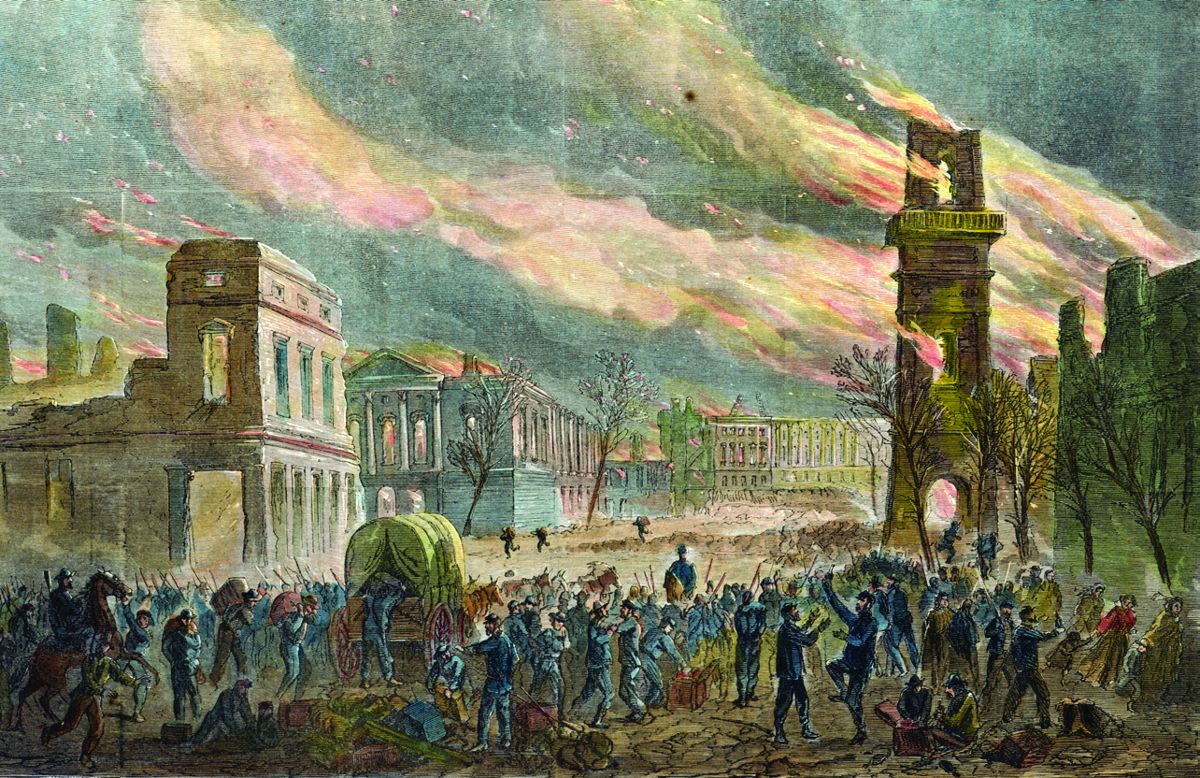
Paths of Destruction S herma n ’ s Fin a l C a mpa ig n See a life-size diorama of Columbia in flames, excavated relics, weapons, interactives and much more on display through May 28!
The author substitutes the fields and camps of battle for the comforts of hearth and home. The theme here is what the true spirit of the season should be. The illustrations are majestically presented and enhance the text perfectly. The large-scale format makes it easy for young readers to grasp. Although it is a rather short story, it is right on point. It is meant to encourage our youth to be less concerned with themselves and share with those less fortunate. It tugged at the wings of my better angels. This is a tale that stresses the need for compassion, and that is something we can never get enough of. This is a wonderful book to start our young “buffs” with, but you better hurry before the minions of “political correctness” petition to have it removed from bookshelves. Reviewer Joseph A. Truglio is president and business agent for a motion picture film technicians local union and a lifelong student of the Civil War. His memberships include the Lincoln Group of New York and New Jersey Civil War Heritage Assn. He is president of the Phil Kearny Civil War Round Table in Wayne, N.J.
Antietam Battlefield Guides The 1862 Maryland Campaign
Gettysburg 1863 — Seething Hell: The Epic Battle of the Civil War in the Soldiers’ Own Words. By Thomas R. Pero. Illustrated, photos, maps, bibliography, index, 426 pp., 2016, Wild River Press, www.wildriverpress.com, $75.
Thomas Pero is a Seattle-based travel journalist who for 16 years was the editor of Trout magazine. He has produced a 6-pound, 9-inch-by12-inch, 406-page, heavily illustrated book on the battle of Gettysburg. Pero’s publishing firm, Wild River Press, usually specializes in posters, greeting cards and photograph-books of trout, grouse, tarpon and salmon. So it is something of a surprise to find among Wild River’s offerings Gettysburg 1863 — Seething Hell, which Pero has not been shy about touting as a “lavish production,” offering “a stunning new perspective on the most famous battle of the American Civil War.” Maybe. The question that led Pero to Gettysburg was one many Gettysburg enthusiasts have tinkered with: “What would it have been like?” By his own reckoning, Pero has “spent every day for the last three years asking this question,” and his answer has taken the form of an anthology of excerpts from the diaries and letters of the soldiers who actually marched and fought at Gettysburg. This is not the first time such a collection has been offered. Richard Wheeler’s Witness to Gettysburg (1994), Richard Rollins’s Pickett’s Charge: Eyewitness Accounts (1994), and Jim Slade and John Alexander’s Firestorm at Gettysburg (1998) all pulled-together personal accounts of the battle to create a youare-there impression. But Pero implies that Seething Hell will be different – not only a far larger selection, with maps and photographs in a large format, but unpublished materials like the letters provided him by a granddaughter of George Buswell of the 33rd Virginia, or the “letters, diaries, notes written by dying soldiers, battle reports” from “large archival boxes” at Gettysburg National Military Park. There are, however, two problems with this. One is the difficulty every battle historian encounters: battlefield myopia. A soldier in combat is necessarily in the middle of the most terrifying experience anyone ever encounters and in that environment the reality a soldier can afford to notice shrinks to a perimeter of about 36 inches in radius. The British war journalist Richard Holmes recalled (in Acts of War: The Behavior of Men in Battle) that even decorated soldiers were frequently unable to see their behavior as heroic because, at the time, they scarcely knew what they were doing anyway. In the Civil War, the use of black-powder muzzle-loaders ensured that battlefields would become so densely smothered in powder smoke that few men on the line had any idea of what was going on elsewhere. Journalists may believe that direct reporting can write the first draft of history, but no one who has spent time with soldier letters and diaries of the Civil War will leap automatically to that conclusion. A worse problem, though, comes in the form of Pero’s suggestion that he is employing “thousands of pages of original letters, journals and diaries…from dozens of historic collections.” In some ways, he is, but what he offers is neither “new” nor “stunning.” If we take the first hundred pages of Seething Hell as a guide, we discover extracts from the letters or journals of 30 individuals, of whom five are civilians, 15 are Confederates, and 10 Union. Eighteen of these have long been published in various “hard” formats, while four others are available in accessible digital format or as digital images. Pero does sometimes post images of the original letters he is excerpting, as he does, for instance, with Tally Simpson’s letters. But the actual texts are, for the most part, very familiar ones. Nor do Pero’s excerpts follow his initial promise to tell his story without “bias…staying true to the experience of those who did the fighting.” In this sample, Confederate sources easily over-balance Union ones. Thomas Lewis Ware (whose five-volume diary was used for its Gettysburg portions by Mark Nesbitt in Five Days to Gettysburg: The Campaign Diaries of Two American Enemies) earns 13 entries in the first quarter of Seething Hell. He is followed by Nimrod Newton Nash (13th Mississippi) at six and Tally Simpson at five. The most any Union soldier gets is five extracts by Manley Stacey of the 111th New York (whose letters can be read at the website of Historical Society of Oak Park and River Forest in Illinois). What Pero’s documents lack in novelty is made up for by the 600 photographs splashed across Seething Hell’s pages. Curiously, Pero chose to include almost nothing from the body of contemporaneous battlefield photographs made famous by William Frassanito. Pero instead equipped a team of professional photographers to accompany reenactors to the Gettysburg battle sesquicentennial in 2013 and, in numerous instances, stage lurid recreations of blistered feet, bloody heads, blood-spattered stunt falls, exploding skulls and flying bodies propelled by shell-bursts. These images make Seething Hell seem more like a heaving mess and give the book an eerie sense of looking like war pornography – of people playing at being grotesquely butchered, and with no other discernible purpose than provoking a titillated “Oh, yuck!” These images are then mixed with more conventional shots of reenactors on the march, wading streams, firing by volley – and all, strangely, in black-and-white, which I can only suppose is intended to confer on the photographs a verisimilitude of 19th-century photography. Perhaps there are readers who find “realistic” recreations of mutilation entertaining. I do not, and I have never known any reenactors who do. If anything, such images mock the horrors of war – not to mention the maiming and death of Civil War battlefields – and turn them, in the name of “reality,” into a theater of perversion. What is worse, we know perfectly well that Civil War munitions did not merely dirty and bloody their victims. They dismembered them, tossed body parts into the air, mashed them with solid shot and occasionally blew them into obliteration. If “realism” is the excuse, I dare the entertainers to recreate and photograph that. Ironically, the book’s title – Seething Hell – is drawn from Walt Whitman, who never actually witnessed a battle at any time during the Civil War, although his brother, George Washington Whitman, certainly did. Stuffed-chair poetry of that sort comes easily to those who have never actually been shot at, but I question how reliable an answer it provides to the question, “What would it have been like?” I have the same skepticism about Seething Hell. Reviewer Allen C. Guelzo is the Luce Professor of Civil War Studies at Gettysburg College and the author of the New York Times best-seller Gettysburg: The Last Invasion.
Informative Essays About Good History Of First Georgia Cavalry Texans During Civil War Lone Star Unionism, Dissent, and Resistance. By Jesus F. De La Teja. Illustrated, photos, map, notes, bibliography, index, 296 pp., 2016, Oklahoma, www.oupress.com, $19.95 softcover, $29.95 hardcover.
This intriguing book describes Texas’s civil war within the American Civil War. Several essays describe fairly widespread opposition to secession, the Confederacy and the draft — as well as the resulting turbulence and violence. One essay describes the dissatisfaction of slaves with their bondage and their attempts to flee the state, especially into Mexico and the Indian Territory. Although the failure of Union forces to establish a significant presence in the state prevented the mass slave defections that occurred elsewhere, Texas whites became increasingly aware of their slaves’ disaffection.
Another essay portrays the slave owners who fled into Texas from other states with their slaves as Union armies advanced into the Deep South. Although some slaves fled during the interstate movements, others went willingly to keep their families intact. After the war, many ex-slaves left Texas to return to their “home” states in search of family members from whom they had been separated. Other essays describe the anti-secession and anti-Confederate activities of North Texans, East Texans (often German-Americans), Tejanos (Texans of Mexican origin), and Rebel deserters. These individuals faced violent opposition and death because of their views and activities. Individual and group lynchings were all too widespread for their comfort. Tejanos found themselves in a series of awkward positions. They often were labeled Mexicans and thus denied the right to vote and other benefits of citizenship. However, when Texas had problems meeting its draft quotas, they suddenly found themselves conscripted as Confederate citizens. This book is recommended for those interested in Civil War Texas or the role of Unionists, minorities and other dissenters in the Civil War South. Reviewer Edward Bonekemper is Civil War News Book Review Editor and author of six Civil War books, including The Myth of the Lost Cause: Why the South Fought the Civil War and Why the North Won.
The First Georgia Cavalry in the Civil War: A History and Roster. By Michael Bowers Cavender. Photos, roster, notes, bibliography, index, 268 pp., 2015, McFarland, www.mcfarlandpub.com, $39.95 softcover.
Although this book is nominally a history of the First Georgia Cavalry Regiment, it also evolves into a narrative about Lt. Gen. Joseph Wheeler’s cavalry corps — particularly during the later stages of the Civil War. It focuses on Wheeler’s triumphs and travails in contending against Union forces. Michael Cavender’s motivation to spend several years researching and writing this regimental history was the “need to understand the extent of their devotion to the states rights of Georgia and the Confederacy.” He is a descendant of William Washington Cavender, whom he describes as “the famous secret service man and scout” in Wheeler’s cavalry. Included are accounts of operations in the Department of East Tennessee under Lt. Gen. Edmund Kirby Smith beginning in mid-1862. The action shifts from Murfreesboro into Kentucky and back to Tennessee before moving south into Georgia — culminating in the Battle of Atlanta in July 1864. From that point on, the First Georgia regiment as a part of Wheeler’s cavalry fought tirelessly in a futile effort to interdict Union Maj. Gen. William T. Sherman’s March to the Sea and eventual push through the Carolinas. The author depicts Wheeler’s cavalry in general and the First Georgia in particular as frequently contending successfully against much stronger Union forces. He describes instances when the Rebels outwitted and whipped the enemy practically at will despite overwhelming strength in numbers. However, these accounts are based primarily on Confederate reports published in the Official Records, where objectivity is typically not a standard practice. One such account involved an event during August/September 1862 in Kentucky. Col. Joseph R. Scott, commander of a cavalry brigade that included the First Georgia, reported the capture of nearly 4,000 Union prisoners, 375 wagons, 1,500 mules and a large number of horses. Scott’s total force at the time numbered less than 900. The First Georgia had competent leadership throughout the war, beginning with its organizer Col. James Jefferson Morrison in April 1862. Speaking of Morrison’s confidence and capability, the author comments “[he] knew his regiment could whip any two Yankee regiments.” The regiment was constantly in the saddle on reconnaissance missions or in combat against the enemy. When Morrison received a temporary promotion to brigade commander following the September 1863 Battle of Chickamauga, Lt. Col. Samuel W. Davitte took the First Georgia reins. In combat at Philadelphia, Tenn., the brigade reported capturing 500 to 700 of the enemy, and killing and wounding a much larger number than Morrison’s loss of 14 killed and 82 wounded. Combat wounds caused Morrison’s resignation in April 1864, and Davitte received promotion to colonel of the First Georgia. The regiment took an active part in the grueling Atlanta campaign. Wheeler’s cavalry strove to harass and delay Sherman’s armies that pressed southward through the mountains. Sherman’s maneuvering forced Confederate commander Gen. Joseph E. Johnston to withdraw so often that President Jefferson Davis replaced him with Lt. Gen. John Bell Hood. Despite, or due to, Hood’s aggressiveness, Atlanta fell into Sherman’s hands on Sept. 2, 1864. Wheeler’s cavalry reported continued success against Union cavalry accompanying Sherman under Brig. Gen. Hugh Judson Kilpatrick’s command. Wheeler’s hit-and-run tactics kept Sherman’s forces on alert throughout their marches through Georgia and the Carolinas. The First Georgia Cavalry played an integral part in these operations. This regimental history includes a roster with annotations about the men who fought under its banner. There are no maps, however, in a book that is replete with the names of places throughout several states where this unit was engaged. Descendants of the participants and those interested in fighting units from Georgia will find this work required reading. Anyone with a particular interest in Civil War cavalry actions will also find it rewarding. Reviewer Thomas J. Ryan is the author of Spies, Scouts, and Secrets in the Gettysburg Campaign: How the Critical Role of Intelligence Impacted the Outcome of Lee’s Invasion of the North, June-July 1863. His website is www.tomryan-civilwar.com.
Enjoyable Novel About 16 Children Of ’63 Confederate Raider The Civil War Gettysburg Is Updated In North Atlantic Beyond Their Years: Stories of Sixteen Civil War Children. By Scotti Cohn. Photos, bibliography, index, 170 pp., 2016, Globe Pequot, www.rowman.com, $16.95 softcover.
Perhaps the fastest-growing genre in Civil War literature is biography. This small volume contains a series of biographies, and its unique voice is that of children who witnessed and participated in the war. The tales of 16 young people and their experiences during the war are included. Their backgrounds vary, but their wartime experiences are similar. Some are familiar, like Jesse Root Grant, the general’s son; Ed Fitzgerald, known popularly as Eddie Foy; and Rose Greenhow, the spy’s daughter. Other children are not so famous but are equally important and interesting. Each story is succinct, well written, informative and thought-provoking. For example, we see how Jesse Grant rode with Tad Lincoln, Ella Shepard survived slave rebellions, 13-year-old drummer boy Ransom Powell survived Confederate prison camps, and Eddie Fitzgerald grew up to be a famous vaudeville performer. A short bibliography provides sources for further study of each included child. This type of book is a favorite of mine. The biographies are a great source of information and a wonderful means to get youths involved in our history. Scotti Cohn is on the mark. I highly recommend that you get a copy for a young adult in your life and get him or her started on the historic journey. In fact, get a copy for yourself. You will be entertained and informed. Reviewer Joseph A. Truglio is president and business agent for a motion picture film technicians local union and a lifelong student of the Civil War. His memberships include the Lincoln Group of New York and New Jersey Civil War Heritage Assn. He is president of the Phil Kearny Civil War Round Table in Wayne, N.J.
Book Features Confederate Dead At
Gettysburg’s Confederate Dead: An Honor Roll from America’s Greatest Battle. By Robert K. Krick and Chris L. Ferguson. Roster, photos, 180 pp., 2016, Angle Valley Press, www.anglevalleypress.com, $22.95 softcover.
As Robert K. Krick makes plain in his preface, Confederate recordkeeping was a rather haphazard affair. Even the Compiled Service Records, which offer the most complete surviving contemporary records, are deficient. The company clerks who labored over musters, explains Krick, “produced them expressly to balance pay ledgers, not as documents of lasting historical importance.” A soldier killed at Gettysburg, for example, “fell into the same status as one merely captured, for payroll purposes, leaving no imperative to clean up the record subsequently.” Thankfully, the incomplete nature of surviving records has not stopped Krick and co-author Chris Ferguson from dedicating untold hours scanning a wide variety of documents and collating all they found to produce the most thorough and up-to-date roster of Gettysburg’s Confederate dead. Their combined four decades of labor have produced this updated edition (their first, The Gettysburg Death Roster, appeared in 2004) and identified 5,001 specific men. Most are from Virginia outfits, which, Krick explains, is largely the result of the writers who produced the regimental histories in H.E. Howard’s Virginia Regimental History Series. According to Ferguson’s introduction, every man who appears here was “killed in action or mortally wounded in the fighting of July 1-4 and [died] prior to Jan. 1, 1864, from wounds received during this four day period.” The limitation makes sense because one has to cut off the date of death related to wounds at some reasonable point. Also, those unwounded who were captured but died in captivity are thus excluded. The alphabetical roster could have been produced in a wide variety of ways, but the large book format and across-the-page listing makes it easy to read. Each entry in the death roster contains six columns: name, regiment (often including rank and company), birth, death, comment and burial. The comment section is always brief and includes such notations as “killed in action,” “died of wounds received on July 2,” or the name of the cemetery in which the soldier is buried. It seems as if the deluge of Gettysburg titles continues unabated. Many are unnecessary and add nothing to the literature, but Gettysburg’s Confederate Dead: An Honor Roll from America’s Greatest Battle stands apart in this regard. Krick and Ferguson’s accounting reflects deep and relentless research that will prove invaluable to historians, genealogists, specialist collectors and researchers. Reviewer Theodore P. Savas is the owner and managing director of Savas Beatie Publishing, an independent military and general history press. A former litigator, he taught college classes in business, law, and history for two decades, and is the author or editor of more than a dozen books in eight languages. He lives in El Dorado Hills, Calif. He can be reached at [email protected].
Digital Issues of CWN are available by subscription alone or with print plus archives from 2012 at www.CivilWarNews.com
August 1864: A Civil War Naval Adventure. By H.V. Rhodes. Historical fiction. 2015, Write Thought, www.thewritethought.com, $15.95 softcover.
On Aug. 6, 1864, the CSS Tallahassee, a two-screw steam sloop, slipped out of Wilmington, N.C., and began a raid up the North Atlantic coast that would net 33 Northern vessels. Her commander was John Taylor Wood, a grandson of Zachary Taylor and a nephew of Jefferson Davis. In this novel H.V. Rhodes only touches briefly on Wood. Instead he draws sympathetic portraits of fictional officers on the Southern ship and on a pursuing Northern frigate, the fictional USS Chowan. Lt. Matthew Deaton has given up a promising career and a possibly advantageous marriage to join the
Confederate navy. He deplores the cruelty of war that requires the destruction of Northern family-owned fishing boats and Union armies’ widespread destruction throughout the South. Quartermaster Nathaniel Brooks, a highly skilled navigator on the Chowan, lives in a world of bigotry and humiliation because of his African-American race. Readers will be thrilled by this account of the Tallahassee’s cruise and its daredevil escape back into Wilmington. They also will learn about day-to-day operations on a naval ship and the skills required to prepare a detailed navigational route. In truth, the Tallahassee was not a good candidate for raiding. Its steam plant and need for coal severely limited its range, and the vessel shortly resumed its career as a speedy blockade runner. Although it caused temporary consternation in the North, the raid’s chief result may well have been the redoubled Union effort to capture Fort Fisher and close the port of Wilmington. Readers will find this novel enjoyable and educational. Reviewer Patrick E. Purcell, a graduate of Northeastern University, is a retired railroad manager. He is a former president of the Old Baldy Civil War Round Table in Philadelphia and was on the Board of Governors of the Civil War Library and Museum in Philadelphia
Detailed Account Of Shepherdstown (W.Va.) In The War Mosby’s First Year Private John S. Mosby, First Virginia Cavalry: Picketing Fairfax County before Becoming the Confederacy’s “Gray Ghost”. By Gregory P. Wilson. Illustrated, photos, maps, notes, appendix, bibliography, index, 188 pp., 2015, Gregory P. Wilson, www.civilwarquakerscout.com, $25 softcover.
Perhaps no Civil War figure captures the imagination more than Col. John Singleton Mosby. The so-called “Gray Ghost” has been the subject of many studies over the decades, from Virgil Carrington Jones’s classic Ranger Mosby (1944) to more recent studies by such notable historians as Jeffry Wert and William Connery. While every book about Mosby chronicles what Jones referred to as the “thrilling incidents in the career of Mosby,” no study just describes Mosby’s experience during the war’s first year. That year proved critical in molding one of the conflict’s more intriguing personalities. Gregory P. Wilson has filled that void with this study. He has produced a fast-paced chronicle based largely on published sources and a smattering of unpublished manuscripts. After a brief first chapter outlining Mosby’s prewar life, Wilson presents a crisp narrative detailing Mosby’s every move as a private in the Washington Mounted Rifles (later Co. L, 1st Virginia Cavalry). He meticulously describes Mosby’s scouting in such places as the Shenandoah Valley and Fairfax County.
“A must-have reference tool for anyone wishing to understand the second day at Gettysburg” CWN
Gettysburg, July 2:
The Ebb and Flow of Battle BY JAMES A. WOODS Follow the movements of each Union and Confederate regiment and battery during the entire 24 hour period, often on a minute-by-minute basis. 164 full page maps with an additional 9 detailed maps depict the battle as never before attempted.
Preview sample pages on our website: www.gettysburgjuly2.com
ORDER YOUR COPY TODAY: $38 (plus $3.99 s/h) Canister Publishing | P.O. Box 43 | Gillette, NJ 07933 Paypal • Amazon • B&N Hardcover 8.5” x 11” | 735 pages Illustrations, Index, Appendices, Bibliography
Wilson does a fine job analyzing Mosby’s thoughts on the First Battle of Manassas — an engagement in which he did not participate — and capturing the excitement Mosby felt after killing his first Union soldier in autumn 1861. Mosby callously wrote about the killing to his wife with a gold pen taken from the dead soldier. Although some might view Wilson’s in-depth treatment of months of picket duty and scouting as somewhat pedantic, he makes a compelling argument that the time Mosby spent scouting, particularly in Fairfax County, played a significant role in educating him about “the land” where he earned his reputation as the Gray Ghost. Throughout this engagingly written book, Wilson traces Mosby’s movements and fixes them on today’s landscape with modern-road names and GPS coordinates. This allows readers who trek to Fairfax to follow in Mosby’s steps. This book also offers some insight into Mosby’s complex attitudes on slavery. He was no apologist for slavery’s existence in the antebellum South and believed that slavery was the source of secession and the war. A brief biographical sketch of Mosby’s slave Aaron Burton, who accompanied Mosby to the field, affords an opportunity to understand the complexities of the master-slave relationship in wartime. The inclusion of a chronology of Fairfax County events during the conflict’s first 11 months enhances this profusely illustrated volume. Although not a complete biography of Mosby, Wilson’s volume fills an important void in Mosby literature and serves as a nice complement to existing treatments of Mosby and his wartime exploits. Reviewer Jonathan A. Noyalas is assistant professor of history and director of the Center for Civil War History at Lord Fairfax Community College in Middletown, Va., and is the author or editor of 11 books on Civil War history, including the recently released Civil War Legacy in the Shenandoah: Remembrance, Reunion, and Reconciliation.
Shepherdstown in the Civil War: One Vast Confederate Hospital. By Kevin R. Pawlak. Illustrated, photos, map, notes, bibliography, index, 172 pp., 2015, History Press, www.historypress.net, $21.99 softcover.
Sept. 17, 1862, America’s bloodiest day, produced an overwhelming number of casualties. Add the battles of South Mountain, Crampton’s Gap and Harpers Ferry to the casualty list and you had a monumental disaster in western Maryland. Just about every church, farmhouse, public building and private home became a makeshift hospital. The community that was hit the hardest was Sharpsburg, Md., which adjoined the Antietam battlefield. But other nearby communities also bore their share of the carnage. Shepherdstown in Virginia (now West Virginia), was one of those nearby communities. With a population of less than a thousand, it had to cope with more than 6,000 sick and wounded. Even with the help of the locals, there were not enough doctors, nurses and medical supplies to keep up with the demand. The Army of Northern Virginia was said to have entered Maryland with over 2,500 wagons, but they l were insufficient to meet the need for ambulances. Therefore, countless unattended wounded suffered and died on the battlefield. The overwhelmed caregivers, with very little sleep, fought heroically, but the odds were against them. To make matters worse, disease ran rampant in the crowded, unsterile conditions they had to work in. Incoming Union artillery shells raining down on the streets and buildings made the situation hellish. As bad as it was when casualties flowed in from the battles of the gaps and Harpers Ferry, the maelstrom of Sept. 17 drove Shepherdstown to the breaking point. Both sides were illprepared to deal with never-imagined causalities of that great magnitude. The problem had existed since the war’s start. The Union army had a medical department with only 23 surgeons. The Confederacy had 11 with a budget of $350,000. Jefferson Davis appointed Dr. Samuel Preston Moore Surgeon General of the Confederacy by. He and his family had extensive medical backgrounds. The doctor began work immediately to prepare his department for what he believed would be a long war. During the Seven Days’ Campaign, Gen. Robert E. Lee appointed Dr. Lafayette Guild of Alabama as medical director for the Army of Northern Virginia. He was also well qualified for the job. Without much direction, it was onthe-job training for doctors Moore and Guild and their staffs. They both soon realized that the key to saving lives was to recover the wounded and transport them to safe medical help as quickly as possible. Shepherdstown in the Civil War will be especially welcome to students of the Maryland Campaign, the Confederate Medical Department, the plight of the wounded and the communities involved during and after a major battle.
Author Kevin Pawlak is an Antietam licensed battlefield guide and has served as an intern at other Civil War battlefields. His extensive study of the subject is evident in his concise and well-written text. He also gives a broad overview of the Maryland Campaign and the battles and skirmishes at Crampton’s Gap, South Mountain, Harpers Ferry and Boonsboro. As to the battle of Antietam, Pawlak covers in great detail the fighting at Miller’s Cornfield, Hagerstown Pike, the West Woods and the Sunken Road. The maps are well done. The many images are nicely reproduced, and the bibliography and endnotes are extensive. On your visit to Antietam, drive a few miles to Shepherdstown and be sure you have a copy of this book. Reviewer Michael A. Cavanaugh is the former editor and publisher of the Civil War Book Exchange, now Civil War News. He has authored and co-authored five books on the war.
1864 Battle History Mississippi Artillery Sergeant’s Diaries Of Trevilian Station Trevilian Station, June 11-12, 1864: Wade Hampton, Philip Sheridan and the Largest All-Cavalry Battle of the Civil War. By Joseph W. McKinney. Illustrated, maps, photos, notes, bibliography, index, 360 pp., 2016, McFarland, www.mcfarlandpub.com, $39.95.
While Brandy Station is considered the largest cavalry battle of the Civil War, Trevilian Station was the war’s largest all-cavalry battle. That’s because at Brandy Station two Union infantry brigades played small parts while at the time of Trevilian Station, west of Richmond, all Union and Confederate infantry brigades were east of Richmond taking part in the Overland Campaign’s closing days. Joseph W. McKinney sets the scene for the clash, taking us through the evolution of both armies’ cavalries, past and current leadership, arms, accoutrements and horses. The battle took place almost a month after Jeb Stuart’s mortal wounding at Yellow Tavern, and Robert E. Lee had not appointed his successor. Union Maj. Gen. Philip H. Sheridan’s orders were to break up the
The Maine Powder House
482 Sokokis Ave., Limington, ME 04049 phone & fax (207) 637-3775 E-mail: [email protected] www.mainepowderhouse.com Authorized Distributer of: The title of this work is somewhat misleading since bayonets are neither referenced in the index nor in the
Your Black Powder Source!
Virginia Central Railroad northwest of Richmond and proceed west to the Shenandoah Valley destroying bridges and facilities along the way. Confederate Maj. Gen. Wade Hampton was senior to Maj. Gen. Fitzhugh Lee and coordinated the efforts of their two divisions as they thwarted Sheridan. The South was beaten on the first day but fought the Union to a draw on the second day. This result caused the isolated Sheridan to retreat and shoot many broken-down horses on the way. The book covers the pursuit and retreat to Union lines, the Battle of Samaria Church, a Confederate victory that, according to a trooper in the 1st Massachusetts Cavalry, was “the most disorderly retreat I have seen.” A plaque placed on the Trevilian Station battle site by the United Daughters of the Confederacy in 1926 states that it was the “Greatest All-Cavalry Battle of the War” and a “Signal Confederate Victory.” McKinney ends the volume by stating: “It is likely that all Confederate participants, and many Union participants as well, would agree with both assertions.” The author brings a vast amount of scholarship to bear on this battle — along with his knowledge of military leadership, strategy and tactics and of horses and horsemanship. This is an interesting, wellwritten book. It will appeal to Civil War buffs interested in the Eastern campaigns, the mounted branches of both armies, or the Civil War generally. It is highly recommended. Reviewer Joseph A. Derie is a VMI graduate and a longtime Civil War buff and military book reviewer. A retired Coast Guard officer and Merchant Marine licensed officer, he is a Certified Marine Investigator and marine surveyor.
To Succeed or Perish: The Diaries of Sergeant Edmund Trent Eggleston, 1st Mississippi Light Artillery regiment, CSA. Edited by Lawrence Lee Hewitt, Thomas E. Schott and Marc Kunis. Illustrated, photos, maps, appendices, notes, bibliography, index, 248 pp., 2015, Tennessee, www.utpress.org, $49.95.
This book is a welcome addition to Confederate historiography in the Western Theater. Too few published primary sources are available – especially about the 1st Mississippi Light Artillery. There are the usual disappointments in Edmund Eggleston’s diary because it, like most, is incomplete. Especially regrettable is the lack of entries during most of the inland Vicksburg campaign. Though three editors are listed, this volume was primarily edited by Lawrence Lee Hewitt. He does an admirable job mending the continuity of Eggleston’s account. Eggleston, born in 1833 in Wilkinson County, Miss., divided his diary into two volumes. The first, surviving only in typescript, covers 1862 to May 9, 1863. The second includes one entry in late 1863 and, in the most informative part, covers much action in Georgia in 1864. Hewitt fills gaps with narratives about where Eggleston’s Co. G was serving. Several appendices list the company’s bookkeeping accounts. Another contains rather mundane entries about documents omitted in the second diary. Although the entries describe only the letters’ dates and recipients, genealogists will welcome them. There is also an appendix of “Other Documents,” which are official in nature but relate only to Eggleston. One is a letter to Jefferson Davis regarding an assignment request. Davis passed the letter along to a member of his cabinet, and it made a long trip through the bureaucracy. It did not, however, result in an assignment to commissary duty that both Eggleston and his mother had requested. The last appendix is a roster of Co. G. It includes more information of genealogical value. Included are maps of battles at Resaca, Cassville, Kennesaw Mountain and Allatoona and of Civil War Atlanta. The maps are disappointing because small print makes them difficult to read. They need to be larger and more informative. They are not marked with the locations of Eggleston’s battery during all the fighting. Fortunately, the Battle of Franklin map is better, and the map of the Nashville fight clearly depicts where Eggleston and his comrades had to abandon their guns. Eggleston served the remainder of the war (1865) in the unsuccessful Confederate defense of Mobile. There are no diary entries for that period. He lived his postwar years in Vicksburg, where he died at 62 in 1896. Historians will find entries of value throughout Eggleston’s diary – especially descriptions of the Atlanta Campaign. He provides details of the fighting around Atlanta, including the number of rounds Co. G fired: May 21, 86; May 22, 103; May 23, 53; May 24, 206. These entries place readers in the battle lines and provide an understanding of artillerists’ lives in battle. Eggleston’s diary has many such nuggets. So instead of lamenting the gaps, historians can be thankful for the pages that survived. Hewitt does a fine job bringing the project together and providing thorough documentation. This not inexpensive book is well worth the price for those interested in Civil War artillery, the life of the common artillerist and the social interaction among the battery members. The book is one in the University of Tennessee Press’s “Voices of the Civil War” series, and it is delightful to hear Edmund Eggleston’s voice among those previously published. Reviewer Michael B. Ballard is Professor Emeritus of Libraries, Mississippi State University, and author and editor of 14 books.
Little New In Book About Impact Of Disease In American Military History Bacteria and Bayonets: The Impact of Disease in American Military History. By David R. Petriello. Illustrated, photos, notes, bibliography, index, 264 pp., 2016, Casemate, www.casematepublishing.com, $32.95.
Civil War chapter. David Petriello describes the impact of disease in American military history from Columbus’s explorations through the recent terrorist activities. Each chapter has a catchy name to capture readers’ attention. Malaria, dysentery, diarrhea, typhoid and influenza are among the many maladies addressed. The author does a good job telling the story of how battlefield medicine has evolved to keep up with changing tactics and different types of enemies. While this work outlines several medical advances made during America’s wars, it provides very little new analysis and relies heavily on published secondary sources. It is disappointing that bayonets are essentially not covered. This weapon/tool was used not only for hand-to-hand combat, but for cooking and a variety of other functions. Although it was not a major battlefield weapon, the bayonet would have been an interesting topic – particularly an examination of how its uses might have impacted the spread of various bacteria. The main focus of my analysis was chapter nine, “Johnny Dysentery and Billy Typhus.” It contains several factual errors. Union Gen. George McClellan did not face Confederate Gen. Robert E. Lee in western Virginia. Gen. John Pemberton’s surrender to Gen. Ulysses S. Grant was not unconditional. There is much debate about where Lee was camped near Gettysburg in July 1863. The Thompson House served as his headquarters, but that doesn’t necessarily mean he remained encamped there. Readers wanting gimmicks and catchy titles will find this work very appealing. Scholarly readers will find this book a bit pricey for a work that relies almost totally on already published materials. Reviewer Richard J. Blumberg has a master’s degree with honors in Civil War studies. He is past president of the Houston Civil War Round Table and is a speaker for that group and the Society of Women in the Civil War. He also reviews books for the Blue and Gray Education Society.
Intriguing Telling Of Streight’s Essays About War In Indian Territory Foiled ’63 Raid On Railroad Streight’s Foiled Raid on the Western & Atlantic Railroad: Emma Sansom’s Courage and Nathan Bedford Forrest’s Pursuit. By Brandon H. Beck. Illustrated, photos, maps, appendices, notes, bibliography, 112 pp., 2016, History Press, www.historypress.net, $21.99 softcover.
This small, highly illustrated volume tells the story of Col. Abel D. Streight’s mule-mounted infantry raid against the Western & Atlantic Railroad. This railroad ran from Atlanta, Ga., to Chattanooga, Tenn., with many connections. It was one of the Confederacy’s main transportation links and highly important to the Rebel war effort. Streight’s Foiled Raid begins with the story of the railroad and the first Union attempt against it, the “Great Locomotive Chase” in April 1862. After a good description of James J. Andrews and the “Chase,” the book gives brief biographies of the main characters involved in Streight’s Raid. It then describes the April and May 1863 raid. This account would not be complete without a description of Confederate Gen. Nathan Bedford Forrest’s dogged pursuit of the raiders. Forrest’s chase is the subject of many tales that have become legends. Streight led his mounted infantry from Murfreesboro, Tenn., through portions of Mississippi and Alabama in an effort to get to Rome, Ga., where a branch line (the Rome Railroad) connected to the Western & Atlantic (W&A). From there, it was a short distance to the W&A, where they could begin their destructive work. Unfortunately for them, Forrest had different ideas. Although outnumbered, he pushed the Yankees ruthlessly, giving them no relief. In the end, Streight abandoned the attempt to hit the W&A and tried to escape. One of the legendary but true narratives is that of Emma Sansom. Streight’s men destroyed a bridge over Black Creek, which Streight thought would finally give him the respite he needed. Forrest asked at a local house if there was any other way to cross the creek. A 15-year-old girl, Emma Sansom, said there was a nearby low-water ford where Forrest’s troopers could probably cross safely. Forrest took her up behind him on his horse and she showed him the way to the ford. The author, Brandon Beck, provides us with Emma’s own story of how she helped Forrest. The ford that Sansom showed Forrest allowed him to finally catch up with Streight’s main body. The story of how Forrest convinced him to surrender is another that has become almost mythological — among the many yarns that are spun around Forrest, the “Wizard of the Saddle.” In case the story of Streight’s Raid is new to some readers, I will not divulge this tale. This book has some great illustrations and maps. I highly recommend this modest volume to anyone interested in the war in the Western Theater, Nathan Bedford Forrest or a good story well told.
The Civil War and Reconstruction in Indian Territory. Edited by Bradley R. Clampitt. Map, notes, index, 200 pp., 2015, Nebraska, www.nebraskapress.unl.edu, $25 softcover.
This volume consists of an introduction and eight scholarly essays spanning the gamut of the Civil War in the Indian Territory. “Bitter Legacy: The Battle Front” covers the war in the Indian Territory and parts of Missouri and Arkansas.
“Hardship at Home: The Civilian Experience” covers the war the civilians endured. The suffering of both Union and Confederate sympathizers was as bad as or worse than that of civilians in any other part of the country. “Our Doom is Sealed: The Five Nations in the Civil War” discusses the choices the major tribes in the Indian Territory (Cherokee, Chickasaw, Choctaw, Creek/Muscogee and Seminole) had at the beginning of the war. As Bradley Clampitt points out, the eventual choices were made “not necessarily out of affection for the Union or Confederacy.” “‘The Most Destitute’ People in Indian Territory: The Wichita Agency Tribes and the Civil War” tells the little-known story of the Wichita Tribe and its agency, which was located in the westernmost portion of the Indian Territory. This area was far from the major battlefields of the Indian Territory but close to the Comanche and other hostile tribes. Two essays cover Reconstruction. “Who Defines a Nation?: Reconstruction in the Indian Territory” discusses the Federal government’s move to end the sovereignty of the Five Tribes after the Civil War.
In “‘We Had a Lot of Trouble Getting Things Settled after the War’: The Freedpeople’s Civil War” the author points out that “the freedpeople found themselves caught in a second civil war for their rights as members in the Five Nations.” Two memory essays complete the volume. “Hearth and Home: Cherokee and Creek Women’s Memories of the Civil War in Indian Territory” contains interviews conducted during the 1930s Writers Project. “To Reach a Wider Audience: Public Commemoration of the Civil War in Indian Territory” is about “bringing historical research to the public consciousness through historical reenactments and ‘living history.’” This is a serious, scholarly book with some excellent essays. It is highly recommended for Civil War buffs interested in the Indian Territory and the Trans-Mississippi during the Civil War and Reconstruction. Reviewer Joseph A. Derie is a VMI graduate and a longtime Civil War buff and military book reviewer. A retired Coast Guard officer and Merchant Marine licensed officer, he is a Certified Marine Investigator and marine surveyor.
Historical Fiction Work Portrays Waste Of War The Waste of War: The Story of a Civil War Union Surgeon and His Nurse. By Carole Emma Matthewson. Historical fiction. 336 pp., 2014, Mogollon Press, [email protected], $19.99 softcover.
Lt. Col. Harley P. Matthewson, a doctor, and his wife and nurse Mary Sanborn Matthewson were ancestors of the author. Beginning with an ancestry research endeavor, Carol Matthewson has crafted a story of love, devotion and service to the Union. Following the Matthewsons from their initial surge of patriotism after Fort Sumter, the author travels with them through the Civil War. She highlights their service from Yorktown and Williamsburg to Fair Oaks, the Seven Days, 2nd Bull Run, Antietam, Vicksburg, Fredericksburg and the Red River campaign. Conversations involving the war’s luminaries, such as Abraham Lincoln, Ulysses S. Grant, George McClellan, Joseph Hooker and Walt Whitman, are contrived, but generally seem historically accurate. They simultaneously convey the author’s major theme that war is terrible and the human cost of failing to compromise political disputes. Harley and Mary Matthewson seem to always be where battlefield action occurs. Amputating shattered limbs, battling scarlet fever outbreaks and writing to dead men’s families show both their medical skills and their humanity. They never waver in their support of the Union and opposition to slavery. Nonetheless, they assess individual generals’ abilities and, using comments by ordinary soldiers, lament how inexperienced leaders cause tremendous human suffering. They admire both Gen. George McClellan for his concern for his troops and Gen. Ulysses S. Grant for his desire to end the war quickly. They are equally vociferous in their criticism of generals Ambrose Burnside and Joseph Hooker for needlessly wasting lives in frontal assaults. Finally, they constantly praise President Abraham Lincoln as a kind, fair and gentle leader whose love of country motivates his actions. Throughout the novel, military actions play a secondary role to the author’s four main points: (1) Mary
Matthewson’s courage in shredding feminine myths and braving the horrors of war, (2) Dr. Harley Matthewson’s adherence to modern visions of cleanliness and compassion as the medical profession’s dual responsibilities, (3) the worth of human life and how political decisions cost families their loved ones’ health and happiness, and (4) how politicians should strive to become instruments of peace instead of catalysts for human carnage. Despite a few historical errors, the novel reflects both historical fact and myth. The conversations allow the author to emphasize her themes using both historical figures and literary license. My only criticism of the style is that the conversations appear too scripted, formal and stiff to reflect 19th-century discussions. This historical fiction work is recommended for those opposed to war; those tasked with dealing with the medical, emotional and social aftermath of war; and politicians who contemplate sending young men into harm’s way. Reviewer Wayne L. Wolf is Professor Emeritus at South Suburban College and the author of numerous books and articles on the Civil War including The Last Confederate Scout and Two Years Before the Paddlewheel. He is past president of the Lincoln-Davis Civil War Roundtable.