
Teresa Roane Is Finding Blacks Who Fought For Confederacy
By Nancy Jennis Olds · Originally published March 2016 · p. 16
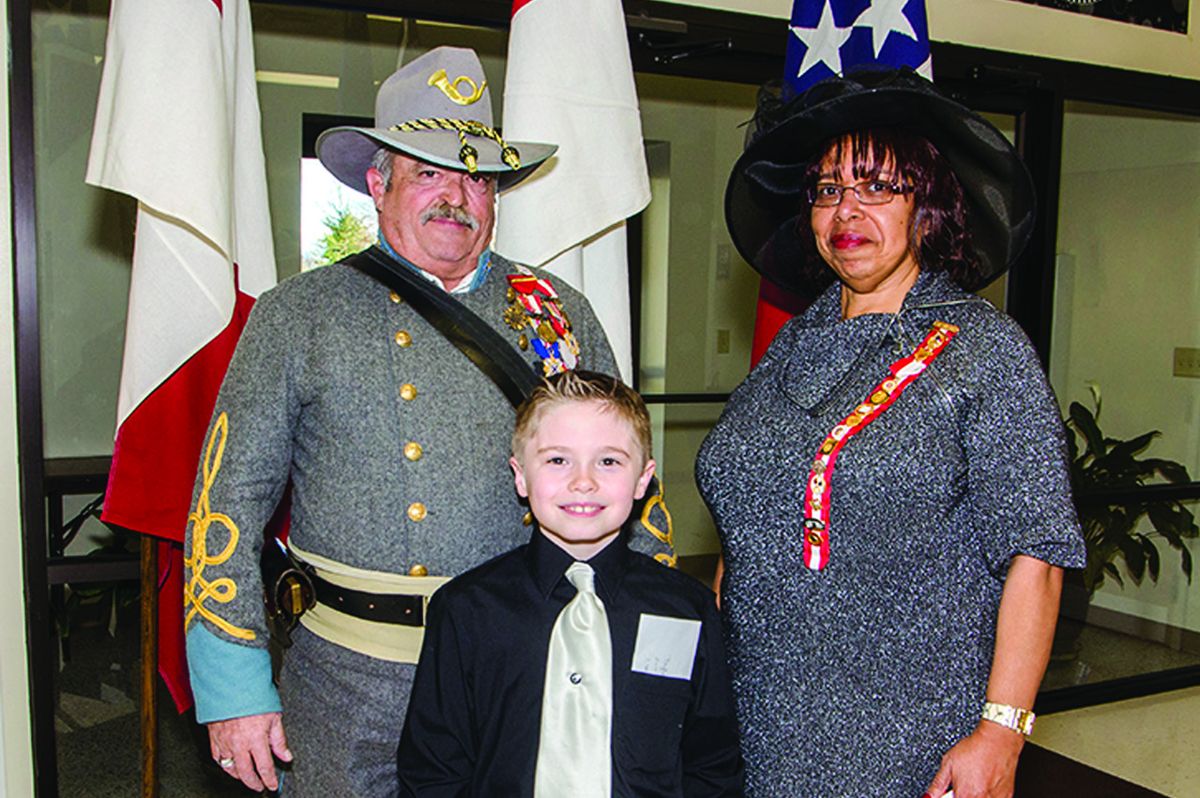
Teresa Roane Is Finding Blacks Who Fought For Confederacy By Nancy Jennis Olds BRANDY STATION, VA. — Did blacks serve in the Confederate States military or were they present on the battlefields and in the camps serving their masters? What about the free men of color in the states that seceded? Did they leave or remain and fight? Teresa Roane, archivist for the United Daughters of the Confederacy (UDC), says that meticulous research of muster rolls, pension records, letters and other documents provides a more complicated answer to such questions than previously acknowledged. She spoke on “Minorities in the Confederate Military” at the UDC Culpeper Chapter 73 program, “Lee-Jackson Commemoration-Minorities In the Confederate Military,” to which area Civil War organizations and student essay contest winners were invited. Roane’s great-great-grandfather was a free man of color who worked for the Confederacy as a hired laborer for full wages at Gloucester Point Fort. A former archivist for the Museum of the Confederacy, she is proud of her connection with Confederate Civil War heritage. Her research was prompted by a friend’s comment that there were no black Confederates, only body servants, teamsters and musicians who were never paid or listed on any muster rolls. She decided to learn what had happened to the African Americans, Native Americans, women and other minorities who served in the Confederacy. Photographs and films show aging veterans, including blacks, at reunions. If African Americans didn’t serve in the Confederacy why did they attend Confederate veterans’ reunions and stand side by side with them shaking hands? Why are they in their best suits, some wearing ribbons and medals, with these elderly white Confederate veterans? Roane has examined documents in the National Archives, museums, and state records that indicate African Americans did participate in the Confederate army, marines and navy. She found names with physical descriptions attached, muster rolls, discharge papers, prisoner exchange documentation and state pension records. She was able to determine quite a few names. There was Charles Dempsey, a private and cook for the 2nd North Carolina Artillery who was captured and sent to Point Lookout, Maryland, prisoner of war camp. He was released through the prisoner exchange system. Another Dempsey, Henry, of the 36th Regimental North Carolina Artillery, was captured at Fort Fisher, imprisoned at Point Lookout, and was also exchanged. George Price, a free man of color, became a member of the 18th Virginia Infantry according to information in his discharge papers. Pvt. Richard Poplar was a member of Co. H, 13th Virginia Cavalry, Sussex Light Dragoons. He was captured at Gettysburg, sent to Fort Delaware, and spent 14 months at Point Lookout. He refused to sign the Oath of Allegiance. After his 1886 death in Petersburg, Va., Poplar “was buried with full Confederate honors as befitting a loyal Son of the South,” according to Find A Grave — Black Confederates, created by Martha Reid. Blacks, slave and free, worked as musicians, teamsters, cooks, hospital attendants and farriers. One, named Ellick, listed as a Negro, was a farrier with the South Carolina Artillery. Pvt. Jefferson Shields was a body servant of Col. James Kerr Edmondson and the cook for the Stonewall
(Nancy Jennis Olds) Brigade. Shields’s headstone in Evergreen Cemetery, Lexington, Va., reads: “Company H 27th Virginia Infantry, the Stonewall Brigade, CSA.” A photograph from a Confederate veterans’ reunion, shows a white-bearded Shields wearing several ribbons and pins on his chest. At a Stonewall Brigade reunion in Staunton, “Uncle” Jeff was voted in as a member and authorized to wear a brigade badge. Roane said black Confederates are buried in both Hollywood Cemetery and Oakwood Cemetery in Richmond. Local historian and community activist Veronica Davis is said to have seen the words “Colored Confederates” on an old map of Oakwood Cemetery. She was unable to get a photocopy and the map has not been located since. The estimated number of black Confederate soldiers varies. It is possible that some passed as white, which happened in Union armies.
Some men assigned to other jobs were pressed into service and given arms out of necessity. Union officers reported black Confederates serving as pickets, manning artillery and fighting in battles. Abolitionist and author, Frederick Douglass, a former slave, once observed the presence of black Confederates: “There are at present many Coloured men in the Confederate Army doing duty not only as cooks, servants and labourers, but real soldiers, having muskets on their shoulders, and bullets in their pockets ready to shoot down loyal troops, and do all that soldiers may to destroy the Federal government and build up that of the traitors and rebels,” he wrote in September 1861. African Americans also served the Confederate States Navy as coal heavers and officers’ stewards and were highly prized as skilled tidewater pilots, Roane said. Some served on raiders and ironclads including the CSS Alabama, the CSS Virginia II and the CSS Shenandoah. Black marine W.S. Lewis served on the CSS Atlanta and the famous raider, the CSS Alabama. He received a soldier’s pension from the South Carolina government on April 14, 1923. The Savannah Squadron commander wrote to Secretary of the Navy Stephen R. Mallory recommending Moses Dallas’s skills as a pilot: “I have also been compelled to increase the pay of Moses Dallas from $80 to $100 per month in order to retain him. He is a colored pilot and is considered the best inland pilot on the coast.” Roane also discussed another minority with deep connections to the Confederacy, the Five Civilized Tribes: the Creek (Muscogee), Cherokee, Choctaw, Seminole, Chickasaw. Brig. Gen. Stand Waite, a Cherokee, was the highest-ranking Native American in either army. Among other minorities who served the Confederacy were immigrants, including Germans, Irish, Chinese and Hispanics. Jews were a small minority of the Southern population, yet approximately 3,000 enlisted and Judah Benjamin served in the Confederate cabinet. In the waning days of the Confederacy, Benjamin argued for freeing and arming slaves to fight for the South. On March 14, 1865, the Confederate Congress approved General Orders Number 14 to do that, but it was far too late. Roane fears that segments of Civil War history are being subjectively removed and that black and other minorities who served with the Confederacy will be entirely left out of the history books and other historical records. “If we keep telling people this doesn’t exist, they’ll keep believing this,” she said.