
Mathew Brady’s Upstate New York Birthplace Debated
By Paul Post · Originally published March 2016 · p. 27
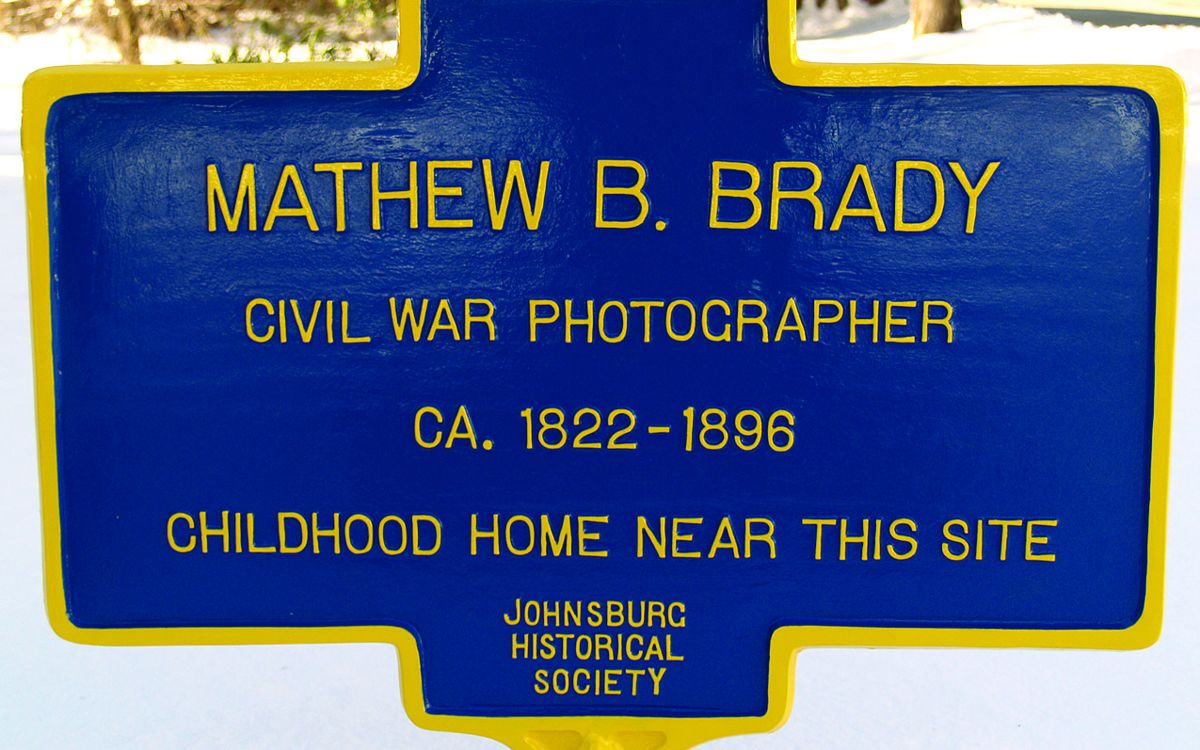
Mathew Brady’s Upstate New York Birthplace Debated By Paul Post JOHNSBURG, N.Y. — The thief who stole a historical marker dedicated to Mathew Brady, the Civil War photographer whose battlefield scenes shocked the American public, has never been apprehended. However, the thief may have unknowingly shed light on the truth about Brady’s origins and sparked international debate on the subject. In August 2014 someone took a roadside plaque that was near Brady’s supposed birthplace in Johnsburg, N.Y., a small town in the Adirondack Mountains. The sign read: “Mathew B. Brady. Civil War photographer. Ca. 1822-1896. Born near this site.” Whoever stole the sign went to great lengths, using a tractor to dig up the concrete base and metal pole that held the sign. Publicity about the strange theft sparked reaction from Brady scholars who insist he was born in Ireland and came to the U.S. as an infant or small child. To Johnsburg residents, already stung by the sign’s loss, such allegations inflicted worse pain on their wounded civic pride. There is compelling, but inconclusive, evidence that Brady was, in fact, born in the Emerald Isle. As a concession to such uncertainty, a new sign has been made that says: “Mathew B. Brady. Civil War photographer. Ca. 1822-1896. Childhood home near this site.” “It will be installed at the same site in the spring once the ground has thawed,” said Delbert Chambers, Johnsburg Historical Society president. “We have raised enough money to allow us to add other signage at the site, a very brief biography of Brady. We’re very excited about that.” Johnsburg resident Glenn Pearsall discovered the site of Brady’s boyhood home while researching a local history book. He cites several biographies that say this was Brady’s birthplace. But improved electronic archiving of historical documents, previously unavailable to researchers, tells a different story. Mary Panzer, a former National Portrait Gallery curator, wrote the 1997 book Mathew Brady and the Image of History, which says Brady was born in Warren County, N.Y. Now she thinks otherwise. “The evidence we have today was simply not available to me in the mid1990s, or not available in a form that
The Maine Powder House
“Brady, the photographer, returned from Bull Run,” July 22, 1861. (Library of Congress) I could use,” she said. “Digitized versions of the census records for New York State now make it possible to find records of Brady and his father. I regret that I did not track down the originals and pore through the volumes in search of the entries that would have confirmed Brady’s Irish origins, but it would have taken weeks or months, and one would have to know the addresses where each of the Bradys lived, more information I did not have.” Panzer admitted, “In hindsight, this sounds awfully lame to me.” She noted the alternative would have been dedicating weeks to search in archives “and would have depended, at least in part, upon luck.” The strongest evidence for Brady’s Irish origins are the 1855 and 1860 census records and Brady’s 1863 draft registration. For each document, Brady indicates that he was born in Ireland. It wasn’t until the 1870 federal census, and again in an 1891 New York World newspaper interview, that Brady said he was born in Warren County, N.Y. Why the change? “Team Ireland” scholars say Brady did this because he was struggling financially after the Civil War and hoped to sell his photographs to the U.S. government. In the anti-Irish era of the mid-19th century, promoting himself as an American citizen would help land a government contract, researchers say. However, there is no proof positive, either way.
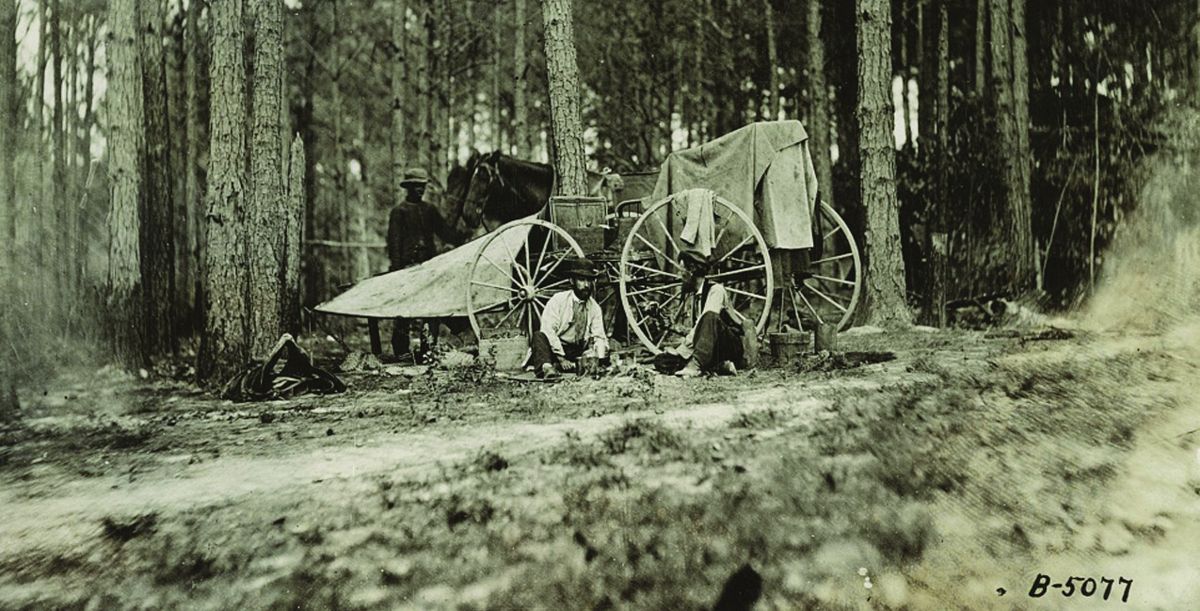
Pearsall points out that there are no immigration records indicating that Brady came to the U.S. with his parents. But there are no birth certificates in Johnsburg or Warren County offices, either. So no one knows for sure where he was born. “What is clear is that Mathew Brady was in Johnsburg with his parents at age 7, and probably years earlier than that, and lived there until he left for Saratoga Springs and New York City at age 16,” Pearsall said. “As such, Johnsburg, more than any other town, had more influence on his character as a man and his later achievement as the preeminent photojournalist of his time.” Pearsall supports the new sign’s “childhood home” reference. “The fact that we cannot say with certainty that he was actually born here versus arriving as an infant in no way diminishes the importance of Johnsburg, then a small settlement in the Adirondack wilderness, on his life,” Pearsall said. In Saratoga Springs, N.Y., Brady met and became a student of portrait painter William Page. In 1844, they went to New York City, where Brady studied under Samuel F.B. Morse, who also painted portraits, but is most famous for inventing the telegraph. Morse had learned the new art of capturing images with daguerreotypes, after meeting Louis Jacque Daguerre in Paris in 1839. Brady, too, became excited by this emerging technology and opened his first photographic studio at the corner of Broadway and Fulton Street in New York. In 1849, he established a studio in Washington, D.C., so that he could photograph the most famous men of his time. Abraham Lincoln credited pictures Brady took of him during the 1860 campaign for helping him become president by making his likeness known to voters throughout the country. Brady’s image of Abraham Lincoln is on the $5 bill. Because of his upstate New York roots and New York City studio, Brady is featured in the New York State Military Museum’s exhibit “Empire for Union: New York State in the Civil War,” now on display in Saratoga Springs. Special mention is made of “The Dead at Antietam,” the New York Brady studio exhibit that opened in October 1862, shortly after the Sept. 17 Battle of Antietam. The photos were taken by Brady photographers Alexander Gardner and James F. Gibson. This was the first time that cameras were used to document a battlefield before most the dead were buried, (Library of Congress) bringing into public consciousness the war’s horrific carnage. Huge throngs turned out to see the exhibit. Brady was a field photographer during the war’s first major battle, Bull Run, in July 1861. Thereafter, he sent cameramen in his employ to follow the army and take photos under the Brady name. By the war’s end, Brady and his staff had produced more than 3,000 photographs, an extremely costly effort that drained his savings. This explains why Brady, on the 1870 federal census, listed his birthplace as upstate New York, perhaps hoping to gain credibility with the government as an American citizen. In 1875, Congress paid him $25,000 for full title to his images, but it was not enough to pay off his debts. Broke and alone, he died in January 1896. Regardless of where he was born, one thing is absolutely clear. “Brady is one of the most important photographers in American history,” said Sandra Markham, an archivist at Yale University’s Beinecke Rare Book and Manuscript Library. She previously worked at the New-York Historical Society where she handled its extensive Brady photograph collection and wrote an article about it for the society’s journal. Markham said she is more than 90 percent convinced that Brady was born in Ireland. “One more pre-Civil War document citing Ireland and I’ll be at 100 [percent],” she said. A sentence from Markham’s treatise on Brady seems to sum up the ongoing debate: “Considering that his career was based on recording historical facts in visual images, Mathew Brady’s own origins are remarkably out of focus.”