
Two Antique Parrott Rifles New Home At Cedar Mountain
By Nancy Jennis Olds · Originally published June 2016 · p. 38
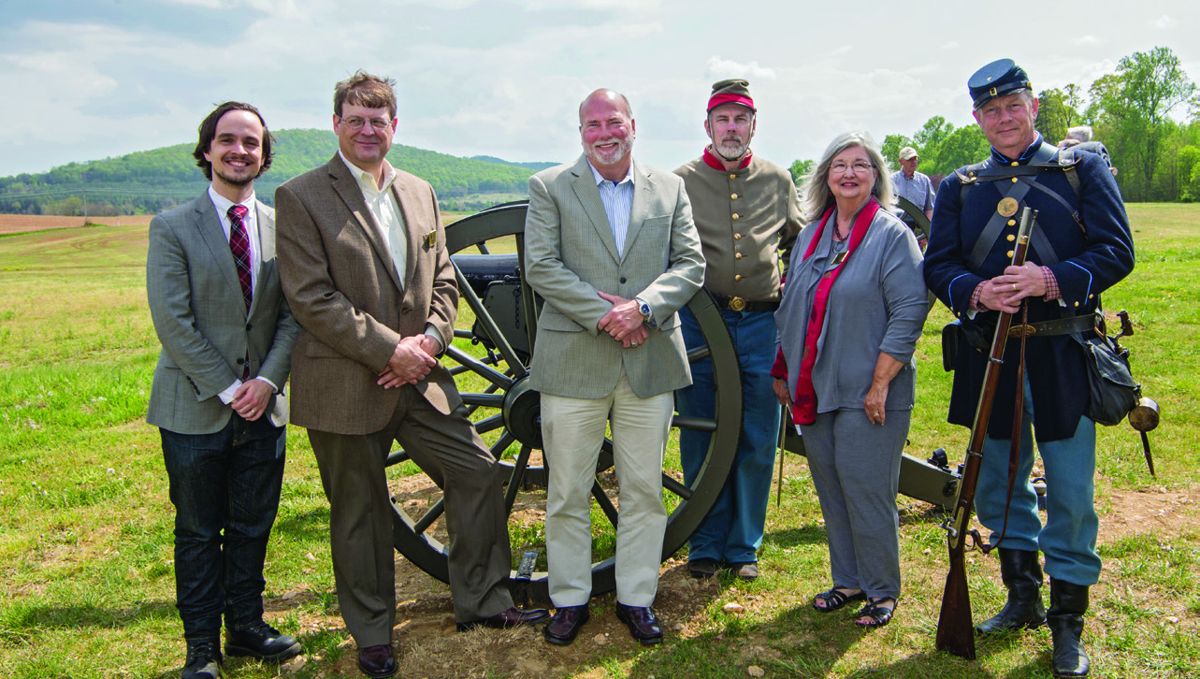
CEDAR MOUNTAIN BATTLEFIELD, Va.—On a beautiful spring day two 100-year-old replica Parrott guns, which formerly graced the historic General Lee’s headquarters in Gettysburg, were formally dedicated on April 23, 2016 at the Cedar Mountain Battlefield in Rapidan, in Culpeper County, Virginia. Part of the ceremony included a demonstration and several firings of a reproduction 10-pounder rifled Parrott by the Manassas’ Own artillery crew of volunteers from the Manassas National Battlefield Park, lead by Manassas Battlefield Park Museum Specialist Jim Burgess. The two 10-pounder rifled Parrott guns were “adopted” by the Friends of Cedar Mountain Battlefield after the Civil War Trust made its decision to offer FOCMB an opportunity to purchase the two cannons since the Trust had the guns moved away from the Seminary Ridge site once the Civil War Trust had acquired the historic property. The guns were moved from the Gettysburg battlefield because they were not historically appropriate for the site, according to Meg Martin, Communications Manager at the Civil War Trust. Elated with acquiring these two cannons, Lon Lacey, a member of the Friends of Cedar Mountain Battlefield Inc., coordinated the restoration of these two century-old plus reproduction cannons. A local restorer carefully sandblasted, primed and repainted the two guns, insuring that the paint color accurately matched period cannons. The restored wooden carriages were painted the original military green typical of the Civil War era. These fully restored cannons, which are not capable of being fired, have a new home in the Cedar Mountain Battlefield, surrounded by lush fields, rough-hewn fences and rolling hills with Cedar Mountain rising in the horizon “They are perfect,” Lacey said. “And they are historically placed. It definitely adds a lot to the interpretation of the battlefield.” The gun crew of the Manassas Battlefield Park provided several rounds of artillery fire for the crowd which included Diane Logan, President of the Friends of Cedar Mountain Battlefield, Mike Block, Vice-President of the Friends of Cedar Mountain Battlefield, Matthew “Matt” George, Land Stewardship Manager for the Civil War Trust, Jim Burgess, National Park Service Museum Specialist for the Manassas National Battlefield Park, and Mark Coombs, State and Local Relations Manager for the Civil War Trust. Mark Coombs greeted the audience filtering in for the ceremony mentioning that “together with the Friends, with the Brandy Station Foundation, with Culpeper County and all the member groups of the Brandy Station and Cedar Mountain State Park Alliance, the Civil War Trust is endeavoring to shine an everlasting spotlight on Cedar Mountain as well as Brandy Station.” Coombs added that with both the Cedar Mountain Battlefield and the Brandy Station Battlefield Park, the combined preservation community has permanently protected approximately 1,200 acres of historic battlefield. Coombs, among his remarks, reminded the audience that the Battle of Cedar Mountain, which took place on August 9, 1862, “was the first major, and bloodiest fight of the American Civil War to take place in Culpeper County.” According to Coombs, although the Civil War Trust and its over 250,000 members and supporters were proud in playing a vital role in preserving this land, “we believe, like Diane [Logan] and her team here at Cedar Mountain, that the Virginia state park system is ideally positioned to steward and promote these treasured landscapes moving forward”. Mark Block, Vice-President of the Friends of Cedar Mountain, and a member of our Bull Run Civil War Round Table in Centreville, Virginia, expressed his gratitude that the Civil War Trust contacted the Friends of Cedar Mountain Battlefield, offering them the chance to acquire two antique cannons. Block also thanked former FOCMB member Dale Duvall for coming up with a fundraising plan through Give Piedmont, thereby assuring funding for purchasing the two cannons. In a later interview that I had with Diane Logan, the FOCMB president mentioned some of the creative methods that her organization utilized to raise funds for the purchase of the two antique rifled 10pdr. Parrott guns. While continuing to raise funds for two years, Logan added, the FOCMB organized membership special events, private tours and received donations from several historical groups. Logan stressed that this was “truly a community effort”, people giving of their time, contributions, and talents. She mentioned Marvin Jenkins, the groundskeeper of the Cedar Mountain Battlefield who provided the trailer and transportation to transport the two cannons from Pennsylvania to the Cedar Mountain Battlefield. Block acknowledged the extraordinary achievements of the artillerymen during the Civil War. According to Mark Block, the artillerymen had to be athletic and highly skilled in geometry and physics to be able to operate their cannons. “ These men were a team”, said Block. “They trained endlessly, going over their tasks again, and again, and again. When a man went down, someone automatically stepped into that position. No matter what. They must be served, the enemy must be struck.” The Battle of Cedar Mountain, also known as Slaughter’s Mountain, occurred when Union Maj. Gen. John Pope’s Army of Virginia marched south into Culpeper County hoping to capture the railroad junction at Gordonsville. However, this strategy was challenged when the Federals confronted Confederate forces led by Maj. Gen. Thomas J. “Stonewall” Jackson and A.P. Hill at Cedar Mountain, so named for the mountain overlooking the battlefield. Union Maj. Gen. Nathaniel P. Banks’ isolated division was being threatened by General Jackson’s forces. Maj. Gen. John Pope called in for reinforcements, ordering Brig. Franz Sigel’s division to meet up with General Banks’ forces on high ground near Cedar Run. On August 9th, Gen. Jackson’s three divisions crossed the Rapidan River and encountered General Banks’ forces. While the heat climbed, the Confederates advanced their artillery, planning to attack the (Nancy Jennis Olds) Federal line. In the subsequent artillery assault, Confederate Brigadier Gen. Charles Winder was struck by shell fragments and succumbed to his wounds a few hours later. With the loss of Gen. Winder, Confederate forces were in danger of crumpling under the steady barrage coming from Gen. Banks’ troops as they pursued their advantage. Despite the danger of exposure to the enemy, Gen. Stonewall Jackson bravely rode into the center of the fighting, determined to turn the tide against the Confederates. During this crucial moment, Gen. Jackson attempted to draw his sword from its scabbard to lead his men. The sword was so rusted inside its scabbard that it wouldn’t budge. Undaunted, Gen. Jackson lifted his scabbard-encased sword above his head, grabbed a battle flag waving it as he rallied his forces. Federal forces, exhausted and almost out of ammunition, were steadily driven back. By 7 pm the Union line was in full retreat. Casualties were high on both sides with the Union suffering 2,353
(1,445 wounded) and the Confederates 1,338 (1,107 wounded). Vice-President Mike Block, representing the Friends of Cedar Mountain Battlefield, spoke of the courage, camaraderie, fates, triumphs and the moments of defeat for some of the Confederate artillery batteries that served with distinction at the Battle of Cedar Mountain. No doubt their courage under fire saved the day for Maj. Gen. “Stonewall” Jackson. But whether it was triumph or defeat on Cedar Mountain, Block wanted the audience to takeaway another thought, as these two cannons would remain on the battlefield from that day forward. “Today, it’s our challenge to carry on their story”, said Block. “The men of the ‘Roughs’ [Carpenter’s Battery] and Rockbridge Artillery, along with every other artillerist who served on both sides of this field, would be proud and honored to have two pieces on the field once again