
The Source
Supplement to the Official Records
By Michael K. Shaffer · Originally published June 2016 · p. 11
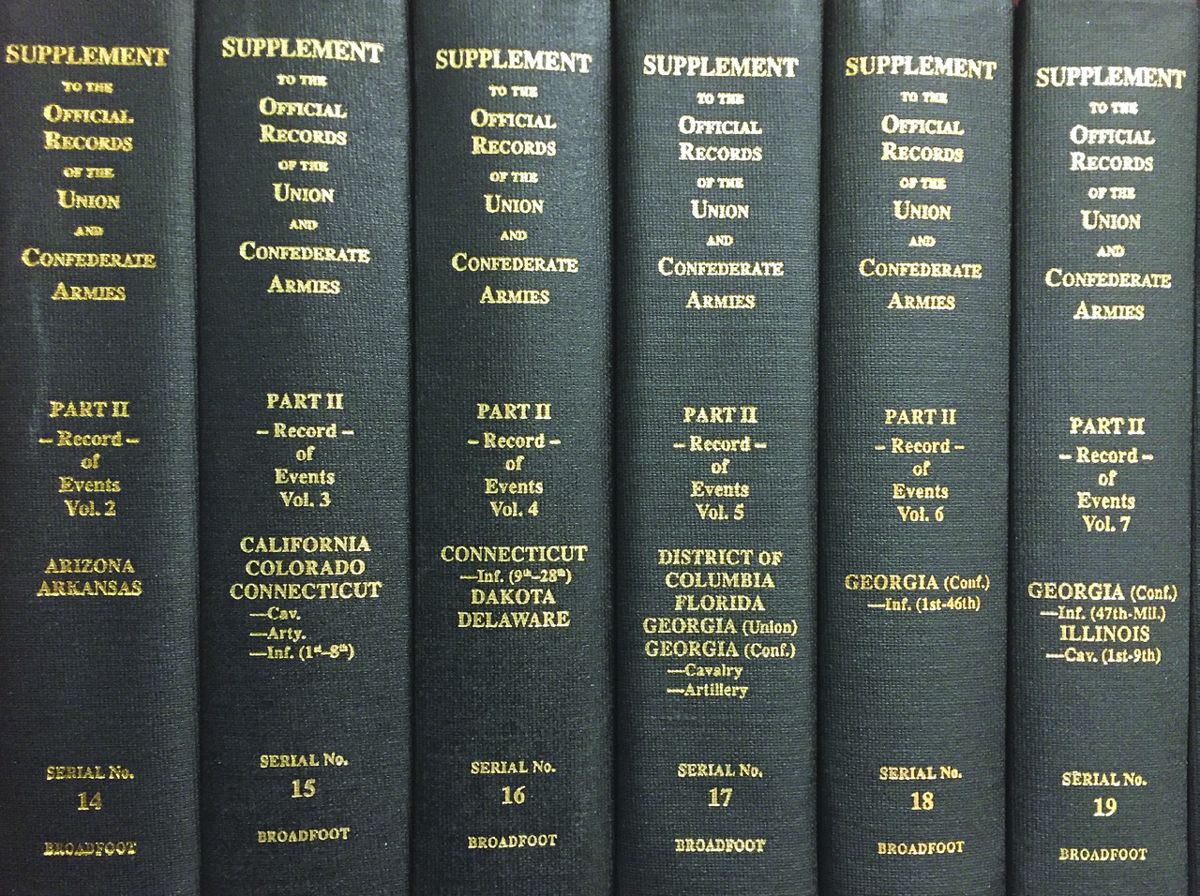
Supplement to the Official Records In an earlier installment of this column, we learned about compiling the Official Records, and discovered some documents - either overlooked or presented too late - failed to make the pages of the 128-volume set. Editor Janet Hewett - and many noted historians who served as co-editors – began work in the early 1990s, under the support of Broadfoot Publishing, to close this void. Their work, entitled Supplement to the Official Records of the Union and Confederate Armies, at 100 volumes, aids historians seeking added information. As stated on the Broadfoot website, http://www.broadfootpublishing.com/: “The Supplement contains twice as many names as does the original Official Records and, whereas most of the names in the original Official Records are of men ranking major and above, most of the names in the Supplement are ranked below major, and it is in the lower ranks that names and often information are hardest to come by.” Scouring the countryside - visiting many libraries, historical societies, and other institutions - a team of researchers began collecting and cataloging various reports and other records. Hewett oversaw development of procedures for labeling and indexing, and a method for corroborating the authenticity of each document received. To mirror the format of the Official Records, the work involved dividing the Supplement into three parts. A planned fourth part, one dealing with the Secret Service, remains unpublished. Part I includes various reports arranged in chronological order. The image shown depicts an excerpt from Part I, Volume 1, and provides an example of a cover page used to explain each section throughout Part I. Section Cover Page in Part I Following in each section of Part I, one will find a ‘Summary of the Principal Events.’ An example from the same volume previously noted appears as shown. This serves as a helpful index of the reports found in each volume. Most of these reports, never published elsewhere, came from the National Archives (Record Groups 94 and 109), from period newspaper accounts of participants, as well as material obtained from various journals and periodicals. The editors wisely opted to list each source, as this example shows: Captain John D. Imboden’s account of the Battle of First Manassas/Bull Run, came from the July 29, 1861, edition of the Charleston (SC) Daily Courier. Twelve volumes comprise Part I, and align with the O.R.; Volume one
Summary of Principal Events covers the period found in the first 10 volumes of the O.R., and the second Supplement volume encompasses volumes 11 and 12 of the O.R. Volume three aligns with volumes 1321; four with volumes 22-26; five to volumes 27-30; documents in six relate to volumes 31-37, and seven with volumes 38-50. The final five volumes contain the Warren Court of Inquiry documents, court-martial reports, information on the Signal Corps, and an index. Series II - arranged in alphabetical order according to state - provides a record of events (occasionally, incredibly detailed accounts), which enable researchers to pinpoint various geographical locations and dates of occupancy for regiments of infantry, artillery, and cavalry. For example, the two-page spread shown highlights the early positions of the 1st Michigan Infantry Regiment. For each accounting, whether blue or gray, the section begins with ‘Field and Staff’ records. ‘Regimental’ data comes next, and ‘Company’ detail follows. Mining the records at the National Archives, specifically, microfilm reels M594 and M861, allowed the editors to retrace the footsteps of the soldiers, include details on horse logistics for the cavalry, and indicate the types of ammunition provided to various artillery batteries. Closing the Supplement, the three volumes of Part III contain various pieces of correspondence arranged in chronological order, and as with the Official Records, Federal reports come first, then Confederate communications. A four-volume index enables users to find specific references for individuals, place-names, and more. A typical listing in the index appears as follows. Tennessee Troops (Confed.), Ser. 78, 137, 359, …. The first points to the serial number (bold in original) of the respective volume(s); yes, just like the Official Records, each volume of the Supplement has a serial number. Next, the various page numbers containing, in this example, information on Confederate troops from Tennessee. Remember to check WorldCat http://www.worldcat.org/ for help in finding the Supplement in a local library, and take advantage of this helpful source! Next month, we will explore other primary source materials, and please continue to send suggestions for future ‘The Source’ columns to the e-mail address shown below. Good luck in your research!
Michael K. Shaffer: a Civil War historian, author, lecturer, and instructor, remains a member of the Society of Civil War Historians, Historians of the Civil War Western Theater, and the Georgia Association of Historians. Readers may contact him at [email protected], or request speaking engagements via his website www.civilwarhistorian.net. Follow Michael on Facebook www.facebook.com/michael.k.shaffer and Twitter @michaelkshaffer.
Record of Events 1st Michigan Infantry Regiment