
North Carolina Museum Hosts 26th Annual Battle Reenactment
By Bob Ruegsegger · Originally published June 2016 · p. 37
WASHINGTON COUNTY, N.C.—Every year for the last quarter of a century, the Historical Society of Washington County has faithfully hosted an event to commemorate the Battle of Plymouth. “We have been commemorating the Battle of Plymouth for 26 consecutive years. It’s a living history event,” said David Bennett, curator and executive director of the Port O’ Plymouth Museum. “There are battles, artillery demonstrations, and encampments. The biggest battle is the fight for Fort Comphor, the last Union fortification to fall,” he said. “It opened the way for the Confederacy to take the town.” For the Confederacy, the Battle of Plymouth in April of 1864 was significant for a number of reasons. It was the first time that the Confederate military had successfully launched an attack that combined land and naval forces. Secondly, it was the last significant Confederate victory of the Civil War.
Preston Nuttall reveals in Duel on the Roanoke how Union Captain Charles Flusser was at least partly responsible for his own death. (Bob Ruegsegger) In Plymouth, North Carolina, the Battle of Plymouth was probably the most significant historical occurrence that had ever taken place in the vicinity – until the sinking of the CSS Albemarle six months later. “General Hoke devised a plan using the two ironclad rams under construction, the rams Albemarle and the Neuse.,” said Wayne Newnam, the commander of Confederate forces for this year’s event. “He had plans to take New Bern, Plymouth, and Washington.” When Hoke reached Plymouth, he found the going tough. Union forces had been in Plymouth for a year and a half. They had fortified Plymouth. They had artillery located in strategic positions. Union gunboats patrolled the Roanoke River. “The Yankees had naval guns that could shoot five miles. Hoke had field pieces that could shoot a mile,” said Newnam. “That’s what Hoke was up against.” General Hoke knew that if he could get the ironclad warship – CSS Albemarle - down the river that he could take out the backside of the Union defenses and expose the belly of the army in Plymouth. “Luckily that’s what happened. The boat got down the river and Hoke surrounded them on three sides – four sides with the gunboat in the river,” said Newnam. “General Wessel had no recourse but to surrender. The Union surrendered the town and the rest is history.” Reenactors and the descendants of Union and Confederate soldiers who fought in the Battle of Plymouth flock to the town by scores to honor the courage of the soldiers who fought there in 1864. Visitors wear ribbons that identify them as descendants of either Confederate or Union soldiers or sailors. Dr. Bill Krause of Charlottesville, Virginia was among the descendants of Union veterans. Krause’s great, great grandfather, William B. Newman was the acting master and executive officer on the USS Southfield which was rammed by the Albemarle during the Battle of Plymouth on the morning of April 20, 1864. “William Newman was in charge of the gun crew on the bow of the Southfield, a converted Staten Island
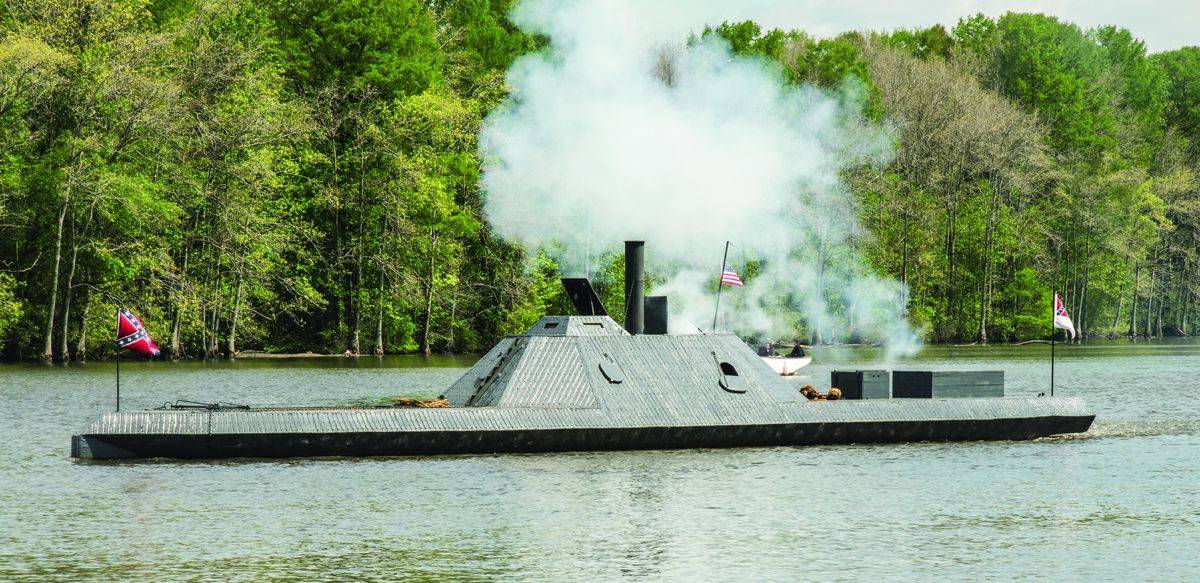
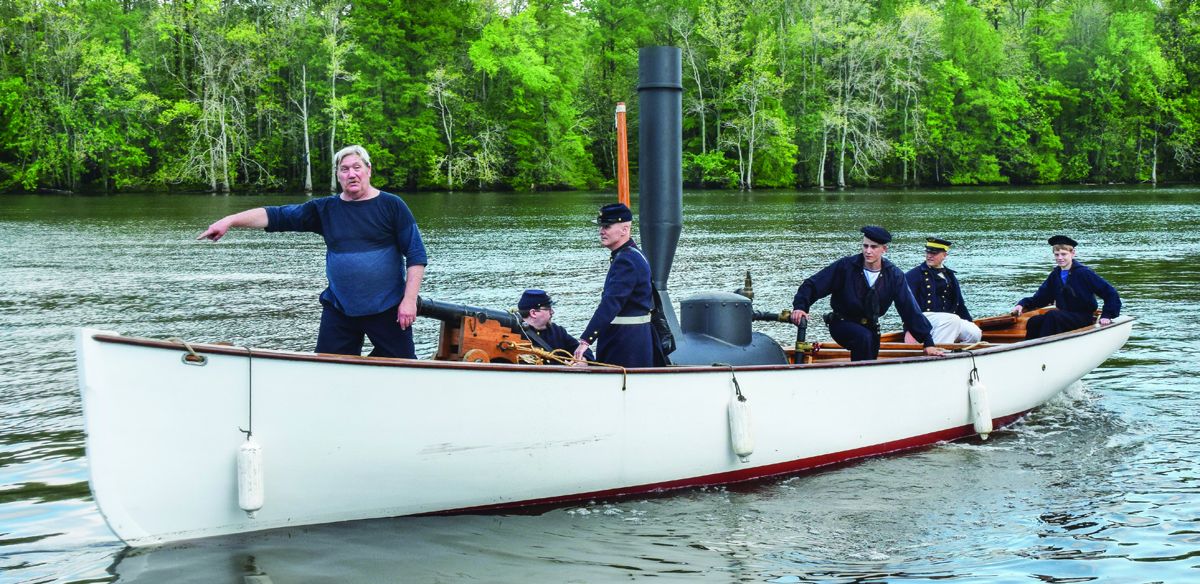
Dr. Bill Krause of Charlottesville, Virginia, is the descendant of William Newman, the master and executive officer of the Southfield, a Union vessel sunk by the CSS Albemarle. (Bob Ruegsegger) (Bob Ruegsegger) ferry boat,” said Krause. “It patrolled the waters of the Roanoke River, and it was here with the USS Miami, the flagship.” When the Albemarle rammed the Southfield, the Union vessel began to sink. Newman fired the last shot and jumped into the river. He and a number of Union sailors swam to shore and were immediately captured by Confederates and sent down to Andersonville with the army prisoners. Newman was eventually transferred from Camp Oglethorpe in Macon, Georgia to Libby Prison in Richmond. Captain Charles Flusser died aboard the USS Miami when a shell exploded on deck and killed him. Flusser’s death inspired Lt. William Cushing to undertake the daring attack that sunk the CSS Albemarle six months later. Duel on the Roanoke by Preston Nutall explores the adversarial interactions between two naval commanders in the Battle of Plymouth – Captain Flusser of the Union navy aboard the flagship Miami and Captain Cooke of the Albemarle. “They knew each other before the war and were both navy men. Each knew the other was there. Flusser was in Plymouth and Cooke was aboard the Albemarle,” said Preston Nuttall. “They spent two years dueling mentally with each other to see what each could do to stop the other.” Flusser led unsuccessful expeditions up the Roanoke River to try to destroy the Albemarle. The destruction of the ironclad Albemarle, according to Nuttall’s book, became an obsession with Flusser. Instead of destroying the Albemarle, the Confederate ironclad destroyed Flusser. The Albemarle was alongside the Miami. The casemate in the center of the Rebel ship had sloped ironclad sides. Flusser became impatient because his gun crews were not firing their pieces fast enough. He jerked the lanyard out of one of his crewman’s hands and fired the 9-inch Dahlgren leveled at the Albemarle. Flusser didn’t know that the weapon had been loaded with an explosive shell that had a ten-second fuse instead of solid shot. The shell hit the side of the Albemarle. “Since the side was sloped, it ricocheted straight up in the air and came down on the deck of the Miami – right at Flusser’s feet and blew him to pieces,” said Nuttall. “That’s how he got killed.” When Lt. William Cushing – a devoted friend of Flusser’s from the Naval Academy - heard of Flusser’s grisly demise, he blamed Captain Cooke and the CSS Albemarle and decided to avenge Flusser’s passing by sinking the ironclad. “He was looking for a way to get even for his fallen buddy,” said Nuttall. “That’s when he came up with this plan to come up the Roanoke River at night and sink the Albemarle, and that’s what he did.” Sinking the dreaded Confederate ironclad with a steam-powered launch armed with a spar torpedo made Lt. Cushing a hero. He continued his career in the U.S. Navy but was released at an early age. The typical reason given for his release from service was that he had gone insane. That was not true – according to Nuttall. Cushing was treated at a hospital near his home which also treated the mentally ill. “It was a coincidence,” said Nuttall. “He was a daredevil. He did a lot of things that most people would never have done,” he noted. “That included coming up the river and trying to blow up an enemy ship when there were armed guards all around it.” The annual Battle of Plymouth event hosted by the Port O’ Plymouth Museum on Water Street in downtown Plymouth tells the story of the last Confederate victory of the war – aided by the CSS Albemarle. It also offers a look at Lt. Cushing’s heroic plan to sink the Albemarle. Historic relics related to the Battle of Plymouth fill the galleries of the museum. One gallery exhibits a phenomenal array of Civil War artillery projectiles. The ship’s bell of the CSS Albemarle is prominently and proudly displayed.