
News Briefs
News Briefs — June 2016
Originally published June 2016 · pp. 14–15
GETTYSBURG, Penn.—A substantial segment of the Gettysburg community gathered on Saturday, April 16th to commemorate the passing of one of their own: longtime minstrel band member, re-enactor, park volunteer, and local bon vivant Roy “Renny” Allgyer.
Roy “Renny” Allgyer. (Photo contributed by Bernadette Loeffel-Atkins) Allgyer, age 56, was known for his individual efforts to keep the battlefield clean and was a popular figure in Gettysburg’s large local community of “buffs.” When asked about his monthly
Gettysburg Battlefield Preservation Association And The American Living History Education Society GETTYSBURG, Penn.—The Board of Directors of the Gettysburg Battlefield Preservation Association has agreed to incorporate the American Living History Education Society (ALHES) into the GBPA. GBPA Vice President Kirk Davis, the founder of the ALHES, said that the involvement of the society at the GBPA-owned Daniel Lady Farm has grown so much that members felt they might as well become part of the GBPA. The ALHES will operate as a self-governing entity within the GBPA, much as the 1861 Boy Scout Venture Crew does. The approximately 400 members of the ALHES are living historians dedicated to presenting all periods of American history in a family-friendly environment to honor our heritage and educate adults and children about this legacy. Outside of its Lady Farm activities, the ALHES offers design, management, and coordination of historical events, living histories, seminars, forums and other historical programs. “I can’t say enough about the impact our relationship with the ALHES has had,” said GBPA President Barb Mowery. “From the first day cleanup visits to the battlefield, Allgyer answered “It kind of gives you some peace of mind when you’re out there. I especially like it when it’s early in the morning and this time of the year when there aren’t a lot of people out. So many people say that how peaceful it is. And that’s interesting because there was so much violence going on there at the battle, it helps you see it differently.” Allgyer and his band, the Camptown Shakers, performed widely for more than a decade. They made frequent appearances in Gettysburg, including an appearance at the 2013 ceremonies in honor of the 75th anniversary of the Peace Light. They also traveled throughout the northeast and as far away as North Carolina, where they played at ceremonies for the 150th anniversary of the Battle of Bentonville. The band appeared in the 2007 movie “Racing Daylight,” and Allgyer also appeared as an Irish immigrant in the PBS series “Philadelphia: the Great Experiment.” (2011) Allgyer had a mild heart attack which temporarily suspended the band’s activities in 2013. He went into the hospital for a procedure in February 2016 and did not survive. Over 200 of Renny’s friends gathered in a tent at the Gettysburg Heritage Center to celebrate his life and mourn his passing. Among the visitors was King Bennett, another member of the Camptown Shakers, and Renny’s fiancé, Bernadette Loeffel-Atkins. His friends remember him as a gentle soul who touched the lives of everyone he met. they began volunteering at the Lady Farm, they brought a badly-needed spark to the GBPA – an initiative that facilitated progress at the Lady Farm that we could only dream of a few years ago. “In fact, it’s more than we could have dreamed of back then.” “With this association of GPBA and ALHES,” added Davis, “we combine the assets of American historic preservation and educational programs into a long-standing organization that has the physical facilities and the dedicated, educated people to achieve our mutual goals of sustaining the legacy of Gettysburg telling the story of what made the America we enjoy today.” The GBPA acquired the historic Daniel Lady Farm on Hanover Road about 15 years ago and restored the 1843 bank barn and the fieldstone farmhouse that served as a Confederate field hospital during and after the Battle of Gettysburg. Both buildings have damage caused by Union artillery and the floors in a portion of the house still exhibit bloodstains from wounded and dying Southern officers. The farmhouse also served as a headquarters for the regiments on the Confederate left flank, including several that assaulted the Union lines on Culp’s Hill. The current President of the ALHES is Suzanne Cheeks. Paul Sanko is Vice President. Info at website www.alhes.com and on Facebook.
Franklin Civil War Round Table Members Appreciation Dinner By Gregory L Wade
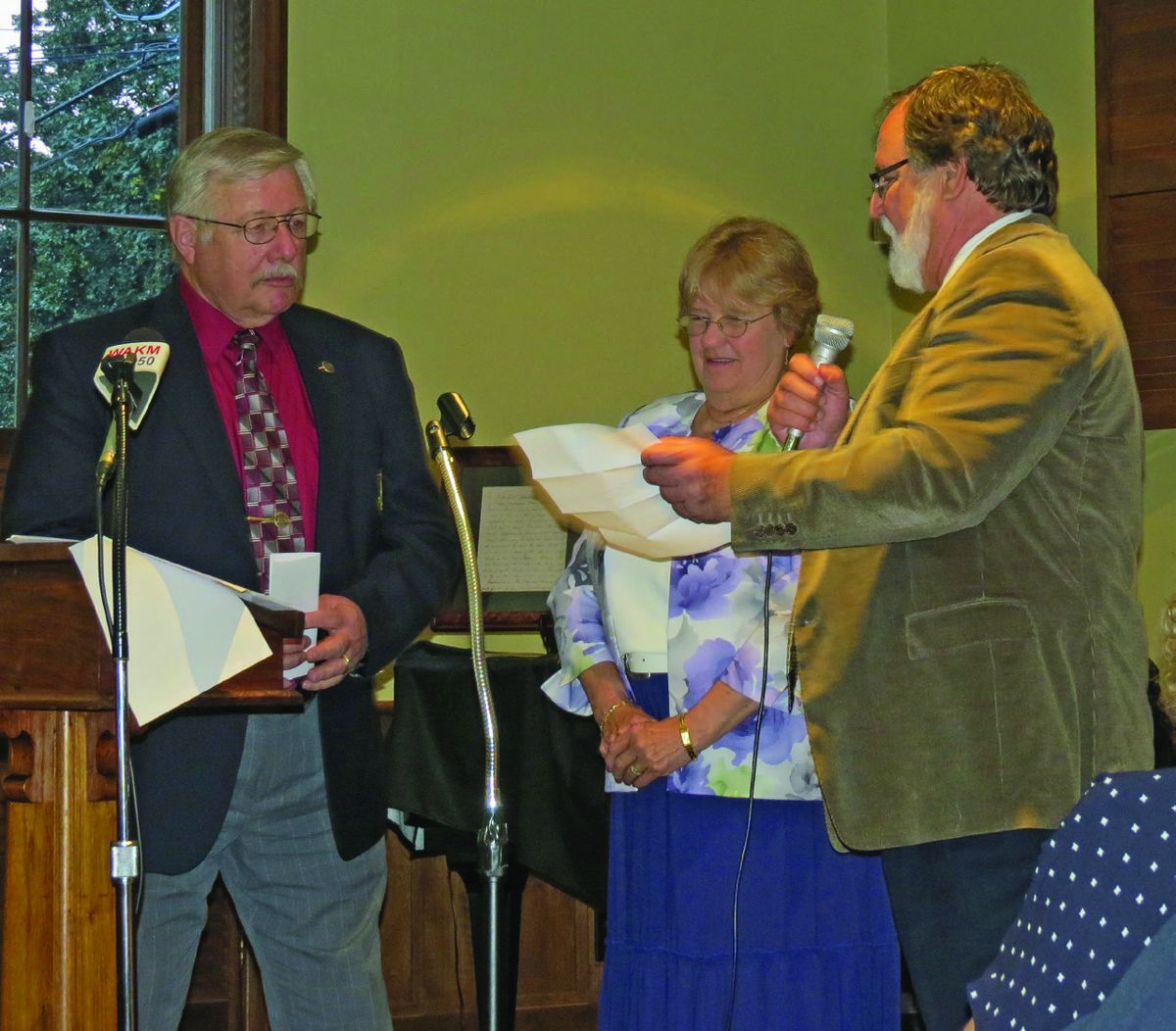
FRANKLIN, Tenn.—The Franklin Civil War Round Table (FCWRT) hosted on April 21 a membership appreciation dinner at St. Paul’s Episcopal Church which was a hospital and barracks during the Civil War. Church Historian, Scott Smith, spoke to attendees about the collections of Civil War era artifacts and documents the church holds while FCWRT member Rachael Finch led tours of the church sanctuary itself. The organization also recognized Hans and Virginia Hooker who recently moved to Tennessee from Europe. Hooker worked for the American Battle Monument Commission (ABMC) for twentythree years after retiring from his service with the U.S. Army. He and his wife, Virginia, served at Normandy, the Ardennes and Flanders Field as well as other assignments managing and protecting memorials and the final resting places of American service personnel. Hooker said, “work at these sacred places is an avocation, a calling, not a job.” The ABMC is responsible for American cemeteries and monuments around the world which now inter over 100,000 Americans killed in foreign wars. Included are soldiers from Tennessee lost in the Mexican War as well as isolated grave sites from many of our nation’s other conflicts, including the Civil War. Prior to his ABMC service, Hooker was
Transportation Grant Helps Local Fourth Graders “Find Their Parks” RICHMOND, Va.—This spring more than 1,500 Richmond-area fourth graders, including 1,245 from Henrico, are experiencing the National Park Service centennial at their local parks thanks to a grant from the National Park Foundation. Maggie L. Walker National Historic Site and Richmond National Battlefield Park were among 186 federally-managed sites selected by the foundation to receive funds to transport area fourth graders on field trips to the two parks. The parks’ staff worked closely with local school boards and the East End Community Collaboration in Richmond to identify interested schools and secure the funds. The grants come during the National Park Service’s 100th anniversary and are part of the organization’s efforts to connect youth with parks During the field trips to Richmond’s national parks, fourth-grade students engage in programs highlighting Richmond’s rich tapestry of Civil War and Civil Rights history. “This transportation funding provides our fourth-grade students with an amazing historically significant and hands-on learning experience,” said Carol Simopoulos, educational specialist for kindergarten through (Beth Wade) involved in anti-terrorism training and part of General Alexander Haig’s security and driving team when Haig served as commander of NATO. He received injuries in a 1979 bomb attack on Haig’s car while serving as Haig’s driver in Belgium. The FCWRT presented to Hans and Virginia Hooker a letter of gratitude and welcome from Franklin City leaders. They were recognized with a certificate of appreciation for their years of protecting the legacies Craig Morris and Patricia McGaw and stories of Americans from all Round Table members. conflicts who paid the ultimate price (Greg Wade) in defense of the United States. fifth-grade social studies with Henrico County Public Schools. One of the highlights of the programs is the distribution of passes that offer fourth graders and their families with free admission to all national parks, national forests, and other federal public lands. National Park Service Deputy Director Peggy O’Dell handed out over 50 of these passes to fourth-grade students at George Washington Carver Elementary School in Richmond during a recent Every Kid in a Park event. “We are appreciative of the National Park Foundation’s assistance in bringing so many Richmond-area kids to their national parks,” said Richmond National Battlefield Park and Maggie L. Walker National Historic Site Superintendent David Ruth. “We look forward to continuing to work with area school districts to connect the next generation of park goers with these special places.” The Every Kid in a Park program and transportation grants are expected to continue into 2017. Current third graders will be eligible for passes beginning on September 1. Information about the program, visit http://www.everykidinapark.gov
– Briefs of Civil War News Interest – Gettysburg Mourns A Beloved Community Member By Leon Reed
SVBF Announces Largest Battlefield Preservation Effort In The History Of The Shenandoah Valley WINCHESTER, Va.—Today the Shenandoah Valley Battlefields Foundation (SVBF) announced an effort to preserve a 34-acre parcel of the historic “West Woods” on the Third Winchester battlefield. Because of the value of the property, this will be the largest battlefield preservation effort ever undertaken in the Shenandoah Valley. The 34-acre tract was the center of a vortex of battle that drew in and spun off troops of both armies throughout the Third Battle of Winchester on September 19, 1864. No parcel of ground was more involved in the fighting. The property is one of the last large parcels of ground available to preserve on this part of the battlefield. It also connects directly to the SVBF’s 572-acre Third Winchester Battlefield Park to its north. This announcement will kick off a four-year capital campaign to preserve this battlefield site. Keven Walker, CEO of the Battlefields Foundation, said that “The preservation of this parcel of land forever saves the site of some of the most ferocious fighting of the largest battle ever fought in the Shenandoah Valley; the site where for a few moments the fate of our entire nation rested.” Heavily wooded at the time of the fighting, and comprised of both a relatively commanding knoll and a steeply narrow ravine, the terrain within this parcel of ground and its relationship to the open fields immediately to its east made it a tactically significant location during all phases of the Third Battle of Winchester. The ground here is remarkably preserved – the eye in a hurricane of development to its west, east, and south – and connects directly to the 572-acre Third Winchester Battlefield Park to its north. But it has come increasingly under threat. The West Woods is surrounded by major development with plans to construct additional business facilities. “For the Battlefields Foundation, our responsibility was clear,” said Bob Mitchell, the Secretary of the SVBF’s Board of Trustees. “If this battlefield land is not preserved now it will be lost forever. But it is an enormous undertaking.” Fortunately, the SVBF’s preservation initiative has already been blessed with the invaluable help of many key partners. Among them are Bruce Griffin and his family, owners of the property, who have been both generous and patient during the long, detailed process. Another is United Bank, which has been creative and laudably community-minded in supporting the effort. And a critical part of the effort is the James R. Wilkins Charitable Trust, which has made an exceptionally generous donation to launch the fund-raising stage of the preservation campaign. James R. Wilkins noted that the Trust’s decision to support the project reflected their belief in the value of this preservation opportunity, saying that, “The opportunity to preserve several hundred acres of open and wooded land for future generations while recognizing the Shenandoah Valley’s legacy in the history of the United States is important enough for our involvement.” The property is also of exceptional historical value because of the notoriety of those who clashed on the land. The fighting in and around the West Woods involved some of the most famous names and units of the war in the Valley – Confederate Gen. Robert Rodes, Union Gen. David Russell, the “Louisiana Tigers,” and Union Gen. Emory Upton. Both Rodes and Russell were killed during the battle, and Upton was wounded. And for the common soldier, the fighting in the woods was just as costly. “Perhaps no place on this bloody ground [Third Winchester] did the demons harvest more souls than on the thirty or so acres of trees known as the West Woods,” wrote Historian Jeffry D. Wert, author of From Winchester to Cedar Creek. “This woodlot seemed to be engulfed in its own particular terribleness. The officers and men who fought in the West Woods wrote later of volleys that cut down entire ranks, of lines that ‘melted away,’ or of regiments that ‘went to pieces’ amid the musketry and cannon fire. A Yankee asserted that West Woods ‘was the deadliest spot of the day.’” Today, the Shenandoah Valley Battlefields Foundation embarks on an ambitious, multi-year effort to honor those me by preserving the ground on which they fought and died. “The Battlefields throughout Winchester and Frederick County are stark reminders of how much has been sacrificed to forge our great nation,” said Keven Walker. “Preserving this woodlot preserves for all time a place of remembrance and reflection; a place of learning and understanding; a place healing and unity.” For more information, call the SVBF offices at 540-740-4545 or go to www.ShenandoahAtWar.org.
Tourism To Stones River National Battlefield creates $20.6 Million In Economic Benefits MURFREESBORO, Tenn.—A new National Park Service (NPS) report shows that nearly 265,000 visitors to Stones River National Battlefield in 2015 spent $15.2 Million in communities near the park. That spending supported 242 jobs in the local area and had a cumulative benefit to the local economy of $20.6 Million. “Stones River National Battlefield welcomes visitors from across the country and around the world,” said Acting Superintendent Joycine Lowe. “We are delighted to share the story of this place and the experiences it provides. We also feature the park as a way to introduce our visitors to this part of the country and all that it offers. National park tourism is a significant driver in the national economy, returning $10 for every $1 invested in the National Park Service, and it’s a big factor in our local economy as well. We appreciate the partnership and support of our neighbors and are glad to be able to give back by helping to sustain local communities.” The peer-reviewed visitor spending analysis was conducted by economists Catherine Cullinane Thomas of the U.S. Geological Survey and Lynne Koontz of the National Park Service. The report shows $16.9 billion of direct spending by 307.2 million park visitors in communities within 60 miles of a national park. This spending supported 295,000 jobs nationally; 252,000 of those jobs are found in these gateway communities. The cumulative benefit to the U.S. economy was $32 billion. According to the 2015 report, most park visitor spending was for lodging (31.1 percent) followed by food and beverages (20.2 percent), gas and oil (11.8 percent), admissions and fees (10.2 percent) and souvenirs and other expenses (9.8 percent). Report authors this year produced an interactive tool. Users can explore current year visitor spending, jobs, labor income, value added, and output effects by sector for national, state, and local economies. Users can also view year-by-year trend data. The interactive tool and report are available at the NPS Social Science Program webpage: go.nps.gov/vse. The report includes information for visitor spending at individual parks and by state.
National Park Service And Outdoor Foundation Select Glass House Collective As 2016 Challenge Cost Share Program Recipient CHATTANOOGA, Tenn.—The National Park Service and the Outdoor Foundation announced earlier this month the recipients of the 2016 Challenge Cost Share Program, which supports projects that promote urban outreach, youth engagement and connecting people to the outdoors. Nationally, the partners selected 17 projects from 62 applications, awarding more than $360,000 that will be matched by an estimated $760,000 in direct and in-kind contributions from recipients. More than 10,000 youth are expected to be engaged during this celebration of the National Park Services Centennial. Glass House Collective received $25,000 to support its work to engage the local East Chattanooga community. Planning is underway to establish the Glass Street Connector trail between the community and Sherman Reservation, a unit of Chickamauga and Chattanooga National Military Park located on Missionary Ridge. Through a diverse partnership with the Trust for Public Land, the Southeast Conservation Corps, the Sierra Club, Friends of the Park, and the City of Chattanooga, the project is making headway. Several community clean-up days have already been held in the past months, and Phase I of trail construction is scheduled to begin this summer. “You can see Sherman Reservation from Glass Street, but few of our residents are aware that we have a National Park within walking distance to this community,” said Teal Thibaud, Executive Director of the Glass House Collective. “We have an opportunity to connect our community with nature and history, increase physical activity, and make this neighborhood a more inviting place to live.” “This year the National Park Service celebrates its 100th Anniversary. This project represents the future of our nation’s park system as we look to educate young people about the importance national, state and local parks,” explained Alison Bullock, Community Planner with the National Park Service’s Rivers, Trails and Conservation Assistance Program. The Challenge Cost Share Program supports National Park Service parks, National Trails and Wild and Scenic Rivers that are aligned with partners that promote urban outreach, youth engagement and/or connecting people to the outdoors. The initiative requires a 1:1 match by the local recipient — resulting in greater financial leverage and impact. In addition, the Outdoor Foundation is actively seeking additional support for the selected projects. Program priorities include: • Urban Outreach: Projects to promote active healthy living, restore or conserve community natural and cultural assets, or promote close-to-home access to recreation within an urban setting. • Youth Engagement: Projects to engage youth participants to play, learn, serve and work associated with National Park Service sites and programs. • Connecting People to the Outdoors: Projects to enhance tangible and/or intangible access to the outdoors that provide increased outdoor recreation opportunities.
“The Outdoor Foundation is thrilled to partner with the National Park Service to reconnect Americans to their national parks and engage a new generation of outdoor enthusiasts and stewards,” said Chris Fanning, executive director of the Outdoor Foundation. “The Challenge Cost Share program is one of the most effective initiatives that leverages public and private funds and invests in local partnerships that deliver results.”