
John Kinser Confederate Revolver
By John Sexton · Originally published June 2016 · p. 32
Ask The Civil War Appraiser By John Sexton John Kinser Confederate Revolver Question to the Appraiser:
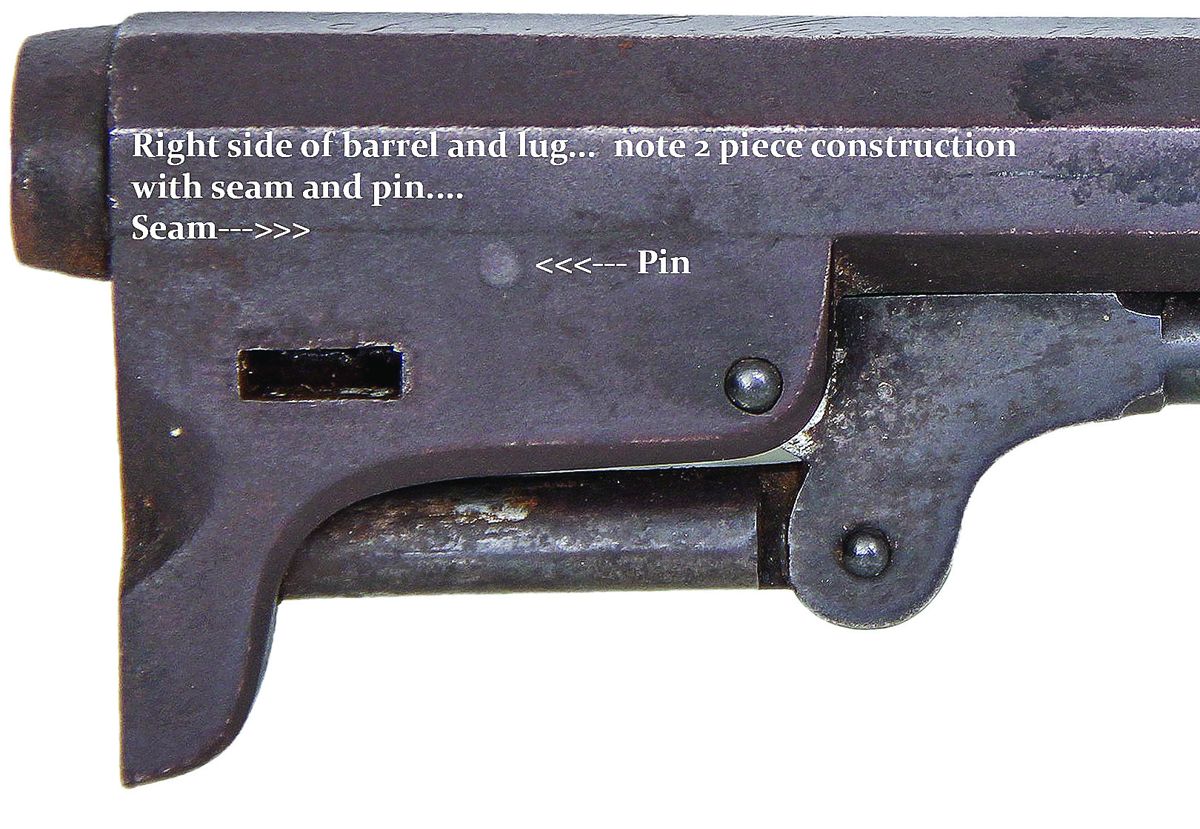
“John, I was referred to you by Tim Prince at College Hill Arsenal because the information I have given him he says is above his pay grade. I believe I have a John Broce Kinser made Confederate pistol. There are no markings on the gun at all except the engraving John B. Kinser 1863. I have research from the family that show enlistments in the Confederate Army and family ties to wartime gunsmiths including his father and brother. His signature on his enlistment papers matches the name on the barrel. I have sent photos to several dealers who want to buy this gun.” David Murphy, Ohio retaining heavy patina on internal surfaces. This revolver is fully functional, retaining thinning areas of a plum color similar to Colts where original finish has turned from blue. Two-piece walnut grips retain strong original traces of varnish seen on other contemporary 19th century arms with special “amber” fluorescence noted especially on Colts of this era. Gun measures entirely in English, not metric, showing no chance of this gun being European brevette manufacture which was my first thought. The screws are most unusual all being handmade machine-type with tapered flat heads as can be seen in photos. They made them on proprietary screw machines by several C.S. arms manufacturers, John B Kinser 1863 signature engraved on top barrel flat.
Unique screws.
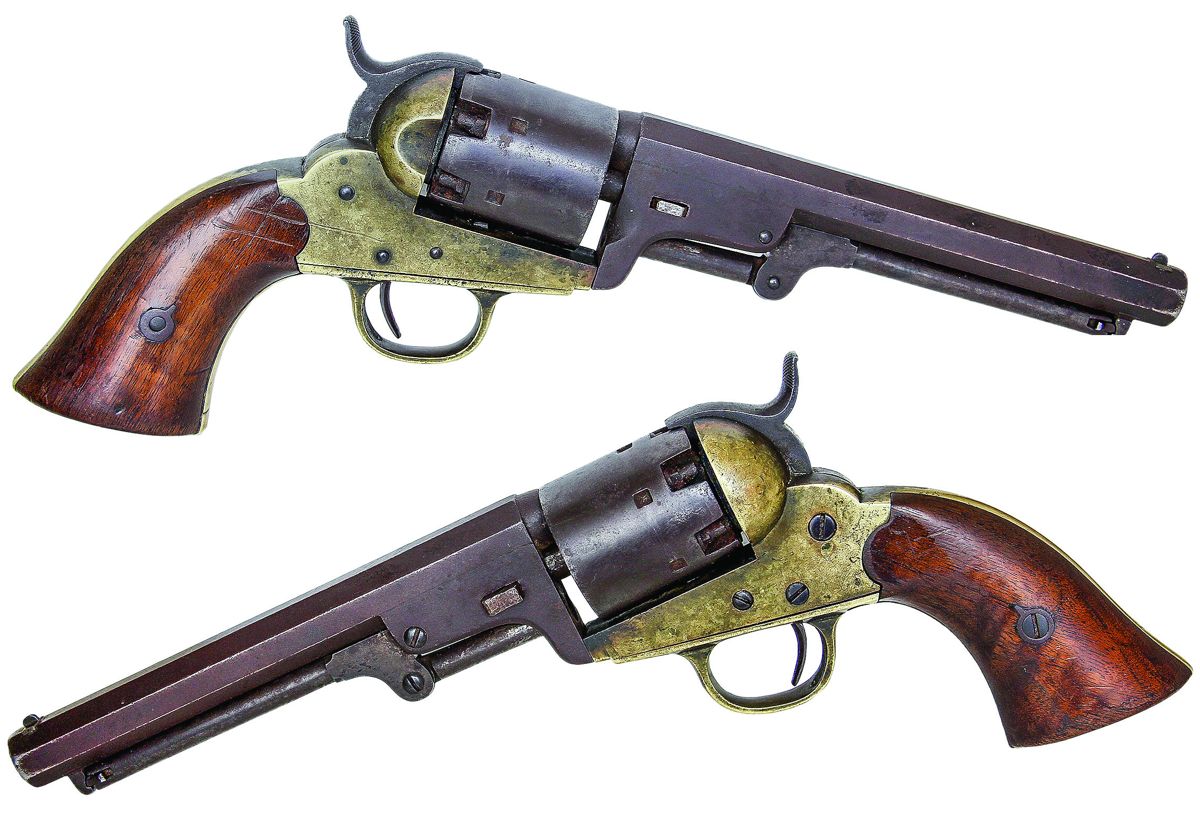
Full views of both left and right sides of John B. Kinser revolver.
Response:
I would like to thank David Taylor David for allowing us to use his excellent photographs in this column. David was first to lend his opinion that this is a wartime Confederate made revolver. I have no doubt he is correct. Ironically this gun was just vetted by a major U.S. arms museum, and Mr. David Murphy was told “We took the liberty of sending some images to one of the major arms historians/appraisers we know. His opinion was that it was a very well done modern piece - aged professionally. This man has done appraisals for the Smithsonian and many other museums over his 50+ year career. He pointed out the replica components that were employed. Would suggest having other parties review this piece.” Gun is totally unmarked with the exception of “dry pencil” etched name on top barrel flat “John B Kinser 1863”. This style is typical of Southern rifle makers and often seen on Confederate bowie knives. This gun appears “as found”, most notably Samuel Griswold’s pistol factory near Macon, Georgia. Griswold screws like these are unique to each maker. Gun emulates a Colt Navy overall though much heftier, no safety pins on the cylinder, tapered wedge with no spring or screw (which functions well). A most unusual feature which required great skill is the (almost invisible) braised and pinned barrel housing to the barrel. This feature I have seen on brevettes in past and have not noticed it on any known Confederate arm before now. Pins retaining barrel housing to the frame are steel like early Griswolds and not cast brass frame extensions as typically seen. Arbor is well fit tightly in frame with no apparent shim, pin, wedge or peening. This brass frame revolver has more “meat” with heavier solid frame and integral backstrap which is still tight, where most noted Griswolds of this type had loosened and had various shims, wedges or pins abutted to arbor base with less brass support. The solid grip frame and flat grip panels where abutting the frame are much like the style utilized by Spiller & Burr, another central Georgia manufacturer. Spiller based their design on Whitney Arms substituting brass frames. John Broce Kinser, George W. Kinser and Phillip Kinser all appear to be brothers from western Virginia. All three served in the Confederate army. John B. Kinser was 25 when he enlisted into the 36th Virginia in 1861 and later became a sergeant in the 23rd Va. At war’s end, he was on detached service as an artificer. An artificer in this era had mechanical and technical skills in arms. His brother Phillip was detailed near war’s end at the arsenal at Danville, Va. His brother George W. Kinser left Virginia after the war and moved to Plattsmouth, Nebraska. He was an accomplished gunsmith until his death in 1903. George even patented arms. Mr. Murphy found numerous newspaper accounts of this from about 1880. There was great gun making skill in this family though it is unknown if George may have handmade machine made revolvers for his brothers and put their names on them. Could It be that John made this unique example? Is there another example out there? Have our reader’s seen another similar revolver? A little more research should find a mention of this handgun in old newspaper account possibly. There is a comparable instance in that a unique Confederate revolver was made by gifted craftsmen (and engineers) at Sisterdale, Texas in 1862. The provenance of
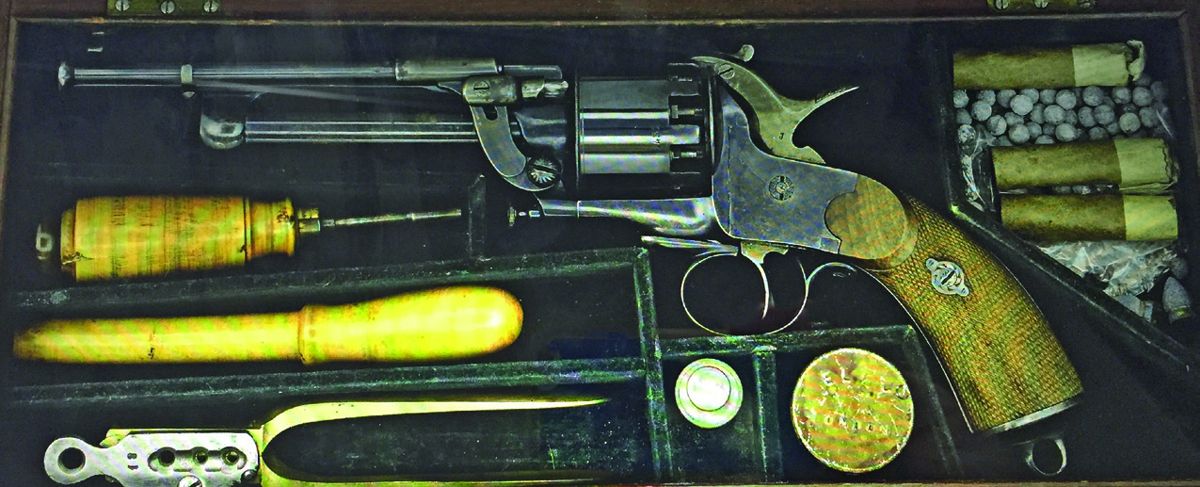
Brass frame retains deep patina note solid seal of arbor to frame. and at least bring more than common C.S. revolvers which sale in similar fine condition, $25,000-40,000 in my opinion. Original, authentic and complete examples are all scarce, the rarest patterns have been highly sought by collectors for decades The finest collections have come to market recently with several auction companies selling them. James Julia set many records with the fabulous Don Bryan collection of which the cited Sisterdale, Texas revolver was a part. Mr. Bryan had assembled the finest collection known of most patterns of Confederate revolvers. Cliff Young, who is recently deceased, had several of the best Confederate revolvers among his truly fine collection of about 50 arms which also include swords and carbines which he collected since just after WWII. The first of three scheduled auctions of the Clifford and Lynn Young collection was April 26 at Cowan’s in Cincinnati with all Confederate revolvers finding new homes. One highlight was lot 79, which is the finest known standard model LeMat revolver. It is housed in English casing which adds an interesting insight to our mystery LeMat in last month’s column marked “P&C/SAMPLE” SN 1473 with London proofs. LeMat SN 1432 which is only 41 serial numbers apart shows that the British were most likely selling Paris proofed guns based on this beautiful cased example. Who was P&C? manufacture in Sisterdale is well documented in diary accounts of the maker. One of the workers used this gun in the Civil War. This gun just sold for over $250,000 at James D. Julia Auctions, Fairfield, Maine on March 4. The John Kinser revolver is another unique Confederate firearm, though not famous or well provenanced. In a well-advertised auction, this gun could excel too,
John is an certified appraiser with International Society of Appraisers specializing in Civil War memorabilia. He authenticates and evaluates other rare and valuable historic items also. Send “Ask The Appraiser” questions and photographs to [email protected].