
Through The Lens
CSS Teaser
By Stephanie Hagiwara · Originally published June 2016 · p. 5
Through The Lens By Stephanie Hagiwara
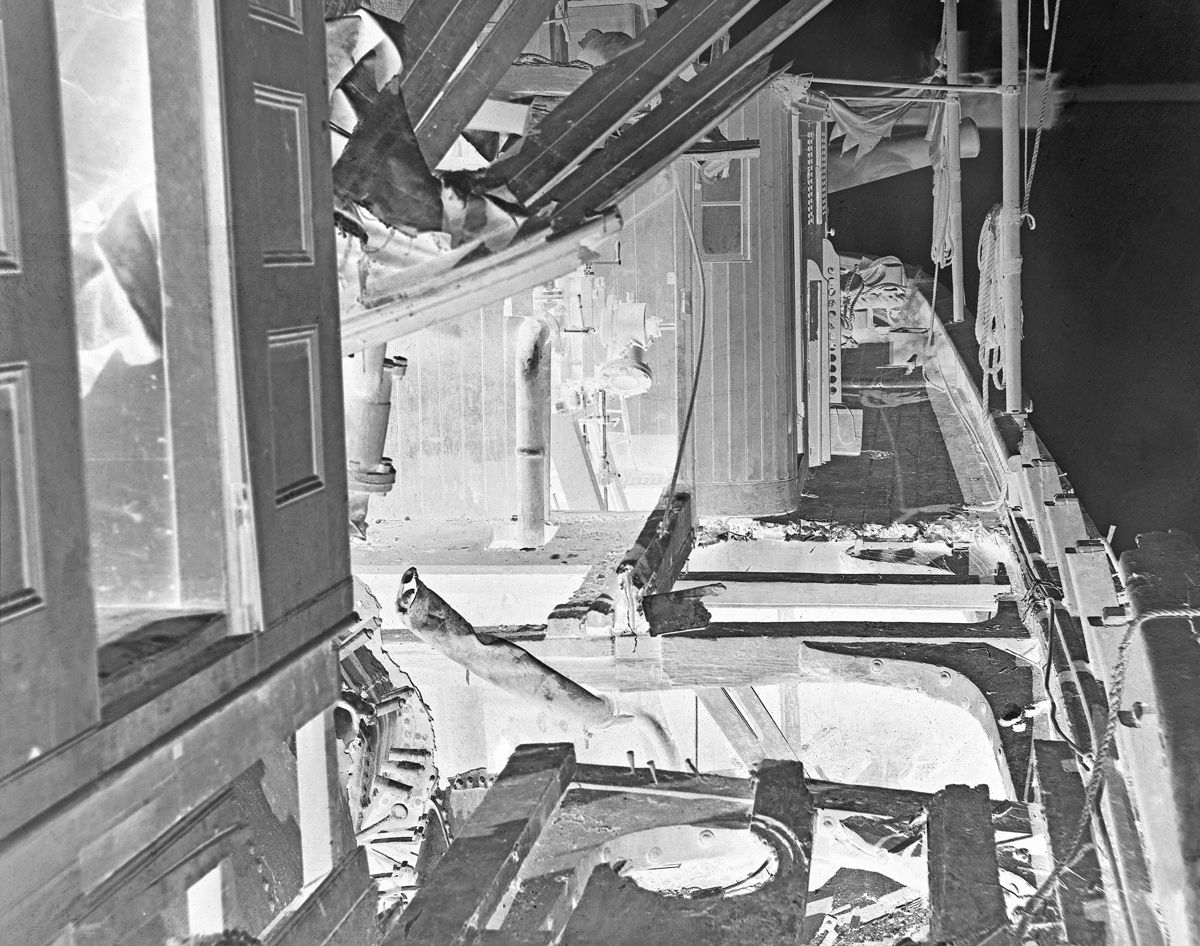
CSS Teaser Mrs. Susan Archer Weiss, eye-witness, Battle of Hampton Roads wrote “…the little Teaser (commanded by Capt. Webb) pushed her way in between the Patrick Henry and Jamestown and advancing close to the shore fired her one gun in face of the battery of sixty guns. Probably her insignificance saved her, for now every shot seemed concentrated upon the Merrimac [CSS Virginia], and the air and the very ground where we stood seemed trembling with the roar of shot and shells.” The CSS Teaser, Confederate Lt. Hunter Davidson and the USS Monitor paths first crossed at the Battle of Hampton Roads, Va. on March 8 - 9, 1862. During the Battle, Davidson served as the commander of the forward gun division for the CSS Virginia. The Teaser, a 64 ton, 80 feet by 18 feet tugboat, acted as the Virginia’s souped up tender while the ironclad Monitor took her place in Naval history. The Teaser fought her way past the Federal shore batteries, to support the Virginia, arriving during the surrender of the USS Congress.
Stephanie Hagiwara is the editor for Civil War in Color.com and Civil War in 3D.com. She also writes a weekly column for History in Full Color.com that covers stories of photographs of historical interest from the 1850’s to the present. Her articles can be found on The Virginia’s flag lieutenant, Robert Dabney Minor, had volunteered to go in the ironclad’s only remaining cutter to finish the destruction of the ship. To the outrage of the Confederates, the shore batteries fired upon the cutter, wounding Minor and at least two of his men. The Teaser picked up the survivors, returning them to the Virginia. For this, her captain and crew were later, formally acknowledged by the Confederate Congress for their brave action. In June of 1862, Davidson was appointed the commander of the Teaser. He also became the head of the Submarine Battery Service. With Davidson at her helm, the Teaser became the first ship to lay mines. Furthermore, it was resolved that the qualities needed to lay mines, handling and transporting a large and delicate cargo, would be useful in transporting and launching a balloon. That is why the Teaser also became one of the world’s first aircraft carriers. It was the multi-colored, patchwork balloon called “Gazelle” or “the Silk Dress Balloon” that ascended from the Teaser. “Gazelle” was designed and constructed by Capt. Langdon Cheves. He had to visit several of Savannah, Georgia’s shops to obtain over 110 yards of dress silk, that he purchased for $1.50 per yard. Unlike the Union, which manufactured their balloons entirely of white silk, Cheves had to buy whatever color material he could get. He then sealed the balloon with a light, flexible coating before sending it to Richmond, Va. However, the South hadn’t developed a method to inflate the balloon with gas in the field. Someone suggested filing up the balloon at the Richmond Gas Works and transporting it, inflated, by train to where it was needed. On June 27th, 1862, during the Battle of Gaines’ Mill, Va. the “Gazelle” first went aloft during battle. The balloon was commanded by the future general and signal officer Lt. Col. Edward P. Alexander. Capt. Charles Cevor and Lt. Adolphus Morse alternated flying the balloon. According to Alexander, “I saw the battle of Gaines’ Mill from it, and signaled information of the movement of [U.S. Gen. Henry] Slocum’s division across the Chickahominy to reinforce [U.S. Gen. Fitz John] Porter. Ascensions were made daily, and when the enemy reached Malvern Hill, the inflated balloon would be carried down the river and ascensions made from the deck of a boat.” Unlike his brother, U.S. Gen. John W. Davidson, decided to “stand by the flag that I promised to protect.”
Years later, Hunter Davidson claimed that the brothers, “fought against each other in the seven days battles around Richmond and I came within less than five minutes of catching him, but he dodged into the Chickahominy and [U.S. Major Henry B.] Clitz was caught.” As is true today, when a multi-color balloon is floating above, people tend to notice. On July 4th, the balloon went aloft in the morning. A report of the sighting was dispatched to the Union Headquarters. The Monitor and the USS Maratanza were sent to investigate. In the meantime, the Teaser was near Haxall’s Wood Mill on the James River, Va. laying down mines. Spotting the Union ships, the Teaser went into emergency mode. The mooring line was cut, the Ship’s Master, William Face rang for steam. As the Teaser turned to escape up river, she ran aground and became a sitting duck. The Maratanza moved in as the Teaser fired first. During the exchange of cannon fire, the Maratanza’s first shot hit high. Her second shot inspired Davidson to order his men to abandon ship. The third round hit the Teaser’s boiler causing it to explode. According to Lt. T.H. Stevens, the Maratanza’s commanding officer, he “took possession, capturing everything on board, including public and private papers and effects, even the side arms of her officers.” Stevens also noted that the Teaser had “one 32-pounder banded and rifled gun of 57 hundredweight, and one rifled 12-pounder, with ample supplies of ammunition. We also captured a Confederate balloon, a quantity of submarine telegraphic wire, and other appliances for submarine batteries.” Acting Paymaster William Keeler of the Monitor, went through the captured papers. There were maps with the locations of Confederate torpedoes along the James River. Documentation of torpedo placement and usage. And private correspondence between Davidson and his wife. Nonetheless, the papers Keeler found most interesting was: “The private memorandum book of Hunter Davidson who was in command. He was one of the officers of the Merrimac & this book was [sic] drafts of the Monitor & sketches of the mode of our capture, as they intended to attempt it. It was minute in all its details. We were to be bonded from four tugs at the same time (one of them was the Teaser) by men carrying turpentine, ladders, fire balls, wedges, sheets of metal, chloroform, etc. The names of the men were given, just what article each one was to carry, to what part of the Monitor he was to go, etc., it even gave the men who were to carry matches & sand paper to rub them on.” Afterward, the Teaser was repaired and taken in by the U.S. Navy. As part of her anti-smuggling patrols, she may have captured the smallest vessel running the blockade - three men in a canoe, near the mouth of the Rappahannock, Va. She remained in service through the end of the war and then was operated commercially until 1878. As for the Captain of the CSS Teaser, Davidson continued his work with torpedoes. On April 9, 1864, at Newport News, Va., Davidson jumped at the chance to finish what the Virginia had started at the Battle of Hampton Roads, and the Monitor prevented - the destruction of the USS Minnesota. On the 50 feet long CSS Squib torpedo boat, Davidson rammed the Minnesota 10 feet below the waterline with 53 pounds of explosives. The explosion sent “the heavy ship rolling to the starboard” but did not sink the ship. Davidson later wrote, “This was the only instance during our war, and the first, of course, when the ‘spar torpedo’ was used with effect and without the loss of the attacking party.” While Davidson had not been able to sink the Minnesota, he was able to stop the U.S. fleet with a single mine. On May 6, 1864, the U.S. fleet was traveling up the James River to assist U.S. Gen. Benjamin Butler. Davidson blew up the lead boat, the USS Commodore Jones, out of the water. The stunned fleet immediately turned around ending their advancement.