
Book Reviews
Book Reviews — June 2016
Originally published June 2016 · pp. 20–28
– Reviews of Civil War Books –
CWN Announcement 1863 New Mexico Fort Kept The Peace Civil War News book reviewer Brian Matthew Jordan was announced as a finalist for the Pulitzer Prize in History for his latest book, Marching Home: Union Veterans and Their Unending Civil War (Liveright/W.W. Norton, 2015). A CWN reviewer since 2012, he is an assistant professor of history at Sam Houston State University. Jordan earned a Ph.D. and two master’s degrees in history from Yale University and a B.A., summa cum laude, in history and Civil War Studies from Gettysburg College, where he was class valedictorian.
C.S. Cavalry Commander Rufus Barringer’s Career Fighting for General Lee: Confederate Rufus Barringer and the North Carolina Cavalry Brigade. By Sheridan R. Barringer. Illustrated, photos, maps, notes, bibliography, index, 304 pp., 2016, Savas Beatie, www.savasbeatie.com, $32.95.
Rufus Barringer had a distinguished career as a Confederate regimental and brigade commander. It is a record, however, relatively unknown to many, if not most, Civil War buffs. It is not that his achievements had been forgotten, but rather obscured. A North Carolinian, Barringer served in the cavalry of the Army of Northern Virginia, a command dominated by Virginians. As far as history is concerned, he also had the misfortune of missing the cavalry engagement at Gettysburg on July 3, 1863. An antebellum lawyer in his native state, Barringer was elected captain of Co. F, 1st North Carolina Cavalry. He proved to be a very capable officer, eventually rising to the colonelcy of the regiment. He suffered a severe wound to his face at Brandy Station on June 9, 1863. He was promoted to brigadier general during the Overland Campaign and assigned to command of the North Carolina Cavalry Brigade. During the Appomattox Campaign, Union scouts dressed in Confederate uniforms captured Barringer and his aides. He spent four months in prison at Fort Delaware, and returned to civilian life in August 1865. Barringer was among the minority of former Confederate officers who joined the Republican Party. He advocated for voting rights for freedmen. He died in 1895. Author Sheridan R. Barringer is a collateral descendant of the general. This book is a straightforward and favorable biography of the Confederate cavalryman. The author has based his narrative on in-depth research in manuscript collections, contemporary newspapers and published memoirs and reminiscences. It is likely to remain for a long time as the standard work on Rufus Barringer. Reviewer Jeffry D. Wert is a retired Pennsylvania high school teacher. He is the author of eight books on the Civil War, including his recent Cavalryman of the Lost Cause: A Biography of J.E.B. Stuart.
Fort Bascom: Soldiers, Comancheros, and Indians in the Canadian River Valley. By James Bailey Blackshear. Illustrated, photos, maps, appendices, notes, bibliography, index, 272 pp., 2016, Oklahoma, www.oupress.com, $29.95.
Many history books claim that during the Civil War the Western Plains were abandoned by the U.S. Army as troops fought in the East. Nothing could be further from the truth. Indian wars continued on the Western frontier by regular U.S. and state regiments. While some frontier forts were abandoned, others were built. Among the latter was Fort Bascom on the Canadian River near Tucumcari, N.M. In 1863 the 7th U.S. Infantry and the 1st New Mexico Volunteer Cavalry built that fort. It was on the land bridge between the Canadian River and the Pecos
SHARPSHOOTER
River. It protected portions of New Mexico and Texas from raids by the Comanche and their allies. Fort Bascom was an adobe post that was always in need of repairs and constantly short of drinkable water, fresh vegetables and feed for its animals. The fort’s story is partially told through the lives of the officers and men who served there. The Comancheros acted as middlemen between the white settlers and the Indians. They were merchants who journeyed onto the Plains to trade goods for plunder the Indians had seized from other settlers. This plunder generally consisted of livestock, but also included people and goods. In exchange, the Comancheros supplied weapons and other goods the Indians could not manufacture. Many contend that this trade was the foundation of New Mexico’s economic life during the first half of the 1800s. This book is far from a dry history of Fort Bascom. James Blackshear places the fort in its social, political, historical, geographic and geological context. Readers learn that the fort was located at the end of a slender and expensive supply line. It was garrisoned by soldiers who spent their time building or patrolling. During the patrols there were few encounters with hostile Indians. Not understood by the War Department was that, although there were few engagements with hostiles, the daily patrolling by the soldiers broke up the normal pattern of Indian raiding and trading with the Comancheros. Fort Bascom thus kept peace in its area by serving as a deterrent force.
One aspect of the fort’s history that Blackshear fails to develop is purported Confederate efforts to mobilize the Comanche and their allies to launch attacks on settlements in New Mexico, Colorado and Kansas following the Sand Creek Massacre and Kit Carson’s Canadian River Expedition. The Comanche and their allies viewed these two events as a coordinated effort by the U.S. Army to kill every Indian on the Western Plains. In 1874, as a cost-cutting move, the army abandoned Fort Bascom over the locals’ objections. The War Department contended there was no longer a need for Fort Bascom and its troops could contain Indians elsewhere. Unfortunately for Texas and New Mexico settlers, once Fort Bascom was closed the Comanche and other Plains Indians were again free to strike against isolated targets on the frontier. Fort Bascom had been home to the 7th, 15th and 37th Infantry, 57th and 135th USCT, 1st New Mexico Cavalry, and 3rd and 8th Cavalry. The 1st New Mexico Volunteer Cavalry was one of the last Civil War volunteer regiments to be mustered out. It was constantly in the field from May 1862 to September 1866. This book is well worth reading since it sheds light on an important but forgotten theater of military operations of the Civil War period. Reviewer Charles H. Bogart has a B.A. in history from Thomas More College and an MA in urban planning from Ohio State University. He is the historian for Frankfort, Kentucky’s Fort Boone Civil War Battle Site.
Civil War Photo Book On Georgia Major Served In 2 State Units Washington County, Md. Washington County in the Civil War. By Stephen R. Bockmiller. Illustrated, photos, 128 pp., 2016, Arcadia, www.arcadiapublishing.com, $21.99 softcover.
If you marched north through Virginia’s Shenandoah Valley and across West Virginia’s eastern panhandle, you would eventually reach the Potomac River. Located on its northern shore is Washington County, Md., famous as the Battle of Antietam location. The county is interesting not only because of the major battles fought there but also for its population, which was a blend of Northern and Southern sympathizers. You could say that the county was a microcosm of the nation as a whole. In a photo album such as this, there is a temptation to focus on the largest, most famous battles. However, author Stephen R. Bockmiller chose to concentrate on the smaller, more intimate events and the people and families that intersected with them. What emerges is a personal, more nuanced portrait of Washington County’s role in the war. Bockmiller has mostly collected period portraits from local families. Some of them have never been published. Extended captions give the story behind each picture. This core of portrait photographs is supplemented with a host of drawings, paintings, documents and maps that amplify the basic stories. If you browsed through the album, you would spot a photo of James Breathed, a debonair-looking man with a receding hairline and a full mustache and goatee. A physician from the town of Hancock, Breathed joined J.E.B. Stuart’s cavalry in 1861. He rose to become a prominent commander of a horse artillery battalion. After the war, he returned to Hancock and resumed his medical practice. Next, you might see a stern, darkhaired man with a full beard. This is Union Lt. Thomas Torrence of the 18th Pennsylvania Cavalry. While riding through Hagerstown in July 1864 his unit was surprised by Rebel troops involved in Jubal Early’s raid on Washington, D.C. The detail surrendered, but Torrence tried to fight. Wounded twice, he fled and hid in a nearby house. Some Hagerstown residents were obviously pro-North; otherwise, they would not have taken the risk of hiding him. After the war, Torrence, who became a traveling salesman, periodically paid courtesy calls to visit the family that had saved him during the war. Among the more striking documents presented is an 1864 hand-written loyalty oath from a county resident. Bockmiller explains that in areas regularly transited or occupied by Union troops, residents were expected to sign an oath of loyalty to the United States. Those who declined were monitored and sometimes forced into Southern exile. This is a somewhat dark side of Civil War history that is often overlooked. No, you won’t find any of the popular wartime Antietam battlefield images here. Instead, you are treated to lesser-known images illustrating the battle’s impact on locals in later years. An example is a 1920s photograph taken of the Burnside Bridge. Ford Motor Company was promoting its vehicles as a way for American families to sightsee. An advertising photo shows a Ford crossing the bridge. This book, which would be of special interest to locals, is easy to skim. My one complaint is that the brief stories with the photos are so interesting that I frequently found myself longing to read more. Reviewer Walt Albro is a magazine editor and writer based in Rockville, Md. His history articles have appeared in such publications as MHQ (Military History Quarterly), Military History and The Civil War Times.
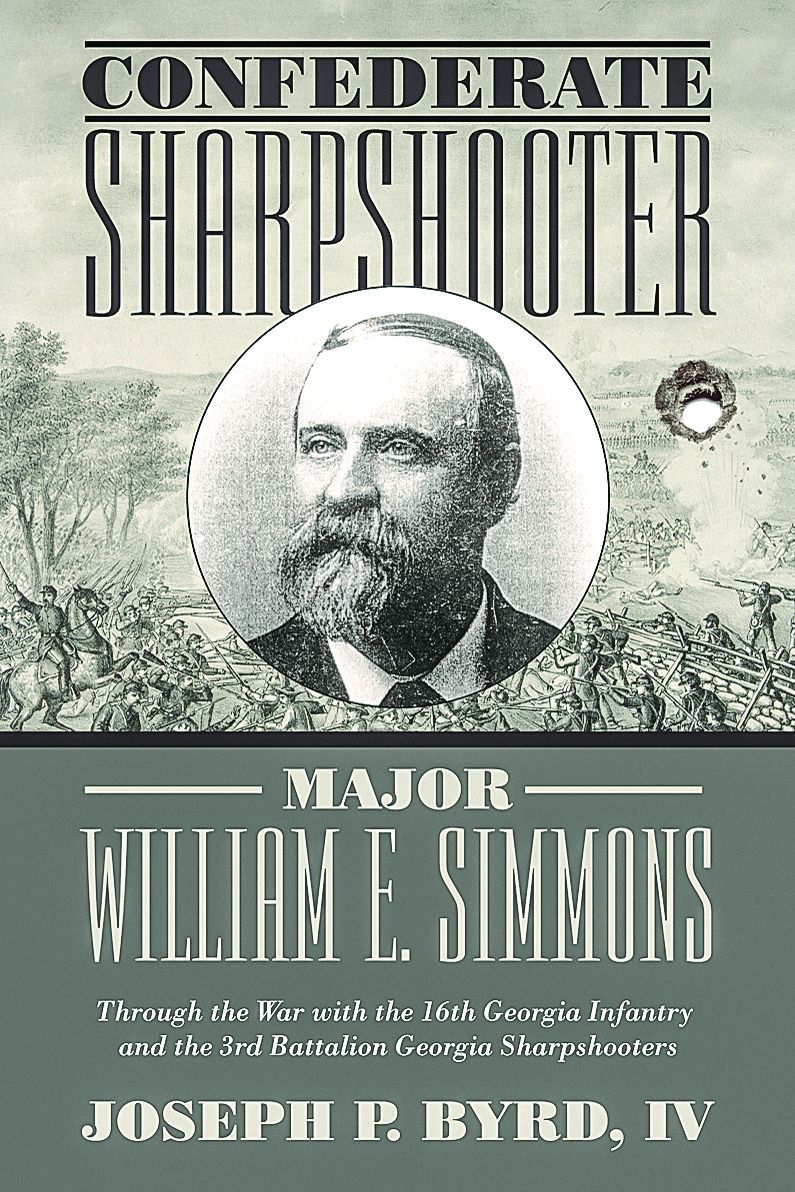
Like so many Civil War biographers, Joseph Byrd started this to honor an ancestor — his great-great maternal uncle William E. Simmons. Simmons’s biography serves as the background for a very nice regimental history of the 16th Georgia and the 3rd Battalion Georgia Sharpshooters.
South Carolina’s Wartime Hospitals South Carolina’s Confederate Hospitals. By Rebecca Barbour Calcutt. Illustrated, photos, notes, bibliography, 70 pp., 2015, CreateSpace, www.createspace.com, price unknown.
The catastrophe of the Civil War caught men and women, both North and South, in many ways unprepared and in a state of confusion. While military planners and the media dreamed of swift victories, the war instead dragged on for four bitter years. Perhaps the least prepared for the war were the medical services of both sides. Union and Confederate governments were slow to respond to the crisis of hideous and voluminous casualties. In her slim volume on the subject of South Carolina’s Confederate hospitals, Rebecca Barbour Calcutt demonstrates how the wide gaps in care for the wounded were handled by ordinary men and women carrying out extraordinary service. Calcutt opens with a chapter on the well-known shoddy care received by the wounded. Amputations, sepsis and disease were the far greater threat to soldiers than bullets or bayonets. Care varied from place to place. Most “hospitals” were run by volunteers in churches and even private homes. Competence and outcomes varied greatly. Calcutt provides vignettes of each South Carolina Civil War hospital, focusing on those in Charleston. She includes separate chapters on those just outside Charleston and others throughout the rest of the state. The heroes of the story are the least known — people like Louisa McCord of Columbia, S.C. This dynamic woman from the upper-class of Columbia was the daughter of former U.S. Speaker of the House
This book chronicles in detail all of the engagements in which the two units participated in the Eastern Theater of the war. I particularly appreciated how the author uses a wide variety of primary sources – letters, diaries, after-action reports, newspaper accounts – to flesh out the front-line soldiers’ lives. One instance occurred during the fighting around Chattanooga, Tenn., in September 1863. A Union officer, while on a mission to retrieve wounded between the lines, asked then Capt. Simmons what unit his men had encountered the evening before. Simmons asked why he wanted to know that information. The officer replied, “We knew it want not any of [Braxton] Bragg’s regular troops from the accuracy and rapidity of their fire.” During the ill-fated Nov. 28, 1863, assault on the icy walls of Fort Sanders at Knoxville, many Confederates died in the ditch at the base of the wall because they could not gain a foothold on the walls to scale the parapet. But Capt. James L. Lemon managed to reach the parapet by cutting handholds and footholds in the sides of the wall with his sword. As he neared the top, he plunged the blade into the earthwork above his head and pulled himself up. About 12 of his men, using bayonets and Bowie knives, followed suit and scaled the wall.
Lt. Col. Solomon Z. Ruff (18th Georgia) joined in the assault by using the staff of the regimental colors to pull himself up. Only Captain Lemon and a few of his stalwarts got into the works, and they were captured. After being captured in the Shenandoah Valley in 1864, Major Simmons was imprisoned at the notorious Fort Delaware. Amid horrid conditions, he devised a way for him and his fellow officers to receive female visitors who were “relatives.” Simmons had his comrades vouch that his first lady visitor was his cousin. After that, every woman to drop by announced that she came to see “Cousin William.” He sounds a bit like Rhett Butler in Gone With the Wind. Much more than a typical regimental history, Confederate Sharpshooter goes well beyond the standard recitation of battle after battle. It brings the men to life with all of their foibles. I thoroughly enjoyed this book. It is a pleasant addition to my personal library. Reviewer John Michael Priest retired from teaching in 2011 after serving 30.5 years. He is a guide at Antietam. He has published four Civil War books and is an avid 54mm wargamer — French and Indian War through the U. S. Civil War.
Langdon Cheves. She worked tirelessly collecting donations, rolling bandages and turning her plantation into a food and supply depot. She sat bedside with the sick and dying — giving comfort and companionship, reading to the men and writing their letters. McCord is just one of many unheralded South Carolinians worthy of our respect. As Calcutt repeatedly shows, it was people making do with whatever they had at the local level to help their cause. This book helps readers understand how Civil War medical care was given and how people and communities showed their humanity during that grueling struggle. Reviewer David A. Galli is a private practice physician in St. Louis, Mo., and Instructor of Medicine at St. Louis University Medical School. He has a degree in history from St. Louis University and a long-time interest in the Civil War.
Cannon’s Union Flag Book Is Updated Fiction Book Tells Of Lee’s Gettysburg Mindset, Battle The Flags of the Union: An Illustrated History. Revised edition. By Devereaux D. Cannon Jr. Edited by Alan H. Archambault. Illustrated, appendices, index, 108 pp., 2016, Pelican, www.pelicanpub.com, $22.95 softcover.
Few things created by man cause as many problems or reflect a nation as flags. The recent flap over Confederate flags is but one current example of the power of these pieces of cloth. The United States flag is not only striking in design, but has come to represent freedom to many oppressed people over the years while having a different meaning to others. In war, flags take on another meaning besides reflecting the nation they represent. Starting more than 2,000 years ago, battle flags were used to guide troops and differentiate one army from another. Europeans evolved battle flags into matching regimental facings with regimental flags by color. The Continental Army and the later U.S. Army borrowed heavily from the British by creating national and regimental flags for each regiment to carry into combat. While very important in American military history from the Revolutionary War through the Spanish-American War, U.S. military flags have gotten short shrift by authors, in particular Civil
War writers. In 1994 noted flag historian Deveraux Cannon Jr. addressed this vacuum with his book on Union flags. Intended as a primer rather than a definitive project, the book gave beginning students of Civil War vexillology a good start. Moreover, it helped the reenacting community to some extent by getting them focused on types of flags needed. Although deceased, Cannon’s legacy lives on with editor Alan Archambault’s new revision of the Union flags book. The color flag plates in the center of the original book are now spread throughout the pages by flag type. This is a big improvement. Archambault adds an appendix covering more designating flags, which served as headquarters banners, and state colors issued to regiments. An explanation of the state flags would have been helpful. These were flags paid for by states – not flags representing states. The latter did not exist outside of the Confederacy. Other designating flags are U.S. Colored Troops flags, those of other ethnic units, and those from various quartermaster depots. They are illustrated and show their diversity in styles and patterns. The book remains Cannon’s at its core with a short history of the Stars and Stripes before moving into the various types of Union Army flags. This book shows U.S. colors went beyond national and regimental flags. Posts and forts had special flags that were regulated by sizes for garrison and storm flags. Flank markers were important in the alignment of regiments on a battlefield. Hospital flags were crucial to marking those important sites for the wounded to find and letting the foe know what they were. Camp colors were detailed as to what purposes they served while units were encamped. Very helpful is the diagram showing the proper alignment for a regiment in camp and the location of their color line. This will benefit reenactors. The core of the Union Army was its fighting regiments. The two types of flags they carried receive proper attention with citations from regulations as to their proper size and additions like battle honors. Several examples illustrate this section. Naval and special designating flags flesh out the remainder of the book. The latter were created during the war to mark the locations of headquarters off the field and unit commanding officers. Each represented an army, corps, division or brigade. Omitted are the designating flags that Gen. George McClellan created in 1862. His very complex system was replaced with the much simpler system adopted in and after 1863. This book remains a fine starting point for flag students made even better by the aforementioned additions. The bibliography needs updating because more sources on flags have appeared since the original publication. Also helpful would have been an explanation of the flag designs issued by various depots that supplied the armies. Each had its own styles for national and regimental flags. As a flag historian, I use Cannon’s book quite a bit and it is good to see that his legacy lives on in improved form. This book remains the best place to start your study of Union flags.
Reviewer Greg Biggs has studied Confederate flags and the Civil War in the West for many years. He has written about flags for several publications and the Flags of the Confederacy website and has contributed to several books. A member of the Company of Military Historians, he also leads Civil War tours in Tennessee, Georgia and Kentucky.
What Must Needs Come: A Legacy of Gettysburg. By Richard Fritzky. Historical fiction. 270 pp., 2015, Tate Publishing, www.tatepublishing.com, $20.99 softcover.
The title of Richard Fritzky’s book comes from an expression used by Abraham Lincoln. The story pertains to the battle of Gettysburg and the mindset of Confederate Gen. Robert E. Lee. This is a lot of fertile material to fit into one piece of historical fiction. The event descriptions are factual, and many famous quotes are used to clarify the story. The fictional aspects appear to be in the dialogue used by the participants. Although the presentation all seems real, I was never sure just where fiction ended and fact began. Chapters about the author’s interpretations and presumptions are interspersed in the book. All in all, this approach seems to work well in presenting the story. Also included are sections describing the landscape then and now. Fritzky describes his travels to Gettysburg and his recollections of what he saw and learned. These diverse approaches give readers a unique view of both the battlefield and Robert E. Lee the man. The author is an admirer of Lee, and this shows in his writing. However, I did detect a sense of subliminal condemnation of Lee’s belief in the absolute superiority of his ideals. There are some disturbing errors of fact that could have been eliminated with more careful editing; however, they do not detract from the story. I did not learn anything new but did get to ponder a different perspective on the man and events. That is always a plus in reading fiction. Overall, I enjoyed this book. It is not your usual historical and is a most worthy effort and worth your time to give it a look. Reviewer Joseph A. Truglio is president and business agent for a motion picture film technicians local union and a lifelong student of the Civil War. His memberships include the Lincoln Group of New York and New Jersey Civil War Heritage Assn. He is president of the Phil Kearny Civil War Round Table in Wayne, N.J.
Gottfried’s New Work Is 25 Years Of Postwar Black Education Maps Of The Wilderness The Maps of the Wilderness, An Atlas of the Wilderness Campaign, Including all Cavalry Operations, May 2-6, 1864. By Bradley M. Gottfried. Maps, orders of battle, notes, bibliography, index, 324 pp., 2016, Savas Beatie, www.savasbeatie.com, $39.95.
Continuing his outstanding series of battle map books, Bradley Gottfried presents maps and narratives describing the evolution of the Battle of the Wilderness. Over the past 25 years or so, Civil War buffs have been rewarded with many scholarly, detailed renditions of military campaigns to savor. Map sets seem to be their own genre, however, and are indispensible for a thorough understanding of any battle. Like many readers of excellent narratives with few maps, I find it difficult to flip back and forth from the text to a map several pages away in order to understand the ebb and flow of the action being described. In many cases, the few maps in those studies leave gaps in understanding because they cover just one small part or time sequence of the action. John Bigelow Jr.’s prodigious 1912 maps of the Chancellorsville campaign set the standard to be emulated. But few followed in his footsteps until recent times. Gottfried’s book provides a clear, crisp depiction of the Wilderness Campaign with 120 full-page color maps drawn to a regimental level. These are grouped into 24 sets to portray phases of the action. While the narrative opposite each map is not as detailed as other literature on the battle, it serves the purpose of telling what is being depicted on the map. As in all such studies, some readers might reasonably quibble with Gottfried’s depictions and placement of regiments. Readers must consider the confusing nature of the battle itself, where the opposing forces were mired and tangled in scrub brush and trees. Probably no one will know exactly where each of the regiments was located at any given time. One example is the extent of Gen. Harry Heth’s advance toward the Federal position on May 5. Juxtaposing a series of sources, Gottfried concludes that Heth’s men were actually located closer to the Federal position than other scholars suggested. This conflict is brought out in the endnotes rather than the text. Thus, discerning readers should check the notes for such details as they read the narrative. Another example is the number of Confederate brigades available to attack the Federal position on the Brock Road on May 6. Gottfried takes issue with Edward Steere’s The Wilderness Campaign, where Steere contended there were more brigades facing the Federals than postulated by Gottfried. Based on a regimental history, Gottfried opines that Paul Frank’s brigade occupied the breastworks along the Brock Road when Confederate Gen. James Longstreet began his flank attack on the Federal left, rather than being near the front of the action as suggested by historian Gordon Rhea. Gottfried’s fine work fills a void that has long existed in map studies of this campaign. For those of us who can never get enough map detail, including all the cavalry operations, this book should satisfy that desire.
Reviewer Frank J. Piatek graduated from Geneva College with a B.A. in history and received his J.D. from Duquesne University in 1972. He is past president of the Mahoning Valley Civil War Round Table and author of Cannoneers, To Your Posts!, the story of Cooper’s Battery B, 1st Pennsylvania Artillery at Gettysburg.
Educational Reconstruction: African American Schools in the Urban South, 1865-1890. By Hilary Green. Notes, bibliography, index, 268 pp., 2016, Fordham, www.fordhampress.com, $35 softcover, $125 hardcover.
This book details African-American educational struggles in the 25 years following emancipation. Hilary Green focuses on Richmond, Va., and Mobile, Ala., as case studies. She chronicles two very different approaches to establishing strategies and relationships with individuals and organizations to maintain an educational system for African Americans. Both Richmond and Mobile benefited from the initial endeavors of the Freedmen’s Bureau, missionary societies, the Peabody Fund, and local and state governments. These entities were vehicles to transition blacks from slaves to educated citizens capable of fully participating in civic society. The Freedmen’s Bureau initiated the cooperation necessary for the survival of the African-American schoolhouse. But its 1870 departure from the South left black schools to the mercy of local and state officials. In Richmond initial white resistance to black education was characterized by intimidation, harassment and social ostracism. The social order had been upended, and it would take time for white Richmonders to accept African-American education as part of a postwar definition of freedom. By the early 1870s, however, white Richmonders accepted that education and began supporting a system of free public schools, as well as the establishment of Richmond Colored Normal School to train black teachers. In Mobile, however, the transition to a free public school system did not occur as smoothly. Local white opposition resulted in the Emerson Institute twice being destroyed by arsonists, a lack of African-American representation on school boards, and little local government financial support. While these two cities saw a different white response to black educational needs, they also had similarities. In both cities African Americans never gave up their demands for more public schools to educate every child, black faculty to teach their children, financial resources equal to white schools, and support for private schools giving parents more choices in educating their children.
African Americans used petitions to press local leaders to address their demands, formed alliances with white officials to advocate for them, and used their political power to hold local officials to their promises. In both Richmond and Mobile, these tactics bore fruit, albeit more quickly in Richmond. By 1890, public schools for African Americans had become enduring institutions and demonstrated how the long struggle for quality education had been a success. Aside from a few grammatical errors, this book is eminently readable, historically accurate, and well researched. Primary sources are used effectively. Readers will find this period of Educational Reconstruction illuminating as to African Americans’ view of education as the liberating force to move from slavery to full citizenship. Yet the demand for only AfricanAmerican teachers and administrators for black schools denigrated the role of white philanthropists and teachers who sacrificed much to the cause of African-American education. This book’s hardcover cost may make it more appropriate for library, rather than personal, purchase. Reviewer Wayne L. Wolf is Professor Emeritus at South Suburban College and the author of numerous books and articles on the Civil War including The Last Confederate Scout and Two Years Before the Paddlewheel. He is past president of the Lincoln-Davis Civil War Roundtable.
Bishop Lynch Tried To Sway Vatican Annotated Offerings Of Patrick N. Lynch 1817-1882: Third Catholic Bishop of Charleston. By David C.R. Heisser and Stephen J. White Sr. Illustrated, photos, maps, notes, bibliography, index, 280 pp., 2015, South Carolina, www.uscpress.com, $39.95.
This book represents the completion by Stephen J. White Sr. of a significant biographical project begun by the late Professor David C.R. Heisser. The subject, Patrick N. Lynch, was an important Roman Catholic cleric who became the third Bishop of the Charleston, S.C., diocese and played a prominent role in European diplomatic efforts by the Confederate States during the Civil War. At the age of one, Lynch emigrated with his family from Ireland to Cheraw, S.C., in 1819. Educated for the priesthood in Rome, he returned to South Carolina and was named bishop in 1858. Lynch energetically promoted the growth of the diocese, which included both Carolinas and was overwhelmingly outnumbered by Protestants. When the war finally came, it commenced in Lynch’s home city. That would be far from his most significant involvement in the conflict. Instead, two related events would ensure Lynch’s prominence. The first was his February 1864 assignment by President Jefferson Davis as an envoy to the Vatican with the hope of obtaining recognition of the Confederacy. Under Pope Pius IX, the Catholic Church had taken a deliberately neutral official stance on the conflict.
Avoiding the blockade and supported by a monthly stipend, Lynch arrived in Europe and undertook his diplomatic efforts. After disclosing his purpose to Vatican Secretary of State Cardinal Giacomo Antonelli, Lynch was received by Pius IX in his capacity as a bishop and not as a Confederate emissary. Although Pius conveyed his willingness to mediate the American war, Lynch’s attempts at gaining official recognition went nowhere. The South was not alone in sending Catholic clerics abroad on diplomatic missions. President Abraham Lincoln and Secretary of State William Seward had arranged for New York Archbishop John Hughes to visit Spain, France and Italy to dissuade those nations from recognizing the Confederacy. As the authors show, Hughes and Lynch had engaged in a written debate about the merits of secession in summer 1861. Lynch later asserted, without much credibility, that Hughes had gone public with what was intended to be private correspondence. While in Europe, Lynch also became involved in the other event that would mark his career. Like many Southern clerics, Catholic and Protestant, Lynch was a slaveholder. Although the 1839 apostolic letter In Supremo Apostolatus by Pope Gregory XVI had condemned slavery in broad terms, it was interpreted as applying to the international slave trade and not to the domestic practice of owning slaves. Lynch practiced what might loosely be termed a “Christian” form of slavery. Paternalistic and racist in tone, this philosophy recognized that the owner had a number of moral duties to his slaves, including fostering marriage (which was unlawful as a civil matter throughout the South), family integrity (often violated in the South), religious instruction, and adequate food and shelter. Failing at recognition, Lynch sought to at least influence European public opinion to favor the South. While in Rome, he wrote and published a pamphlet in French, German and Italian that articulated the benevolent form of slavery in which he believed. While the pamphlet engendered debate, it never had the intended effect. While Lynch was absent, his diocese became a battleground as
William T. Sherman’s Union forces barreled through the Carolinas in early 1865. Catholic properties were destroyed or badly damaged in both Charleston and Columbia, placing the diocese in severe financial straits. Lynch was unable to return because of his status as a Confederate emissary. After other American Church officials interceded on Lynch’s behalf, President Andrew Johnson pardoned him in August 1865. Lynch returned to resurrect his critically injured diocese. The authors demonstrate that because the American Catholic Church had not sundered along sectional lines, unlike other Christian denominations, Lynch became an important church figure in the postwar years and was a popular speaker throughout the country. This book is a welcome addition to the literature on religion in the Civil War. The Catholic Church was pulled in several directions by the war and emancipation. Lynch’s career embodied the Southern Catholic experience. The Northern Church was strongly pro-union but largely silent on emancipation. It was influenced by its ties to Irish immigrants, who saw freed blacks as an economic threat, and by the nativist and anti-papist leanings of many Republicans and abolitionists. There was the occasional strongly anti-slavery element led by Bishop John Purcell of Cincinnati. The authors illustrate these tensions and the overarching desire of the Church to remain immune to sectional conflict. Criticisms are minor. Occasionally material from one chapter is repeated in a later chapter. This may reflect White’s assumption of a project for which Heisser already had written several chapters. There is also the isolated minor error. For example, Notre Dame has always had “University” in its name even though during its early years that title was more aspirational than accurate. It was never called “Notre Dame College.” This book is strongly recommended for readers with an interest in religion in the Civil War era, particularly the role of the Catholic Church. Reviewer John Foskett is a practicing attorney in Boston, Mass., and has a life-long interest in the Civil War.
Various Lincoln Writings The Annotated Lincoln. Edited by Harold Holzer and Thomas A. Horrocks. Illustrated, photos, bibliography, 640 pp., 2016, Harvard, www.hup.harvard.edu, $39.95.
Many people today routinely send hundreds of texts and tweets on a weekly or even daily basis. Instant communication certainly has its benefits, but seldom can something of lasting significance be expressed in fewer than 140 characters. The telegraph might be regarded as the Civil War era’s Twitter, and Abraham Lincoln most certainly put it to good advantage. As this volume shows, he effectively used the wires to stay in touch with his generals, attempting to goad George B. McClellan to action and encouraging Ulysses S. Grant to fight on. Nevertheless, we should be grateful that Lincoln lived in an age of handwritten letters and painstakingly drafted speeches. It’s also our immeasurable gain that he was his own wordsmith rather than relying on paid staffers and speechwriters to articulate important ideas or explain essential policies. If writing is indeed “the great invention of the world,” as Lincoln expressed in 1859, then this work aptly pays homage to a man who seemingly mastered this art. As the introduction points out, Lincoln grew as a writer and honed his skills through much practice. In 1832 a recently transplanted 23-year-old wrote a handbill announcing his candidacy for the state legislature of Illinois. Residents of New Salem would have never imagined that this unsophisticated youth, who confessed that his “peculiar ambition” was to be “truly esteemed by my fellow men,” would not only achieve that aspiration in his lifetime but also earn universal approbation as the author of some of our nation’s greatest speeches. The Annotated Lincoln showcases nearly 100 of Lincoln’s most noteworthy writings — speeches, letters, annual messages and other compositions — spanning his adult life. It could have been subtitled “Lincoln’s Greatest Hits.” Of course, some readers might quibble with some choices and insist that different speeches or letters should have made the cut instead. In truth, the corpus of Lincoln’s writings is rich, and the documents included capably reflect his personal ambition, political views, and lasting imprint on the Civil War era. These selections are all included in The Collected Works of Abraham Lincoln, the nine volumes of primary sources published in the 1950s and currently accessible online. This fact, however, does not render this work superfluous. Instead, the book is a veritable feast for the eyes. Nearly 200 illustrations, approximately half in color, grace its pages — photographs, paintings, lithographs, broadsides and other impressive images. Furthermore, the annotations are substantive and informative, in numerous cases highlighting historiographical debates and directing readers to relevant scholarship old and new. Marketed as a trade publication, this volume, on the most basic level, will appeal to bibliophiles from all walks of life. From the general public to Lincoln scholars, all readers will find something that is instructive, fascinating or insightful. Tablets and e-books certainly have a place in today’s publishing industry. However, The Annotated Lincoln gives readers the simple pleasure of holding a beautifully crafted book, both visually pleasing and intellectually engaging. Harold Holzer, Thomas Horrocks and Harvard Press deserve our gratitude for conceiving and producing this attractive tome, which serves as a fitting tribute to the man whose words still resonate and inspire today. Reviewer Sean A. Scott is Assistant Professor of History at The Indiana Academy for Science, Mathematics, and Humanities and writes about religion during the Civil War.
9 Essays About Lincoln, Utah, Mormon Attitude Toward War Law And His Leadership Lincoln, the Law, and Presidential Leadership. Edited by Charles M. Hubbard. Illustrated, photos, notes, index, 224 pp., 2015, Southern Illinois, www.siupress.com, $34.50.
This is a marvelous collection of nine essays on Abraham Lincoln, the law and leadership by highly qualified Lincoln scholars. Since much has been written about Lincoln, readers may wonder why another book about him is warranted. Wonder no more. These essays explore the impact that the law had on Lincoln as president. They also examine how Lincoln’s respect for the law shaped his decisions during the Civil War and the effects of those decisions on the Constitution. He was a lawyer by profession — a very good one. He was familiar with the law and comfortable in the judicial system. His cabinet was comprised of men who had legal backgrounds. As Daniel Stowell astutely points out in his contribution, “The presence of so many attorneys as counselors and, more important, Lincoln’s own experience as a lawyer deeply influenced his presidency. Not only was he acutely aware of, and committed to, the constitutional limitations on his power, but also he was confident enough in a room – or a city – full of lawyers to stand on his own interpretation of the Constitution to guide his actions.” The Civil War plunged the nation and its president into uncharted waters. Many of the decisions to be made and actions to be taken lacked any precedent that could be used in deciding an appropriate course of action. Lincoln logically relied upon his training in the law to deal with these problems. Matters of tremendous import had to be handled to preserve the Union. Four essays enable readers to better understand that. Charles Hubbard writes about the constitutional issues inherent in the war. Frank Williams contributes a thought-provoking essay on how the war impacted civil liberties. The important social and political questions revolving around emancipation and Lincoln’s role are covered very well by Edna Greene Medford. Burrus Carnahan’s contribution is an essay addressing the law of war and how Lincoln interpreted it. The theme of leadership runs throughout the book. Stowell’s Abraham Lincoln: Lawyer, Leader, President frames the issue nicely and gives readers insights into Lincoln’s leadership style. Mark Steiner’s “Lincoln and Citizenship” demonstrates how Lincoln’s views on citizenship evolved during the war. Each of the essays is well researched and well written. Lincoln, the Law, and Presidential Leadership is a stimulating, fresh view on Lincoln that will be enjoyed by readers interested in Lincoln, law or leadership. Reviewer Jay Jorgensen has written several books about Gettysburg, including Gettysburg’s Bloody Wheatfield. He is a Superior Court Judge in New Jersey.
The Civil War Years in Utah: The Kingdom of God and the Territory That Did Not Fight. By John Gary Maxwell. Illustrated, photos, chronology, notes, bibliography, index, 488 pp., 2016, Oklahoma, www.oupress.com, $29.95.
While the North had its hands full with the open rebellion of the Confederate states, it also had its hands full with the Territory of Utah, which was in all but open rebellion against the Union and had been so for a number of years. This rebellion had led to the “Mormon War,” otherwise known as the Utah Expedition of 1857-1858, when a U.S. Army expedition under Brig. Gen. Albert Sidney Johnston was sent to quell unrest. Bloodshed was avoided only by last-minute negotiations. For many years before and after the Civil War, the Utah Territory was basically a theocratic dictatorship headed by Brigham Young. He wanted control of the territory either on his own terms under the Union as the State of Deseret or as a separate republic. This approach meant rejection of appointed Federal officials and authority, and the maintenance of a 7,000-man armed force, the Nauvoo Legion, answerable only to Brigham Young. This unit was not, and was never intended to be, the Utah territorial militia. To assist the Union, the Utah Territory provided one 95-man cavalry company enlisted for 90 days during 1862 to scout and guard trails and the telegraph line in Utah. It lost one man to drowning. When asked to provide more troops to assist the Union, which other territories were happy to provide, Brigham Young refused. He also refused to extend the cavalry company’s brief service. Mormons accepted the 1832 prophecy of their founder Joseph Smith that a great war would begin in South Carolina. Since the war would result in the mutual destruction of both sides, they saw the Civil War as accelerating the rise of the Kingdom of God on earth. In this view, any aid given would not be in the interest of the Church of Latter Day Saints. Thus, says John Maxwell, “neither the LDS nor Utah citizens … contributed cash or goods to the United States Sanitary Commission. Utah was the only state or territory not to do so.” Furthermore, there were a number of instances of Mormons assisting Indians against Federal troops by providing false or misleading information and standing by, watching and refusing to lend assistance during Indian fights. This is a well researched, scholarly volume. The author takes an evenhanded approach and is fair to both sides. It is somewhat spoiled by extraneous information, such as a threepage description of the Battle of Gettysburg and descriptions of other battles and events not pertinent to the subject. In addition, the volume suffers from a lack of maps. Unless you are familiar with Utah geography and place names, sections of the book will be hard to follow. The Civil War Years in Utah is recommended for those interested in the Civil War in the West or in the history of Utah. Reviewer Joseph A. Derie is a VMI graduate and a longtime Civil War buff and military book reviewer. A retired Coast Guard officer and Merchant Marine licensed officer, he is a Certified Marine Investigator and marine surveyor.
Maud Morrow’s Narrative Garrison Dominated Abolition Memory Of Child’s View Reissued The Civil War: A Child’s Perspective. By Maud E. Morrow. Edited by Sebastian Certik. Illustrated, photos, 76 pp., 2016, Sebastian Certik, www.createspace.com, $8.99 softcover.
This brief book is a reissue of a 1901 publication entitled Recollections of the Civil War, From a Child’s Point of View. The author of the earlier book and this latest publication was Maude E. Morrow, born in Ohio in 1853. She lived there until she moved to Delphi, Ind. in 1930, where she died in 1948. It was in 1899 that she wrote about her 1862 adventures as a child during the Civil War. The editor, who provides what he calls a “Historical Context,” is Sebastian Certik. In this book, Morrow describes her life during the Civil War — traveling to Corinth, Miss., in early November 1862 with her mother and baby brother, living there, and taking care of her injured soldier-father. Later, the family moved to Jackson, Tenn., before returning to their Ohio home in February 1863. The book is a series of short chapters, each one discussing some aspect of young Maud’s time in the South. She talks about her experiences as a Northern child in Confederate Mississippi and Tennessee, then already under Federal control. Perhaps the most intriguing sentences concern her meeting in Corinth with “Mother” Mary Anne Bickerdyke, the famous administrator of Union hospitals for wounded Civil War soldiers. Young Maud also talks about African Americans, free from slavery, and, in her eyes, admirable yet clearly inferior. In all, Maud Morrow, who wrote this book as a mature woman, maintained her wide-eyed reaction to everything she saw and did as a child. This book and the comments by Certik provide fascinating insights into a child’s place in America’s difficult Civil War. Readers wanting a more complete perspective on the Civil War from a Northern child’s viewpoint might better read James Marten’s The Children’s Civil War (1998). Reviewer John F. Marszalek’s latest book is The Best Writings of Ulysses S. Grant, the first volume in Southern Illinois University Press’s new book series, The World of Ulysses S. Grant.
William Lloyd Garrison and American Abolitionism in Literature and Memory. By Brian Allen Santana. Notes, bibliography, index, 212 pp., 2016, McFarland, www.mcfarlandpub.com, $35
In a slender volume published in 1961, the legendary Southern novelist Robert Penn Warren mused about the Civil War’s meaning and legacy. According to Warren, while Southerners clung tightly to the Lost Cause mythology, Northerners devotedly replenished their “Treasury of Virtue.” This dominant Northern narrative touted the conflict as a high-minded drive for liberty and equality waged collectively, without hesitation and despite great suffering. This narrative irks Brian Allen Santana, whose book explores how the story of American abolitionism came to be dominated by William Lloyd Garrison. The bespectacled Boston editor had deemed the U.S. Constitution a “covenant with death” and a “document from hell.” Taking a literary approach, Santana contends that in Garrison’s public writings the abolitionist underscored his personal sacrifices and suffering for the cause. Ultimately, this self-righteous rhetoric identified white reformers — and not African-American slaves — as the real objects of pity. Borrowing plot devices from Christian martyrdom narratives, Garrisonians held that their noble sacrifices alone spited slavery and salvaged the Union. Almost immediately after the war, aided by the hagiographic writings of activists Parker Pillsbury and Samuel May, Garrison’s self-styled tale achieved supremacy. This is all the more remarkable considering the derision with which many antebellum Northerners greeted Garrison and his work — to say nothing of the stress fractures that splintered the antislavery coalition. In considering the transmission of the Garrison-centric narrative, Santana thumbs through newspapers, poems and eulogies; gazes at monuments; and recalls the 1905 Garrison centennial. He also considers the labors of Garrison’s children. Wendell Garrison produced a popular, multivolume biography of his father. He also assumed a leading role in shaping both the public school curriculum and the textbooks used in Massachusetts classrooms. A final chapter progresses into the 20th century, analyzing Ross Lockridge’s 1948 novel, Raintree Country. A breezy epilogue considers Garrison’s legacy in the late 20th century and during the sesquicentennial. This book is important in that it turns our attention to the way Northerners — especially New Englanders — constructed memories of the Civil War era. For far too long, Civil War memory has been almost the exclusive province of Southern historians. Santana’s excavation of an important facet of the Northern, redemptive narrative should encourage other scholars to continue in this vein. His discussion of education reform and Civil War memory is especially intriguing. Moreover, the book makes the important claim that the emancipationists could, not unlike reconciliationists and Lost Cause writers, erase African Americans and their activism from the history of the Civil War. Still, this book has a few shortcomings. Santana does not seem able to account for the revisionist interpretation of the Civil War that, in the 1920s and 1930s, derided the abolitionists as fanatics whose conceited rage plunged the nation into a needless war. This interpretation appealed to popular audiences for decades. He considers neither the more recent neo-revisionist attempts to second-guess abolitionists nor the impact of the self-emancipation thesis on his argument. Also curious is the absence of Julie Roy Jeffrey’s important book, Abolitionists Remember: Antislavery Autobiographies and the Unfinished Work of Emancipation (2008) from Santana’s bibliography. Finally, more than a few typographical errors mar the text. In sum, while not a definitive work, this is a thought-provoking addition to the literature on memory. Reviewer Brian Matthew Jordan, assistant professor of history at Sam Houston State University, is author of Marching Home: Union Veterans and Their Unending Civil War, which was a finalist for the 2016 Pulitzer Prize in History. He is at work on a biography of Ben Butler.
Source Material On The Memoir Of African Sold As Slave 19th Regiment, USCT 19th Regiment U.S. Colored Troops: Profiles in Courage. By Robert K. Summers. 422 pp., Illustration, 2016, Robert K. Summers, www.createspace.com, $14.95 softcover.
When Abraham Lincoln authorized the enlisting of African-Americans into the Union Army, six regiments were organized in Maryland in the fall and winter of 1863 and 1864. The 19th U.S. Colored Troop, along with the 4th, 7th, 9th, 30th and 39th USCT, was formed. The ranks consisted of runaway slaves, free men, draftees, substitutes and enlistees all commanded by white officers. Maryland slave-holders were offered $300 compensation for each slave if they would sign a paper freeing the slave and sign a loyalty oath to the Union. Most did not. The 19th spent much of the winter in training. In March 1864, they recruited in Western Maryland and West Virginia. At the end of April 1864, they moved to Baltimore, where they boarded ships for Annapolis. There they became part of Maj. Gen. Ambrose Burnside’s Ninth Army Corps. Moving on to Washington, D.C., they proudly marched past the Willard Hotel where they Lincoln reviewed them. Crossing the Potomac River into Virginia, they joined Gen. Ulysses S. Grant’s 1864 Overland Campaign, in which the 19th USCT would receive its baptism of fire. As part of the 4th Division, Ninth Corps, the 19th fought in the battles of the Wilderness, Spotsylvania, North Anna and Cold Harbor. When Grant moved his army across the James River to the outskirts of Petersburg, the 19th fought its most costly battle. On July 30, 1864, the 48th Pennsylvania Infantry exploded four tons of black powder under the Confederate works and blasted a huge gap in the line. The charge by three white divisions was a dismal failure. The black troops were then moved forward. They were soon overwhelmed by Confederate artillery and infantry. They suffered horrific casualties. Many were killed after they surrendered. The 19th lived and died in the trenches for the remainder of the war. After Appomattox Court House, the 19th USCT’s service to the United States was not yet over. They, along with several other black regiments, were sent to Texas to guard the border with Mexico. The living conditions were horrible. Many men suffered and died of disease. The 19th USCT was finally disbanded on Jan. 15, 1867, and the men made their way home. Robert K. Summers’s 19th Regiment is not your typical regimental history. It is mostly a reference work. Except for a brief introduction and roster, everything else is copied verbatim from its original source. This is not to say that the material the author selected has no value. One good example is a paper read by Bvt. Maj. Gen. Henry G. Thomas before the Commandery of the State of Maine’s Military Order of the Loyal Legion of the U.S. It is a most fascinating tale. Thomas was taken prisoner by the Confederates during a truce called two days after the Crater battle. As the commanding officer of a black brigade, he was not looked upon kindly by his Confederate captors. His life was threatened several times. There are other entries of interest, such as an 1894 lecture by Capt. James H. Rickard of the 19th to the Rhode Island Soldiers and Sailors Historical Society entitled “Service with the Colored Troops.” The remaining documents are copies of general and special orders pertaining to U.S. Colored Troops. The roster, however, is the most valuable part of this book. The author made good use of the military service and pension records to compile his rosters. He rightly states that pension records are a great source of personal information. He incorrectly writes that there were no pension records for soldiers who did not survive the war. But there would be such records where family members applied for pensions. Without explanation, Summers concludes with a redundant 33page list of soldiers’ names. Despite its limitations, this book will be helpful to those who are students of African-American troops in the Civil War. The rosters alone will be of value to genealogists and researchers. Reviewer Michael A. Cavanaugh is the former editor and publisher of the Civil War Book Exchange, now Civil War News. He has authored and co-authored five books on the war.
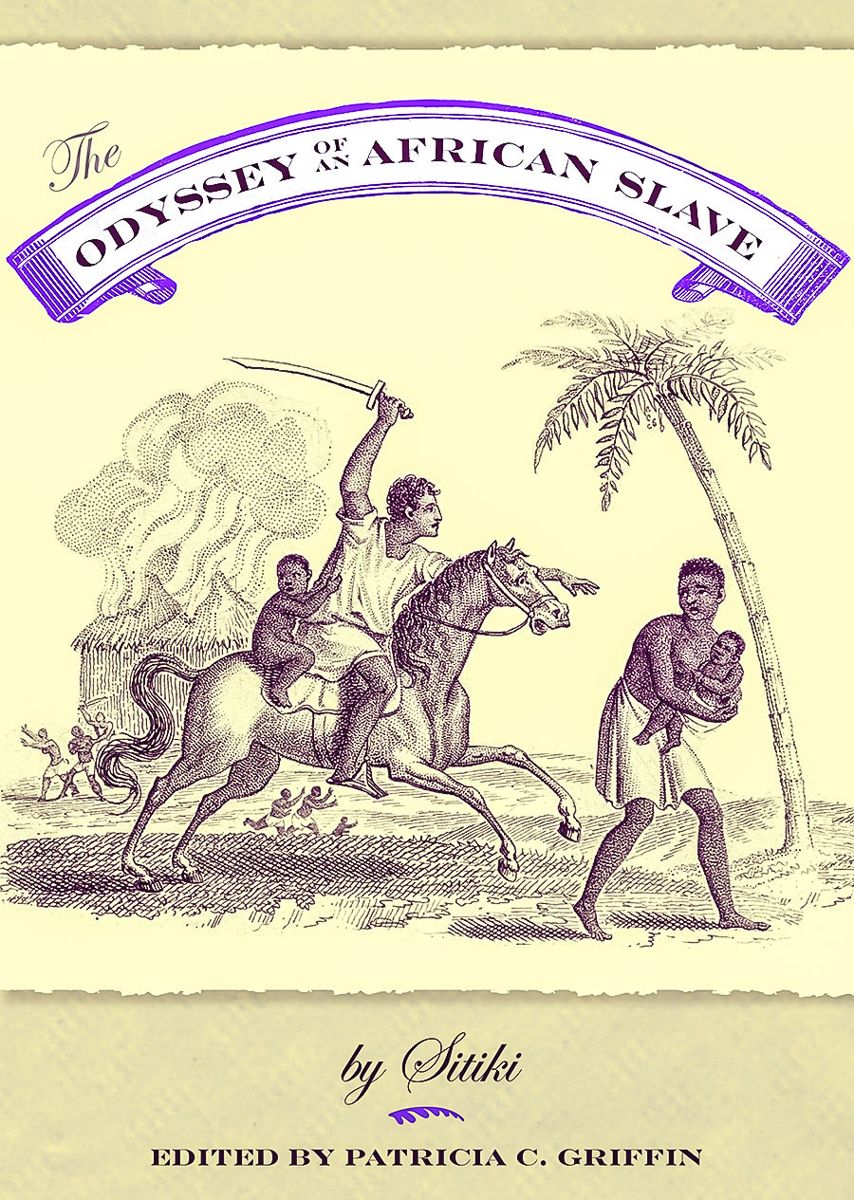
The Odyssey of an American Slave. By Sitiki. Edited by Patricia C. Griffin. Illustrated, notes, appendices, bibliography, index, 224 pp., 2015, Florida,www.upf.com, $19.95 softcover.
Slave memoirs are quite uncommon, especially by those who were born free in Africa. There are considered to be only 50 or so known narratives that fall into this category. This short, narrated autobiography is one of those few. It tells the story of Sitiki, the African name given to a boy born in western Africa around 1795. He was captured and sold into slavery by a “neighboring people” when he was approximately five years old. His slavery boyhood was spent on the African coast, first tending sheep and then as a house slave to wealthy owners. Sitiki’s passage to America occurred in 1808 after he was sold to a ship’s captain. His journey was a far cry from most of the ship’s human cargo. According to Sitiki, he was “treated like a son” by the captain and allowed to run on deck as he pleased. During a stop in Savannah, the captain sold Sitiki to Josiah Smith. That successful businessman named l his young slave “Jack Smith,” which Sitiki carried for the rest of his life. Smith’s business ventures took his family and chattel to Connecticut and then back to Georgia. In 1817, Smith moved his family to St. Augustine, Fla., which would be the family’s primary residence for the rest of Sitiki’s life. Josiah Smith’s son, Buckingham, took ownership of the family’s 12 slaves in 1859. Records indicate that the Civil War’s emancipation granted “Uncle Jack” his freedom at about age 70. He became an employee of the family rather than a slave. Though Sitiki was taught to read by his owners, his writing skills were rudimentary. So like many others, he narrated his tale in 1869. Sitiki’s transcriber was, of all people, his former master, Buckingham Smith. The two men had known each other for close to 50 years and shared a relationship unlike most masters and slaves. When Buckingham died in 1871, his will specified that Jack was to be allowed to remain in the cabin he then occupied and farm a portion of the family land for his benefit for the remainder of his life. Sitiki became a full-fledged Methodist minister in 1868 with Buckingham’s blessing and became known in the community as “Father Jack.” We learn from editor Patricia Griffin that the honorific title of “Uncle” or “Aunt” was deemed a mark of respect toward certain blacks by whites. For those black men of the church, “Father” was an even higher-status title. When he died in 1882, Sitiki was considered one of the most esteemed members of St. Augustine’s African-American church community. Two drafts of Sitiki’s narrative and portions of a third were found in the Buckingham Smith Papers at the New-York Historical Society during the 1980s. Of special importance is that Sitiki’s autobiography represents the only known narrative of a Florida slave.
Sitiki’s narrated memoir represents only 24 of this book’s 200-plus pages. The remainder is devoted to Griffin’s superb analysis of his story. Each of the 12 chapters discusses a unique part of her subject’s life. Within each chapter, Griffin provides historical explanation and background for literally every corresponding paragraph of Sitiki’s narrative. While she admits that her semi-literate subject’s narrative is not gripping literature, Griffin’s firstrate editorial work provides the necessary historical context that allows the modern reader to fully understand and appreciate Sitiki’s reminiscence. Four bonus appendices include a chronology, analyses of the manuscript’s condition and Sitiki’s language, and a transcription of Buckingham Smith’s last will and testament. Unfortunately, readers who are seeking a slave’s eyewitness accounts of life in Civil War Florida will be disappointed, for there are none. Despite being a slaveholder, Buckingham Smith was a devoted Unionist who left Florida with Jack for three and a half years shortly after the rebellion started. The two men lived those years in New York, returning only after the war concluded. Those were the only years when Jack lived outside of St. Augustine following his 1817 arrival. This is an important account of a 19th-century life that flows from freedom to bondage and then back to freedom. It offers modern readers a rarely seen glimpse into a slave’s life during Florida’s transition from territory to statehood. Reviewer Paul Taylor is the author of six Civil War era books. His latest is the award-winning Old Slow Town: Detroit during the Civil War, published by Wayne State University Press. His website is www.paulrtaylor.com.
Perhaps no Civil War figure captures the imagination more than Col. John Singleton Mosby. The so-called “Gray Ghost” has been the subject of many studies over the decades, from Virgil Carrington Jones’s classic Ranger Mosby (1944) to more recent studies by such notable historians as Jeffry Wert and William Connery.
Detailed Account Of John S. Mosby’s First Year In War Private John S. Mosby, First Virginia Cavalry: Picketing Fairfax County before Becoming the Confederacy’s “Gray Ghost”. By Gregory P. Wilson. Illustrated, photos, maps, notes, appendix, bibliography, index, 188 pp., 2015, Gregory P. Wilson, www.civilwarquakerscout.com, $25 softcover.
While every book about Mosby chronicles what Jones referred to as the “thrilling incidents in the career of Mosby,” no study just describes Mosby’s experience during the war’s first year. That year proved critical in molding one of the conflict’s more intriguing personalities. Gregory P. Wilson has filled that void with this study. He has produced a fast-paced chronicle based largely on published sources and a smattering of unpublished manuscripts. After a brief first chapter outlining Mosby’s prewar life, Wilson presents a crisp narrative detailing Mosby’s every move as a private in the Washington Mounted Rifles (later Co. L, 1st Virginia Cavalry). He meticulously describes Mosby’s scouting in such places as the
Shenandoah Valley and Fairfax County. Wilson does a fine job analyzing Mosby’s thoughts on the First Battle of Manassas — an engagement in which he did not participate — and capturing the excitement Mosby felt after killing his first Union soldier in autumn 1861. Mosby callously wrote about the killing to his wife with a gold pen taken from the dead soldier. Although some might view Wilson’s in-depth treatment of months of picket duty and scouting as somewhat pedantic, he makes a compelling argument that the time Mosby spent scouting, particularly in Fairfax County, played a significant role in educating him about “the land” where he earned his reputation as the Gray Ghost.
Throughout this engagingly written book, Wilson traces Mosby’s movements and fixes them on today’s landscape with modern-road names and GPS coordinates. This allows readers who trek to Fairfax to follow in Mosby’s steps. This book also offers some insight into Mosby’s complex attitudes on slavery. He was no apologist for slavery’s existence in the antebellum South and believed that slavery was the source of secession and therefore the war. A brief biographical sketch of Mosby’s slave Aaron Burton, who accompanied Mosby to the field, affords an opportunity to understand the complexities of the master-slave relationship in wartime. The inclusion of a chronology of Fairfax County events during the conflict’s first 11 months enhances this profusely illustrated volume. Although not a complete biography of Mosby, Wilson’s volume fills an important void in Mosby literature and serves as a nice complement to existing treatments of Mosby and his wartime exploits. Reviewer Jonathan A. Noyalas is assistant professor of history and director of the Center for Civil War History at Lord Fairfax Community College in Middletown, Va. He is the author or editor of 11 books on Civil War history, including the recently released Civil War Legacy in the Shenandoah: Remembrance, Reunion, and Reconciliation.