
Behind The Scenes Tour Of The Library Of Congress
By Nancy Jennis Olds · Originally published June 2016 · p. 10
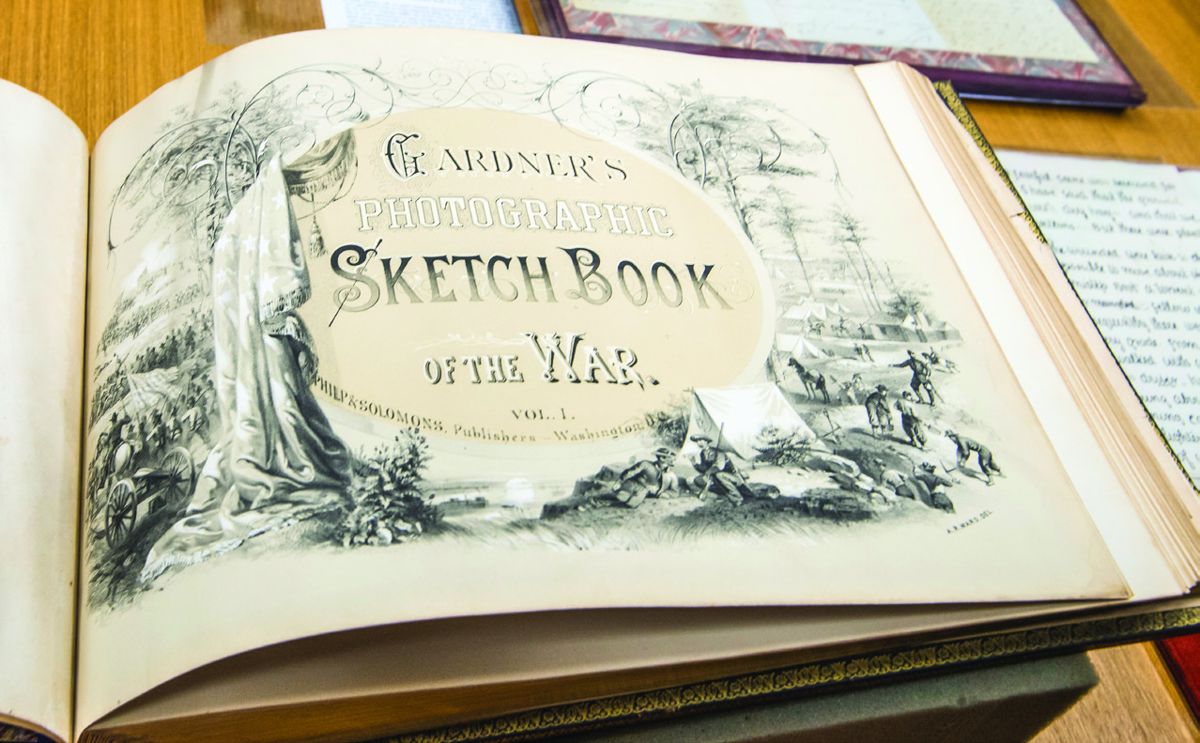
WASHINGTON, D.C.—Try to top this! There we were staring at the original copy of the collected works of Civil War photographer Alexander Gardner’s book, “Gardner’s Photographic Sketch Book of the War”, Volume 1, from 1865 to 1866. Gardner, the supervisory photographer for Mathew Brady’s photographic studios, was arguably the most famous photographer in the United States during the Civil War. Brady, renowned for his portraits of Senator Daniel Webster, Edgar Allan Poe, President John Quincy Adams, Robert E. Lee (while serving the Union and at the surrender at Appomattox in 1865), actor and assassin John Wilkes Booth, novelist Mark Twain, the Prince of Wales, writer and humanitarian Walt Whitman, orator and abolitionist Frederick Douglass, and who was also in charge of many portrait sittings of President Abraham Lincoln, began documenting the Civil War extensively with his highly skilled team of photographers. Alexander Gardner left Brady’s business to make a distinguished career of his own as shown with his book on display at the Library of Congress. Those of us who gathered that morning were members of the Bull (Nancy Jennis Olds)
President Abraham Lincoln’s “Blind Memo”, dated August 23, 1864.
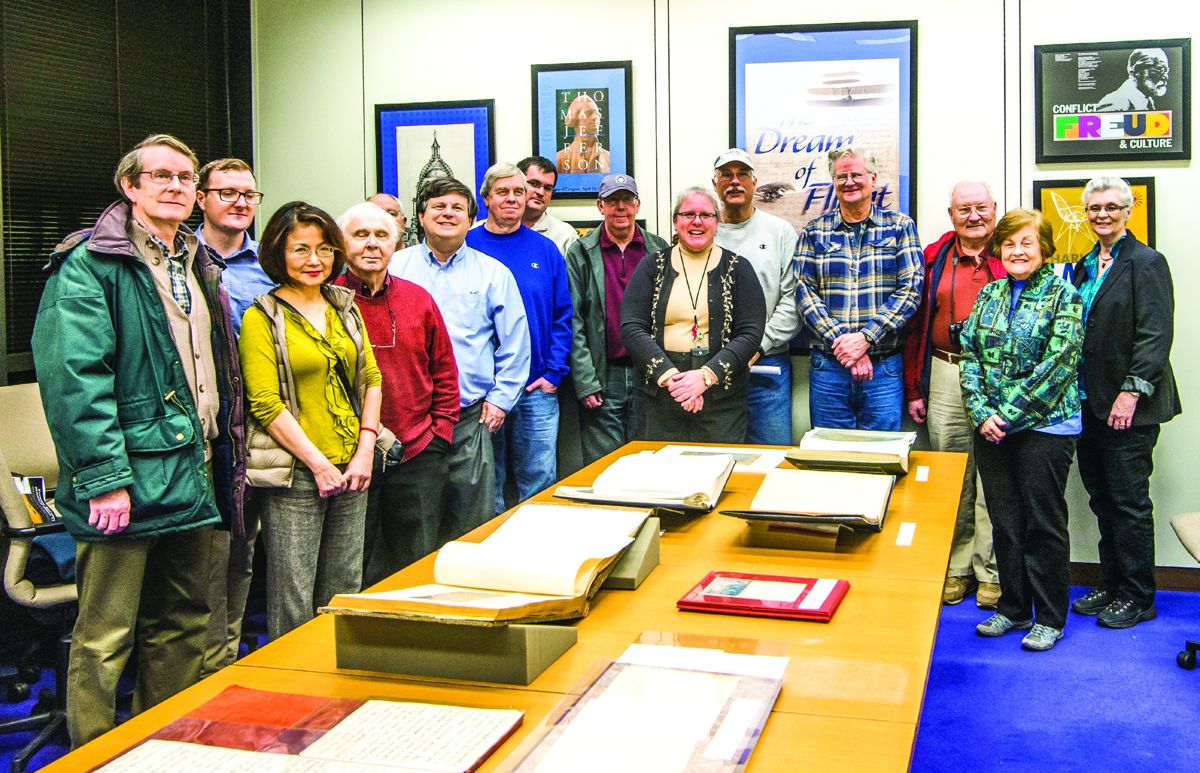
Run Civil War Round Table. Our non-profit organization meets every second Thursday of the month at the Centreville Library in Virginia for meetings, book swaps and presentations. Kimball “Kim” Brace, one of our members, had done a considerable amount of research at the Library and wanted others to see what information was available. Brace coordinated our behind the scenes tour. Only twenty people could attend at one time, and the Library of Congress staff organized a display of their collections specifically with our organization’s emphasis in Civil War history. Our tour began in the lobby of the Madison Building located at 101 Independence Ave., SE at 10 am. The Library of Congress is a network of three buildings located in Washington, D.C. The Thomas Jefferson Building, just across Independence Avenue, is the older more ornate Beaux-Arts style building, which was built in the late 19th century for the purpose of maintaining a permanent and specifically designed building for the Library of Congress’ collections. The John Adams Building opened to the public in 1939 and the James Madison Building officially opened in 1980. We were escorted into a small meeting room where several documents and two books were placed on a table. Michelle Krowl, Civil War and Reconstruction Specialist in the Manuscript Division, began identifying the Civil War treasures. Among them before our eyes was President Abraham Lincoln’s “Blind Memo of August 23, 1864”, written before the start of the next presidential election, when the Civil War’s conclusion was very much in doubt. Lincoln’s letter was in anticipation should he fail to be re-elected president for a second term. His cabinet members did not read his remarks but loyally signed on the back of the folded and sealed document. This is the “Blind Memorandum” that Lincoln wrote:
“This morning, as for some days past, it seems exceedingly probable that this Administration will not be re-elected. Then it will be my duty to so co-operate with the President elect, as to save the Union between the election and the inauguration; as he will have secured his election on such ground that he can not possibly save it afterwards.” We could read original letters such as John G. Nicolay’s letter to his fiancée, Therena Bates, from July 2122, 1861 describing the news reaching him about the outcome of the Battle of First Manassas/Bull Run. Nicolay was President Lincoln’s private secretary. It was an exciting opportunity to examine the original Special Order 191, discovered wrapped with some cigars, by the 27th Indiana Volunteers in Frederick, Maryland. General Robert E. Lee’s Lost Orders, a copy of Lee’s campaign plans and movements recovered by these Union soldiers in September 1862 was a significant find for Union Major General George B. McClellan, commander of the Army of the Potomac, just before the Battle of South Mountain and Antietam campaigns. However, Civil War historians and President Lincoln have criticized General McClellan, for not fully exploited his knowledge of General Lee’s Special Order 191 to his advantage. In a time where women were expected to remain mainly in the background during the Civil War, Clarissa “Clara” Harlowe Barton, a Massachusetts native, became an enduring celebrity for her humanitarian efforts on the battlefield. After the Civil War, Barton founded the Missing Soldiers Office in Washington, D.C. to help families reunite with the missing soldiers or found out about their fates. Over 22,000 soldiers were located with Clara Barton’s determined efforts. In 1880, Barton successfully established the American Red Cross and served as the organization’s first president until 1904. Clara Barton was in great demand as a speaker by a grateful public, quite unusual for the period when women were not encouraged to speak in public. On the table was a collection one of her speeches, written in large cursive, which she would have employed as her cue cards or as today’s teleprompter. As much as we wanted to linger there for hours, we followed our schedule and met with Mike Buscher, Reference Team Leader in Maps, Civil War specialist. Mike Buscher met us by an enormous globe with an elaborate pedestal. Next to the globe was a photograph of President Theodore “Teddy” Roosevelt standing next to the very same globe appearing before us. Buscher mentioned that President Roosevelt was very proud of his Civil War ancestry. Roosevelt’s mother, Martha “Mittie” Bulloch, was a southern belle whose relatives served in the Confederacy during the Civil War. President Roosevelt’s two uncles were his mother’s brother Irvine Bulloch and her half-brother, James Dunwody Bulloch. Irvine Bulloch joined the Confederate Navy and a Confederate blockade-runner and was a midshipman on the Alabama when it sank off France. James Bulloch, initially a Confederate captain and blockade runner, became in charge of the massively secret construction of Confederate ships in England. We were ushered into a vast room where many maps were laid out before us. The largest map was that of Confederate General Thomas J. “Stonewall” Jackson’s Battle Map of the Shenandoah Valley, 1862 as drawn by cartographer and topographer Major Jedidiah “Jed” Hotchkiss. A native New Yorker living in Virginia, Hotchkiss, self-taught in geography and geology, became an essential mapmaker for the Confederacy. Hotchkiss’ sketchbook, which documented his fieldwork that he later applied to the map and his highly detailed maps are credited for General Jackson’s victories during the Valley Campaign of 1862 were also on display. There were maps of all sizes, materials and subjects including an original map of Alexandria designed by surveyor and future first president of the United States George Washington, a “National Political Chart & Map of the United States” from 1860, a detailed map of Point Lookout, in southern Maryland, a prisoner of war camp for Confederates, and a map from an eyewitness at Appomattox Court House during the surrender of General Robert E. Lee and his Army at 10 AM on April 9, 1865. Our last destination for the day was over to the Prints and Photographs Division with a talk by Barbara Orbach Natanson, Head of the Reference Section for the Prints and Photographs Division. We could feast our eyes looking through the stereoview lenses to gaze at three-dimensional images of life during the Civil War, such as the destruction of Richmond after it was evacuated and “Negro quarters on Fripp Place, St. Helena Island, South Carolina”. There was an arresting tinted tintype of “Two unidentified sailors in Union uniforms with rope and anchor”, a quarter plate tintype, part of the vast “Liljenquist Family Collection of Civil War Photography” at the Library of Congress. It was explained to our group that the online catalog digital images are high resolution, high image quality, and the images can be downloaded and printed without restrictions except that the Library of Congress does request attribution should go to the Library of Congress’ photographic collection as a source. Among other artifacts was the eyewitness sketch by British-born Alfred R. Waud of a battle scene complete with artillery explosions, smoke and the grittiness of being there. Waud’s on scene submission was alongside a finished newspaper print done by skilled woodblock artists and engravers for his employer, Harper’s Weekly. The quick sketch by Waud, who was watching the battle, and possibly in harm’s way, has an immediacy that can’t be captured in a detailed and highly finished print. History does come alive whenever you have an opportunity to view the original letters, books, maps, illustrations and photographs that played a key role in that epic conflict known as the American Civil War. FURTHER INFORMATION: Library of Congress 101 Independence Avenue, S.E. Washington, D.C. 20540 Phone: (202) 707-5000 Website: www.loc.gov