
Saving The Falling Waters 1863 Battlefield In Maryland
By George F. Franks III · Originally published July 2016 · pp. 52–53
During the Summer of 2002 Melissa Cooperson and I began the search for an old house as a weekend and vacation project. Our search took us to various areas in Virginia, Pennsylvania, Delaware and Maryland. One weekend we ventured to Western Maryland. It was there after looking at two Civil War-era homes in Washington Country that we found our dream project. It was a brick farmhouse built in 1830 on nearly twenty acres. It had been neglected for years and was in terrible condition, but it had great features. Additionally, according to the realtor it had served as a hospital during the Civil War. The house was two miles down a country road which led to a fish and game club. It was also less than a mile from the Chesapeake & Potomac Canal and the Potomac River.
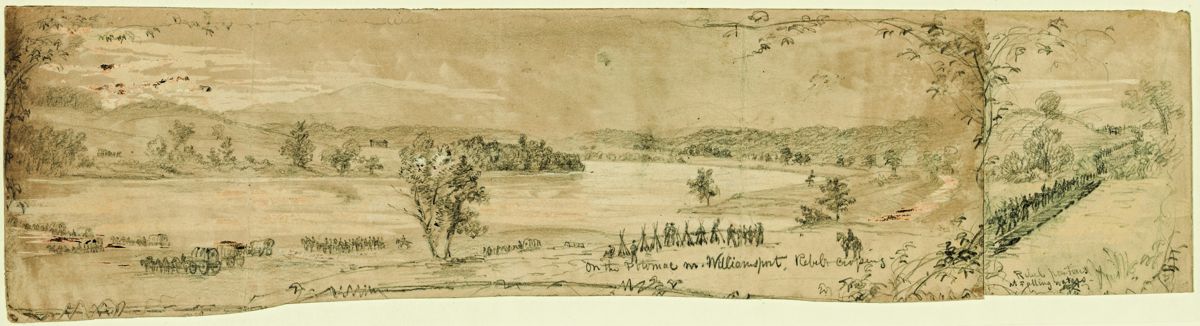
Author George F. Franks III giving a tour of the Falling Waters Battlefield. Both research and restoration work commenced after closing the following winter. Research uncovered both the history of the house and its Civil War connection. Restoration work initially focused on stabilizing the house. New gutters, repointing exterior brickwork and rebuilding the pair of double chimneys topped the list. Next followed the taming of the surrounding sixteen acres. We decided to lease ten acres to a local farmer and made our best effort to cut the grass, weeds and tangled growth surrounding the house and our two non-historic outbuildings. At the same time, we began to research the history of the house and its Civil War connections. Melissa engaged a local historian to examine the history of the house. Soon after her work was completed we began the process of applying for local, state and National Register of Historic Places status. I, myself, started researching the Civil War history of the house and surrounding land at the Western Maryland Room of the Washington County Free Library and the Library of Congress. I learned the National Park Service during the 1990’s had commissioned consultants to prepare a brief report about Civil War activity on the property, but no action was taken, and the report was filed away and forgotten. The local historian’s research uncovered that the house was built in 1830 by an Irish-born attorney named Daniel Donnelly as his home and office. An attorney, politician, businessman and militia officer, Donnelly had business connections with the Canal and also served a term in the State House in Annapolis. The house served as a showplace to do business with his clients although the family spaces were much more modest. The history and the quality of the exterior and interior features made the house an ideal candidate for the state and National Register. Designation was awarded within a year of submission. The process of uncovering the Civil War history was not quite as simple. From the purchase of the house in 2003 until July 2013, my research evolved into an international military history magazine article, multiple submissions to the Civil War Trust and ultimately a book. The Civil War hospital link remains a plausible yet undocumented mystery to this day. There are clearly bloodstains in the first-floor hallway and the southwest or rear parlor. The local myth of limbs being tossed out the parlor window and dumped in the cistern remain unsubstantiated. Research included inquiries to experts at the National Civil War Medical Museum in Frederick, Maryland. What I did find through extensive research was just as compelling. The retreat and pursuit phase of the Gettysburg Campaign concluded behind our house. On July 13, 1863, Gen. Robert E. Lee decided to withdraw his Army of Northern Virginia from Maryland because the flooded Potomac River was receding and the single pontoon bridge had been rebuilt. His men moved from substantial earthworks to crossing points at Williamsport and Falling Waters that night. On the morning of July 14, Major General Henry Heth led his four brigades to their rear guard positions on both sides of
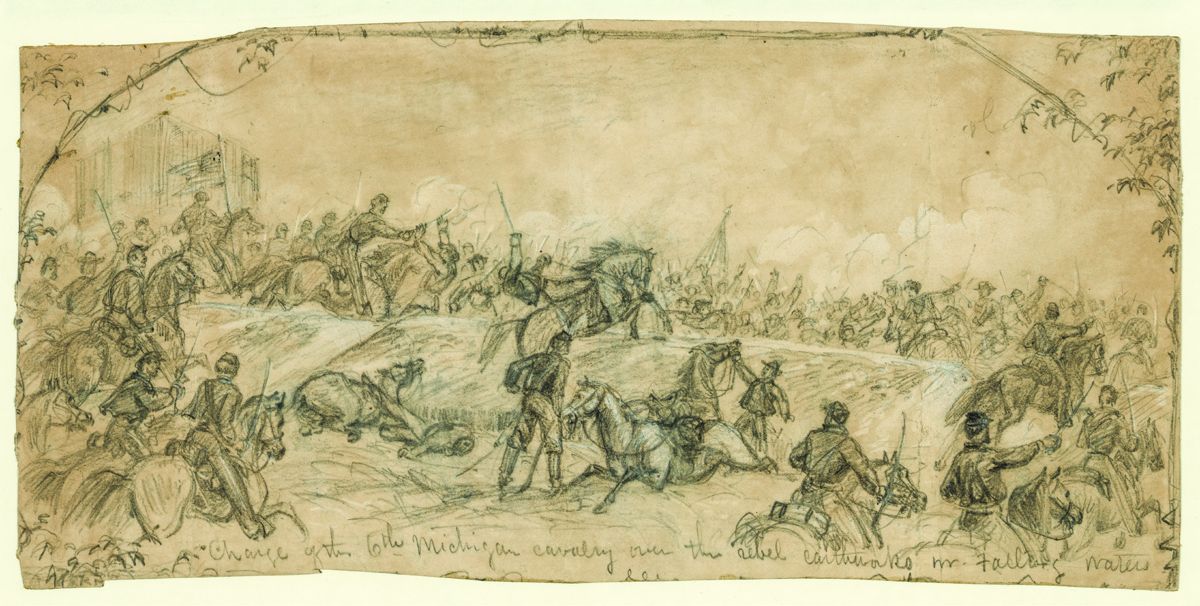
(Library of Congress) (Library of Congress) Falling Waters Road approximately two miles from the pontoon bridge spanning the Potomac River at the Falling Waters crossing to Virginia (now West Virginia). It was on the steep rise behind our house that Brigadier General Judson “Kill-Cavalry” Kilpatrick’s 6th Michigan Cavalry charged the center of Heth’s rear guard and were decimated. The attack was ordered against the recommendations of the “Wolverines” commander, Brigadier General George A. Custer, Kilpatrick’s subordinate. Fighting on both sides of Falling Waters Road, including behind our Donnelly House, raged for approximately three hours. At the peak of the fighting, Heth’s rear guard of fewer than 3,000 infantrymen was engaged in hand-to-hand combat with nearly 7,000 of Major General George G. Meade’s finest cavalry supported by attached artillery under Kilpatrick and Brigadier General John Buford. In the opening moments of the fighting, the Confederate general considered the most brilliant man in the South, was mortally wounded. Brigadier General James Johnston Pettigrew, slightly injured during the July 3 charge at Gettysburg, was thrown from his mount and shot in the abdomen by a Union trooper between the barn (see the Edwin Forbes sketch) and the rear of the Donnelly House. The grievous wound proved to be fatal. He died three days later in Bunker Hill, Virginia (now West Virginia). By 1 p.m. Heth requested artillery and additional infantry from his commander Lieutenant General Ambrose P. Hill. Although Hill, decided not to send any precious artillery back over the Potomac River to support Heth, he did order two brigades to support Heth’s withdrawal. For the most part, the Confederates maintained discipline and fought the entire two miles to the Potomac River. Once the last troops were across, they cut the pontoon bridge free leaving Meade’s troopers standing on the banks of the river unable to continue the fight. The Gettysburg Campaign was over. Why was this battle lost to history? President Abraham Lincoln was furious that Meade had not been more aggressive and bagged Lee’s entire army. In Lincoln’s mind, such an action could have ended the war. Lincoln even wrote as much in a letter that he chose not to mail to Meade. From the Confederate’s perspective, the rear guard action was an embarrassment. Cavalry commander “Jeb” Stuart had been ordered to remain between any advancing Union troops and the rear guard. Contrary to his orders, Stuart’s troopers crossed the Potomac River at Williamsport before many of Hill’s troops reached the Virginia shore of the Potomac. Protective of his army’s reputation and his cavalry leader, Lee went to the extreme of downplaying the action in letters written to and published in prominent newspapers. The battle was not forgotten by those who fought in it. Two companies of Michigan “Wolverines” were decimated. George Custer personally led subsequent charges and his men documented their admiration of him for his courage. Many Virginians serving under Colonel John Brockenbrough were captured due to his failure of leadership. And with the tragic death of Pettigrew, North Carolina lost a brilliant scholar and general officer who many looked to as the future of the South. A battlefield in our back yard. The dream of every Civil War enthusiast. The remaining question was how to document it and ultimately save it? As the research and restoration work progressed, we began hosting group tours of the battlefield. These included Civil War Roundtables, a stop by author-historians with their own tours, the Smithsonian Institution, veterans’ organizations and descendants of those who fought in the battle and thought it had been forgotten. Battlefield tours continue on a reservation basis. We established contact with the Civil War Trust (CWT), Save Historic Antietam Foundation (SHAF), the Hagerstown Convention and Visitors Bureau, local political leaders and neighbors. Work with these organizations led to the CWT spearheading an effort to save an adjoining lot of more than three acres that had been targeted for development. Secondly, under the mentorship of Tom Clemens of SHAF, we established the Battle of (Library of Congress) Falling Waters 1863 Foundation, Inc. in early 2014. My book “Battle of Falling Waters 1863: Custer, Pettigrew and the End of the Gettysburg Campaign” was finished and published in time for the 150th anniversary of the battle. Presentations to Civil War Round Tables, historical societies and other organizations soon followed and continue to provide an opportunity to educate the public about one of the least recognized battles of the Civil War. Today, Melissa and I continue the never-ending work of preserving the Donnelly House and the surrounding sixteen acres. The weekend and vacation project became our year round home in September 2011. Because most of 500 plus acre battlefield is private property, we actively work through our friends and supporters with the Battle of Falling Waters 1863 Foundation, Civil War Trust and other organizations to save the most significant areas of the battlefield through easements and purchase along with on-going educational efforts. For more information on the Battle of Falling Waters 1863 Foundation, Inc. visit our website: battleoffallingwaters1863foundation.wordpress.com. We can also be contacted by email at fallingwatersmd1863@ gmail.com George F. Franks, III is the founder and President of the Battle of Falling Waters 1863 Foundation,
Inc. and a member of the Board of Directors of the Heart of the Civil War Heritage Area. He is a Governor and former officer of the Company of Military Historians and the former President of the organization’s Chesapeake Chapter. George served as President of the Capitol Hill Civil War Round Table and is a member of Hagerstown Civil War Round Table, Save Historic Antietam Foundation and Civil War Trust. He is the author of Battle of Falling Waters 1863: Custer, Pettigrew and the End of the Gettysburg Campaign and lives in the 1830 Daniel Donnelly House on the battlefield. George studied history at the U.S. Naval Academy and the University of Pittsburgh.