
Minié Ball Holes And Legendary Stories Invite You To Visit The Farnsworth House Inn
By Nancy Jennis Olds · Originally published July 2016 · pp. 44–45
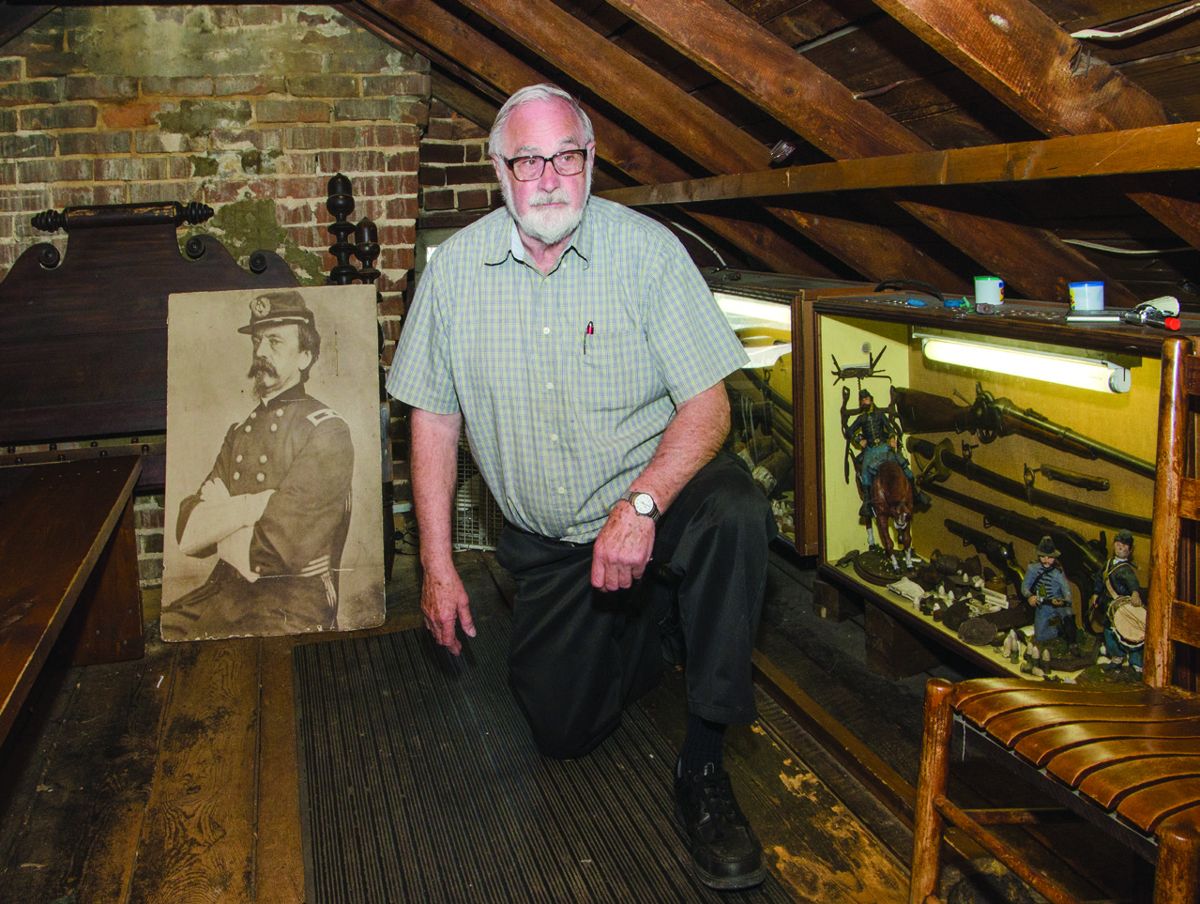
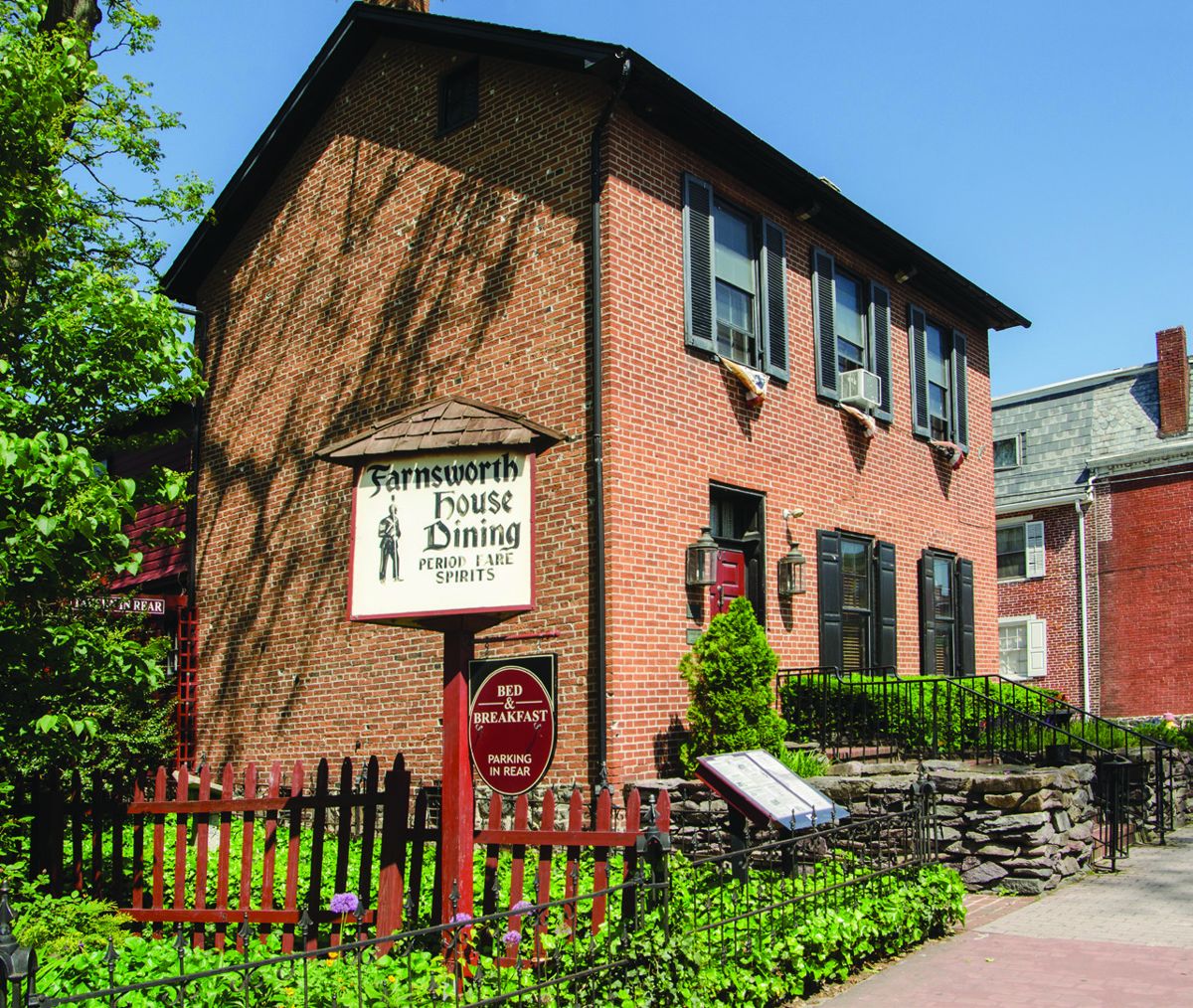
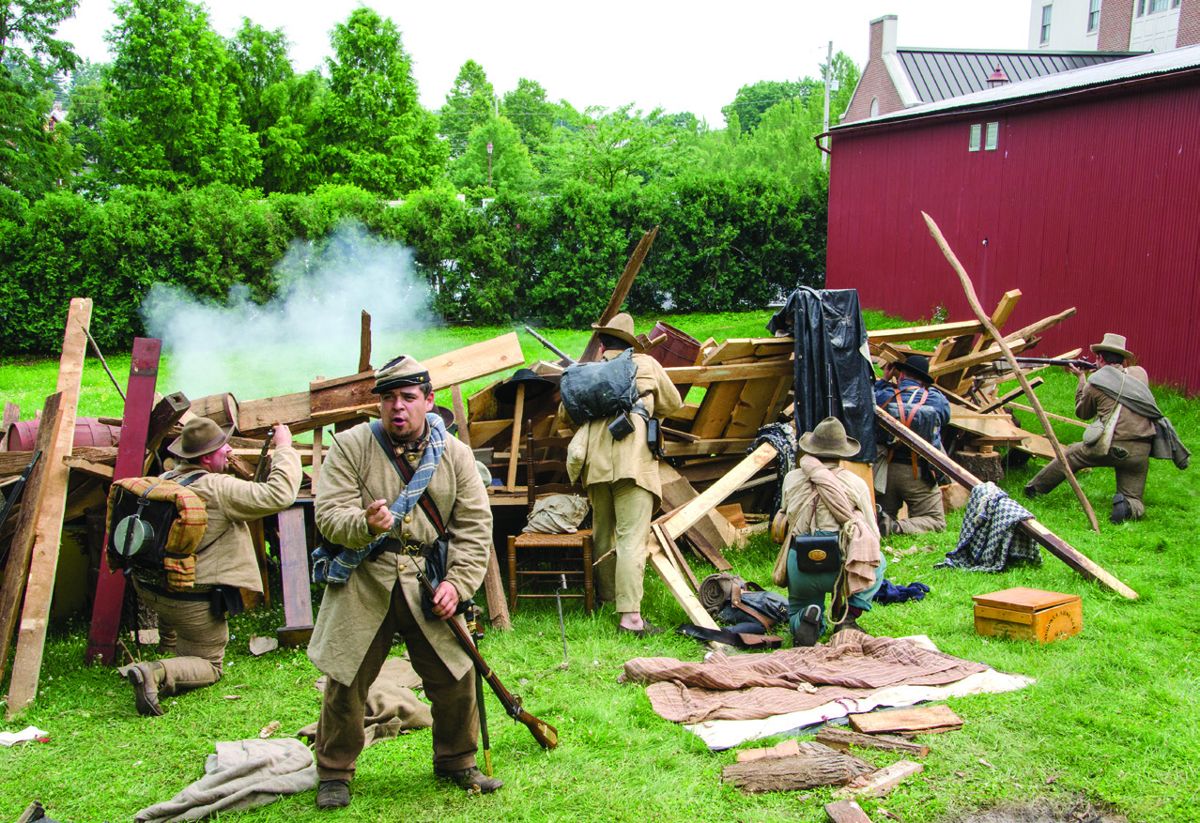
GETTYSBURG, PA.—Visiting Gettysburg is an adventure back in time in a still vibrant town. It is filled with battlefield sites, historic homes, businesses catering to Civil War enthusiasts, Civil War living historians and reenactors alike all of whom are undoubtedly rejoicing that Gettysburg is witnessing many commendable changes in restoring and retaining the familiar 1863 landscape that witnessed an epic battle lasting three days. Not only can a visitor explore the many battlefields, Little Round Top, Big Round Top, The Peach Orchard, Seminary Hill, Devils Den, Culp’s Hill and more, one might consider trying an alternative adventure, such as finding lodging at an historic place right in the heart of Gettysburg. One such location is the Farnsworth House Inn located on Baltimore Street. I have long been attracted to historic homes and their fascinating history. Last year, on the 152nd anniversary of the Battle of Gettysburg, I returned to Gettysburg to cover several events despite the postponement of the annual Civil War reenactment until August. I followed a group of Confederate infantry filtering into the backyard behind the Farnsworth House Inn with a tour group in tow led by Brian Schade, portraying Major Eugene Blackford in command of Blackford’s Sharpshooters, the 5th Alabama Infantry. Schade gave the tour group a thorough presentation on Blackford’s Sharpshooters and their vital role during the Battle of Gettysburg. Afterward, the infantrymen staged a skirmish. Civil War history is an essential part of the Farnsworth House Inn experience, both outside and inside the several buildings that comprise the Farnsworth House Inn. I met with the Farnsworth House Inn’s longtime owner, Loring Shultz, who with his wife Jean, acquired this house, in 1972 from the Black family who had formerly called the place the “Sleepy Hollow Inn.” It is on the National Register of Historical Places (October 7, 2004). The original wooden structure of the building was most likely constructed in 1810. The brick structure of the main building was built in 1833 while the original owner, John McFarlane, still owned the home until he passed away in 1851. After his death, the house became the property of the Bank of Gettysburg and subsequently passed through many hands until the Black family bought the house in 1908. Further construction on the house followed in 1929. The house remained with the black family until they sold it to Shultz. Loring Shultz is an amiable man who appears younger than his eighty plus years. The B&B, or bed & breakfast, the tavern, the gift shop and the restaurants have prospered under his direction to
GRANT
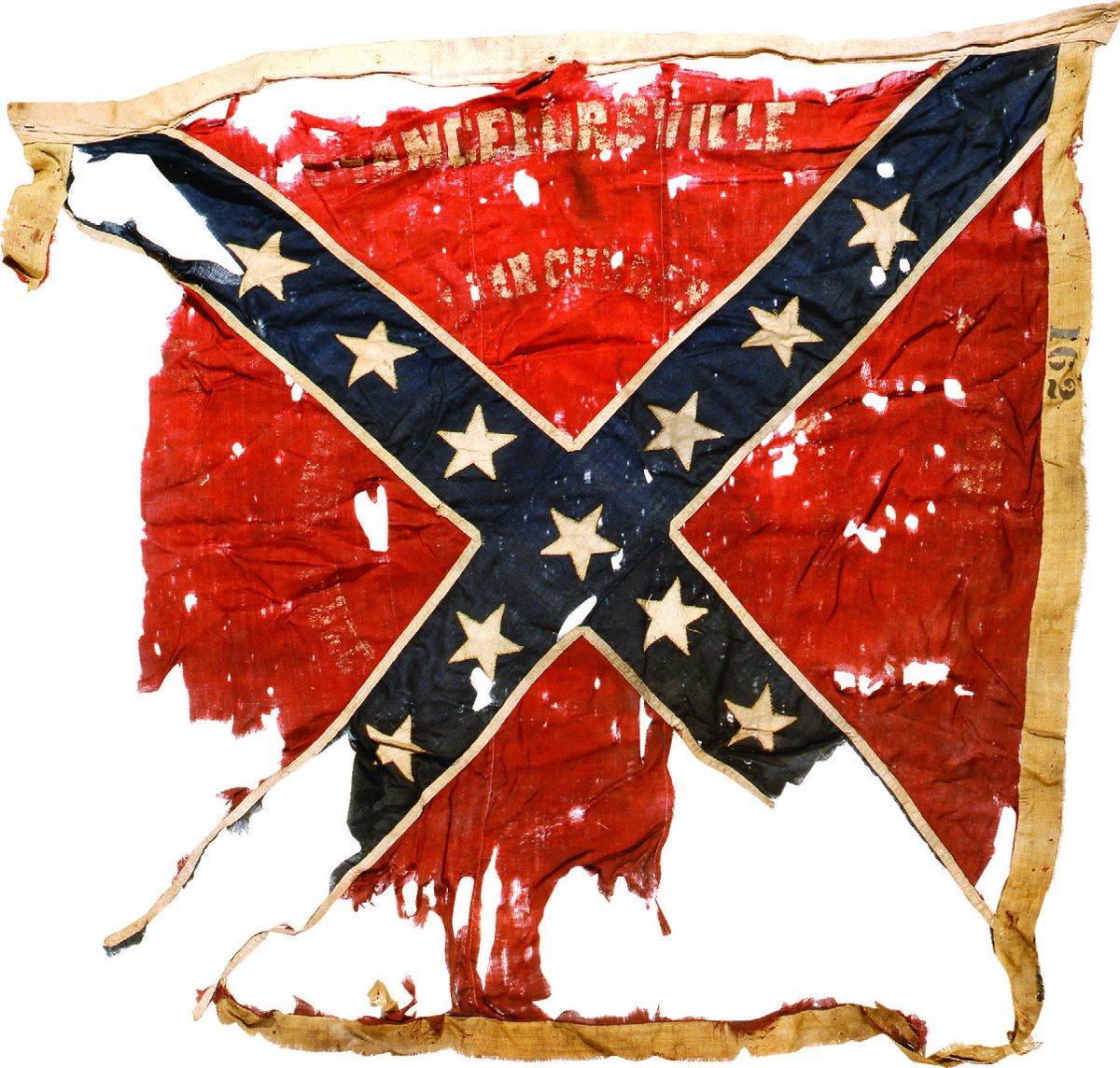
become a cornerstone in the town of Gettysburg. Every Remembrance Day, when Union and Confederate Civil War reenactors convene to Gettysburg for the Remembrance Day Parade in November, the Farnsworth House Inn is located directly on the route of the parade, which is a very special celebration for residents and visitors alike. According to Shultz, Farnsworth House Inn has several historical connections to the Battle of Gettysburg. The garret, or attic of the original main building was most likely the factor of a tragic incident on July 3, 1863. Mary Virginia, “Ginnie” or “Jennie” Wade, twenty years old, was kneading dough to make bread for the hungry Union soldiers at the home of her married sister, Georgia Anna Wade McClellan. Georgia had recently given birth and needed her mother, sister “Ginnie” and her two much younger brothers to help her while she took care of her newborn. The Mother and child were not immediately evacuated despite a fierce battle raging around the home. Confederate sharpshooters, possibly Dole’s Brigade from Georgia, were stationed in the attic of the Farnsworth House Inn. Ballistic experts have visited the Farnsworth House Inn and have measured from the attic to the door where “Ginnie” Wade was bending down to knead the bread for the hungry soldiers, determining it to be 610 feet. The shot that passed through Wade’s left shoulder blade and pierced her heart, killing her instantly, was very likely from one of the sharpshooters in the attic. Such was the heartbreaking fate for the only civilian killed during the entire battle. The basement in the Farnsworth House Inn was converted into a hospital during the Battle of Gettysburg. Bedding was ripped up for bandages and a list of items including a saddle, were discovered to be missing afterward. As Shultz recalled, Harvey Sweney, the owner of the building then, left a document, a requisition list of items for reimbursement by the federal (Nancy Jennis Olds) government. Harvey Sweney, whose name is synonymous with Sweney’s Tavern, one of the additional buildings forming part of the Farnsworth House Inn, is noteworthy for being an eyewitness during a momentous day on November 19, 1863. As Sweney stood on the front steps of his place, President Abraham Lincoln passed through the streets of Gettysburg on his way to make one of the most memorable speeches ever given, the Gettysburg Address. Sweney, evidently touched by the event, wrote an eloquent account of his experience to his brother. It is remarkable that the two-story brick building survived the continuous musket fire and shelling that rained down on the town of Gettysburg for three excruciating days. On the south side and front of the building are remnants of over 135 minié ball strikes and at least one artillery shell perilously stuck in the side of the house. Sara Black Gillean told Shultz that her father had the artillery shell pulled out for fear that it would one day fall on a pedestrian! Perhaps one of the most dramatic and intense stories about the
(Nancy Jennis Olds)
Farnsworth House Inn is revealed in its namesake, Brigadier General Elon John Farnsworth. Farnsworth, born in 1837 in Green Oak, Michigan, was a rising star as a first Lieutenant for the 8th Illinois Cavalry at the outbreak of the Civil War. His uncle, John F. Farnsworth was a prominent politician with the Democratic Party, who switched to the Republican Party and saw service as a Union general as well as his nephew. On June 29, 1863, Elon John Farnsworth was promoted to brigadier general just as two other noted cavalry officers, George Custer and Wesley Merritt, were promoted. Brigadier General Farnsworth took command of the First Brigade, 3rd Division, Calvary Corps, Army of the Potomac, which was under the overall command of Brigadier General Judson Kilpatrick. General Kilpatrick was aptly nicknamed “Kill-Cavalry” Kilpatrick for sending cavalry into reckless charges with huge casualties. On July 3, 1863, as the Union army repulsed Pickett’s Charge, Brigadier-General Kilpatrick ordered Brigadier General Farnsworth to send his cavalry brigade over rocky terrain toward Big Round Top to rout the Confederate infantry, part of General James Longstreet’s First Corps. Captain A.C. Parsons of the 1st Vermont Cavalry was present during this exchange of orders. Farnsworth initially argued against this attack, considering this assault a hopeless mission sacrificing good and seasoned cavalrymen. General Kilpatrick, almost accusing General Farnsworth of cowardice, offered to lead the charge if Farnsworth refused to. Brigadier General Farnsworth then “rose in his stirrups, with his sabre half-drawn; he looked magnificent in his passion, and cried, Take that back!’’ General Kilpatrick quickly retracted his statement with an apology, but “Farnsworth spoke calmly, General, if you order the charge, I will lead it, but you must take the awful responsibility.” Following his orders, General Farnsworth led his cavalry troops to Big Round Top by way of the Slater Farm. Two horses were shot under General Farnsworth, and he was struck five times, succumbing to his wounds on the field. There were about sixty-five Union casualties and the insurmountable loss of a promising young general. Farnsworth’s final resting place is in Rockton, Illinois at the Rockton Township Cemetery.
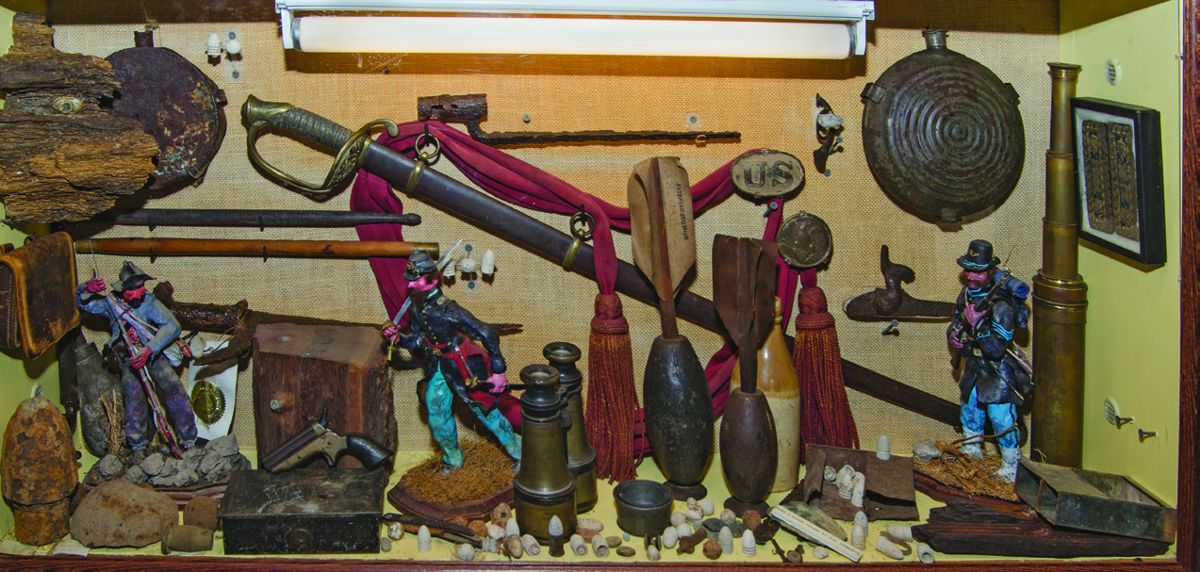
paid a visit to the Farnsworth House Inn. Shultz can also claim Civil War Confederate heritage on his maternal side of the family and a fasci- (Nancy Jennis Olds) There are many circumstances that probably led Loring Shultz to become the current owner of the Farnsworth House Inn. As a boy of seven or eight, Shultz lived on Liberty Street in Gettysburg, which gave him and his friends ample opportunity to find minié balls whenever they visited Gettysburg’s battlefields. One of his friends dug into a dead tree trunk and found seven minié balls in the hollow of the dead tree. Those were the days when a friendly park service ranger would ask, “what did you find?” instead of confiscating those historical treasures! A devoted fan of Ron Maxwell’s movie “Gettysburg”, Shultz has amassed a notable collection of uniforms, hats, props and other memorabilia from the movie set. These items are on display in Sweney’s Tavern. Segments of the movie were filmed on parts of the Gettysburg battlefield. On occasion, actors who appeared in the movie “Gettysburg”, Tom Berenger, portraying Lieutenant General James Longstreet, Stephen Lang, portraying Major General George E. Pickett, and Patrick Falci, portraying Lieutenant General A.P. Hill have nating story about a confrontation involving a pro-Union ancestor on his father’s side. His great grandfather, Trooper J.J. Starkey, served in the 18th Virginia Cavalry, Company H under the command of Captain Frank Imboden, the brother of Confederate Brigadier General John D. Imboden. Another great grandfather, Captain John Pyles, served in the 18th Virginia Cavalry, Company K. General Imboden and his troops were instrumental in guarding the retreat of a train of wagons carrying the wounded from Gettysburg to Williamsport. Imboden’s forces, including the 18th Virginia Cavalry, successfully halted Brigadier General John Buford’s cavalry from occupying Williamsport and capturing the wagons and taking more prisoners. Massive rainfall and flooding in the region prevented the Confederates from continuing until the river level fell and a new bridge could be built for crossing the Potomac River. The retreating Confederate forces narrowly escaped Major General George Meade’s pursuit. The Shultz connection in Cashtown, Pennsylvania during the Civil
War involved a relative, John Shultz, Loring Shultz’ father’s uncle, and it was a case of “getting even”, according to Shultz. Before this incident on June 30, 1863, there was already bad blood in the region after Confederate Major General J.E.B. Stuart’s cavalry organized small raids into Pennsylvania in 1862, reaching as far as Chambersburg. The wife and two kids of a Cashtown citizen were driving their horse-drawn buggy when some of General Stuart’s men approached them and captured their horse. The wife and kids were left helpless in a horseless buggy. Their husband and dad never forgot this injustice, and he would bide his time to seek vengeance. Just before the Battle of Gettysburg, he and his gang of Jayhawkers, a pro-Union vigilante force, including John Shultz, got their wish. They attacked Confederates coming through the pass and mortally wounded a Georgia soldier who succumbed from his wounds in the Cashtown Inn. John Shultz was a wanted man but was able to elude capture. Shultz enjoys his family’s connection with Civil War history and is an active member of the Private John Wesley Culp Memorial Camp #1961, Sons of Confederate Veterans. Three of his four children still live in Gettysburg and are involved in the family business, and his daughter Patti initiated the “Ghost Walks and Presentations” in 1986. Presently a staff of twenty, all wearing woolen uniforms or civilian period clothes, are involved with the ghost tours, which
13G (Nancy Jennis Olds) has generated media coverage on the Travel Channel, A&E, the History Channel and the Syfy Channel. Some of the bedrooms, the Sweney Room and the Sara Black Room have been known to cause high levels of paranormal activity. I was permitted to explore a large part of the Farnsworth House Inn including the attic, basement and some of the bedrooms, and observing Loring Shultz’s vast collection of Civil War era artifacts throughout the many rooms in the Farnsworth House Inn. What came to mind is how do his visitors respond to being guests in a historical B&B? Shultz, who has kept guest books enriched with comments from his visitors over the years, replied that fifty per cent of the guests plan to visit the Farnsworth House Inn for the ghost stories, and fifty per cent want to be there to learn more about the Civil War history. Either way, they are certainly welcome to sleep on it! FURTHER INFORMATION: Farnsworth House Inn 401 Baltimore Street Gettysburg, PA 17325 Phone: (717) 334-8838 [email protected] www.farnsworthhouseinn.com