How A Professional Split Enhanced Photography At Gettysburg
By Bob Zeller · Originally published July 2016 · pp. 38–39
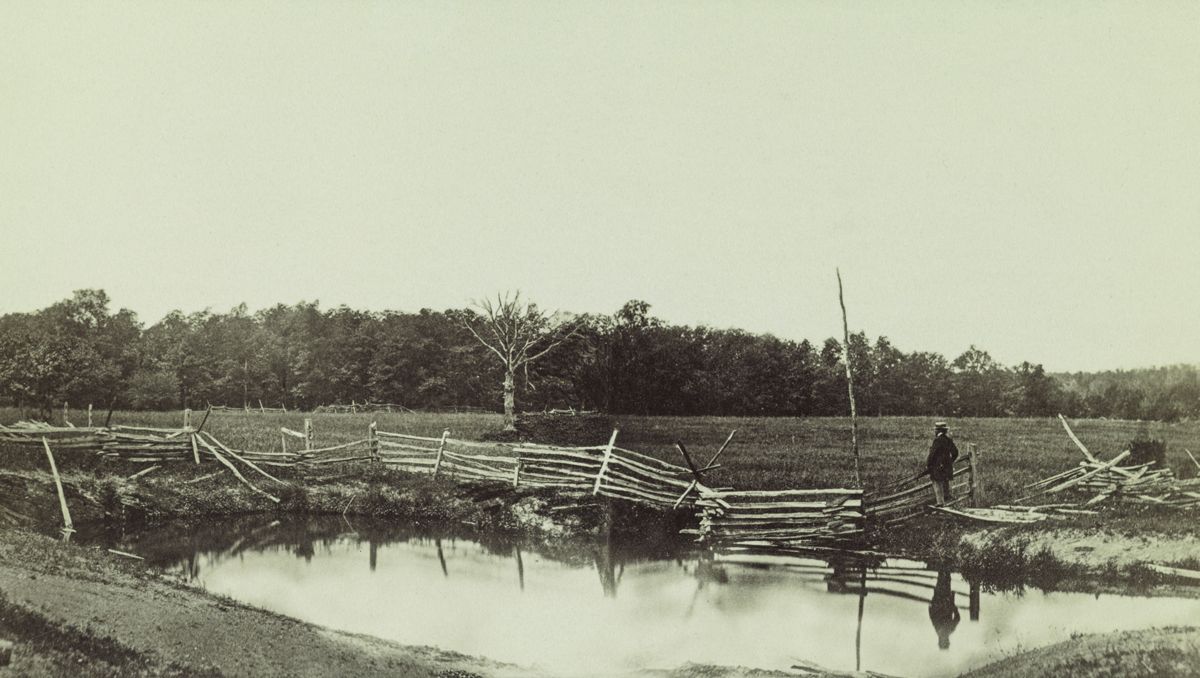
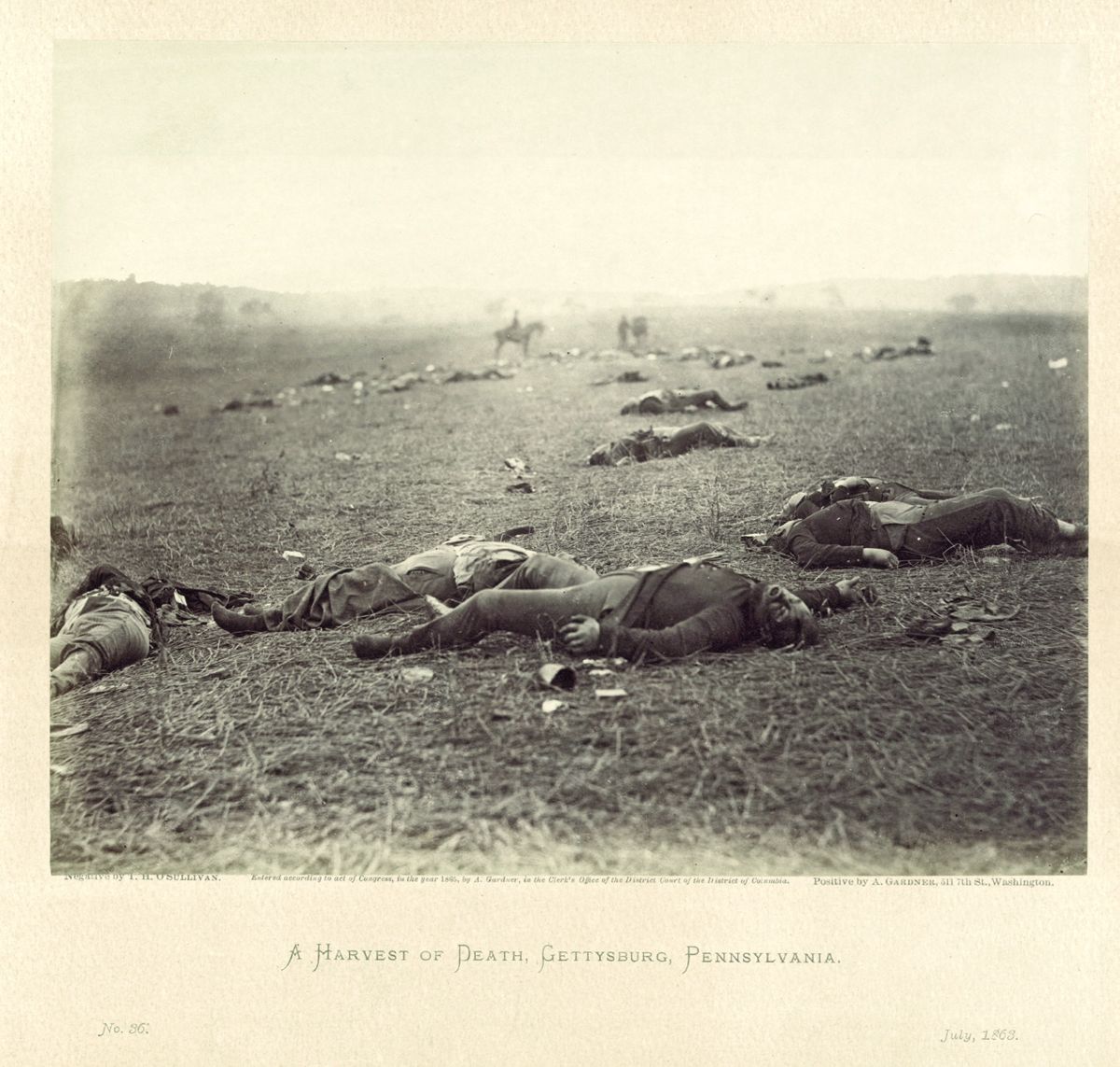
The Battle of Gettysburg, the greatest clash of the Civil War, led to the finest photographic documentation of any fresh battlefield of the war, due in large measure to a professional split between the country’s greatest documentary photographers. Mathew B. Brady and Alexander Gardner were no longer working together when they came separately to Gettysburg, Pa., with their cameras and assistants after the battle of July 1-3, 1863. Gardner arrived first, probably on the evening of July 5, when hundreds of bodies still littered the battlefield. In the next several days, he and his staff photographers Timothy O’Sullivan and James Gibson captured some of the war’s most gruesome and memorable photos, including “A Harvest of Death” and “Home of a Rebel Sharpshooter.” The team produced at least 87 glass plate negatives, including at least 52 stereoscopic views. Brady joined his staff photographers Anthony Berger and David Woodbury around July 15, and together they made some 36 negatives, including 20 images in 3-D. Brady was too late to photograph any bodies. His elegantly composed images are distinctly different than Gardner’s hard-boiled scenes of death. Brady had better atmospheric conditions than Gardner, and some of his images capture panoramas of the battlefield. His images of John Burns emphasize heroism, and other photos show Brady himself and/ or an assistant gazing at the scene, allowing viewers to form their own impression of what the battle must have been like. Another bonus of Brady and Gardner working separately at Gettysburg was that they mostly focused on different things. Although both photographed Little Round Top (from different vantage points) and the Evergreen Cemetery Gatehouse, Brady’s output featured scenes of the first day’s battlefield and Culp’s Hill. Gardner missed those areas, but captured the Rose Farm, the Trostle Farm and Devil’s Den, all with scenes of death. When the war started in 1861, Gardner was Brady’s Washington gallery manager. Both men were eager to go in the field and photograph the conflict. Brady went to Bull Run with a team and fled in the retreat with only a couple of photos of
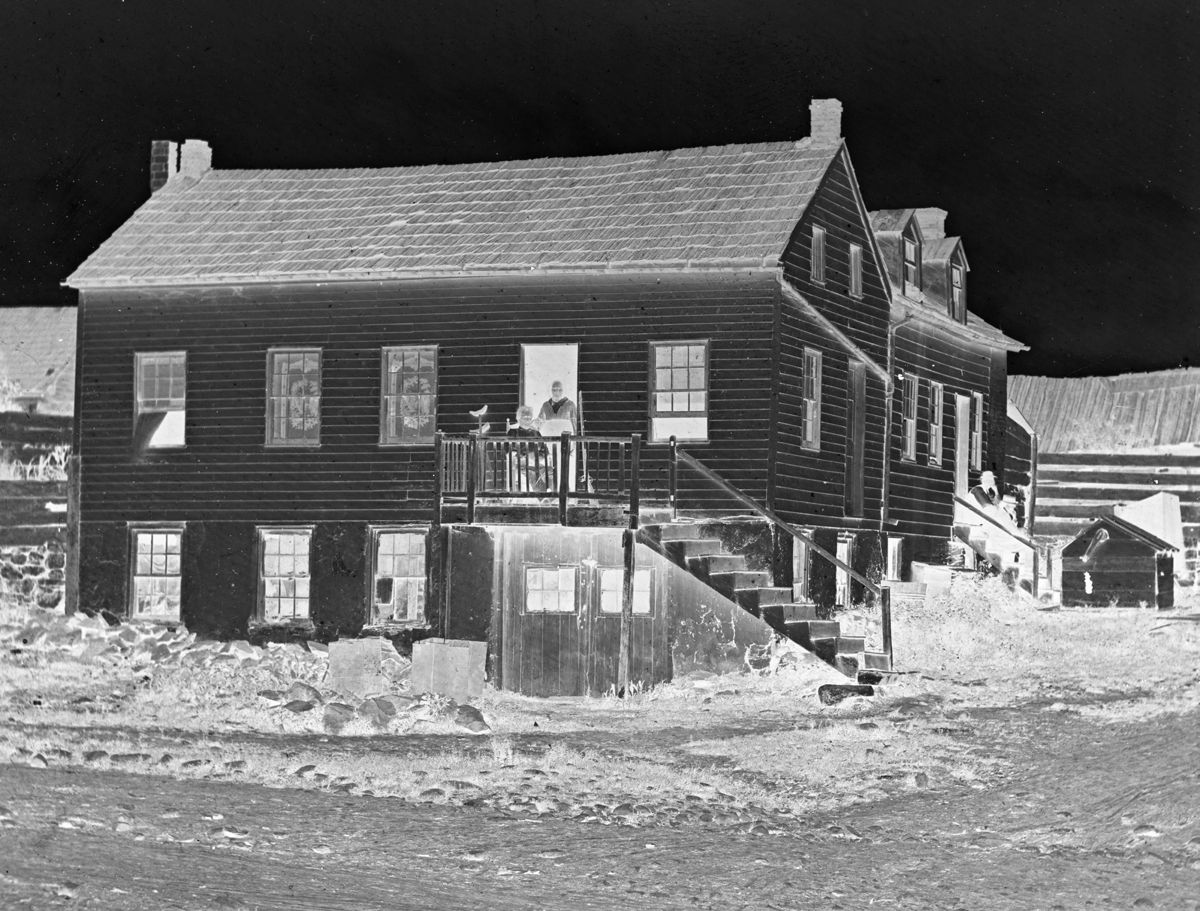
This is the full, 4x10 inch, twin-image stereoscopic negative published by Alexander Gardner of a scene commonly known as Home of a Rebel Sharpshooter. In fact, Gardner’s original caption read: “Rocks could not save him at the Battle of Gettysburg.”
Fairfax Court House. Gardner took the lead at Antietam and captured the first images of American dead as they fell in battle. By the end of 1862, Brady and Gardner together had produced for Brady’s Gallery at least 425 glass plate negatives of scenes in the field, including battlefields. The vast majority – at least 335 – were taken in 3-D and provided a stereoscopic viewing experience that was the ‘video’ of Civil War America. But with the advent of 1863, or in its early months, Gardner resigned as Brady’s Washington gallery manager and set out on his own. In May 1863, he opened his own brand-new Washington gallery, festooned with advertising signs. One of the most persistent myths of Civil War photography is that Gardner quit, along with O’Sullivan and Gibson, because they were not getting credit for their photographs. The large plate prints and stereo views Brady’s Gallery produced from Antietam shatter this myth entirely. Both names – “Gardner, Photographer” and “M.B. Brady, Publisher” appear on Brady’s large plate prints from 1862. In fact, Gardner’s name appears twice as it is also printed in the copyright line on the mount. (Library of Congress) The Brady Antietam stereo views were affixed with a “Brady’s Album Gallery” label on the back, but Gardner’s name appeared on the front in the copyright line. It is quite possible, if not probable, that Gardner and Brady remained on good terms after the split. In a military telegram Gardner sent to O’Sullivan after leaving Gettysburg, he used more than half of his 34 words to say that Brady’s men – Woodbury and Berger – were at Gettysburg and “I hope you will give them every attention.” What caused the split? No hard evidence exists, but Gardner likely resigned because he wanted to strike out on his own, believed he could do it better and probably felt hampered by Brady’s chronic financial problems. This theory is reinforced by the fact that Gardner took with him the vast majority of the 1861-62 negatives and thereafter printed and marketed them as his own. Brady did keep some of the Manassas and Peninsula Campaign negatives, but Gardner took the rest, including one stereo negative taken in Harper’s Ferry in 1862 with Brady himself posing in the photo. On his own, Gardner became much more prolific. By the end of the war, his negative archive had swelled to almost 2,200 negatives, including some 950 large-plate (7x9 inch) negatives and more than 1,230 stereo negatives. Another myth is that many of these precious Civil War documentary negatives, including several thousand more produced by other photographers during the war, ended up as greenhouse glass, with the sun slowly burning off the very image it had created. In fact, this vast treasure trove of the original Civil War photographic negatives has survived largely intact, and the glass plates are preserved at the Library of Congress and National Archives. All of Gardner’s Gettysburg negatives, both large plate and stereo, as well as all of Brady’s Gettysburg stereo negatives, are at the Library of Congress. You can instantly download high-resolution scans of these amazingly clear scenes for free and use them as you wish. Just go to this page, http://www.loc.gov/pictures/collection/civwar/ and start searching “Gettysburg” or any other subject. The scans that appear in black and white are largely from the original negatives, while the sepia-toned scans come from vintage albumen prints made from the negatives. Bob Zeller is the president and co-founder of The Center for Civil War Photography, a nonprofit organization devoted to preserving and promoting the visual documentation of our country’s greatest conflict. www.civilwarphotography.org