
German World War II POWs At Gettysburg Battlefield
By John Punola · Originally published July 2016 · p. 46
GETTYSBURG, PA.—In the spring of 1944, America was heavily engaged in World War II, and men of the armed forces were fighting on many fronts in Europe against the Germans and in the Pacific against the Japanese. Times were tense as the world awaited the anticipated Allied invasion of the European Continent which hopefully would lead to the end of the war. The Germans were offering stiff resistance and progress was slow and costly. In America, people were working hard to support the war effort and were praying for an early end of the war. In the quiet, sleepy town of Gettysburg, Pennsylvania, there were little signs of war. The town continued to maintain its place as a popular tourist attraction, and thousands came to see the battlefield and Civil War sites. The greatest and most decisive battle of the Civil War was fought on the fields around Gettysburg, and numerous tourist and descendants of men who fought there July 1-3, 1863 came to pay homage to the dead and visit the countless monuments that were found on all parts of the battlefield. However, the situation was soon destined to change. As Allied armies turned the tide in Europe, it would soon have an effect on the town of Gettysburg, Pa. The North African campaign had come to a victorious conclusion with the surrender of the famed Afrika Korps and 275,000 German and Italian prisoners were taken. These POWs were transported to holding camps in Algeria to await further movement to prisoner of war camps in America. As soon as transport ships were available, the prisoners of war (POW) were loaded for the trip to America and then to designated POW camps scattered thru out the forty-eight states. Once the transports arrived at Norfolk, Virginia, the prisoners were transported via rail to camps at numerous locations and many states. To the surprise of Gettysburg citizens, a temporary tent camp was erected right on the sacred grounds of the battlefield. The first arrivals entered the camp on June 20, 1944. The camp was surrounded by barbed wire and carefully guarded by military troops.
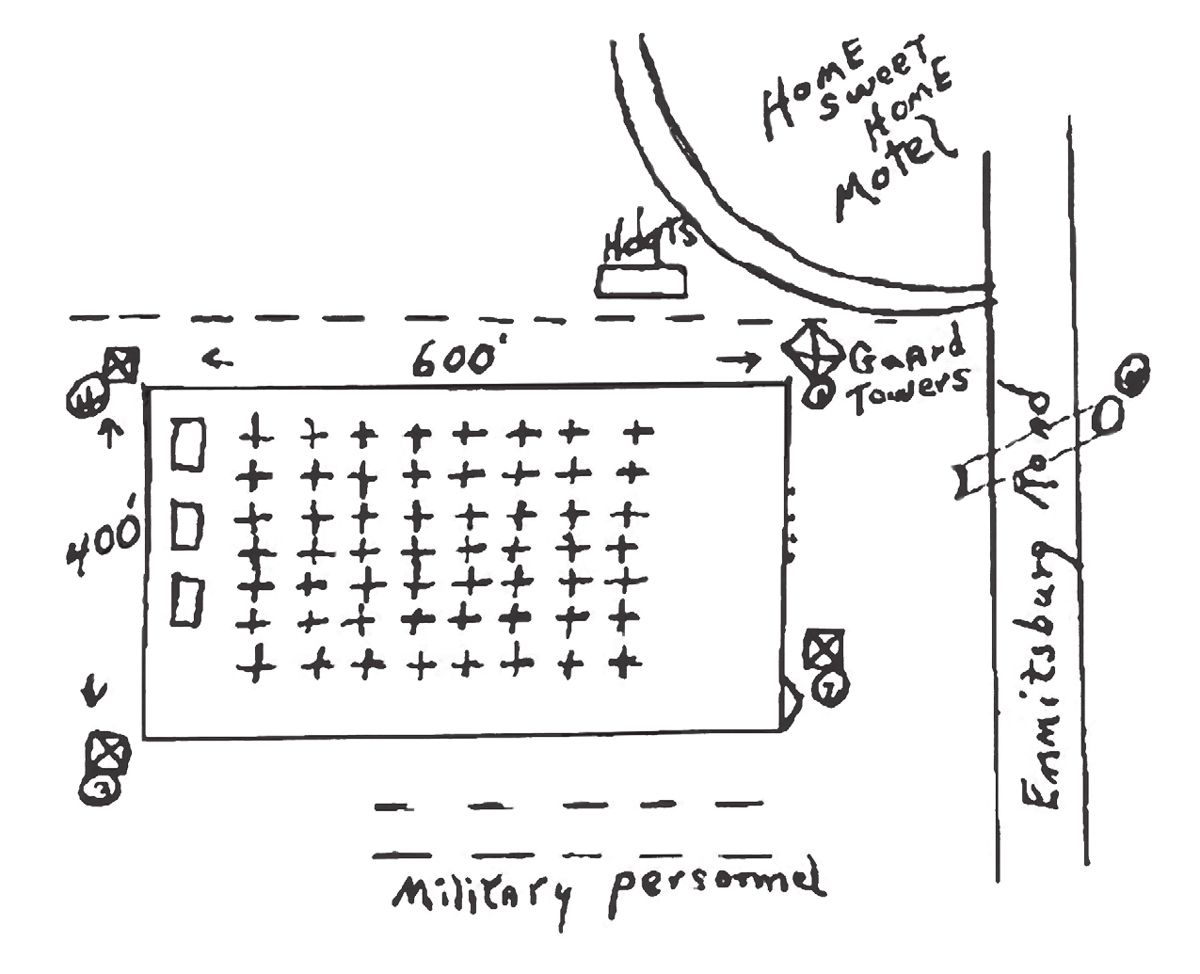
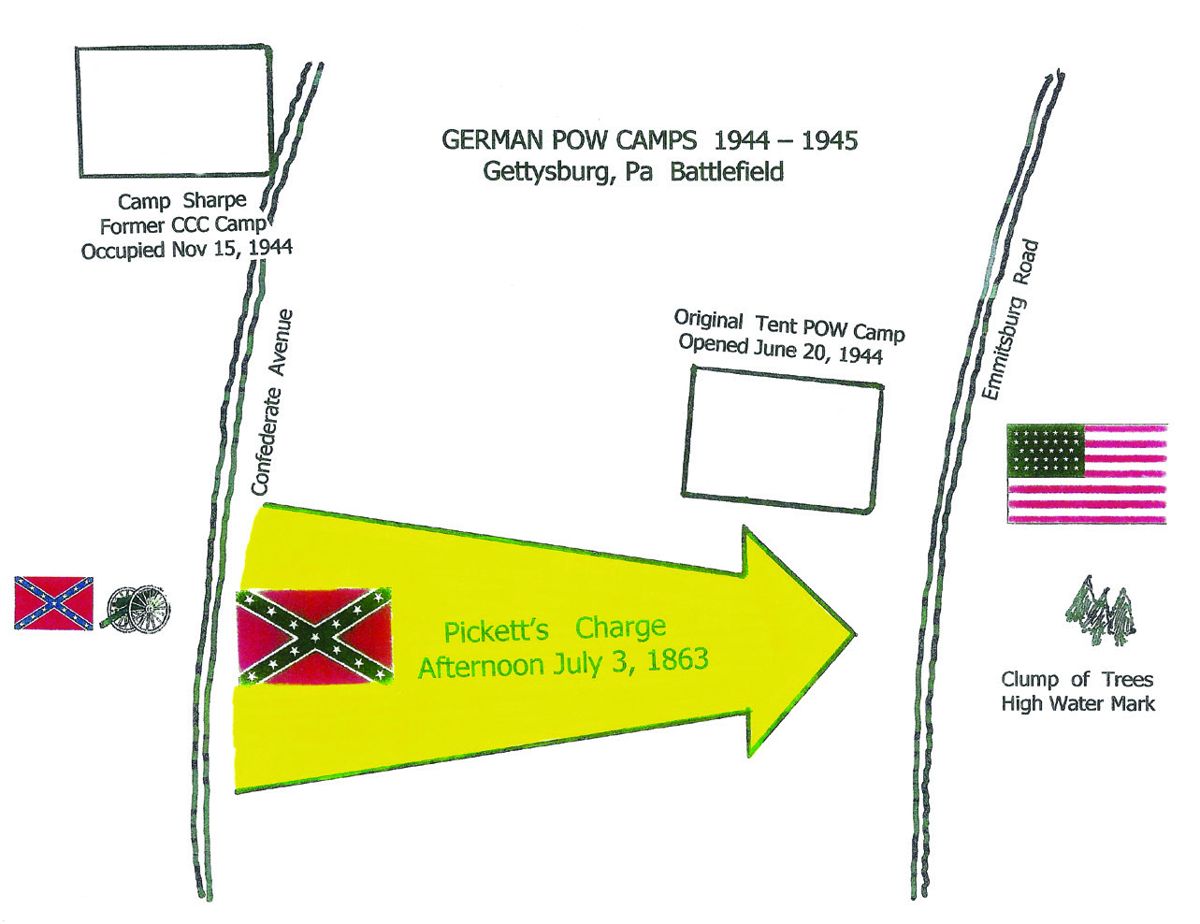
The camp measured 600’ by 400’ and contained 56 tents plus four guard towers, the tent camp housed about 500 prisoners. The tent camp was located just West of Emmitsburg Road, in the field close to the High Water Mark. The disturbing thing about the location of the tent camp was its location, which was on hallowed grounds, the site of General George Pickett’s immortal, but failed charge on July 3, 1863. The tents were relatively close to the clump of trees that served as the aiming point of
A drawing of the German POW Tent Camp made by one of the army personnel in 1944. No known photos exist. the attacking Confederates. The very thought that a German POW camp would occupy the exact ground where thousands of Confederates and Union soldiers bled and died was shocking to the historians and the general public. The United States War Dept. was granted permission by the National Park Service to locate a prisoner of war work camp on the battlefield just West of the high water mark, along the Emmitsburg Road. On May 31, 1944, fifty war prisoners from Camp George G. Meade, MD, under the guard of U.S. Army troops began work placing poles for the stockade to surround the tent camp. The fifty German prisoners were housed temporarily in the National Guard Armory, Confederate Ave., Gettysburg, Pa. Soon another hundred prisoners arrived and finally an additional three hundred fifty.
Work on the new tent camp was completed on June 20, 1944, and all prisoners moved in. Any farmer, fruit grower or packing plant in need of help could make application to the local employment service in Gettysburg. The man in charge of the prisoner work details was E.A. Crouse. It was his responsibility to coordinate the contracts with local farmers and industries, then coordinate with the military. The original group of prisoners was assigned to fourteen a huge apple crop and the harvest carried on into the middle of October. With the approaching winter season, the tent camp was not suited to cope with the cold weather of Pennsylvania, so a permanent camp was needed. This problem was solved when an abandoned CCC camp, later a Boys Scout camp, was chosen for the new prisoners’ quarters. The converted camp was located on Seminary Ridge, just beyond Confederate Ave. and was given the name Camp Sharpe. About two hundred prisoners moved into this permanent location on November 15, 1944, where they remained until the end of the war. The remaining prisoners from the tent camp were sent to other locations in Pennsylvania. With the harvesting completed for the year, the prisoners housed at Camp Sharpe would now spend the winter months cutting wood pulp for the nearby mills, and working in the stone quarry and hide factory. The prevailing wage scale was one dollar per hour paid to the employers by the U.S. Government, with the prisoners receiving ten cents per hour that could be used to purchase miscellaneous items at the camp. There was another kind of picking performed within the sacred Gettysburg battlefield property. There was an acute shortage of scrap metal, and the National Park Service was called upon to donate surplus metal from the battlefield. In 1942, the battlefield contributed 18 tons of scrap metal and was asked to survey the vast battlefield for possible future donations. As a result, further scrap drives removed the many pyramids of cannon balls, a large number of cannons, metal fences, anything that could be spared. Cannons used during the battle of July 1863 were spared, but those build after the time of the battle fell victim to the smelting mills. It is interesting to compare the conditions and the treatment that the Americans presented to the German prisoners. They enjoyed relative comfort, were well fed and were paid for their hours spent gathering crops from the nearby farms. After the war, they were returned to their homeland. Many prisoners later made return trips to visit the site of their wartime confinement. Some remained to become American citizens. On the same grounds of the Gettysburg Battlefield, during the battle between General George Meade and General Robert E. Lee, there were a large number of prisoners taken by each side. These prisoners were ultimately located in distant prisoner camps in the North and South, and a large number of them never lived to return to their homes after the war. How times have changed. Can you imagine the surprised look on the faces of visiting tourist who came to Gettysburg during 1944-45 and saw a “tent city” prisoner of war camp in the middle of the spacious grounds where General George Pickett made his valiant charge hoping to win the battle for the Confederates. The permanent prisoner of war camp would have been behind Confederate Avenue in the assembly area for the troops preparing for the charge. After the war had ended, Camp Sharpe POW camp was dismantled and sold as scrap to local farmers. Presently, the former grounds of the camp serves as a youth campground. The only remains are the large fireplace that stood inside the mess hall and meeting place. Our thanks to the Gettysburg National Park Service for their assistance with this article. Information from local newspaper files also provided historical content.
canneries, both fruit and vegetable, three orchards, seventeen farms, one stone quarry, one fertilizer plant and a hide plant. The prisoners were escorted by Army guards to and from their assigned locations, Littlestown, Hanover, Chambersburg, Middletown, Biglerville and Emmitsburg, Pa. Farmers welcomed the prisoners and soon and a good relationship was established. The purpose of the camp location within the boundary of the historic Gettysburg Civil War battlefield was to provide badly need workers to harvest the crops in that area. The 1944 farm crop was abundant, and a shortage of farm hands could have resulted in the loss of much of the ripening crops. The POWs were immediately put to work and began with the pea harvest plus other crops as they ripened. In the fall, there was