
Father William Corby And The Irish Brigade
By Wade Hisiro · Originally published July 2016 · p. 58
The National Civil War Chaplains Museum is currently featuring an exhibit on the Irish Brigade and Father William Corby, a chaplain for the brigade. The museum is part of Liberty University in Lynchburg, Virginia and the only museum in the nation devoted to exhibiting clergy members and religious activities during the Civil War. The exhibit will contain various artifacts and pictures pertaining to the Irish Brigade, on loan from the J. Howard Wert Gettysburg Collection™, America’s oldest privately owned heritage collection. Part of the display on Father Corby will feature a Celtic cross and his white stole embroidered with green foliage. William Corby attended the University of Notre Dame in 1853 and committed himself to the religious life of the university. He entered the novitiate in 1856 and took his final vows in 1859. By the time war broke out in 1861, he had already established himself as the pastor of a local church and the Director of the Manual Labor School at Notre Dame. Along with several other Notre Dame priests, Father Corby volunteered to serve as a chaplain for the Union and was assigned to the 88th New York Volunteer Infantry, part of General Thomas Meagher’s legendary Irish Brigade. The Irish Brigade was approved as an ethnic unit to draw support from the Irish, the North’s largest immigrant group. It was created in an effort to win the Irishmen who were sympathetic to the Confederacy’s struggle for independence from an “autocratic” government. The Irish Brigade was initially composed of the 63rd, 69th, and 88th New York Infantry Regiments. In 1862, the 29th Massachusetts, a non-Irish regiment, was added. Shortly after, the Irish 116th Pennsylvania was also added to the brigade. In November 1862, the 29th Massachusetts was swapped for the Irish 28th Massachusetts. The brigade was famous for its war cry “fág an bealach,” anglicized as “faugh a ballagh,” meaning “clear the way.” It was also known for its high number of deaths in battle, which led to the resignation of Thomas Meagher; only two other brigades surpassed the Irish Brigade with more such deaths. After several requests and denials to recruit replacements, Meagher
Father Corby’s Stole Used to Bless Troops at Gettysburg. (Liberty University)
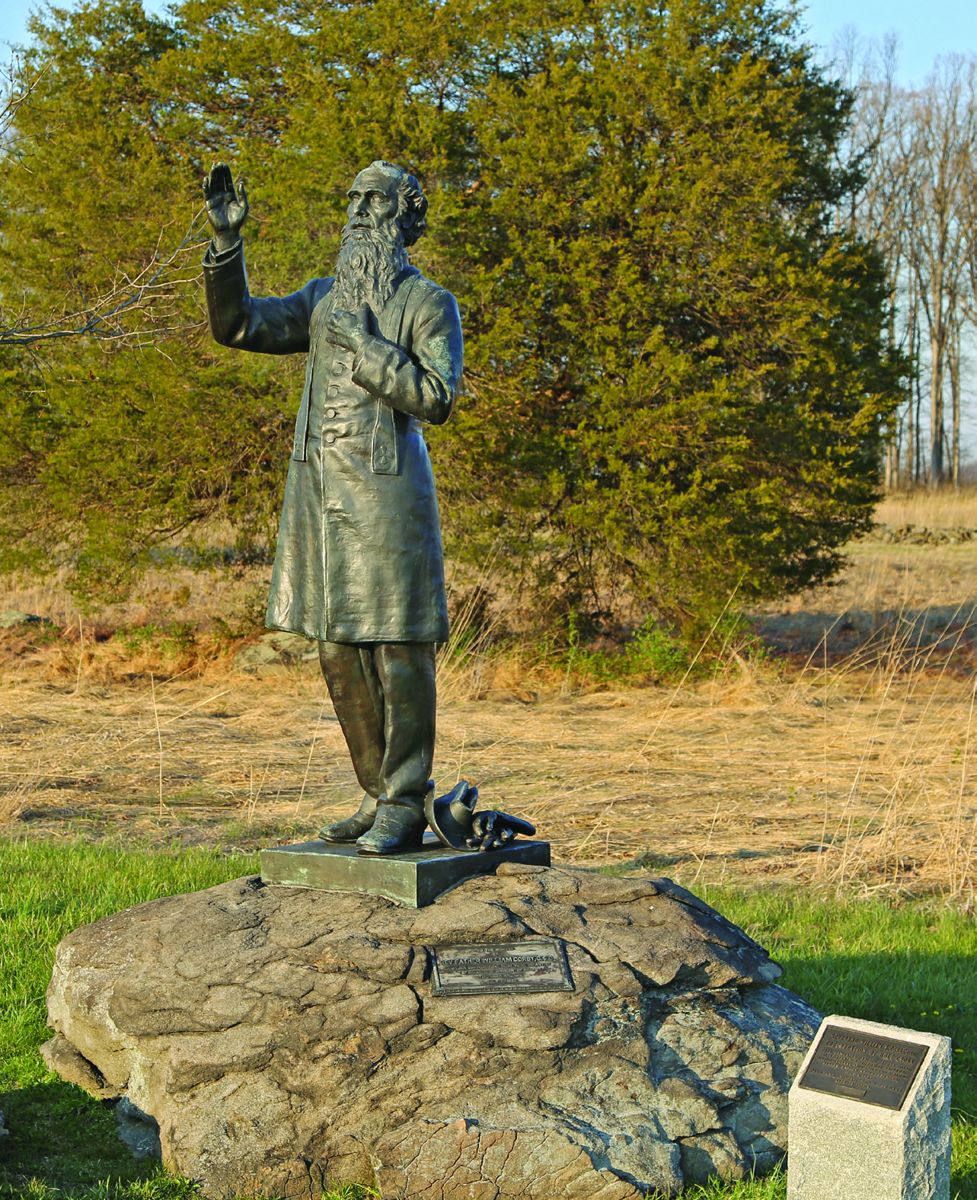
resigned in protest after the battle of Chancellorsville. Col. Patrick Kelly replaced Meagher two months before the Battle of Gettysburg. Father Corby traveled with the regiment giving comfort and absolution to the wounded and dying. By the time of the Battle of Gettysburg, the brigade had already experienced massive losses, and few of the original brigaders remained. During this battle, the goal of the brigade was to reinforce the struggling Union flank on the afternoon of July 2nd in what later came to be known as the Wheatfield. Before the battle, Father Corby wanted to give the men absolution, but realized that there was not enough time for individual confessions. Mounting a large rock, he told the men of the brigade that if they offered a sincere act of contrition, upheld the flag, and didn’t turn their back on the enemy, they would receive absolution and be able to receive a Christian burial. Father Corby put out his right hand and offered the following words: “Dominus noster Jesus Christus vos absolvat; et ego auctoritate ipsius vos absolvo ab omni vinculo excommunicationis et interdicti in quantum possum et vos indigetis. Deinde, ego vos absolvo a peccatis vestris in nomine Patris, et Filii, et Spiritus Sancti. Amen.” In English, this translates to: “May our Lord Jesus Christ absolve you; and by His authority I absolve you from every bond of excommunication and interdict, so far as my power allows and your needs require. Thereupon, I absolve you from your sins in the name of the Father, and of the Son, and of the Holy Spirit. Amen.” While Father Corby was on the rock, sounds of battle could be heard in the background. Major St. Clair Mulholland noted, “The scene was more than impressive, it was awe-inspiring. I do not think there was a man in the brigade who did not offer up a heartfelt prayer.” This marked the first recorded time a general absolution was performed on American soil, despite its somewhat common occurrence in Europe. In commemoration of the absolution, on October 29, 1910, a statue of Father Corby was dedicated on the Gettysburg Battlefield on top of the very same boulder from which he gave the blessing. A replica of this statue can be found outside Corby Hall on the University of Notre Dame’s campus. The Wheatfield was a vicious battle that resulted in a significant number of casualties for both the Union and Confederacy. The Union was struggling in the battle by the time the Irish Brigade was sent in to help. They fought valiantly, along with other reinforcements, and managed to hold off the Confederates long enough to buy the North precious time and stop the South from reaching higher ground. Their valor came at a high cost; many of the men perished in the effort. After the war, Father Corby returned to Notre Dame. He became president of the university in 1866. After six years, he left for Sacred Heart College, but returned to Notre
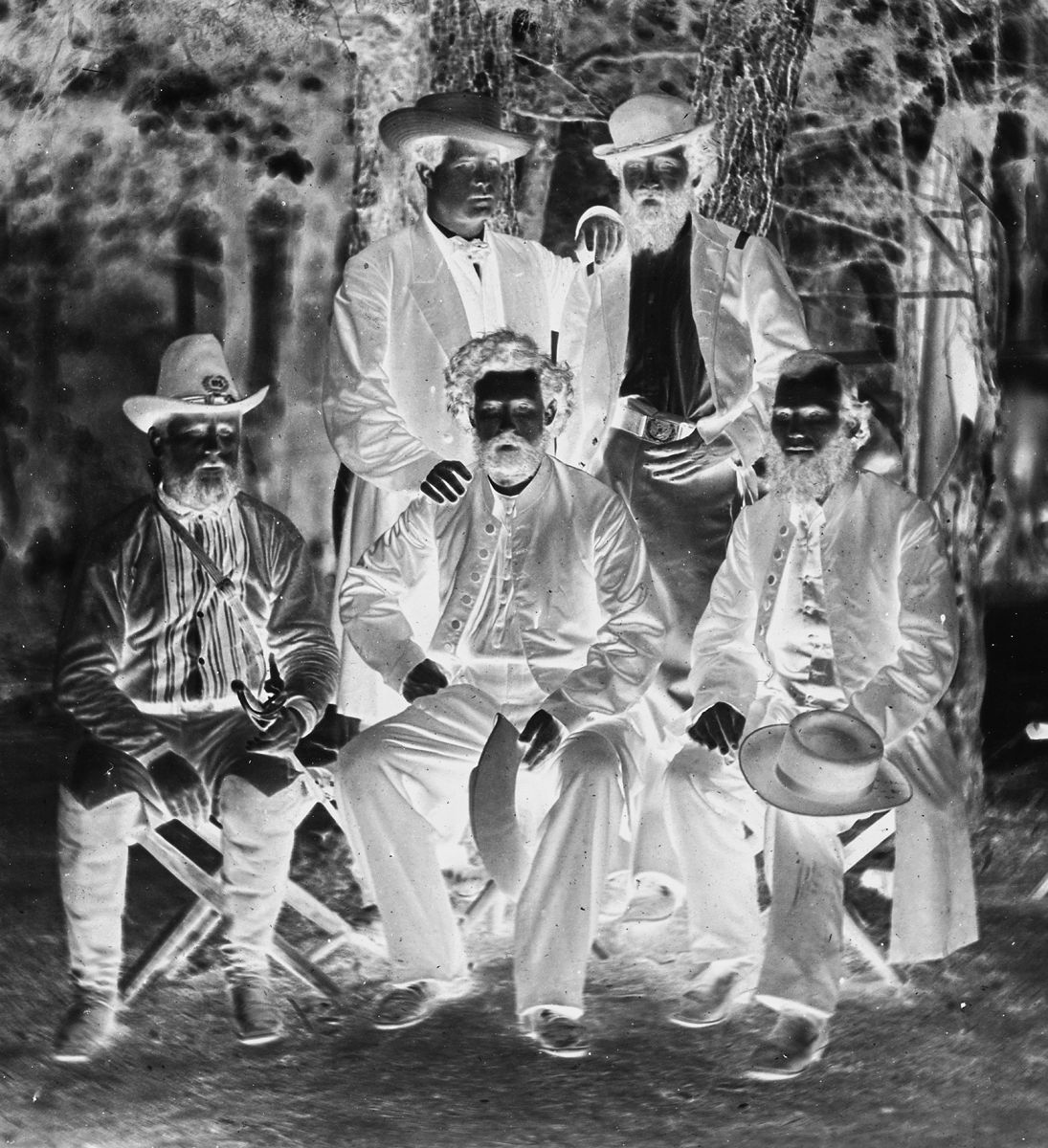
Dame in 1877 for a second term that lasted another four years. During that time, he attained several posts with the Congregation of the Holy Cross, including Assistant General. Father Corby occasionally left Notre Dame to visit St. Clair Mulholland at his home in Philadelphia. One day, the two decided to take the two-hour train trip to visit J. Howard Wert at the Wert house in Harrisburg. They spent the entire day, and even stayed overnight, in order to look at all of the artifacts. To give thanks for the hospitality he received, he sent J. Howard Wert the very same stole that is on exhibit at Liberty University. Upon returning to Notre Dame, Father Corby was inspired to start the first collection of Irish Brigade relics. His plan was to create an Irish Brigade Corner of the Military Museum at Notre Dame. He sent out letters to veterans of the brigade requesting donations and, in response, artifacts began to trickle in. However, Father Corby died on December 28, 1887, before the collection could be finished. His acquisitions are still located at Notre Dame to this day. Wade Hisiro graduated valedictorian from Susquehanna Township High School, Harrisburg, Pa. in June 2016 and plans to attend the University of Virginia in the fall to study mechanical engineering and business.
Father Corby Monument at the Wheatfield, Gettysburg National Military Park. (Gettysburg Foundation)