
Civil War Medals of Honor
By John Sexton · Originally published July 2016 · p. 23
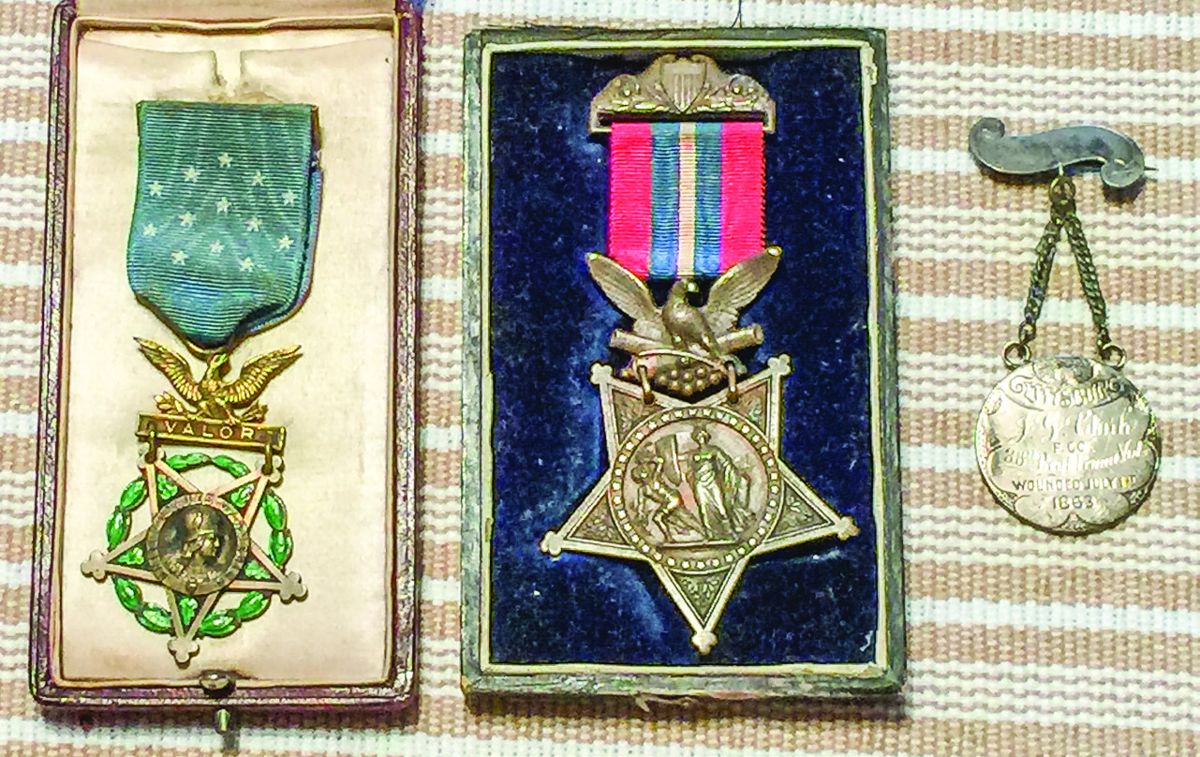
I just inherited this group of medals that were my grandmother’s father. He won the Congressional medal of honor, but I understand they are illegal to sell. What is their value? Paul Sherwin Pensacola, Fla. Paul: Thank you for sending photos of your great-grandfather’s medals. Along with an interesting medal made from half-dollar mentioning wounding at Gettysburg, July 1, 1863, you have original 1892 issued “Congressional Medal of Honor” (MOH) with a rare War Department transmittal letter along with the 1903 MOH as that was a new pattern designed which he also lived to accept. James G. Clark entered service with the 88th Pennsylvania Infantry at 17 years old in September 1861. The 88th was a hard fought unit in the Army of the Potomac, and private James Clark was one of only 95 of over 2,000 men who served with the regiment from original enlistment to disbandment of the unit. Private Clark’s MOH citation reads: “The President of the United States of America, in the name of Congress, takes pleasure in presenting the Medal of Honor to Private James G. Clark, United States Army, for extraordinary heroism on 18 June 1864, while serving with Company F, 88th Pennsylvania Infantry, in action at Petersburg, Virginia, for distinguished bravery in action; was severely wounded.” Severely wounded twice in the Civil War in two major engagements, Clark was a warrior. Ironically three other members of the 88th won our nation’s highest honor at the battles of Gettysburg, Globe Tavern, and Hatcher’s Run. The 88th had 182 fatalities during the war and another 900 discharged due to physical disability or disease due to hard and arduous service. American military medals are commonly bought and sold worldwide in auctions, dealer sales and direct sales from veterans or descendants. American valor medals are illegal to sell in the United States, however, there is a vibrant “black market” among collectors. 19th Century Civil War Medals of Honor can be found in many Civil War, and military collectible trade shows and sell between $3,000-10,000. The highest recent black market sale I can substantiate was for a Civil War medal which was bought for about $20,000 which has been put into will to be given to a 501(c)3 institution upon owner’s death as he felt the medal was too important not to be preserved in the state it was won. Several collector/buyer/sellers anonymously have told me at trade shows they are “cash buyers” of MOHs in total disregard to current law. Prior to 1995 legislation, these medals sold privately and at auction with typical prices being about $10,000-15,000 per medal with interesting Civil War history, or about $20,000-$30,000 in today’s money. So your medals based on just the two medals of honor would be about $50,000 without the current federal law prohibiting sell of MOHs. What an incredible inheritance, regardless of the governmental restrictions concerning commerce on your personal property. Many collectors find it hard to believe that it is illegal to sell a medal of valor bestowed upon an individual for heroism by the recipient or his descendants in America. This is a legal dilemma and maybe never resolved until taken to federal court by a descendant or recipient. There has been a private sale of two important Civil War medals of honor to the same recipient which were once owned by a prominent New York art dealer and this pair of medals were sold for a reported $200,000 privately. They were probably purchased directly from the family before the 1995 legislation when Medals of Honor disappeared from the American auction scene. Several Medals of Honor were sold after the 1994 legislation at Sotheby’s in London (sale #3157) November 10, 1998. Lot 389 was a Medal of Honor given to Commander Richard Byrd in May of 1926. Byrd’s medal was not for valor, but for his courageous flight over the North Pole. This medal sold for $27,027 to a New York dealer, George Harris, a major if not the largest American medal dealer at that time. He, along with many collectors, thought the law should not impact the commercial sale of medallic art. This all changed with specific legislation outlawing any use of the Medal of Honor outside original recipients being allowed to wear them. The law tried to eliminate people benefiting by masquerading as recipients of our Nation’s highest military award which made great sense to most people, but not the restriction of commerce of medals themselves. The Congressional Medal of Honor Society archivist, Laura S. Jowdy, recently responded to my request for an opinion concerning current MOH law: “The Medal of Honor currently has no market value as it cannot be bought, sold, or traded. A Medal of Honor recipient does own the medal, but he/she cannot buy, sell, or trade it, either. The medal may be donated or inherited.” If the recipient can never sell it, when then does the medal actually become personal property? Isn’t the right of an American to do as they wish with their personal property? Isn’t that the definition of personal property? Among the largest auction companies selling rare medals is Stacks of New York City. They set the record for a valor medal for Mexican War gold medal presented by Congress to General Zachary Taylor. This sale was the last public auction I am aware after the law was enforced. It was well known the timing of the auction corresponded with “Stolen Valor” law going into effect the following year. That medal sold January 18, 2005 for $460,000. Technically, this Congressional Medal given to Zachary Taylor for his actions at the Battle of Buena Vista in the Mexican War was a medal for valor; it was thought to be encompassed by the Stolen Valor Act. A Federal Appeals Court on January 11, 2016, tossed out a veteran’s conviction for wearing military medals he didn’t earn, saying it was a form of free speech protected by the Constitution. A specially convened 11-judge panel of the 9th U.S. Circuit Court of Appeals ruled that the First Amendment allows people to wear unearned military honors. If this part of the law was made unconstitutional, why isn’t commerce in same? Elven Joe Swisher of Idaho was convicted in 2007 of violating the Stolen Valor Act, which made it a misdemeanor to falsely claim military accomplishments. President George W. Bush signed it into law in 2006, but the U.S. Supreme Court struck it down in 2012 as a violation of free speech protections. After the Stolen Valor Act had been stricken down, Congress passed a new law making it a crime to profit financially by lying about military service. President Barack Obama signed it in 2013. After Swisher’s conviction,
Rare Gettysburg wound medal made from half dollar.
Inscription on 1892 issue MOH.
Congress removed a provision making it illegal to wear unearned medals. All Medals of Honor are issued in the original only, by the Department of Defense, to a recipient. Misuse of the medal, including unauthorized manufacture or wear, is punishable by fine and imprisonment pursuant to (18 U.S.C. § 704)(b), which prescribes a harsher penalty than that for violations concerning other medals. After the Army redesigned its medal in 1903, a patent was issued (United States Patent #D37,236) to legally prevent others from making the medal. When the patent expired, the Federal government enacted a law making it illegal to produce, wear, or distribute the Medal of Honor without proper authority. Violators of this law have been prosecuted. In 2003 Edward Fedora and Gisela Fedora were charged with violating (18 U.S.C. § 704)(b) - Unlawful Sale of a Medal of Honor. They sold medals awarded to U.S. Navy Seaman Robert Blume (for action during the Spanish-American War) and U.S. Army First Sergeant George Washington Roosevelt (for action during the Civil War) to an FBI agent. Edward Fedora, a Canadian businessman, pleaded guilty and was sentenced to prison; Gisela Inscription on 1903 2nd issue MOH.
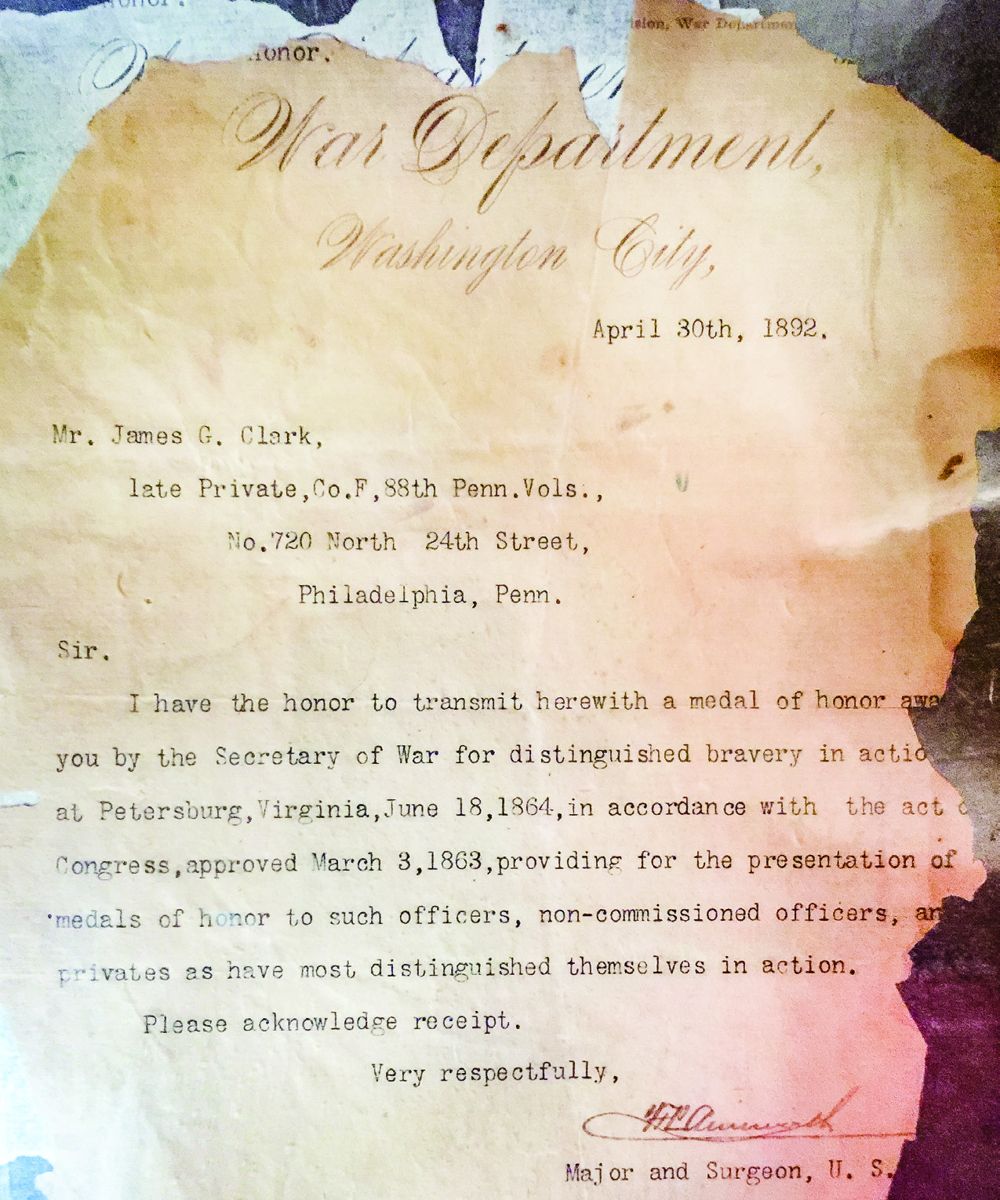
Fedora’s status is unknown. English “Victoria Crosses” are analogous to American Medals of Honor and though once illegal to sell in the UK, commonly sell at auction in excess of $300,000 almost selling exclusively to English clientele. Prior to the 1980’s, most Victoria Crosses sold outside of the UK, and a large private collection exists still in the U.S. Victoria Crosses have a record price of $2,360,000 for the VC awarded Captain Noel G. Chavasse, a WWI medical officer. Medals of Honor once common to market prior to January 1, 2006, Stolen Valor Act, are still abundant in my appraisal practice, especially for estate tax purposes and black market basis is the only market I have utilized for estimating value. These medals are not illegal to own or donate to a qualified institution.
John is an certified appraiser with International Society of Appraisers specializing in Civil War memorabilia. He authenticates and evaluates other rare and valuable historic items also. Send “Ask The Appraiser” questions and photographs to [email protected].