
Book Reviews
Book Reviews — July 2016
Originally published July 2016 · pp. 11–22
– Reviews of Civil War Books –
Lincoln’s Political Life In Hancock Excelled At Gettysburg Battle First 40 Years Is Related A Self-Made Man: The Political Life of Abraham Lincoln, 1809-1849. By Sidney Blumenthal. Illustrated, photos, notes, bibliography, index, 556 pp., 2016, Simon & Schuster, www.simonandschuster.com, $35.
Readers might ask: Do we really need another biography of Abraham Lincoln? Some might answer that not only do we not need another Lincoln biography, we do not need another book on Lincoln, period. Those of us who study and write about Lincoln, however, are always willing to read another Lincoln book, especially a biography. We like to relearn something through a new or different perspective. This is what I sought in A Self-Made Man. This book, the first of a projected four-volume Lincoln biography, is by Sidney Blumenthal, a journalist and high-level political advisor. He has witnessed up close the controversies and vicissitudes of American politics. It is this experience that shapes Blumenthal’s study. First and foremost, this is a political biography of Lincoln. Blumenthal clearly admires Lincoln as a politician, and this volume covers the period in which Lincoln honed his political skills. The story Blumenthal tells is not new; it’s been told many times in countless studies of Lincoln. He covers fully Lincoln’s tenure as an Illinois state legislator, his anonymous political writings in the Sangamon
Journal and the Illinois Journal, his competition with Stephen A. Douglas, and his congressional career. The story is conveyed in a well-written and fast-paced manner that is a joy to read. In fact, A SelfMade Man is more than a biography of Lincoln. It is really a “life and times” treatment of the first 40 years of Lincoln’s life. There are several chapters in which Lincoln disappears completely from the narrative. Two examples will suffice. Chapter 5 concentrates on John Quincy Adams’s battles against slavery during his post-presidential years in Congress. Chapter 16 is devoted solely to William H. Seward and Thurlow Weed. This is not a criticism. I understand Blumenthal’s intent to provide background he believes essential to understanding the political environment in which Lincoln operated. Blumenthal opens and closes his book with Lincoln’s 1856 quote, “I used to be a slave,” to put Lincoln’s antislavery position in context. He took a moderate position that rejected abolitionists’ immediacy and pro-slavery advocates’ slavery-isgood arguments. Blumenthal presents a generally accurate depiction of Lincoln’s views of slavery during the 1840s — a position that remained fairly consistent until his presidency. One aspect of A Self-Made Man that may raise eyebrows is Blumenthal’s views concerning Mary Todd Lincoln. According to him, Mary was essential to Lincoln’s success as a politician. As far as Blumenthal is concerned, Mary, just as ambitious as her husband, helped make Lincoln what he became: “there would have been no Lincoln without Mary” and Lincoln “knew it.” I look forward to the next installment of Blumenthal’s work but will be surprised if he discovers anything new about Lincoln. Nevertheless, I recommend A Self-Made Man. Reviewer Thomas A. Horrocks is an independent scholar who has written, edited and co-edited seven books, including Lincoln’s Campaign Biographies (2014) and The Annotated Lincoln (2016).
Observing Hancock at Gettysburg: The General’s Leadership through Eyewitness Accounts. By Paul E. Bretzger. Illustrated, photos, maps, notes, bibliography, index, 246 pp., 2016, McFarland, www.mcfarlandpub.com, $29.95 softcover.
Paul Bretzger’s book on Winfield Scott Hancock is an excellent addition to the literature on Gettysburg in general and on Hancock in particular. Although his reputation may have faded in recent decades, Hancock was long regarded as a larger-thanlife, outstanding Union leader in the Battle of Gettysburg. This book helps fill in the blanks as to why and how he was such a domineering personality in the Army of the Potomac during that battle. The author captures the essence of Hancock by focusing on the general’s leadership qualities and performance. Bretzger fulfills his purpose to once again bring Hancock to the forefront of important commanders at Gettysburg. He puts it succinctly in his introduction: “This book seeks to reclaim Hancock’s true historical importance and explain the qualities he had that enabled him to be so important.” Of course, Hancock’s activities during the battle provide much material for readers to examine for the purpose of analyzing his leadership. He played a significant role in each of the three days of fighting. On Day One he was sent to Gettysburg by George Meade to take command and control of the army’s on-scene forces and determine where additional arriving forces should be dispersed. He arrived there as the Union army’s 1st and 3rd Corps were retreating through Gettysburg to Cemetery Hill. Amid the chaos of the disintegrating military situation, Hancock’s commanding presence and decisive actions had a calming influence on harried soldiers. On Day Two he was thrown into the breach once again by Meade, who asked him to take command of the 3rd Corps for the wounded Daniel Sickles. As the battle reached its peak late that afternoon, Hancock ordered the 1st Minnesota to charge the enemy. Their costly (82 percent casualties) and fateful charge into Gen. Cadmus Wilcox’s attacking Alabamians helped stem the final and most dangerous Confederate onslaught that day. Finally, on Day Three Hancock was once again the calming influence on his men as he slowly rode his horse up and down the Union line prior to and during Pickett’s Charge
SHARPSHOOTER
until he suffered a serious wound. To help readers appreciate the significant impact Hancock had at Gettysburg, Bretzger relies heavily on written accounts from those who fought there. He has done an admirable job ferreting out these primary documents from the vast literature that exists on Gettysburg. The book accurately describes Hancock’s actions throughout the battle and how those around him reacted to his presence. It is interesting to note that those reactions were universally positive, reaffirming the author’s contention that Hancock’s reputation should be reinstated to the high level it had immediately after the battle. This is recommended reading for those with any interest in Hancock, Gettysburg or the Army of the Potomac. Reviewer Jay Jorgensen has written several books about Gettysburg, including Gettysburg’s Bloody Wheatfield. He is a Superior Court Judge in New Jersey.
Roahen, Barnard Photos Of Gaston County, N.C. In The Civil War Little Bighorn Since 1930s Photographing Custer’s Battlefield: The Images of Kenneth F. Roahen. By Sandy Barnard. Photos, maps, notes, bibliography, index, 280 pp., 2016, Oklahoma, www.oupress.com, $39.95.
Kenneth F. Roahen (1888-1976) was a U.S. Fish and Game agent. As part of his duties, and as an outlet for his interest in photography and the Battle of the Little Bighorn, he photographed that battlefield. He took photographs, including aerial views, of the then Custer Battlefield (now Little Bighorn Battlefield National Monument) from the 1930s to the early 1970s. What remains of his large collection of photographs is now housed in the Big Horn County Historical Museum in Hardin, Mont. Historian Sandy Barnard is an expert on Custer and the Little Bighorn. He was co-author, with James S. Brust and the late Brian C. Pohanka, of Where Custer Fell: Photographs of the Little Bighorn Battlefield Then and Now. Barnard’s new book features Kenneth Roahen photographs and photographs of the same sites taken by the author during visits in 2012 and 2013 — over 300 in all. The differences among these photographs identify mysteries of the battlefield, as well as showing subtle and major landscape changes. Barnard describes Kenneth Roahen’s life and career. Roahen was beaten up and shot by poachers on a number of occasions. Other topics include battle historical background and all major and many minor battlefield sights. The author also discusses historical interpretations of various events and such mysteries as “Where exactly did Reno first cross the Little Bighorn River?” More than a coffee-table book, this well-researched and well-photographed book may not be the last word on Custer Battlefield photographs, but it will be hard to beat. It will be of special interest to historians and others interested in Custer’s Last Stand and Little Bighorn Battlefield National Monument. It also will enthrall those with an interest in landscape changes revealed by photographs of a single battlefield taken over an extended period of time. Reviewer Joseph A. Derie is a VMI graduate and a longtime Civil War buff and military book reviewer. A retired Coast Guard officer and Merchant Marine licensed officer, he is a Certified Marine Investigator and marine surveyor.
Gaston County, North Carolina, in the Civil War. By Robert C. Carpenter. Illustrated, photos, map, tables, appendix, notes, bibliography, index, 336 pp., 2016, McFarland, www.mcfarlandpub.com, $39.95 softcover.
Robert Carpenter has compiled an extensive, exhaustive look at Gaston County, N.C. (near Charlotte) during the war. Potential buyers should pay attention to that description before buying this book. Readers looking
Women Supporters Of Missouri Guerillas for a history of the regiments formed from Gaston and their actions in battle will be disappointed. There are letters home from soldiers in companies in the 23rd, 37th and 49th North Carolina regiments, all of which were heavily engaged during the war. But there are no battle descriptions detailing where the Gaston County soldiers were on the field. Happenings to soldiers on faraway battlefields become sidelights to what was happening at home. Carpenter keeps the original spelling and punctuation of the letters, as he should, but it sometimes makes for slow if poignant slogging through letters that end like this one: “do right and mind your dear Mother for if I never git home anymore you had better do the way your Mother sez.” One husband was irritated his wife wasn’t writing him enough. So he sent her a note saying: “I think mite hard that i sent you to School and Learnt you to Rite and you dont Send me no letters.” This is more of a socio-economic examination of the county’s citizens with the help of tax records, diary accounts, newspaper articles and
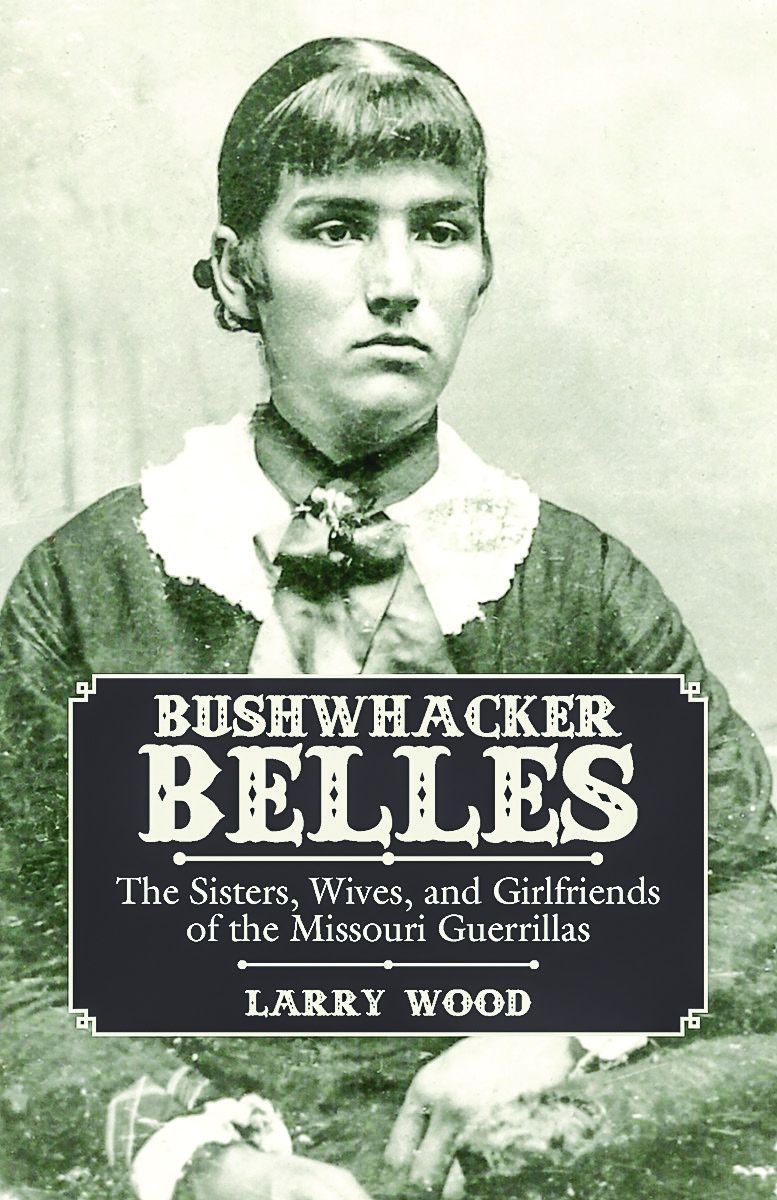
Bushwhacker Belles: The Sisters, Wives, and Girlfriends of the Missouri Guerillas. By Larry Wood. Illustrated, photos, map, notes, bibliography, index, 304 pp., 2016, Pelican, www.pelicanpub.com, $24.95 softcover.
Many books focus on women’s contributions to the Civil War. However, Larry Wood’s newest work deserves serious consideration as one of the best. His writing style transports readers back to the Civil War. Readers will live the lives of the women in his stories. A critical border state with strong Union and Confederate ties, Missouri ranked third behind Virginia and Tennessee for the most battles fought during the Civil War. Missouri provided troops to both sides. Partisans using guerilla tactics emerged out of necessity to protect homes and families. Missouri was in constant turmoil struggling to balance the Union and Confederate sentiments that ran very deep throughout the state. As a result, many individuals took matters into their own hands. The state government did not recognize these soldiers as either Union or Confederate. Instead, they were left to fend for themselves for food, supplies and weapons, and were regarded as outlaws. They made their own rules and followed their own code of conduct. Deception, espionage, treason and aiding or abetting the enemy became commonplace practices for the likes of “Bloody Bill” Anderson. The chapters are a series of short stories about women who served in Missouri during the war. Wood presents their behavior as plausible, defensible actions taken to protect their children and families. Wood explores the women’s lives in their familial and quasi-combat roles. He uses letters, eyewitness accounts and personal recollections to make his women and their actions and beliefs come to life. On the surface, they usually could pass as letters. Readers receive details on the classes of people living in Gaston and how their stations in life influenced their politics. Carpenter’s examination of the 1863 Gaston tax roll shows that 90 percent of the county’s political leaders owned slaves and the value of the slaves exceeded the county’s real estate value by 15 percent. That did not escape the notice of some of the yeoman farmer soldiers, one of whom wrote home about fighting a rich man’s war. Slaves and free blacks get their own chapter, including details of how some were lynched without trial for alleged crimes. Carpenter shows his thoroughness when he notes which soldiers did or did not tell their relatives to give their tidings to slaves. This is not a heart-pounding battle book but a detailed examination of how people lived during the war and what they thought of it. It is recommended for those interested in the war’s home front, especially in North Carolina. Reviewer Clint Johnson has written 10 Civil War history books.
ACE p yro proper ladies. But they were cunning enough to function effectively as spies or abettors of guerilla groups. Many of the women were imprisoned and then banished from the state for the duration of the war. One lady was banished to Canada; she was deemed too risky to be allowed back into the United States until the war had been over for several months. The prose is easy to read and has a fluid style. The book is reasonably priced and is an excellent resource regarding women’s contributions and guerilla fighting in Missouri. It deserves a place in your library if any of these topics interest you. Reviewer Richard J. Blumberg has a master’s degree with honors in Civil War studies. He is past president of the Houston Civil War Round Table and is a speaker for that group and the Society of Women in the Civil War. He also reviews books for the Blue and Gray Education Society.
Seizing Destiny: The Army of the Potomac’s “Valley Forge” and the Civil War Winter that Saved the Union. By Albert Z. Conner Jr. with Chris Mackowski. Illustrated, photos, maps, notes, appendices, bibliography, index, 384 pp., 2016, Savas Beatie, www.savasbeatie.com, $34.95.
With more than 70,000 books published about the Civil War, readers might assume that every imaginable subject has received due attention. Then along comes a study that breaks new ground, such as Albert Conner and Chris Mackowski’s Seizing Destiny. The authors argue that the Union Army of the Potomac’s misery during the difficult winter of 1862-63 mirrored the travail of Gen. George Washington’s army at Valley Forge in the winter of 1777-78. They believe the Union army not only survived this wretched period, but experienced a metamorphosis that eventually led to victory. This thesis stems from a myriad of soldiers’ letters and memoirs that describe in detail aspects of that army’s “Valley Forge.” The authors have set the bar high in their proposal to demonstrate that this was a transformational period that led to victory in the war. Their approach is systematic — beginning with a description of the repulse of Maj. Gen. Ambrose E. Burnside’s frontal attacks against a fortified Rebel position on Marye’s Heights at Fredericksburg and the subsequent demoralizing “mud march” up the Rappahannock River. These failures led to President Abraham Lincoln’s replacing Burnside with Maj. Gen. Joseph Hooker, an outspoken critic of Burnside. Hooker reportedly vowed “to drive the Rebels to Hell or anywhere else.” Despite his awareness of the new army commander’s character flaws, Lincoln thought Hooker could be a capable leader. He bade Hooker, “Beware of rashness, but with energy and sleepless vigilance go forward and give us victories.” Hooker had monumental tasks confronting him. He had to stem the flood of desertions from his deflated army. He also had to reorganize and restore confidence in an army that had been unable to defeat a smaller and less powerful enemy. The first order of business was selection of officers whom the commander could rely on to follow his orders and lead with courage and skill. Additionally, Hooker saw to it that the soldiers had sufficient nutritious food to improve their health and attitude. Adoption of badges on uniforms and equipment for practical identification purposes had the added effect of enhancing morale and unit pride. Hooker turned his attention to reorganizing the cavalry into a separate corps that allowed it to function at a more effective level in conducting reconnaissance and in fighting. That done, he established a unique intelligence staff to gather and analyze information about the enemy and synthesize it for his use in strategic and tactical planning. Other enhancements came in the areas of artillery, supply, communications and medical facilities. Introduction of regular furloughs was a masterstroke in improving the loyalty of the troops and reducing desertions. In effect, Hooker transformed a bedraggled mass that existed following Burnside’s tenure as commander into a fighting force that was intent on exacting revenge on Gen. Robert E. Lee’s army. The authors describe this transformation mainly in the words of the officers and soldiers who persevered through this tumultuous period. They have compiled a convincing case to show that this “Valley Forge” winter led to victory and restoration of the Union. Even in the face of Hooker’s meltdown and crushing defeat at the Battle of Chancellorsville in May 1863, the troops generally recognized that they had performed well on the battlefield and eventually victory would be theirs. The book is entertaining and informative. It includes helpful maps. Its appendices describe the postwar lives of many individuals featured in the narrative and the role of hardy and heroic women during this period. It is highly recommended for its in-depth research and logical, informative analysis of a period of the Civil War that has not received the attention it deserves.
Reviewer Thomas J. Ryan is the author of Spies, Scouts, and Secrets in the Gettysburg Campaign: How the Critical Role of Intelligence Impacted the Outcome of Lee’s Invasion of the North, June-July 1863. His website is www.tomryan-civilwar.com.
Army Of Potomac’s ‘Valley Forge’ Archeologist’s Guide For Musket Ball, Shot Study
Musket Ball and Small Shot Identification: A Guide. By Daniel M. Sivilich. Illustrated, photos, maps, graphs, tables, appendix, bibliography, index, 232 pp., 2016, Oklahoma, www.oupress.com, $34.95 softcover.
At first glance, this book may appear to be a dry, technical text meant only for professional archeologists. Not so. Instead, archeologist Daniel Sivilich’s book is a fascinating study of the humble musket ball, the instrument of death and dismemberment on many American battlefields. Sivilich has assembled far more than just a detailed discussion of the basic musket ball. His book focuses primarily on the Revolutionary
War period, with an emphasis on the 1778 Battle of Monmouth, New Jersey, where extensive archeological work has uncovered many interesting finds. The book includes chapters on what impacted musket balls hit, how to interpret fabric impressions on balls, and how they were altered for both more and less lethality. Additional detailed chapters on artillery canister and small shot (buckshot, birdshot and other types) round out the text. A brief history of early firearms and several appendices provide even more useful information. Sivilich’s groundbreaking research is useful to those studying Civil War sites as well. Although the legendary Minie ball reigned supreme on Civil War battlefields, the musket ball is also frequently found by archeologists, particularly at sites associated with early war activity. Profusely illustrated and free of technical jargon, this impressive book should appeal to anyone interested in weaponry, tactics or ammunition of the pre-1865 period. Reviewer Jeff Patrick is an interpretive specialist with the National Park Service at Wilson’s Creek National Battlefield in Republic, Mo. He holds B.A. and M.A. degrees in American history from Purdue University.
‘Agrarian Ideal’ Views North Carolina War Atlas Is Excellent Influenced Republicans An Agrarian Republic: Farming, Antislavery Politics, and Nature Parks in the Civil War Era. By Adam Wesley Dean. Notes, bibliography, index, 240 pp., 2015, UNC, uncpress.unc.edu, $29.95.
Adam Dean has penned an important and persuasive monograph that reminds us of the centrality of environmental ideas to the Republican Party in the Civil War era. Many Republicans believed that a rural society populated by virtuous, yeoman farmers was the surest way to preserve the republic. Dean demonstrates how the “agrarian ideal,” not nascent industrialism, lent coherence to Republican programs before, during and after the war. At the same time, he suggests the synthetic potential of a budding Civil War environmental history. The agrarian ideal lent a distinctive flavor to many Republicans’ critiques of slavery. They believed that slaveholders were rather irresponsible stewards of the soil. Slavery had only deleterious effects on the land — its oligarchs monopolizing the soil and wantonly depleting its nutrients. Slavery also prevented freeholders from acquiring land, literally short-circuiting national progress.
Dean thus complements Eric Foner’s classic work on Republican ideology, Free Soil, Free Labor, Free Men. Breathing new life into old sources, Dean frames the period as a struggle over the future of the land— collapsing fictional dichotomies between the East and West. The book also recalls the blizzard of domestic legislation enacted during the war. Civil War Republicans created the U.S. Department of Agriculture, established land grant colleges, and passed the Homestead Act — all measures proposed as strategies to suppress the rebellion. Ideas about the land, Dean deftly shows, were entwined with ideas about civilization and democracy. On the other hand, Republicans vigorously debated setting aside national park land in the West. While some argued that conserving natural beauty would testify to the Union’s civilized character, others insisted that the West should remain a preserve for yeomen farmers. The best books raise as many questions as they answer. By that measure, Dean has written a very good book — one that contributes to multiple historiographies. He challenges us to think about Reconstruction as an attempt to sow yeoman values in the South and in the West. He prompts us to think about how unkempt plantations encountered by Yankee soldiers reinforced negative stereotypes of the rebels and their peculiar institution. Perhaps most sobering, he challenges us to think about what we as a nation have lost with the ultimate demise of the agrarian ideal. Reviewer Brian Matthew Jordan, assistant professor of history at Sam Houston State University, is author of Marching Home: Union Veterans and Their Unending Civil War, which was a finalist for the 2016 Pulitzer Prize in History. He is at work on a biography of Ben Butler.
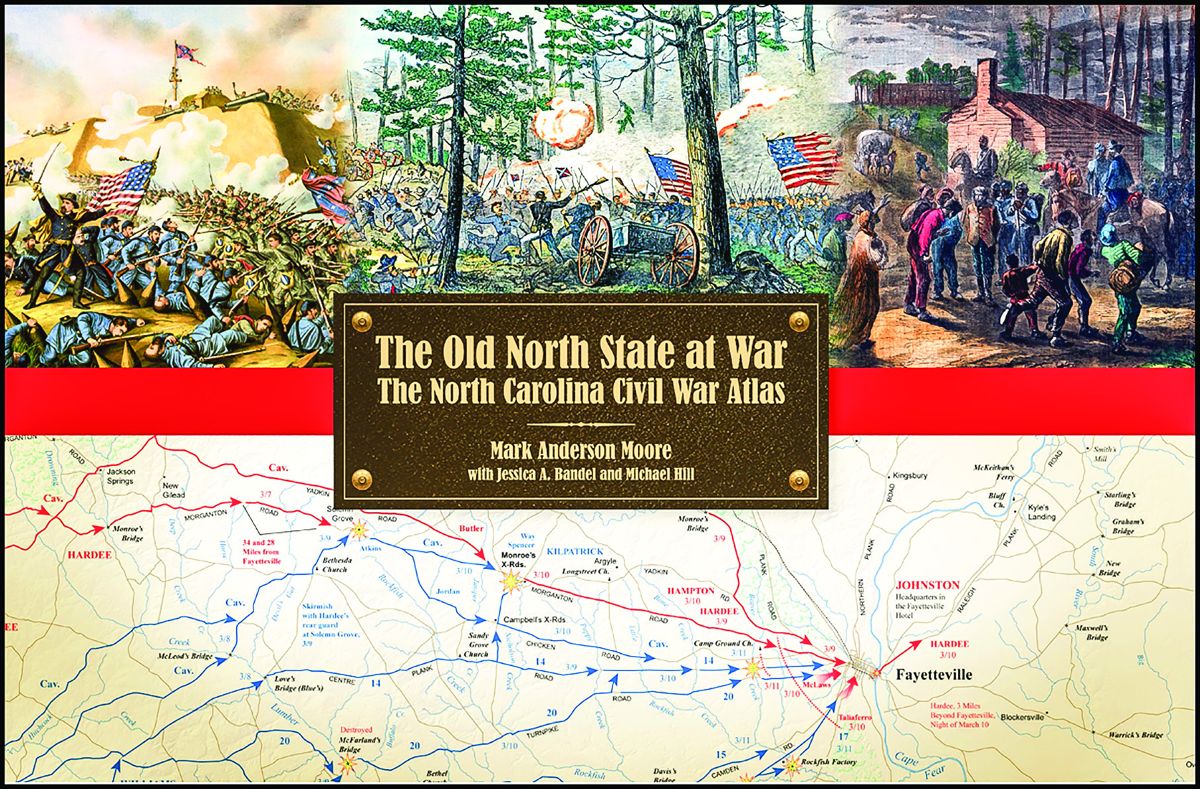
The Old North State at War: The North Carolina Civil War Atlas. By Mark Anderson Moore with Jessica A. Bandel and Michael Hill. Illustrated, photos, maps, tables, bibliography, index, 200 pp., 2015, N.C. Department of Cultural Resources, http://nc-historical-publications.stores.yahoo.net, $85.
The Civil War Sesquicentennial produced many interesting and valuable research projects. I have not seen one as outstanding as this one. Where do I begin? It would take more space than this reviewer is allowed to do justice to this work. But let me try. Let’s start with the 99 maps. They cover the smallest skirmishes to the major battles fought in North Carolina. These maps are equal in scope to the maps in The Atlas to Accompany the Official Records of the Union and Confederate Armies published by the U.S. Government in 1895. Of course, the North Carolina atlas is more accurate due to advances in research and technology over the past 121 years. The maps are clear, detailed, and in full color. Many are on a full 17” x 11” page. Mapping many small engagements for the first time provides rich new research sources. There also are scores of line drawings and charts. It is understandable that this book took more than a decade of intense research to complete. The atlas begins with the state’s secession vote followed by the outfitting and equipping of the troops. Following chapters cover the war years from the invasion of the Carolina Coast and the Burnside Expedition to the surrender of Gen. Joe Johnston to Gen. William T. Sherman at Bennett Place in April 1865. This is not just a battles and campaigns book. There is much more. There is detailed coverage of slavery and plantation life, women, politics and the economy. The demographics of the state’s population are demonstrated in numerous informative charts. Any important activity involving North Carolina’s native sons and daughters who served in or out of the state is covered. No work on North Carolina in the Civil War would be complete without attention to blockade running and the war at sea. When Norfolk fell in 1862 and Charleston was effectively closed to blockade-running, Wilmington stayed open and became state — about 40,000. The authors’ research puts the fatality figure at 31,954 — plus 1,200 African American and white North Carolinians who died in Federal service. Its Rebel deaths are the highest per capita among Confederate states. The text is clear, concise and skillfully written. Many littleknown and interesting stories are scattered throughout the book. Some interesting examples involve Gen. Edward Wild’s African Brigade, Stonewall Jackson and the 18th North Carolina at Chancellorsville, and the chilling story of the Shelton Laurel Massacre. The story of bread riots highlights the severe conditions women back home faced when they were not able to produce enough food for their families. They could not pay the escalating prices demanded as the war progressed. Riots broke out in many the most heavily fortified city on the Atlantic seaboard. It took two major Union assaults on Fort Fisher, the largest earthen fortification in the Confederacy, to force its surrender on Jan. 15, 1865. It is generally accepted that North Carolina lost more Confederate soldiers than any other Southern towns and cities. Images are beautifully reproduced in black-and-white and full color. It is no surprise that this high-quality project comes out of the North Carolina Office of Archives and History. This is the same agency that produced the multi-volume, highly acclaimed North Carolina Troops 1861-1865: A Roster. This atlas belongs in the libraries of serious historians, and schools and historical organizations in and out of North Carolina. It is essential for serious research on North Carolina in the Civil War. This is a beautiful book, one the people of the Old North State can be proud of. It is highly recommended. Reviewer Michael A. Cavanaugh is the former editor and publisher of the Civil War Book Exchange, now Civil War News. He has authored and co-authored five books on the war.
Meagher’s Colorful Life: Borderland Religion, Race, Politics Resistance, Exile & War The Immortal Irishman: The Irish Revolutionary Who Became an American Hero. By Timothy Egan. Photos, notes, index, 384 pp., 2016, Houghton Mifflin, Harcourt, www.hmhco.com, $28.
“Faugh-A-Ballagh” (Clear the Way) was the battle cry of the Irish Brigade in the American Civil War. The brigade’s founder and most famous member was Thomas Francis Meagher. This book regales readers with the happenings of his most interesting life. The story is told in three sections about being Irish in Ireland, being Irish in the Penal Colony, and being Irish in America. The first section deals with Meagher’s life in Ireland from his birth into a wealthy Roman Catholic family, to education and his resistance to repressive British rule. It is here that the “Great Hunger,” the Famine of 1848, is introduced. Meagher joined the Young Ireland group, increased his resistance, and began a life-long crusade for Irish independence. It is at this point that he earned the sobriquet “Meagher of the Sword.” Part two deals with his exile to a penal colony in Tasmania, off Australia’s southern shore, for his seditious activities. He married and had a son. He grew weary of his exile, plotted his escape, and went to America. The last section covers Meagher’s life and activities in America where he became a political force and fostered Irish involvement in the Civil War. He recruited and formed the Irish Brigade. He dreamed of founding a New Ireland in the
American Northwest and died early under suspicious circumstances. Timothy Egan describes all these events in a most lively, entertaining and informative fashion, The book is not without faults. First, there are not enough references. The author uses the reader-unfriendly quote/endnote system instead of the more helpful numbered footnote approach. Other issues are more substantive. For example, Egan writes that Abraham Lincoln withheld the Emancipation Proclamation from his cabinet until Sept. 22, 1862, its issuance date. Elsewhere he states that Lincoln advised the cabinet of it on July 23, 1862. Another issue is whether Meagher was a member of the Fenian Society. Society founder John O’Mahoney, a member of Young Ireland, wrote in 1864 that the Young Irelanders would have nothing to do with the Fenians. Yet in 1886 O’Mahoney wrote that he initiated Meagher into the Fenians in July 1863. Some historians believe Meagher was not a Fenian, but Egan does not clarify the issue. Next is the premise that Meagher was murdered by a vigilante committee in Montana. Although this is widely believed to have been the case, there is no direct evidence that the vigilantes were responsible. Egan leads readers to believe it is fact. All that said, this is a very entertaining book. There is much to learn here concerning Meagher’s helping the Union prevail, his getting the Irish accepted into American society, and disturbing details about the Great Famine. This story is a bit romanticized. Nonetheless, it is worth your time, particularly if you are interested in Irish history or the Irish in America, especially in the Civil War. However, all through the book I kept recalling a phrase from the movie “The Man Who Shot Liberty Valance”: When fact crosses with legend, print the legend. Reviewer Joseph A. Truglio is president and business agent for a motion picture film technicians local union and a lifelong student of the Civil War. His memberships include the Lincoln Group of New York and New Jersey Civil War Heritage Assn. He is president of the Phil Kearny Civil War Round Table in Wayne, N.J.
Bonds of Union: Religion, Race, and Politics in a Civil War Borderland. By Bridget Ford. Notes, bibliography, index, 424 pp., 2016, North Carolina, www.uncpress.unc.edu, $45.
This first book by Bridget Ford should not be her last. It shows tremendous research skills and is well written. To explore the three topics in the title, she focuses on Cincinnati and Louisville, which are just 100 miles apart on opposite sides of the Ohio River. Major cities because of Ohio River shipping, both were deeply affected by religion, race and politics. Readers may find the book’s length and small print a challenge, but good organization offsets those issues. It is in three parts: Protestant and Catholic, Black and White, and Section and Nation. Each has several chapters. Ford focuses on the antebellum decades and also includes some wartime and immediate postwar matters. The book starts with religion, primarily the Roman Catholic and
Protestant church competition. Those rivalries were evidenced by everlarger houses of worship with evertaller steeples. African-Americans had their own modest churches even in slave-holding Louisville. Sadly, members of whites-only congregations in Cincinnati did little or nothing to quell anti-black riots that took place in 1829, 1836 and 1841. Fears among some white workers that blacks might take their jobs were a contributing factor. Several openly racist newspapers inflamed the situation. The last riot, the author contends, “may be properly termed a ‘race war,’ with black and white Cincinnatians both armed to the teeth.” Some whites even hauled a cannon into the street, loaded it with scrap metal and fired it several times at blacks defending their homes. No serious wounds were reported. There were also riots by Protestants against Catholics, who were arriving from Europe in huge numbers. When a representative of the pope arrived on a tour, Protestants in both cities feared the U.S. might eventually be controlled by the Vatican. One of the country’s deadliest religious riots ever was in Louisville in 1855. Protestant mobs feared that Catholics had stored gunpowder and munitions in one of their churches. City officials searched the building and found nothing amiss. But street violence among the two groups of Christians killed an estimated 22 people and injured many more. When Northern Protestant leaders became outspoken opponents of slavery in the 1840s, their churches in the South simply added the word “Southern” to their names, quit the national church organizations and refused to change their views on the issue. Many churches in the South still have the word “Southern” in their titles because of those antebellum actions. Black churches in slave-holding Louisville refused to follow their white brethren in the name change. This refusal triggered spirited discussions and some Louisville white congregations’ unsuccessful attempts to take over the black churches. Though much of this book deals with many unfamiliar persons, one very well-known individual is covered. He is Salmon P. Chase, a two-term U.S. Senator, Governor of Ohio, Abraham Lincoln’s first Secretary of the Treasury, and Chief Justice of the Supreme Court. Chase had a law practice in Cincinnati and, even though he was an abolitionist, firmly believed that the Constitution protected slavery in states where it already existed. He spent much time in Louisville and became active in Kentucky politics. He even gave financial and management assistance to the True American, a Kentucky-based abolitionist newspaper. The book covers education well, including the creation of public schools for black children in both cities and activism among college students. Cincinnati’s Lane Academy, a seminary to educate future Presbyterian ministers, was a hotbed of abolitionism, especially among its students. The school encouraged formal and informal discussions on when, not if, slavery should be abolished. Chase was a strong supporter of the Union and opponent of secession, as was George Prentice, fiery editor or the Louisville Journal, the state’s largest newspaper. At the end of the war, in May 1865, Prentice published a lengthy letter to Kentuckians in his newspaper. Ford says the letter “offered a history of secession and war, a primer on the original intent of the drafters of the Constitution with regard to slavery, and a vision of future progress and prosperity for Kentuckians with the elimination of what Prentice called ‘the disturbing element of human bondage.’” This book will appeal to those who want to delve deeply into how two major cities in the Civil War borderland dealt with major issues of the mid-19th century. Libraries and readers are encouraged to buy this insightful book. Reviewer J. Lee Bailey won an Emmy for a series of television news reports on lax security at a major American airport. His greatgreat-grandfather, Alexander Sutherland, served in the 16th Pennsylvania Cavalry. He working on a novel loosely based on Gen. John Hunt Morgan’s career.
West Virginia War History Elections Were Males’ Rite Of Passage Arranged By ‘On This Day’ On This Day in West Virginia Civil War History. By Michael B. Graham. Illustrated, photos, bibliography, 192 pp., 2016, History Press, www.historypress.net, $21.99 softcover.
This book presents brief descriptions of Civil War battles, skirmishes and maneuvers in West Virginia. They are arranged by calendar months and days without regard to years. It covers major engagements such as Rich Mountain, Philippi and Harpers Ferry, as well as minor skirmishes like Droop Mountain, Carnifax Ferry and Hacker’s Creek. Most entries identify the participants, commanders and casualties for both Union and Confederate forces. Photographs are liberally interspersed to highlight commanders and engaged units. West Virginia units are extensively covered, as are partisan units such as the Moccasin Rangers, McNeill’s Rangers and White’s Comanches.
Individual acts of daring, like Dan Huskey’s bushwhacking and Harry Gilmor’s ruse to capture Petersburg, provide a human perspective. Political events surrounding the debates on West Virginia’s statehood are interspersed throughout the calendar listings. These highlight the deep divisions between Union and Confederate sympathizers in western Virginia counties. Emancipation, taxation, educational inequities and transportation challenges all became issues for delegates during the statehood convention. Author Michael Graham admits that the Official Records of the Union and Confederate Armies are the principal source of his entries. No discussion of their significance accompanies the entries. They are historically accurate, but the few attempts to interpret data are overgeneralized. An example: “Neither side could win the war without controlling the Baltimore and Ohio Railroad in West Virginia.” The basic format is a big problem. Because the entries are not organized by year, but by calendar dates, events from all years of the war are interspersed and chronological continuity is missing. The result is that this book will probably be of interest only to West Virginia readers, who might take a daily glance at the entry for a particular date. Reviewer Wayne L. Wolf is Professor Emeritus at South Suburban College and the author of numerous books and articles on the Civil War including The Last Confederate Scout and Two Years Before the Paddlewheel. He is past president of the Lincoln-Davis Civil War Roundtable.
The Virgin Vote: How Young Americans Made Democracy Social, Politics Personal, and Voting Popular in the Nineteenth Century. By John Grinspan. Illustrated, photos, tables, appendix, notes, bibliography, index, 264 pp., 2016, North Carolina, www.uncpress.unc.edu, $28.
Jon Grinspan starts this book by noting that in 1824 only 26.9 percent of the eligible American population voted in the presidential election. However, from 1840 until 1900
Bios Of Each State’s Last War Veteran The Last Civil War Veterans: The Lives of the Final Survivors. By Frank L. Grzyb. Illustrated, photos, notes, bibliography, index, 197 pp., 2016, McFarland, www.mcfarlandpub.com, $35.
Growing up in Akron, Ohio, I became acquainted with a man who passed his own childhood searching for the Civil War’s last veterans. Thumbing through scrapbooks that teemed with yellowed newspaper clippings and faded snapshots, J. Gary Dillon related fond anecdotes of the boys who lived on into the mid-20th century, wrinkled yet venerable reminders of the past. With special pride, he recalled his trip to Duluth, Minn., to meet with Albert Woolson, the nation’s last living link to its fratricidal conflict. Frank L. Grzyb has done something similar in this book. Mining newspapers, genealogical data and previous works by Jay S. Hoar and C. Stewart Peterson, he presents capsule biographies of the last living veteran in each state. The biographies are divided among seven chapters, one each chronicling the Union, the Confederacy, the border states, Western territories, and even Alaska and Hawaii. Handsomely reproduced photographs of the veterans and brief summaries of their regiments’ activities accompany the entries. The last living survivors represent a stunning cross-section of wartime experiences. Among them were drummer boys and buglers; a substitute and eager, underage volunteers; a free black and a former slave; men who endured captivity in Richmond’s Libby Prison, and at least one who gripped Lincoln’s hand. Grzyb even includes a “manservant” who fought alongside his Confederate master as North Carolina’s final survivor. In their final years, these centenarians became local celebrities. They were commanders of Grand Army of the Republic departments; staples of Memorial Day parades; prized and patriotic citizens trotted out on the Fourth of July or venerated by lovers of the Lost Cause. Grzyb intriguingly labels them “emissaries of peace.” Determining the final veteran who lived in each state is no simple task. This is due to notoriously deceitful claims of Civil War service made by pension-seeking centenarians in the 1940s and 1950s. Richard A. Serrano’s recent Last of the Blue and Gray discusses this subject.
the percentage of eligible Americans voting in presidential elections ranged from a low of 69.6 percent in 1852 to high of 81.3 percent in 1876. Grinspan explains these high voting rates, especially among young voters. He concludes that during the middle and latter half of the 19th century most American males looked upon voting in a presidential election as a sign of becoming an adult. A male upon casting his vote often said he was no longer a virgin. The need to participate in national elections started early in a male’s life. As individual states removed the voting requirement to own property, increasing numbers of people became involved in presidential elections. During the 19th century, presidential campaigns were local endeavors. Candidates could not reach out to the nation as a whole through national news media. They were dependent on local partisans to galvanize their fellow citizens to vote for them. Teenage boys in the 19th century joined in the election process because this was seen as a stepping stone on the path to adulthood. They paraded for their candidates and intimidated other candidates’ supporters. Supporting a presidential candidate allowed a teenage boy to show leadership, gain friends, build relationships and attract mentors. Girls flocked to political rallies because that was where the boys were. Although denied the vote, girls were empowered in the political world by persuading others to vote for their candidates. Grinspan finds this phenomenon among male and female, rich and poor, native-born and immigrant, rural and urban, and educated and non-educated individuals. They all saw their participation in national elections as a necessary step in reaching adulthood and becoming part of their communities. Readers will learn about some of the forces that brought Abraham Lincoln to office and shaped the United States’ post-Civil War political scene. This is a book about politics, but remember that Clausewitz said, “War is merely the continuation of policy by other means.” Reviewer Charles H. Bogart has a B.A. in history from Thomas More College and an MA in urban planning from Ohio State University. He is the historian for Frankfort, Kentucky’s Fort Boone Civil War Battle Site.
In a few cases, Grzyb acknowledges disputes in the historical record or his Departures from previous scholarship. In a handy appendix, he compiles his findings, including the dates of death for each veteran. Other appendices recommend the utility of the 1890 veterans’ census, address those ex-soldiers who moved beyond national borders, and introduce the “last survivors” of various wartime episodes. The latter include the bombardment of Fort Sumter, Pickett’s Charge and the duel between the ironclads. Apart from a few minor errors — Minnesota did not become a state during the war, nor was the Confederacy’s first capital Montgomery, Miss. — this is a thorough piece of work, fully documented and capably written. This book is a reference volume, not an interpretive monograph. As such, readers will not encounter a broad discussion or argument about the memory of the war, nor about the place of these tottering old soldiers in it. But future scholars who want to consider such questions will doubtless find this an indispensable starting point. Reviewer Brian Matthew Jordan, assistant professor of history at Sam Houston State University. He is author of Marching Home: Union Veterans and Their Unending Civil War, which was a finalist for the 2016 Pulitzer Prize in History. He is at work on a biography of Ben Butler.
Texas Cavalrymen Had Reprint Of Lizzie Keckly’s 1868 Unique Skills, Heritage Slavery, White House Memoir Riding for the Lone Star: Frontier Cavalry and the Texas Way of War, 1822-1865. By Nathan A. Jennings. Illustrated, photos, maps, notes, bibliography, index, 408 pp., 2016, North Texas, www.untpress.unt.edu, $32.95.
Texas is unique. It is the only state to have had six different countries’ flags flown over it. Spanish, French and Mexican explorers all claimed Texas. For nine years (1836-1845) Texas was an independent republic. From 1845 until Feb. 1, 1861, it was a part of the United States. During the Civil War it was part of the Confederacy. After the Civil War, Texas came back under the United States flag again.
Texas’s large geographic area and cultural heritage played an important role in how Texans learned to fight, survive and ultimately thrive. Nathan Jennings does an excellent job capturing the strategic and operational influences that shaped Texans into excellent equestrians, as well as independent and strongwilled soldiers. My main focus was on chapters seven and eight, dealing with the conflicts Texas soldiers faced from the early statehood years through the Civil War. Jennings’s analysis and presentation about this era are excellent. In fact, the entire book is factually very solid. This work is typical of the format used by military historians that focuses primarily on terrain and battle tactics. Jennings does a good job weaving all eight chapters together to give readers a perspective that includes battles with Native-American tribes, Tejanos, banditos and other quasi-guerrillas, as well as mounted and dismounted cavalry operations during the Civil War. The author successfully links the military styles of combat that evolved in Texas to make a compelling argument why Texas troops were frequently in high demand throughout the Confederacy. This book receives my highest recommendation as a native Texan, a military historian and a Civil War enthusiast. It is enjoyable to read and provides a good balance of new analysis with already established facts. Reviewer Richard J. Blumberg has a master’s degree with honors in Civil War studies. He is past president of the Houston Civil War Round Table and is a speaker for that group and the Society of Women in the Civil War.
Behind the Scenes Or, Thirty Years a Slave, and Four Years in the White House. By Elizabeth Hobbs Keckley. Notes, 184 pp., 2016, Eno Publishers, www.enopublishers.org, $10 softcover.
Lizzie Keckly’s memoir reveals the remarkable life of an enterprising woman whose dressmaking skills provided her an intimate view of the Lincoln White House. That she forged a friendship with Mary Lincoln despite her subordinate racial and social status attests to her personal charisma and extraordinary abilities. However, their bond, given national attention by this book’s 1868 publication (which spelled her surname as “Keckley” rather than “Keckly as she signed it), proved incapable of sustaining a relationship involving such a complex woman as Mary Lincoln. The daughter of a white planter and slave mother, Keckly experienced firsthand the brutalities of slavery as a child and teenager. Nevertheless, she discerned that enslavement produced one positive outcome by teaching the “important lesson of self-reliance.” As a young woman, Keckly’s resourcefulness and proficiency as a seamstress enabled her to financially support her shiftless master, her biological father’s son-law who had moved his family from Virginia to St. Louis. In 1855 these kindhearted customers raised $1,200, which Keckly later repaid, to purchase her and her son’s freedom. In 1860 she left St. Louis for Baltimore, but her business venture to establish a sewing school for
African-American women failed. She relocated to Washington, where her reputation as an accomplished modiste and a few well-timed references provided opportunities to make dresses for political society’s leading ladies. In November 1860, Varina Davis hired Keckly and later encouraged her to head south with the family. She politely refused the future first lady of the Confederacy and eventually found work with Davis’s counterpart, Mary Lincoln. Most of the memoir recounts incidents inside the White House and portrays Keckly as a close confidant of the Lincolns. She dressed Mary for balls and other public events. Mary grew to rely on Keckly in times of greatest need. Keeping watch at the bedside of the dying Willie, Keckly observed the humanity of a heartbroken president: “genius and greatness weeping over love’s idol lost.” As she narrates her relationship with the Lincolns, Keckly fades from view. Mary dominates about two thirds of the book, and Keckly describes her warts and all. Indeed, she asserts, “I never in my life saw a more peculiarly constituted woman.” Keckly presents what has become the stereotypical view of Mary: a petty and jealous wife who disliked any woman who conversed too long with her husband, contemptuously distrusted the president’s overly “ambitious” and scheming cabinet, and considered McClellan a “humbug,” Grant “an obstinate fool and a butcher,” and Andrew Johnson ”a demagogue.” In contrast, Keckly portrays Abraham as an understanding husband who patiently tolerated his highstrung wife and gently disputed her uncharitable opinions. Good-natured and honest to a fault, the president was oblivious of his wife’s profligate spending, which Keckly erroneously claimed totaled $70,000 at his death. In fact, Mary’s financial troubles prompted Keckly to publish her memoir. In March 1867 Mary implored Keckly to meet her in New York to assist in an ill-advised scheme to raise funds by selling her dresses and jewelry. The public exhibition of Mary’s cast-off clothes created an unseemly spectacle that offered ample evidence for the partisan press to play up her psychological instability. Keckly insisted that her account, animated by “the purest motives,”
would set the record straight. She thought her readers would have a better opinion of the former first lady by Keckly’s revealing the personal side of their relationship and explaining “the secret history” of Mary’s recent old clothes debacle. Also, Keckly needed to defend her own reputation since the press had disparaged her name as well. Despite her good intentions, Keckly reaped nothing but trouble from the memoir’s publication. It sold few copies because Robert Lincoln successfully campaigned for its suppression. Instead of lauding her candid account of Mary, the press derided her as an impudent, working-class African-American seamstress who dared to divulge private details about the Lincolns. Worst of all, an offended Mary, who had once leaned so heavily on Keckly for support, cut her off completely and referred to her derogatorily as “the colored historian.” Behind the Scenes is difficult to classify, for it is neither a traditional slave narrative nor a standard memoir focused on one’s life and accomplishments. Some scholars believe it was ghostwritten and, because of the inclusion of Mary’s letters about the clothes scandal, wonder how much control Keckly had over the finished product. Indeed, Carleton and Company, the original publisher, even advertised the memoir as a sensational exposé. Keckly’s recollections of Abraham Lincoln’s alleged conversations sound implausible and are likely invented. These include his alleged praise for Stonewall Jackson and admiration of a Robert E. Lee picture. While the introduction relates an interesting anecdote about a contemporary attempt to find Keckly’s grave, it omits important background information that the reader must find in secondary sources. Regardless of whether or not she actually wrote her memoir, Lizzie Keckly comes across as a devoted companion who genuinely sacrificed to assist Mary Lincoln. It’s unfortunate that her published account stretched the limits of racial and social boundaries too far and ended their friendship. Reviewer Sean A. Scott is Assistant Professor of History at The Indiana Academy for Science, Mathematics, and Humanities and writes about religion during the Civil War.
Hookworms Affected Men, Essays About North American Slavery But Unknown To Doctors The Yankee’s Secret Weapon: Even Lincoln Didn’t Know. By Thomas Power Lowry. Illustrated, photos, bibliography, index, 150 pp., 2016, Idle Winter Press, www.idlewinter.com, $12.99 softcover.
Even if readers get past the “ewwwww” factor that this book is all about hookworms, they face another factor in deciding whether to buy this book. Despite the title (incorrectly using “Yankee’s” instead of “Yankees’”), this book is not primarily a Civil War book. Tom Lowry, a well-known and prolific Civil War writer with a specialty in medical topics, really stretches with this subject. While he makes good arguments that soldiers infected with hookworms likely were very sick and unable to fill the ranks, virtually all of this book deals with the postwar discovery and study of the intestinal pest. It is hard to write a wartime medical history — however correct in its analysis – when the subject of the book was unknown to Civil War period doctors. It is not until the last chapter that speculation about hookworms affecting both Union and
Confederate soldiers appears. Lowry soundly speculates that officers were probably less affected by hookworms than common soldiers because the officers wore boots while the common soldiers sometimes did not even have shoes. Walking barefoot made it easy for the hookworms to break through the soldiers’ skin and then work their way up into their intestines, which had been weakened by their eating coarse cornmeal. Using statistical analysis, Lowry thinks that up to 75,000 of the 250,000 men who served in the Army of Northern Virginia were infected with hookworms. That level of supposed infection astounds Lowry. He ends that final chapter with: “Whatever one may think about their politics and causes, as a group Lee’s army illustrates the ability of men to push their oxygen-starved bodies to the limit.” But that Civil War connection does not come until the book’s last chapter. All the previous chapters chronicle the postwar research and eradication plans and programs. The bulk of this book takes place after the turn of the 20th century and even includes details of eradicating hookworms as far away as Australia. That said, readers who have interest in diseases, medicine or medical research may find this short, easy-toread book of interest. There are some surprises, such as how industrialists like John D. Rockefeller became interested in eradicating the pest. Doctors like Dr. Wickliffe Rose are given due credit for finding ways to rid the South of the nasty worm. If delving into the medical reasons underlying soldiers’ sicknesses interests you, you will want to read this book. It will take just two hours. Reviewer Clint Johnson has written 10 Civil War history books.
Linking the Histories of Slavery: North America and Its Borderlands. Edited by Bonnie Martin and James F. Brooks. Photos, maps, table, notes, bibliography, index, 422 pp., 2015, New Mexico, www.unmpresss.com, $39.95 softcover.
For people interested in the Civil War, it’s easy to think that slavery was a strictly Southern antebellum phenomenon, with an ugly history that ended with the Confederate defeat in 1865. This book disproves that notion. In this unique set of essays by scholars from a wide variety of disciplines, the story of slavery in North America is given a broader telling. It is a sad tale beginning in colonial times. It involves both African-American and Native-American peoples; encompasses Mexico, Cuba and the American West, and has left a legacy that still reverberates. The chapter most related to the American antebellum experience is an essay by Calvin Schermerhorn. He argues that forcibly removing Indians and transplanting African slaves to the American Southeast constituted one of the most important social and economic factors in our history.
This tragic story, involving the infamous Trail of Tears and the destruction of innumerable black families by slave sellers, buyers and traders, is one of greed and inhumanity. It involved the Federal government and the banking industry. The story is told in microcosm in the experiences of William Beattie. He was a land speculator from New York who moved to Alabama in 1830, just as Indian removal from the area was picking up speed and the British textile industry was starving for cotton. Beattie worked with the Alabama Emigrating Company to move thousands of Indians from their native homelands west across the Mississippi River. Joint stock companies formed to take over the land, which was parceled out to wealthy planters, who set up a plantation system. To satisfy the need for labor, slave trading companies such as Franklin and Armstead were formed in the 1830s to transfer slaves from Virginia and Maryland to markets in New Orleans and Natchez. Other essays are less related to the Civil War but still are interesting and tragic. Sarah Deer describes the Native-American experience of slavery and degradation throughout U.S. history. American Indian women now suffer sexual exploitation and violence at levels greater than any other ethnic group. As Indians were shuffled onto reservations and schooled to “civilize” them, the tribal families weakened and the cultural bonds that once gave these strong people their identity were destroyed. This book is an interesting addition to our understanding of slavery, not just in the American South before the Civil War, but in the entire North American continent. Reviewer David A. Galli is a private practice physician in St. Louis, Mo., and Instructor of Medicine at St. Louis University Medical School. He has a degree in history from St. Louis University and a long-time interest in the Civil War.
Hood’s Texas Brigade Took High Casualties At Gettysburg Texans at Gettysburg: Blood and Glory with Hood’s Texas Brigade. By Joseph L. Owen and Randy S. Drais. Illustrated, photos, notes, bibliography, index, 240 pp., 2016, Casemate, www.casematepublishing.com, $28.95 softcover.
About three hours of daylight remained on July 2, 1863, when Hood’s Texas Brigade stepped off the Emmitsburg Road at Gettysburg and launched an attack on the Union left. The attack resulted in what Lt. Gen. James Longstreet later recalled as the “best 3 hours of fighting ever done by any troops on any battlefield.” Those three hours of fighting saw the 1st Texas and 3rd Arkansas, two of the four infantry regiments that made up the Texas Brigade, slug their way through the Devil’s Den and capture a New York artillery battery. Meanwhile the brigade’s other two regiments, the 4th and 5th Texas, joined with Alabama troops in an attack on the Union line’s far left. Their attack ended in a desperate charge up Little Round Top that ultimately failed to capture that pivotal position. Absent from Gettysburg during the first day’s fighting, the Texas Brigade saw only limited action on the third day of the battle — fending off a vainglorious Federal cavalry attack led by Brig. Gen. Elon Farnsworth. The Texas Brigade took frightful casualties at Gettysburg, ranging from about 20 percent in the 1st Texas to over 50 percent in the 5th Texas. Brigade commander Brig. Gen. Jerome Robertson was wounded and almost all of the brigade’s field officers were casualties. Maj. Gen. John Bell Hood, whose division included the Texas Brigade, was seriously wounded just as the brigade went into action on July 2. The trials of Gettysburg left an indelible imprint on the memories of the brigade’s survivors. Over the next seven decades, they shared their Gettysburg experiences in private letters and diaries, public speeches, newspaper interviews and several published war memoirs. Texans at Gettysburg is a compendium of the historical record of these experiences, skillfully assembled and lightly edited by authors Owen and Drais. Each of the book’s first four chapters is dedicated to one of the brigade’s four regiments, starting with the 1st Texas and ending with the 3rd Arkansas. Each chapter has a brief history of the regiment followed by what its men wrote or said about their Gettysburg experiences. Succeeding chapters include letters and official reports about the battle from Generals Hood and Robertson. The book ends with some flowery public speeches given at brigade reunions or memorial gatherings, plus brief recollections of Gettysburg from several men of other commands who settled in Texas after the war. The veterans’ recollections of Gettysburg are the heart of the book and, though repetitive at times, generally interesting. I found the accounts of personal bravery of some of Hood’s men inspiring. Several of the veterans’ stories of death and suffering at Gettysburg are also poignant, even a century and a half later. The strength of Texans at Gettysburg is that it presents personal, sometimes gripping, accounts of some of the most intense fighting in that great battle. The recollections of Hood’s old brigade also add an individual dimension to a grand, impersonal battle that involved over 170,000 men and left an estimated 50,000 of them casualties. The weakness of the book, as an accurate history of even part of the battle, is that the veterans’ accounts are mostly those of ordinary soldiers who saw and recorded only what transpired in their immediate vicinities. Over time the veterans’ declining memories, combined in some cases with their rampant “old soldierism” (their tendency as old men to exaggerate the feats of their youth), limited the reliability of some of their stories and recollections. The aspect of Texans at Gettysburg most likely to appeal to readers who are already familiar with the Battle of Gettysburg is what it has to say about “Hood’s Protest.” Before his division launched its attack on July 2, Hood appealed three times to Longstreet for permission to march around the Round Tops and attack the Federals from the rear. Longstreet’s refusals prompted the only formal protest Hood filed during the war. Although contemporary historians of Gettysburg are skeptical, several of Hood’s veterans went to their graves insisting that had Longstreet acceded to Hood’s flanking attack, the Texas Brigade would have captured Little Round Top and, with it, turned the tide of battle in the
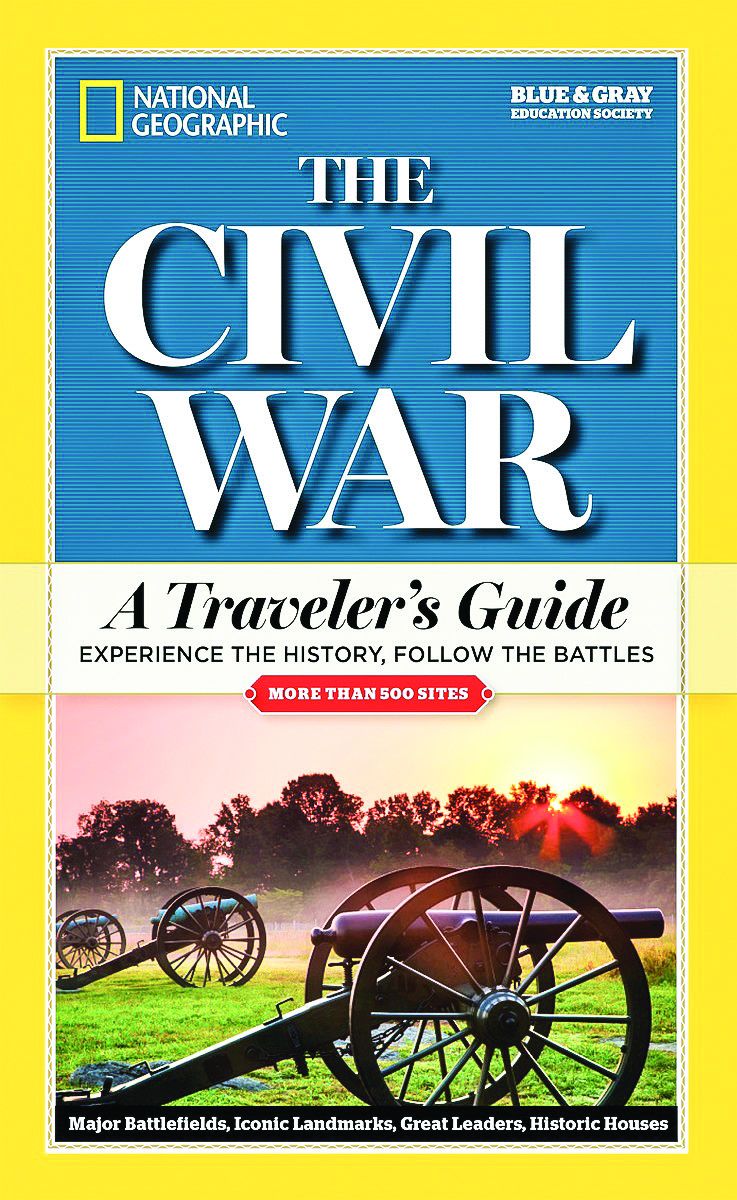
Excellent Guide To Civil War Battles Young Adult Novel Based On An Indiana Cavalryman The Civil War: A Traveler’s Guide: Experience the History, Follow the Battles. Edited by Len Reidel. Illustrated, photos, maps, 512 pp., 2016, National Geographic, www.nationalgeographic.com/ books, $25.95 softcover.
This book is one of the best and most comprehensive Civil War travel guides ever published. It is the product of significant cooperation between the National Geographic Society and the Blue & Gray Education Society. These two organizations play to each other’s strengths in producing an engaging and informative travel guide. Each section corresponds to a region, and each chapter explains the major battles that occurred in one state. Both naval and ground actions are described. Each chapter suggests at least one walking tour complete with a city-block map including numbers corresponding to noteworthy sites. Significant sites are highlighted with high-resolution, full-color pictures. The Gettysburg and Washington, D.C., walking tours are particularly interesting. A dotted line on each map suggests the best route to follow. Because images and maps take up significant portions of each page, the text is limited to short descriptions. Larger battles such as Gettysburg and Vicksburg garner longer narratives of about one page. This book is incredibly specific. Rather than referring to the Battle of Chattanooga in a general sense, Len Reidel analyzes three separate “battles” of Chattanooga. Each chapter concludes with a section that directs readers to other battlefield sites and Civil War attractions such as museums and cemeteries. The maps will be incredibly helpful in planning vacation trips. Maps feature regions, states, and areas as small as a few city blocks. Additionally, the maps display major troop movements, as well as entire campaign/theater summaries. With these maps, getting lost is nearly out of the question as you visit various Civil War sites across America and beyond. Reidel provides directions tied to other battlefield sites to pinpoint small markers or plaques. One of the most impressive and useful aspects of this book is its suggestions for further reading. Major battles and even minor actions are accompanied by the editor’s suggestions. The narrative description that accompanies each site is limited, but the reader can get a more nuanced understanding of the action by consulting the recommended reading. The recommended books range from comprehensive tomes such as Stephen Sears’ Landscape Turned Red: The Battle of Antietam to more “pop” history books. Additional information on commanders is provided in helpful textboxes that include the salient aspects of a military officer’s biography as well as a picture. With summer vacation in full swing, this book would be an excellent gift for a Civil War buff for pleasure reading and tour planning. Importantly, the book dispels the notion that Civil War sites worth visiting only exist in the American South. A Traveler’s Guide highlights the best sites in every state — from Vermont to Florida, from New Jersey to California. Some international sites are also included. This travel guide is highly recommended. Reviewer Evan McLaughlin, a middle school teacher in Mendham, N.J., is working toward an MA in History at Seton Hall University with a concentration in Constitutional Law and the Civil War/Reconstruction Era. He is a member of Phi Alpha Theta history honor society and was New Jersey’s 2014 James Madison Fellow.
Crossing the Deadline: Stephen’s Journey Through the Civil War. By Michael Shoulders. Historical young adult novel. 368 pp., 2016, Sleeping Bear, www.sleepingbearpress.com, $16.99. This young adult novel follows the adventures of Stephen M. Gaston, a bugler in Co. K, 9th Indiana Cavalry, who enlists when the unit is organized in December 1863. His unit is sent to Tennessee and then to reinforce the garrison at the two blockhouses at Sulphur Branch Trestle, Alabama, in September 1864. Captured by the redoubtable Nathan Bedford Forrest, Stephen and the other enlisted men are sent to the prisoner of war camp at Cahaba, Alabama. The camp had many of the problems of other Confederate POW camps: too small, shortages of food and other basic necessities, and poor facilities. In addition, it was poorly sited at the convergence of the Alabama and Cahaba Rivers. When the rivers rose the camp flooded, but the prisoners were not allowed to be relocated to higher ground despite the Confederate guards’ pleas to the camp commander. Author Michael Shoulders writes, “Prisoners sat in cold floodwaters for a week.” Exchanged in March 1865, Stephen and some 2,400 ex-POWs and others were sent north from Vicksburg on the steamboat Sultana. Shortly after getting underway, a boiler burst, causing the vessel to catch fire and sink. Those not killed in the initial explosion were forced into the Mississippi’s cold waters. Little known except to historians, the Sultana’s sinking was the worst U.S. maritime disaster, with an estimated 1,700 casualties (the Titanic lost 1,500). Stephen was injured but survived to be discharged and return to his only family, his invalid mother. Stephen was a real person. It would have been interesting if Shoulders had explained how he came to choose him as his primary character. The author’s history is generally good. Many of the scenes he depicts in the fight at Sulphur Branch Trestle, the Cahaba POW camp and the Sultana sinking are documented. However, Nathan Bedford Forrest would never have allowed a Yankee major to talk to him the way one does in the book during the surrender at Sulphur Branch Trestle. This book would make an excellent gift for a young adult with a possible interest in the Civil War or a simple need to read more. It is interesting and moves along well enough to capture young readers’ interest. Reviewer Joseph A. Derie is a VMI graduate and a longtime Civil War buff and military book reviewer. A retired Coast Guard officer and Merchant Marine licensed officer, he is a Certified Marine Investigator and marine surveyor.
Confederacy’s favor. More than 60 years after the battle, one lst Texas private insisted to a newspaper reporter that only Hood’s untimely wounding prevented his disobeying orders, risking a court-martial and leading a victorious flanking attack on Little Round Top. The endnotes cite the sources and dates for the recollections and other items included in the book. Thus, I found myself constantly flipping to the back to see when some recollection was recorded and wishing that this information had been included with the introduction of the item. The editors also use the endnotes to correct some, but not all, the veterans’ factual misstatements. The bibliography is short but comprehensive. A few maps of the ground over which the Texas Brigade fought at Gettysburg would have been helpful. I recommend this book to readers interested in Gettysburg, and particularly the experiences of the Texans and Arkansans who fought there. Reviewer C. Michael Harrington is a member of the Houston Civil War Round Table and Civil War Aficionados. He has written several articles on South Carolina Confederates. A practicing lawyer, he has degrees in economics from Yale and Cambridge and a law degree from Harvard.
The Lincoln Assassination Riddle: Revisiting the Crime of the Nineteenth Century. Edited by Frank J. Williams and Michael Burkhimer. Illustrated, photos, notes, index, 224 pp., 2016, Kent State, www.kentstateuniversitypress.com, $29.95. This book is an appetizer for those who have not read much about Abraham Lincoln’s assassination and perhaps an after-dinner drink for those who have. Editors Frank Williams and Michael Burkhimer present 15 essays on various aspects of the president’s murder. Since the essays occupy only 201 pages of text (including photographs and footnotes), no topic is explored in detail. The novice, however, is treated to discussions of John Wilkes Booth’s Confederate connection, his possible role in the 1861 Baltimore assassination plot, and his capture and death. Other essays explore the roles of Mary Surratt, John Surratt and Lewis Powell/Paine in Booth’s conspiracy. On the flip side, there are essays about numerous people affected by the assassination and others on the specific impacts on Mary Todd Lincoln and Robert Lincoln. I found four essays particularly interesting and informative. Michael Kauffman’s perceptive “Guilt by Insinuation” explores Booth’s “setting up” conspirators and invitees to his plot by making public, witnessed statements to them that could be interpreted against them. Because a contemporary “defendant declarations” rule prevented the eight alleged co-conspirators from testifying about their actions or words, they could not explain the context of their meetings and discussions with Booth. Booth had ensured they all appeared guilty. A related essay by Steven Wright discusses key prosecution witness Louis Weichmann (Wiechmann), who provided decisive testimony against Mary Surratt and Dr. Samuel Mudd. He eagerly sought to testify so that he would not be charged as a co-conspirator and silenced by the “defendant declarations” rule. Burris Carnahan explores the relationship among the common law of war, General Orders No. 100 (the [Francis] Lieber Code), and the military trial of the conspirators. The first two provided legal justification for trying the defendants before a military commission instead of in a civilian court. In “What Goes Around Comes Around,” Thomas Turner examines the changing interpretations of who was to blame for the assassination. Suspects have included Confederate leaders, President Andrew Johnson, Radical Republicans and Secretary of War Edwin Stanton. Turner argues that historical opinion has come full circle to again place probable responsibility on the Confederate government. Some of the essays are so short as to seem superficial. All of them could have been expanded. Also, I wish there had been one on the role and guilt of Dr. Mudd. Nevertheless, this book is an excellent introduction to the Lincoln Assassination and is highly recommended for that purpose. Reviewer Edward Bonekemper is Civil War News Book Review Editor and author of six Civil War books, including The Myth of the Lost Cause: Why the South Fought the Civil War and Why the North Won.
Artillery Instructions For Essayists Revisit Lincoln Assassination Today’s Reenacting Crews Muzzle-loading Artillery for Reenactors. By William Speir. Illustrated, technical drawings, tests, drills, 282 pp., 2015, Progressive Rising Phoenix Press, www.progressiverisingphoenix.com, $29.95. This book is what it sounds like: a manual for Civil War reenactors who have joined an artillery unit. It covers not only field pieces, which most reenactors crew, but also heavy guns like those demonstrated at historic forts and parks. It is not a book for the average history reader. Still, those readers with an intense interest in exactly how period gun crews operated should find it interesting. William Speir used seven different period instruction books as his primary sources. He then adds things that are pertinent to reenactors, such as safety measures mandated by organizations like the National Park Service. This is a textbook for reenactor safety so readers will not get a precise sense of what real artillerymen did. For instance, Speir emphasizes “the three minute rule,” meaning at least that amount of time must pass from the firing of the cannon until it can be loaded again. In Civil War combat, real artillerymen did not wait that long. But reenactors worried about shoving down a charge of black powder onto an errant, burning ember are very conscious of waiting until the gun is made safe. The book could have been improved for the general reader if it had photos of the most common cannons used during the war and of reenactors in the various positions of the crews. For instance, some readers may not be able to visualize the written description differences between an 1841 6-pounder and a 12-pounder Napoleon. They would be helped by photos comparing the two. A photo of a reenactor throwing the rammer down the tube as he seats the powder charge rather than holding onto the rammer (as too many do) would reinforce the idea that one can lose fingers and hands in this hobby if safety measures are not followed. Because the book lacks an index, readers cannot easily look up details on their favorite cannons. Watching cannon batteries fire at reenactments is always thrilling for spectators and reenactors alike. This textbook shows that making those thrills requires safety-first concerns and practices by the gun crews. Reviewer Clint Johnson has written 12 Civil War and American Revolution history and historical travel books.
Find us on Facebook facebook.com/CivilWarNews
Wm. Herndon’s Letters About Lincoln Siege Of Jackson, Miss.; Impact On City, People Herndon on Lincoln: Letters. By William H. Herndon. Edited by Douglas L. Wilson and Rodney O. Davis. Letters, register of correspondents, index, 408 pp., 2016, Illinois, www.press.uillinois.edu, $35.
Anyone conducting research on or contemplating studying Abraham Lincoln’s life ought to genuflect at the feet of Douglas L. Wilson and Rodney O. Davis. Co-directors of the Lincoln Studies Center at Knox College, they have contributed greatly to our understanding of Lincoln through their scholarly editions relating to William Herndon. They have produced Herndon’s Informants (1998), Herndon’s Lincoln (2006) and now Herndon on Lincoln. Soon after Lincoln’s tragic death, Herndon, his former Springfield, Ill., law partner for 16 years, was bombarded with inquiries concerning his late friend. Herndon was convinced that prospective biographers were attempting to create a saintly or God-like Lincoln. So he decided to “set the record straight” and write his own biography of a man he believed was great and noble but also a less-thanperfect human being. Lacking knowledge of Lincoln’s pre-Springfield life, Herndon sought out individuals who knew his law partner when he had been a child in
Kentucky and a young man in Indiana and New Salem, Ill. Through personal interviews and letters, Herndon assembled a massive archive of documents containing much of what we know of Lincoln’s early life. Wilson and Davis’s 1988 edition of these documents, Herndon’s Informants, is essential to understanding Lincoln’s formative years. Their Herndon on Lincoln complements their earlier work concerning Lincoln’s biographer. It presents a collection of letters and excerpts from letters about Lincoln that Herndon wrote from 1844 to 1890, the year before his death. Most of these had been sent to former friends and associates of Lincoln, other Lincoln biographers and newspaper editors. They were part of Herndon’s investigations into Lincoln’s life and related to his own efforts and frustrations associated with writing a Lincoln biography. Herndon’s biography of Lincoln did not appear until 1889 — only after he found a collaborator, Jesse W. Weik, to assist him. In the meantime, other Lincoln biographies were published, and Herndon, as his letters show, wasn’t shy when it came to expressing his opinions about them. Herndon was particularly upset by those, such as Josiah Holland’s, who presented Lincoln as a saintly, devout Christian. If there was one subject that animated Herndon and brought his blood to a boiling point, it was Lincoln’s religious views. In numerous letters presented by Wilson and Davis, Herndon insisted that, while Lincoln may have been in his own way a religious man, he was an unbeliever in Christianity and a committed agnostic who rejected the idea that the Bible’s teachings were inspired by God. Herndon’s statements on Lincoln’s religion, made in lectures and later in print, drew swift and harsh responses from Lincoln’s friends, family and legion of admirers. Nevertheless, Herndon dug in his heels and refused to budge from his opinion. Herndon believed he was pursuing a righteous quest of preserving the true memory of Lincoln against those who wanted to raise him to sainthood or present an idyllic story of his life. If his views of Lincoln’s religion were controversial, his claim that Lincoln’s one true love was Ann Rutledge, not Mary Todd Lincoln, and that the president’s marriage to the latter was a domestic nightmare, were explosive. Herndon’s letters on Lincoln reveal as much about Herndon as the man he writes about. Regarding Lincoln, Herndon held nothing back from his correspondents. He informed them of various aspects of Lincoln’s physical, psychological and intellectual characteristics, both positive and negative. He was accused of tearing down Lincoln’s reputation by sharing information that should have remained private or, worse, circulating pure fiction. Herndon sometimes exhibited a persecution complex, lashing out at his critics who labeled him everything from a liar to a drunkard. He grew increasingly frustrated as other biographers’ works appeared while his own remained in limbo due to his inability to complete it. Herndon on Lincoln opens a window on Lincoln as well as Herndon. Herndon’s letters reveal the Lincoln he found through scores of interviews and inquiries as well as a man he knew through 16 years of partnership. Herndon’s Lincoln was a noble but human man who had praise-worthy qualities as well as imperfections. His letters reveal that Herndon loved and admired Lincoln and resented charges that he was attempting to debunk the reputation of the martyred president. This is an excellent work and an essential one for anyone interested in Lincoln and the man who strove to tell his story as he believed it should be told. Reviewer Thomas A. Horrocks is an independent scholar and author, editor or co-editor of seven books, including The Living Lincoln (2011), Lincoln’s Campaign Biographies (2014) and The Annotated Lincoln (2016).
The Civil War Siege of Jackson, Mississippi. By Jim Woodrick. Illustrated, photos, appendices, notes, bibliography, index, 158 pp., 2016, History Press, www.historypress.net, $21.99 softcover.
This is the first book devoted exclusively to the Union siege of Jackson, Miss., which occurred after the surrender of Vicksburg on July 4, 1863. Jackson was the state capital and a major industrial center. As long as Confederate Gen. Joseph Johnston’s army remained in Mississippi, Maj. Gen. Ulysses S. Grant did not feel comfortable with his triumph over Lt. Gen. John Pemberton at Vicksburg. So Grant sent Maj. Gen. William T. Sherman eastward to deal with Johnston. Sherman’s Jackson siege, July 1017, 1863, forced Johnston to withdraw his forces and move east out of Mississippi. The ultimate dispersal of Johnston’s army concluded the Vicksburg saga with a total Union victory. The story of the Jackson siege is one of both military strategy and tactics, as well as human impact. It affected the soldiers on both sides and the town’s citizens The latter had first been caught up in the war on May 14, when Johnston initially abandoned the town to Grant’s army. Jackson thus suffered depredations more than once. Jim Woodrick is a skilled historian who brings to life the siege of Jackson in a way that makes it more than a mere footnote to the Vicksburg siege. He puts the Jackson siege in context by describing the early July military activities in Mississippi that led to the confrontation between Sherman and Johnson. The surprise to some was that Johnston chose to stand and fight at Jackson. He had been roundly criticized in Richmond for his initial retreat from Jackson and his refusal to aid Confederate forces trapped in Vicksburg. Johnston likely believed he must do something to salvage his reputation. Woodrick carefully explains that Johnston positioned his troops in an arc facing Sherman’s approach from the west, with the Confederate rear protected by the Pearl River. Sherman, whose army was worn down by the summer heat and lack of water, chose not to charge into Johnston’s position. Sherman doubtless remembered the failed attempts of the Union army at Vicksburg to charge much more formidable works. He correctly believed that by maneuver and sorties he could press Johnston enough to force a surrender or retreat. Johnston’s men fought with skill, and Sherman’s responded with determination. One poorly coordinated Union attack resulted in disaster, but otherwise the 70,000 soldiers in the competing armies sparred back and forth in the wretched heat for several days. Woodrick provides detailed maps of the lines and fortifications of both armies. He reveals many of the personalities on both sides, with descriptions of their backgrounds that bring them to life. Woodrick’s most valuable contribution is his examination of Jackson and its people, who faced danger and deprivation. He provides information on what Jackson was before the war and what it turned into as a result of the war. He includes the decline in businesses and public facilities, and describes the widespread destruction wrought mostly by Union forces who entered the city in May and July 1863. He also tells of the Confederate forces’ destruction of anything that might be of use to the Yankees. The final chapter is “Chimneyville,” the nickname give to Jackson due to wartime destruction. It contains an insightful analysis of what actually happened and later fictional views perpetrated by lost-causers and revisionists. The destruction was not as great as claimed by the former nor as sparse as claimed by the latter. Jackson was not totally destroyed, but the damage was significant. Woodrick ignores the myths and relies on primary-source material to tell the real story. He also cites the location in modern Jackson of significant wartime sites. The battlefield itself has long been lost to rebuilding and urban sprawl, but many places are identifiable. With this book in hand, the siege can be better understood. For anyone interested in the Vicksburg Campaign, Mississippi history, or the history of Jackson, this volume is essential. It lucidly describes the Civil War’s impact on a Confederate state capital. Though controversies regarding the city’s “destruction” will not disappear, the evidence Woodrick presents brings clarity to what actually occurred and debunks multitudes of myths about Jackson, Mississippi in the Civil War. Reviewer Michael B. Ballard is Professor Emeritus of Libraries, Mississippi State University, and author and editor of 14 books.
New Book On Presidents Includes Civil War Period The Complete Book of US Presidents. By Bill Yenne. Illustrated, photos, 256 pp., 2016, Zenith Press, www.quartoknows.com, $24.99 softcover.
With the upcoming presidential election, Bill Yenne’s book is a timely history of America’s presidents. It provides highlights and colorful pictures of presidents and first ladies. For each president, it gives background information, time in office, political affiliations and accomplishments. Short histories of the vice presidents are also given. Little known and interesting facts about each president are included. William McKinley presided over the acquisition of nearly 200,000 square miles of overseas territory, which included Puerto Rico, the Philippines, Guam and Hawaii. Two of Theodore Roosevelt’s sons died in war: Quentin Roosevelt in World War I and Theodore Roosevelt III during the Normandy Campaign in World War II. The Civil War tested this nation and its presidents to their limits. The three presidents who served immediately before, during and after the war were James Buchanan, Abraham Lincoln and Andrew Johnson. Buchanan (1857-1861) held office as the nation’s slavery crisis worsened. “Bleeding Kansas” led to the fraudulent Lecompton constitution, which he unsuccessfully supported. The Supreme Court’s infamous pro-slavery Dred Scott decision (1857) further fueled the NorthSouth antagonism. While Buchanan insisted that states had no right to secede, he also stated that the federal government had no power to stop them. After seven states had seceded, Buchanan left office on the eve of the Civil War. His niece, Harriet
Rebecca Lane Johnston, performed the duties of first lady. Abraham Lincoln’s presidency is well covered. Excerpts from the “House Divided” speech, the complete Gettysburg Address, and excerpts from his second inaugural address are included. Besides winning the Civil War, Lincoln’s accomplishments included creation of the Department of Agriculture, support of the Pacific Railway Acts of 1862 and 1864, and creation of a national currency. A picture of Lincoln on an 1861 $10 bill, numerous Lincoln postage stamps, an Emancipation Proclamation painting, and pictures of the Lincoln Memorial are included. Biographies of Lincoln’s vice presidents, Hannibal Hamlin and Andrew Johnson, are given, as well as a short biography of Mary Ann Todd Lincoln and a list of the Lincoln children. Completing the trio of Civil War-related presidents is a chapter on Andrew Johnson. Perhaps best remembered as the first U.S. president to be impeached, Johnson also faced a myriad of other problems. Most were related to Reconstruction. They included the Civil Rights Act of 1866, passed over his veto; several Reconstruction acts; the Freedmen’s Bureau Bill, passed over his veto; and the Tenure of Office Act, which was passed over his veto and led to his impeachment. Johnson’s removal from office was averted by a single vote in the Senate. His wife, Eliza McCardle Johnson, did not take on the duty of first lady. Her daughter, Martha Johnson Patterson, assumed that role. Yenne’s compact histories of the first ladies include interesting details. Rose Cleveland, sister of Grover Cleveland, served as first lady until the president married Francis Folsom in 1886. Lou Henry Hoover, wife of Herbert Hoover, was the only first lady who was conversant in Mandarin Chinese. She lived in both China and Australia, and was the first presidential wife to make regular national radio broadcasts. This volume is indeed a complete book of the presidents. It is well written, illustrated and filled with facts. Highly recommended. Reviewer Larry Clowers lives in Gettysburg, Pa., and is a professional historical interpreter of Ulysses S. Grant.