
Visiting The Tomb Of General Hood
By Stephen Davis · Originally published December 2016 · p. 37
Yellow fever, Pathol. A dangerous, often fatal, infectious febrile disease of warm climates, due to a filterable virus transmitted by a mosquito. Yellow fever in the United States was not a Southern phenomenon; it struck the capital, Philadelphia, in 1793. But the disease provoked widespread scares in Southern coastal cities throughout the nineteenth century. A yellow fever outbreak in New Orleans in 1853 killed nearly 8,000 people.
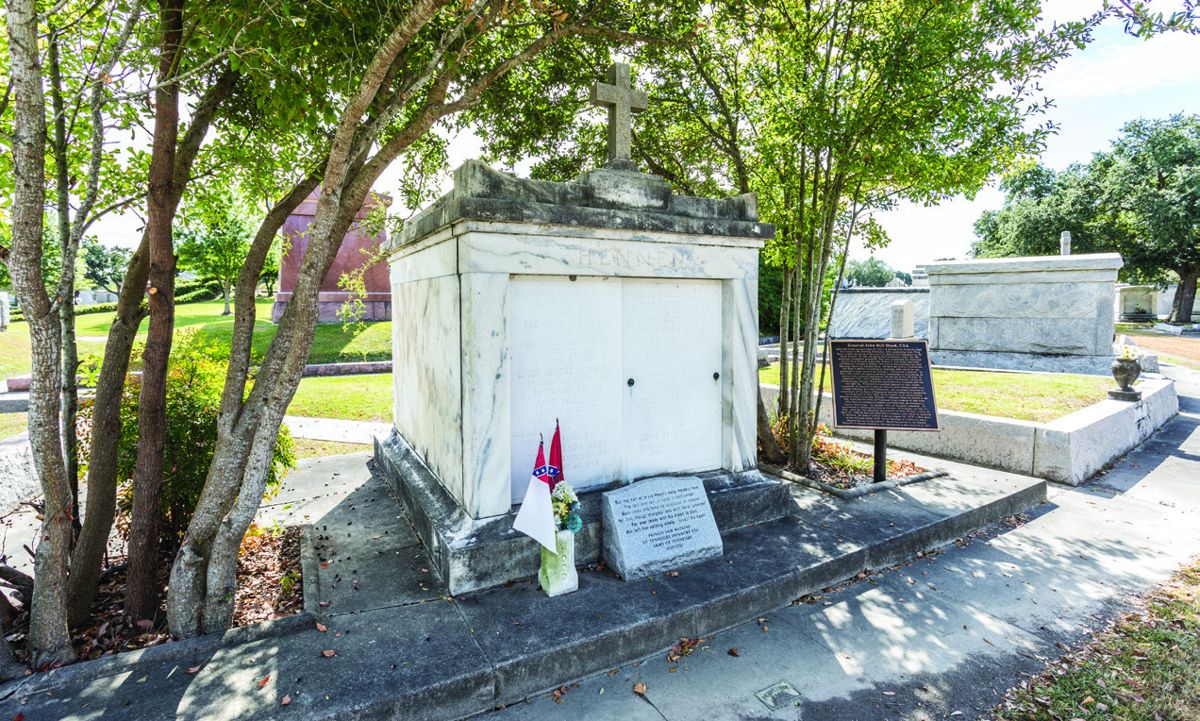
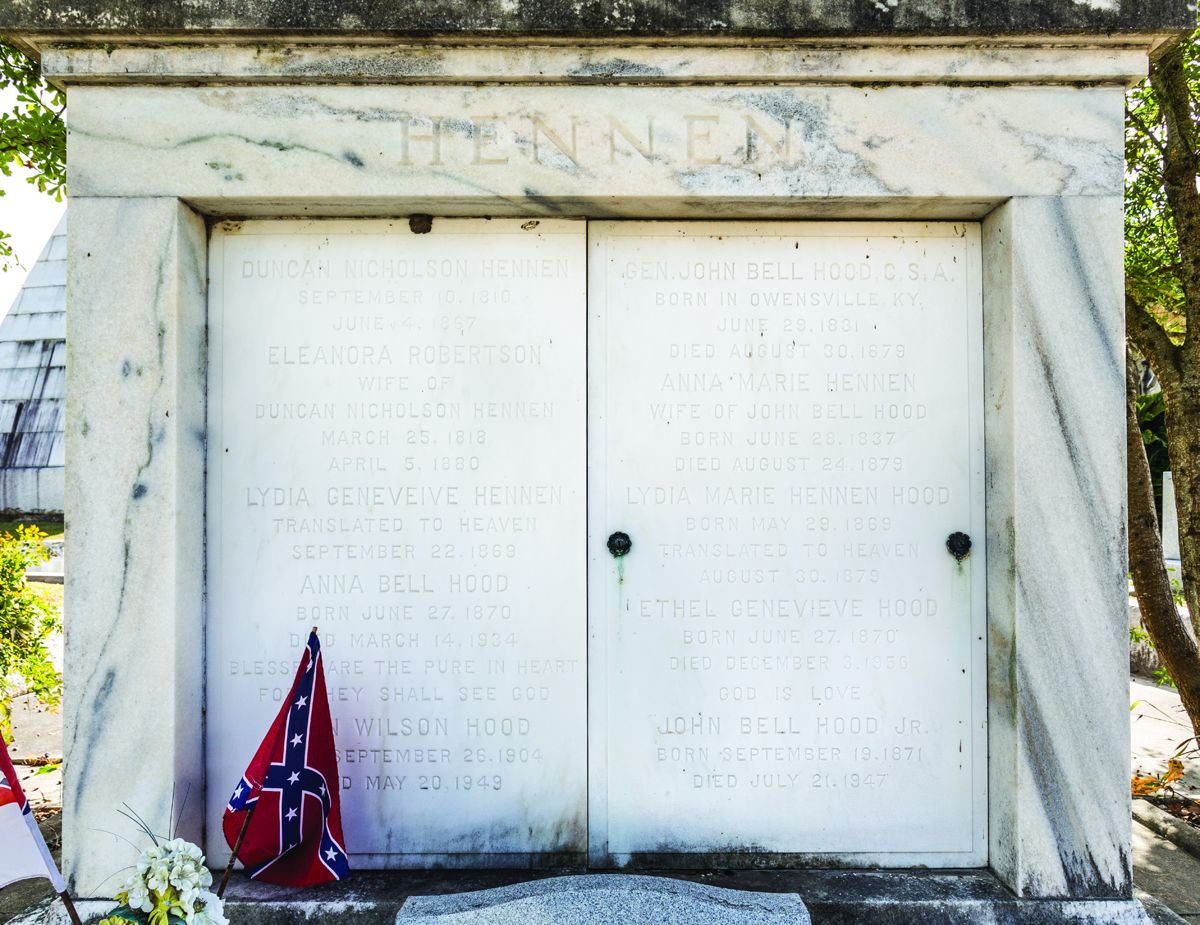
Gen. John B. Hood. (Library of Congress) In 1867 another, much slighter epidemic struck New Orleans, which by that time had become home to ex-Confederate general John Bell Hood. And not only to Hood, but to a whole slew of other former high-ranking Confederates. G. T. Beauregard arrived a month after the war. Simon B. Buckner joined the staff of the New Orleans Crescent in October 1865 and later became a commission merchant. Joseph Wheeler, who had commanded Hood’s cavalry at Atlanta, managed a hardware and carriage business. James Longstreet became a cotton factor; Braxton Bragg arrived in early 1867 and also found work. Randall Gibson, who had led a brigade in Hood’s army, arrived in the city to practice law. New Orleans had been prewar home to Richard Taylor and Harry Hays; they both came back as well. There were many ex-Confederates living in New Orleans, all struggling to make a living. At first Hood found work in Texas land speculation, then turned to buying and selling cotton. In 1869 he turned to insurance, a calling which allowed him a comfortable income throughout most of the 1870s. In April 1868, Hood married Anna Marie Hennen, the well-educated daughter of a prominent Louisiana family. The couple moved into a nice home in New Orleans’ fashionable Garden District and started a family. Did they ever. After their first child, Lydia, born in May 1879, ten more came in just a decade. As their family grew in size, the number of the Hoods’ children became the talk of New Orleans. After the birth of the third set of twins in October 1876, a resident of the city wrote the former general, expressing his appreciation of “your most laudable and successful endeavors to increase the population, and thereby indirectly to add to the general prosperity of the State.”1 The last of “Hood’s brigade”—as some dubbed the familial brood—as born in April 1879, Anna Gertrude. A few months later fever struck New Orleans. The Hoods determined not to leave the city—a fateful decision. On August 22 Hood’s wife fell ill and died two days later. A grieving Bell (as he signed his loving letters to Anna) remarked that he expected to “be taken and go down.”2 He was right. On August 25 Hood began to show symptoms. On Friday, the 28th, he told his physician, Dr. Samuel Bemiss, “Doctor, if you cannot overcome the enemy, do not try any experiments.” Later that day there seemed to be some improvement in his condition. “Doctor,” he told Bemiss, “I believe that we have routed the enemy.”3 In this, however, Hood was wrong. Shortly after his eldest daughter Lydia died of the fever at noon of the 29th, Hood became delirious. Like Jackson and others, his mind returned to the years of war. “I want those stores taken from my own commissary,” he once called out.4 He regained lucidity enough to explain his hope that veterans of the Hood’s Texas Brigade Association might see to the care of the ten surviving children. Then he slipped back into unconsciousness. The New Orleans Picayune claimed that in his last hours the dying soldier was “giving orders to his columns engaged in the battle flame and smoke.”5 At 3:30 in the morning of August 30 Hood died. He was 48. Today a visit to New Orleans’ Metairie Cemetery leads one to the Hennen family mausoleum, at which one reads the simple inscription (which, by the way, misspells Hood’s birthplace of Owingsville, Kentucky): GEN. JOHN BELL HOOD, C.S.A. BORN IN OWENSVILLE, KY. JUNE 29, 1831 DIED AUGUST 30, 18796 The general is buried there with his wife Anna, daughter Lydia, and three of the ten Hood “orphans” who were taken in by foster parents after the parents’ deaths: Ethel Genevieve (1870-1956), John Bell Jr. (1871-1947) and Annabel (1870-1931). In recent years memorializers have placed a plaque there, dedicated on August 30, 2003. Its text, written by Stephen M. (“Sam”) Hood of Huntington W.Va., reads: (Jack Melton)
General John Bell Hood, C.S.A. John Bell Hood was born June 29, 1831, in Owingsville, Kentucky, and was reared in Mt. Sterling, Kentucky. After graduating from West Point in 1853, he served in the elite U.S. 2nd Cavalry Regiment on the Texas frontier. In 1861, he joined the Confederate Army. He was promoted to brigadier general in 1862 and commanded the renowned Hood’s Texas Brigade under Gen. Robert E. Lee at the important Confederate victories at Gaines’ Mill (Seven Days Battles) and 2nd Manassas (Battle of 2nd Bull Run). He held the critical Confederate left flank at Miller’s Cornfield at Antietam, after which he was promoted to major general by Thomas J. “(“Stonewall”) Jackson. In July 1863, while serving as a division commander at Gettysburg, he was severely wounded and forever lost the use of his left arm. In September 1863, while leading a decisive Confederate victory at Chickamauga, Georgia, Hood was again severely wounded and lost his right leg. Promoted to lieutenant general by Gen. James Longstreet, he returned to duty in 1864 in North Georgia under Gen. Joseph Johnston, as corps commander. He succeeded Johnston as commander of the Army of Tennessee and was temporarily promoted to full general in July 1864. In November, in an unsuccessful attempt to draw Union Gen. William T. Sherman from his March to the Sea, Hood led the Army of Tennessee in an invasion of that state. After decisive defeats at Franklin and Nashville, he retreated to Tupelo, Mississippi. In January 1865, he resigned command. He surrendered to Union authorities at Natchez, Mississippi, on May 31, 1865. After the war, Hood set up residence in New Orleans, where on April 30, 1868, he married Anna Marie Hennen, with whom he fathered 11 children. He died of yellow fever on August 30, 1879, within days of his wife and eldest child. Seven families in 5 different states adopted the surviving orphans. Hood was buried in the Garden District’s Lafayette Cemetery, but was moved to this location in 1927.7
A small granite stone, also of recent dedication, sits in front of the mausoleum, thus inscribed:
But the half of brave Hood’s body molders here The rest was lost in honor’s bold career. Both limbs and fame he scattered all around. Yet still, though mangled, was with honor crowned. For ever ready with his blood to part, War left him nothing whole—except his heart.
PRIVATE SAM WATKINS 1ST TENNESSEE INFANTRY CSA ARMY OF TENNESSEE 1839-1901
Endnotes: 1. Stephen M. Hood, ed., The Lost Papers of Confederate General John Bell Hood (El Dorado Hills CA, 2015), 210. 2. John P. Dyer, The Gallant Hood (Indianapolis, 1950), 315 (“Hood’s brigade”); Richard M. McMurry, John Bell Hood and the War for Southern Independence (Lexington KY, 1982), 202 (“taken and go down”). 3. “Death of Gen. J. B. Hood,” New Orleans Picayune, Aug. 31, 1879. 4. Dyer, Gallant Hood, 318. 5. “Death of Gen. J. B. Hood.” 6. Richard Owen, & James Owen, Generals at Rest: the Grave Sites of the 425 Official Confederate Generals (Shippensburg PA, 1997), 96. 7. Brian Craig Miller, John Bell Hood and the Fight for Civil War Memory (Knoxville, TN, 2010), 282-83.