
The Deadly Stone Wall: The 116th Pennsylvania At Fredericksburg
By Robert Durham · Originally published December 2016 · pp. 22–24
In the spring of 1862, President Abraham Lincoln issued a call to the governors of the loyal states to provide troops, in addition to the regiments already raised in 1861. One of the new regiments raised was the 116th Pennsylvania Infantry Regiment. Recruiting for the regiment began on June 11. Dennis Heenan was appointed Colonel and St. Clair Augustin Mulholland Lieutenant Colonel.
Bvt. Maj. Gen. St. Clair Augustin Mulholland. (Library of Congress)
Union General Thomas Francis Meagher. (Library of Congress) The Second Battle of Bull Run was fought in August, with disastrous results for the Union. Therefore, on September 1, the regiment, though numbering only about seven hundred barely trained recruits, was ordered to Washington, D.C. They were eventually ordered to Harper’s Ferry. While there, they were presented with state and national colors. The regiment was then assigned to the already famous Irish Brigade under Brigadier General Thomas Francis Meagher.1 The men of the 116th were now part of Brigadier General Winfield Scott Hancock’s Second Division, Major General Darius N. Couch’s Second Corps. The Irish Brigade consisted of the 63rd, 69th and 88th New York; the 29th Massachusetts and, now, the 116th Pennsylvania. Only the three New York regiments were predominantly Irish. The 116th proudly referred to themselves as “Americans” (actually, the recruits were mainly German and Irish). However, they got along splendidly with the men of the New York Irish regiments and were proud to be part of the legendary Irish Brigade.2 The men of the 116th first saw the elephant on the 16th of October when the Irish Brigade captured Charlestown, the site of John Brown’s trial and hanging. Their behavior, under the personal observation of General Meagher, impressed him greatly. When asked later how the 116th reacted, Meagher replied, “Nobly, worthy of being a part of the Irish Brigade.” A few days after returning to Bolivar Heights, they received a new Pennsylvania state flag. They never flew a green flag of Erin such as the New York regiments carried.3 On October 26, the troops at Bolivar Heights (at Harper’s Ferry) started a march into the Shenandoah Valley, in a chase after the Confederates of General Thomas Jonathan (Stonewall) Jackson. On November 2, they ran into the Rebels at Snicker’s Gap. The 116th was sent out as skirmishers, their first time to be assigned this duty. Private William McCarter thought it “the most unpleasant, most dangerous and most trying of all army duties. Men were shot down while out skirmishing from every imaginable, hidden, covered position.” Here, McCarter saw his first friend wounded, in the foot. He also saw his first enemy soldier killed, a Rebel skirmisher shot out of a tree. In the evening, the Union skirmishers were ordered in; the next morning they woke to find that the Rebs “dusted” during the night.4
The Irish Brigade then marched to Warrenton, Virginia. As they marched, they were assaulted by the “secession ladies” of the town, who poured upon them “oaths, hisses” and more substantial items in the way of “stones, brickbats, chunks of firewood, bottles, shoemaker hammers and pieces of coal.” Many members of the regiment suffered cuts and bruises. Colonel Heenan, commander of the 116th, was almost hit by a shoemaker hammer, which struck his horse, nearly putting out its eye. Private McCarter was hit on the back of his head by a lump of coal.5 On November 7, General George Brinton McClellan, the commander of the Army of the Potomac, was relieved, replaced by General Ambrose E. Burnside. The men of the Irish Brigade grieved to see McClellan go. On the 11th, the brigade was given orders to march to a road that McClellan was going to travel down upon his departure from the Army and lined both sides so as to give him a proper send-off. The Irish Brigade formed near the center of the route. As Little Mac, with several members of his staff, rode down the road, he was greeted with cheers from the men and salutes from the artillery.6 General Burnside formed the six corps of the army into three grand divisions, under Major Generals Edwin Vose Sumner, William B. Franklin and Joseph Hooker. The Irish Brigade served in Sumner’s Right Grand Division. Shortly before the Battle of Fredericksburg, the 29th Massachusetts was replaced with the 28th Massachusetts. The 28th was another Irish regiment and also carried a green flag. Interestingly, just before the battle, the three New York regiments (the 63rd, 69th and 88th regiments) had sent their green flags to New York City to be replaced, and the new flags had not arrived yet. Therefore, and ironically, the only regiment of the Irish Brigade to carry the distinctive green flag of Erin during the battle was the 28th Massachusetts.7 On November 17, Sumner’s
Maj. Gen. Ambrose E. Burnside. (Library of Congress) Grand Division reached the Rappahannock River near Falmouth, above Fredericksburg. The 116th Pennsylvania was detailed to drive a herd of cattle from Warrenton to Fredericksburg, so they arrived later than everyone else. The Irish Brigade bivouacked in a nearby field. There was a short artillery duel, and the four Rebel guns across the river were quickly silenced. Sumner then ordered the Irish Brigade to cross the river and take Fredericksburg, which was almost undefended. The Brigade dropped everything (they had been resting and making coffee) and formed at the river. Sumner then remembered that he had been ordered by Burnside not to bring on an engagement, so he called off the fording of the Rappahannock. It would probably have been an easy matter to capture Fredericksburg at this time; instead, it would cost many casualties later.8 Burnside had requested pontoon trains be sent, but they did not arrive until 10 December. Before dawn the next morning, engineers began to build the bridges. Confederate soldiers of Brigadier General William Barksdale’s Mississippi Brigade were stationed in Fredericksburg and began targeting the engineers and the work crews. To get the bridges constructed, it was necessary to send troops from two Northern regiments in pontoon boats to row across the river and drive Barksdale’s Mississippians out of Fredericksburg. They did not succeed in driving the Confederates from the town; they had to be shelled out. The two pontoon bridges were finally laid.9 At 7 a.m. on the 12th, Sumner’s Grand Division left camp and marched to the jump-off point. They filed down to the pontoon bridges and began to cross, reaching the Fredericksburg side of the river by 9 a.m. Their crossing was not without incident. Rebel artillery had the range perfectly and fired shells at them. In descending the hill before crossing on the pontoons, three men of the 116th Pennsylvania were wounded. When they crossed the river on the pontoons, a little drummer boy fell into the river and drowned. When the brigade reached the other side, they were ordered to stack arms and await further orders, standing all day in ankle-deep mud. To make matters even worse, General Couch ordered them not to build any fires after nightfall. General Meagher disobeyed the order and let his troops light fires to make themselves as comfortable as possible. They spent a rough, mostly sleepless night, laying down “in the mud and frost.” The small fires attracted enemy artillery fire. The first shell flew over the heads of the men from the Irish Brigade and fell 100 yards in their rear. One man in the rear was wounded, and a commissary wagon was destroyed. Another shell fell in the midst of the brigade, killing two men, wounding three others and killing a Confederate captive held nearby.10 When the brigade marched through Fredericksburg, they saw many dead and wounded Confederate soldiers from Barksdale’s Mississippi Brigade. There was also a lot of looting of houses. General Meagher, in his official report, provides the following description of the brigade’s introduction to the bloody field of Fredericksburg. “On the morning of Saturday, the 13th instant, we were ordered under arms. The order was delivered to me at 8 a.m. Having formed the brigade, I addressed to every regiment separately a few words, reminding them of their duty, and exhorting them to do it bravely and nobly. Immediately after, the column moved up the street, headed by Col. Robert Nugent and his veteran regiment [the 69th New York], being exposed during the march to a continuous fire of shot and shell, several men falling from the effects of each. Even while I was addressing the Sixty-ninth, which was on the right of the brigade, three men of the Sixty-third were knocked over, and before I had spoken the last word of encouragement the mangled remains – mere masses of blood and rags – were borne along the line.”11 General Sumner’s objective on this Saturday was the heights beyond the town, Marye’s Hill. Confederate General Robert Edward Lee and Lieutenant General James Longstreet had made this site nearly impregnable. At the foot of the hill was a sunken road with a stone retaining wall about breast high on the downhill side. This natural fortification was manned by Brigadier General Thomas R. R. Cobb’s Georgia Brigade, along with Brigadier General Robert Ransom’s 24th North Carolina Regiment. The remainder of Ransom’s Brigade served as support behind the hill, out of sight. The men behind the stone wall were later reinforced by Brigadier General Joseph B. Kershaw’s Brigade, with men being stacked behind the wall four deep. Confederate artillery manned redoubts dug into Marye’s Hill. The Washington Artillery Battalion and Lieutenant Colonel E. Porter Alexander’s Artillery Battalion were able to sweep the expanse of land between the stone wall and the town.12 Brigadier General William H. French’s Third Federal Division led the attack, with the brigades in the following order: Brigadier General Nathan Kimball’s First Brigade, Colonel John W. Andrews’ Third Brigade, then Colonel Oliver H.
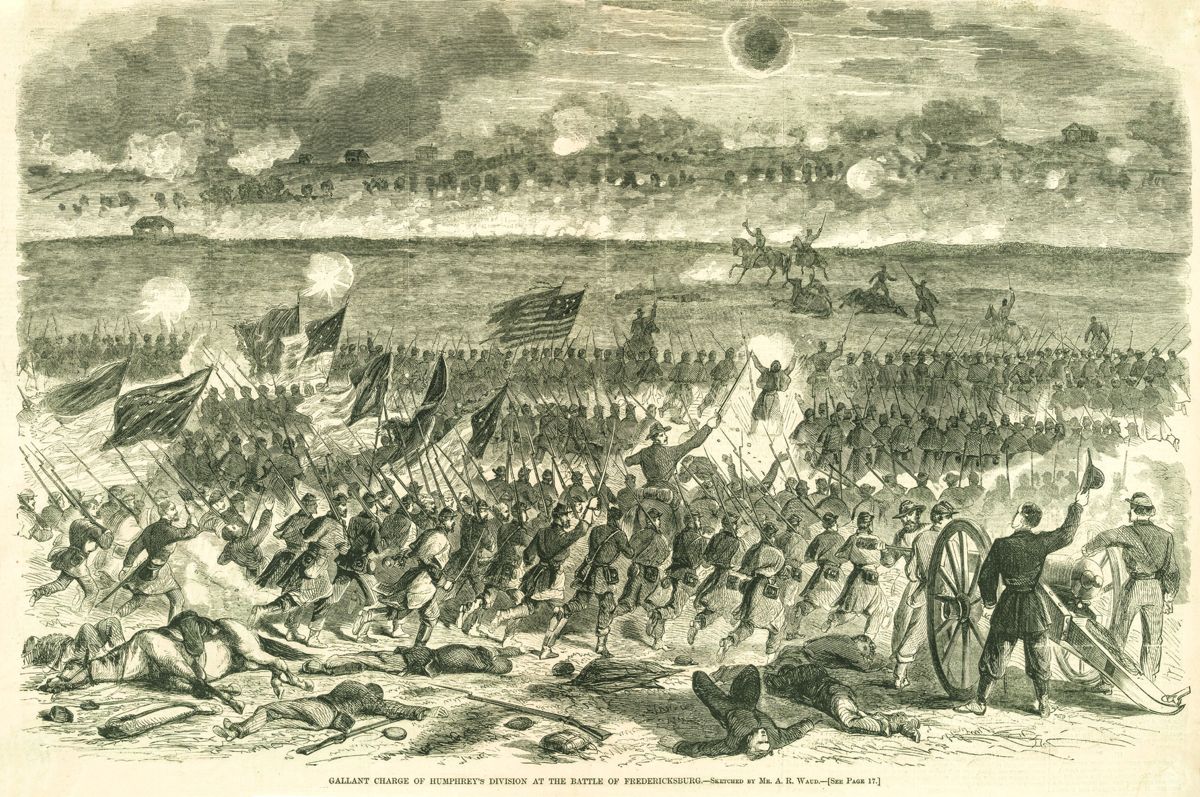
Palmer’s Second Brigade. None of the brigades reached the stone wall. They were followed by Hancock’s First Division, in the order: Colonel Samuel K. Zook’s Third Brigade, Meagher’s Second Brigade (the Irish Brigade) and Brigadier General John C. Caldwell’s First Brigade.13 About 9 a.m., the Irish Brigade received the order to fall in. Until noon, they stood in ranks in one of the streets, under Rebel artillery fire for the whole three hours. In the words of St. Clair Mulholland, “Shells were screaming overhead and frequently striking among the houses of the city, scattering the bricks and stones and wounding many.” The wounded from the troops of French’s Division were coming by in large numbers; A German soldier was wheeled past in a wheelbarrow, with his legs dangling over the side. One foot had been shot off, and blood streamed from the stump, but he calmly smoked his pipe as he was trundled by. The sight was too much for one member of the 116th, who fainted. He came to later and discovered that the regiment had gone on without him; he hurried to catch up with his company.14 General Meagher cut a sprig of boxwood from a garden and placed it in his cap. His men of the Irish Brigade, seeing this, followed suit, adding a bit of Irish green to their uniforms. Finally, the orders almost received as a relief; the brigade was ordered out Hanover Street. A sergeant had his head torn off by a shell. The headless soldier did not fall, but dropped onto his knees with his musket held in both hands, resting on the ground, providing a grisly sight to those around him. Private McCarter saw a captain being carried past on a window shutter. A cannon ball had almost torn his leg from his body at the knee, and it swung back and forth as they carried him, causing extreme pain. One of the men of the 116th ran out with a pen-knife and cut the sinew holding the leg to the body. The captain felt an instant relief. Shells were still dropping; one knocked down a chimney, behind which some of the men were sheltering. The chimney dropped to the ground and exploded, wounding Colonel Heenan severely in the hand, taking off the head of a sergeant, and wounding or killing seven others. Private McCarter was one of those men, wounded in the calf. He still continued with his regiment. The brigade, still marching in a column of fours, finally reached the canal behind the town to find the bridge on which they were to cross had been shot away, only the stringers remaining. Some of the men waded the canal and others crossed on the few planks that were still attached. A lieutenant of Company I was hit by a shell as he attempted to cross the bridge and fell into the canal, mortally wounded.15 Lieutenant Mulholland tried to calm the men. “Steady, men, steady. You’ll soon get forward.”16 After the canal was crossed, a rise of ground shielded the brigade from the enemy, and Meagher was able to form the men into columns for the charge against the stone wall. The brigade was formed with the 69th New York on the right, the 88th New York next, with the 38th Massachusetts, with its green flag in the center. Next in line was the 63rd New York, then the 116th Pennsylvania on the left. Just before leaving this questionable shelter, a shell struck a young lieutenant in the leg, tearing most of the flesh away. Meagher ordered the 69th New York to send two companies to the right as skirmishers. Then, the command was given to advance up the slope, the grass made slippery with blood, and the bodies of the dead and wounded making it difficult to hold formation.17 McCarter said that “From the time that the Irish Brigade was drawn up in line on the streets of the town before advancing on the Rebel works, and before even seeing a Rebel soldier, its loss was reported to be 17 men killed and 26 wounded.” The men of the Irish Brigade were now given the order to “Fix Bayonets.” McCarter said that “one poor fellow at my side, who was afterwards
Cobb’s and Kershaw’s troops behind the stone wall by A. C. Redwood 1886. (Library of Congress) killed, remarked in his good-natured, broad Irish dialect as he placed his bayonet on the muzzle of his musket, ‘Damn them. That’s the ‘thing’ to fetch the sons of bitches’.”18 The men now found themselves in range of the rifles behind the stone wall. Mulholland described the advance: “The men marched into an arc of fire…Officers and men fell in rapid succession.” A lieutenant in command of Company C was downed with a minié ball through his thigh. The major of the regiment fell, and a ball passed through one of the lieutenant’s lungs. Another lieutenant received a ball through his brain. The orderly sergeant of Company H wheeled around with a hole in the middle of his forehead. The captain of Company K received a minié ball through the lungs, the ball passing entirely through his body. A ball cut the leather brim of McCarter’s kepi, leaving it dangling by his ear. In the midst of all this mayhem, the 63rd New York exchanged places in line with the men of the 116th. This act protected the 116th’s left flank from the artillery enfilading fire it had been receiving. Both regiments still had to reach the stone wall.19 The attack was hopeless but still they pressed on. They finally reached to within thirty yards of the stone wall and began firing back. Until this moment, they had been getting the worst the Southerners had to offer and now was finally the time to retaliate. The fire coming from Cobb’s and Kershaw’s men behind the wall was terrible. McCarter was hit in the left shoulder by a spent ball and was hit in the ankle by another minié ball. One of the lieutenants was shot through the shoulder and leg. In fact, the 116th lost nearly all its officers. “Every third man had fallen and, along some parts of the line, every second soldier had been killed or wounded.” McCarter then received a serious wound. Let him describe his wounding, “My own turn came next… I had discharged six or seven shots … into the ranks of Cobb’s brigade… I was getting ready to fire again, had taken the cartridge out of my cartridge box, bitten the end off it, inserted it into the muzzle of my musket, drew the ramrod, … and had just raised my right arm over my head to send the cartridge home … when a bullet struck me in the uplifted arm… I fell down flat on my face on the ground.” Bullets were falling all around him. One of his comrades was hit and fell in front of him. “Owing to the position of his body, it stopped many a ball that otherwise certainly would have entered my own.”20 “The color sergeant, William H. Tyrrell, was down on one knee (the other leg being shattered), but still waving the flag on the crest. Five balls struck him in succession; a dozen pierced the colors; another broke the flag-staff, and the colors and the color-sergeant fell together.” Lieutenant Francis T. Quinlan ran back to save the colors. “A hundred fired at him, but quickly seizing the broken flagstaff, he threw himself on the ground and, with the flag tightly clasped to his breast, rolled back to where the command had halted.” To advance further would have meant a senseless loss of life; therefore, the regiment was ordered to retreat, leaving their dead and most of their wounded behind.21 McCarter was one of those left on the battlefield. One of his lieutenants came to him to see how he was. “Before I had time to reply … he seized my loaded musket by my side, … saying, ‘Bill, I see the bastard that laid you there. I’ll fetch him.’” He took aim at someone behind the stone wall, but before he could fire, a ball struck him in the forehead. Left alone on the battlefield, McCarter took his blanket roll from his left shoulder and used it as sort of a shield in front of his face while he walked down the hill.22 The battle wasn’t over yet; Hancock next sent Caldwell’s brigade in, a forlorn hope. More men would die before the day was over, but for all practical purposes, the fight was over for the 116th Pennsylvania on Marye’s Hill. The Union army had no chance of taking that deadly stone wall. Ironically, the next day, the New York regiments of the Irish Brigade received their green flags from home.23 Endnotes: 1. Mulholland, The Story of the 116th Regiment, pp. 24, 31, 33. 2. Ibid. p. 34. 3. Ibid. pp. 36-38., O’Brien, My Life in the Irish Brigade, note p. 32, p. 50. 4. O’Brien, pp. 57-63. 5. O’Brien, pp. 64-65. 6. Ibid., pp. 63, 67-68. Mulholland, “The Battle of Fredericksburg,” p. 190. 7. Mulholland, “The Battle of Fredericksburg,” pp. 189-191. Battles and Leaders, p. 143. Meagher, OR, pp. 241-242. 8. Mulholland, “The Battle of Fredericksburg,” pp. 191-192. Mulholland, The Story of the 116th Regiment, p. 47. 9. Mulholland, The Story of the 116th Regiment, pp. 50-53. Battles and Leaders p. 146.O’Brien p. 76. 10. Meagher, OR, p. 240. O’Brien, pp. 152-153, 156. 11. Meagher, OR, p. 241. 12. Owen, In Camp and Battle, p. 179. 13. Couch, “Sumner’s ‘Right Grand Division’,” pp. 111–112. 14. Mulholland, The Story of the 116th Regiment, p. 60. 15. Ibid. p. 61-64. O’Brien, p. 171-173. 16. O’Brien, p. 171. 17. Ibid., p. 62. Meagher, OR, pp. 241242. 18. O’Brien, p. 174-175. 19. Condon, OR. 20. O’Brien, pp. 179-180. 21. Ibid. Mulholland, The Story of the 116th Regiment, p. 66. 22. O’Brien, pp, 181-183. 23. Mulholland, The Story of the 116th Regiment, p. 66.
Annals of the War, Written by Leading Participants, North and South, 1996. Battles and Leaders of the Civil War, Volume III: The Tide Shifts. Alexander, Edward Porter, Fighting for the Confederacy: The Personal Recollections of General Edward Porter Alexander, 1989. Alexander, Edward Porter, “Official Report,” Official Records.
![Stone wall at foot of Marye’s Heights, Fredericksburg, Va. at the front carried by 6th Maine Infantry, May 3, 1863. Photographed twenty minutes after storming party had [...] up the hill by Andrew J. Russell.](/article-images/cwn-2016-december/cwn-2016-december-the-deadly-stone-wall-the-116th-pennsylv-03.jpg)
•
• • • •
•
• •
•
Bentley, Richard C., “Official Report,” Official Records. Byrnes, Richard, “Official Report,” Official Records. Cabell, Henry Coalter, “Official Report,” Official Records. Condon, Patrick J., “Official Report,” Official Records. Conyngham, David Power, The Irish Brigade and Its Campaigns, 1994. Couch, Darius N., “Sumner’s ‘Right Grand Division.’” Battles and Leaders. Cozzens, Peter and Robert I. Girardi, Editors, The New Annals of the Civil War, 2004. Dickert, D. Augustus, History of Kershaw’s Brigade, 1990. Freeman, Douglas Southall, Lee’s Lieutenants: A Study in Command, Cedar Mountain to Chancellorsville, Volume 2, 1971. Kelly, Patrick, “Official Report,” Official Records. Kershaw, Joseph B., “Official Report,” Official Records. Kershaw, Joseph B., Kershaw’s Brigade at Fredericksburg. Battles and Leaders. Longstreet, James, From Manassas to Appomattox: Memoirs of the Civil War in America, 1992. Longstreet, James, “Official Report,” Official Records. Longstreet, James, “The Battle of Fredericksburg,” Battles and Leaders. McLaws, Lafayette, “Official Report,” Official Records. McLaws, Lafayette., “The Confederate Left at Fredericksburg,” Battles and Leaders. McMillan, Robert, “Official Report,” Official Records. Meagher, Thomas F., “Official Report,” Official Records. Mulholland, St. Clair Augustin, “The Battle of Fredericksburg,” The New Annals of the Civil War. Mulholland, St. Clair Augustin, The Story of the 116th Regiment Pennsylvania Infantry: War of Secession, 1862-1865, 1899. O’Brien, Kevin E., Editor, My Life in the Irish Brigade: The Civil War Memoirs of Private William McCarter, 116th Pennsylvania Infantry, 2003. Owen, William Miller, “A Hot Day on Marye’s Heights,” Battles and Leaders. Owen, William Miller, In Camp and Battle with the Washington Artillery of New Orleans, 1999. Palfrey, Francis Winthrop, The Antietam and Fredericksburg, 1992. Rowe, D. Watson, “On the Field of Fredericksburg,” Annals of the War. Saunders, James, “Official Report,” Official Records. Sorrel, G. Moxley, Recollections of a Confederate Staff Officer. 1994. Swinton, William. Army of the Potomac, 1995. Teed, John, “Official Report,” Official Records. Tenney, W. J., Military and Naval History of the Rebellion in the United States, 2003. U.S. War Department, The War of the Rebellion: A Compilation of the Official Records of the Union and Confederate Armies, Volume 21, 1887. Walker, Francis A., History of the Second Army Corps in the Army of the Potomac, 1887. Walton, J. B., “Official Report,” Official Records.