
Through The Lens
Popping The Cork
By Stephanie Hagiwara · Originally published December 2016 · p. 5
“It was as deliberate an act of self-sacrifice and valor as was ever performed in our country or any other,” U.S. Lt. Walter Thorn’s superior officer In May of 1864, U.S. Gen. Benjamin Butler was sent to the Virginia Peninsula to cut the Confederate supply line to Richmond and Petersburg. Butler and his 33,000 troops end up hunkering down at Bermuda Hundred, Va. on the North side of the James River. About two miles away, Confederate Gen. P. G. T. Beauregard’s troops blocked Butler’s forward momentum with the earthworks known as the Howlett Line, command by Gen. George Pickett of the Battle of Gettysburg fame. The Line was anchored by Battery Dantzler. Dantzler mounted two 20-pounder Parrott guns, two 7-inch Brooke rifles, two 8-inch smoothbore Columbiads, and two 10-inch coastal mortars. Union gunboats and batteries would duel with Dantzler daily. Gen. U. S. Grant had a conversation with his Chief Engineer John Barnard regarding the situation: “He said that the general occupied a place between the James and Appomattox rivers which was of great strength, and where with an inferior force he could hold it for an indefinite length of time against a superior; but that he could do nothing offensively. I then asked him why Butler could not move out from his lines… He replied that it was impracticable, because the enemy had substantially the same line across the neck of land that General Butler had. … That the position was like a bottle and that Butler’s line of entrenchments across the neck represented the cork; that the enemy had built an equally strong line immediately in front of him across the neck; and it was therefore as if Butler was in a bottle. He was perfectly safe against an attack; but, as Barnard expressed it, the enemy had corked the bottle and with a small force could hold the cork in its place.” To pop the cork, Butler came up with a plan to build a canal on the winding James River at Dutch Gap. A canal between the two points would not only allow ships to avoid the Confederate batteries but would create a shortcut of approximately six miles. Working fast, the Topographical Corp surveyed the area on August 5th. On August 10th work began. On August 13th the Confederates attacked. The ironclads CSS Virginia II, CSS Richmond, CSS Fredericksburg along with three gunboats commenced firing at 20-minute intervals between 6 a.m. to 6 p.m. Confederate land forces shelled the canal workers and the Federal ships. Despite having spotters, Confederate commander John Mitchell reported that the bombardment did not impact work on the canal. Further, the Federals had the advantage of having the Confederate vessels’ smokestacks as a target. The smokestack of the Fredericksburg’s was hit by several shells. “[T]he enemy struck the Ship 3 times in 5-good work”, conceded the vessel’s commander, Thomas Rootes, “and if I had not moved her, she, in my opinion, would have been seriously injured.” Afterward, the Confederates “placed their mortars in sunken batteries … in front of the canal. Our return fire was so heavy that they fell into the error of concealing these batteries behind clumps of trees, and thus lost, what is really essential to success, a good view of the target from the battery itself. The result was that their range was faulty, and their shells fell chiefly from forty to one hundred yards to the eastward of the canal, where they literally ploughed up the ground. This error enabled our working parties to continue the excavation with comparatively little loss, but suffering greatly from the harassing nature of the fire”, wrote Gen. Abbot of the Corp of Engineers. Furthermore, Abbott believed that if the Confederates had multiplied their firing power, the canal couldn’t have been built. The canal had begun by workers using picks in hard soil to create both a breastwork and ditch. “The regiments employed on the work were the 116th and 169th New York volunteers, and the 4th, 6th, 10th, 36th, 38th, and 100th United States colored regiments.” Generally, out of the 700 troops assigned to the project, 300 were needed for picket-guard and other duties. The troops had to be rotated several times due to illness. For a time, Butler even had Confederate prisoners among the workers as retaliation for the use of colored prisoners to reinforce the enemy’s fortifications. The pace quickened as the cut became deeper as steam dredges and a railroad to take away the dirt were able to be used. On December 8th the middle bulkhead was blown out. Water flowed into the lower portion of the canal. Only 50 feet of the upper portion of the canal still need to be excavated. On December 30th, the digging was done. During construction, 7,000 shells have been thrown in and around the canal; 50 men have been killed there, and 200 wounded; 45 horses have been killed, three barges sunk, and nine tugs disabled. On January 1st, Butler and his staff came to watch the explosion that would release the James River into the entire length of the canal. Six tons of black powder had been placed to blow up the remaining bulkhead. Everyone except those
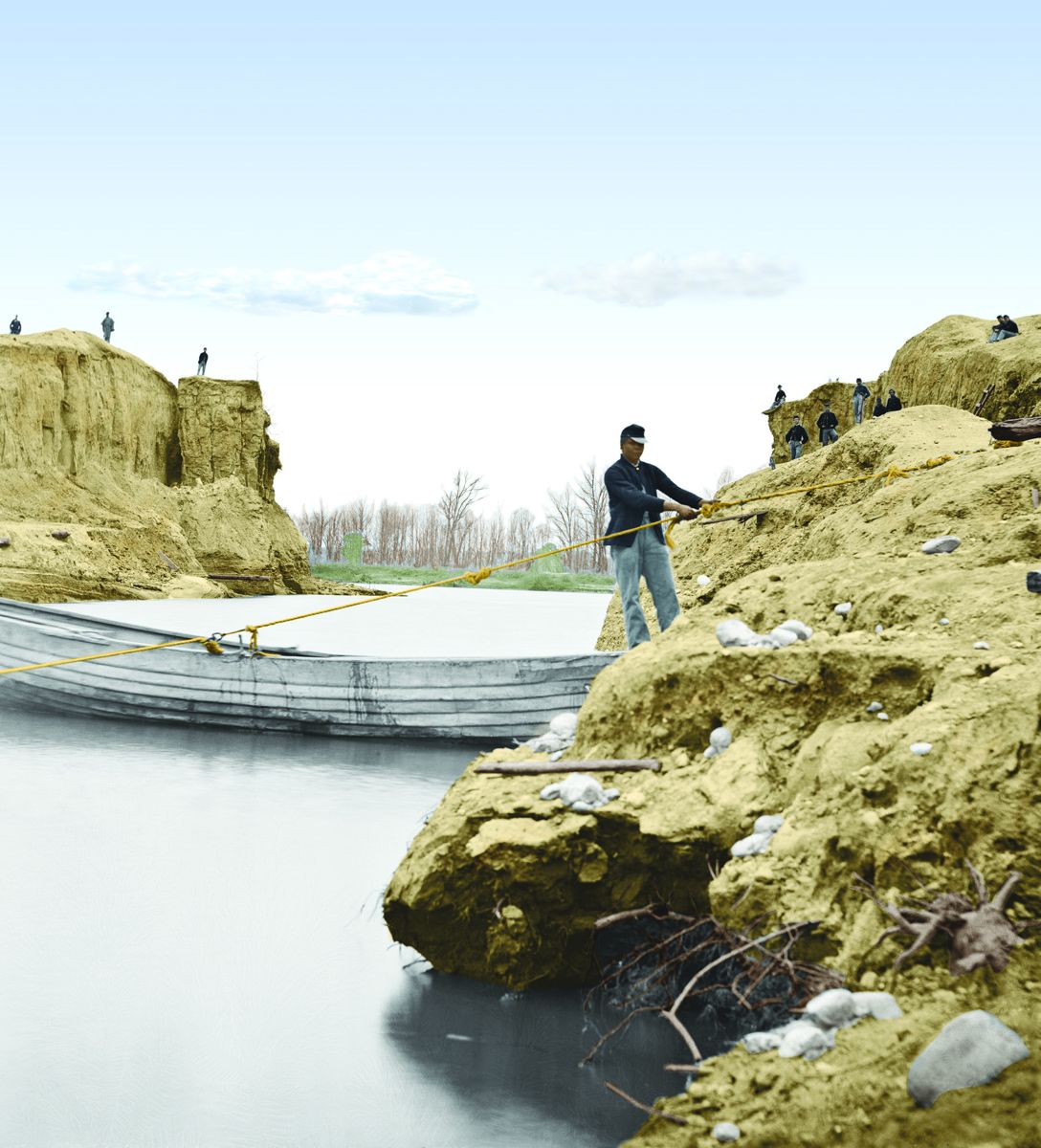
View of Completed Canal, Dutch Gap Canal, Virginia, April; Colorization © 2012 civilwarincolor.com courtesy civilwarincolor.com/cwn (Library of Congress) tasked with lighting the fuse had been removed. As the fuse burned, “a member of General Butler’s staff galloped up and shouted excitedly: ‘Has the guard opposite the bulkhead been withdrawn? Somebody answered, hardly articulately, rather with a sort of gasp: ‘No!’” Lt. Walter Thorn of the U.S. Colored Infantry hesitated before dashing “off in the direction of the bulkhead. Perceiving his intention, his fellow officers called to him to return … Paying no heed, he ran on, reached the bulkhead, climbed to its summit, faced the storm of bullets that the rebels directed at him, and stood there until he had ordered the picket guard to flee to a place of safety. He leaped from the top of the mine; the explosion took place; … but the young lieutenant was unharmed.” Thorn was awarded the Congressional Medal of Honor for this action. The blast flung the earth almost 100 feet into the air, landing where it continued to block the James River into entering the canal. Even worse, with the bulkhead gone, the Confederates could now see the entire length of the canal, giving them a better view of their targets! At this point, the project was abandoned. The troops were reassigned. Two weeks later, the rain swollen James River punched a ten foot opening into the canal, allowing its use for small vessels and presidential sightseeing. On April 5, 1865, President
Lincoln, after visiting the captured Confederate capital of Richmond, Va., returned to City Point, Va., via the James River. According to telegraph operator Capt. Samuel Beckwith, “… the President and party, including myself, boarded the Admiral’s [David Porter] barge which was in readiness with the eight well-armed sailors to convey us to City Point, towed by a tug, as Mr. Lincoln had specially requested. At the mouth of the Dutch Gap Canal, the tug cut loose and passed around the nine-mile bend, while the sailors shipped their oars and took us quickly through the canal.” The enormous scope of the work that was completed in just over four months can be seen in this image by looking at the size of the men on the horizon compared to the soldier in the foreground near the small boat. It wasn’t until after the war that the canal was properly completed. Today, the Dutch Gap Canal is the main shipping channel for the James River. Stephanie Hagiwara provides the trivia and photo info for the 2017 Civil War in Color War calendar. She also writes a weekly column for HistoryinFullColor.com that covers stories of photographs of historical interest from the 1850’s to the present. Her articles can be found on Facebook, Tumblr and Pinterest.
Sources: Deeds Of Valor: How America’s Civil War Heroes Won the
• • • • • • •
• • •
Congressional Medal Of Honor Edited by W. F. Beyer and O. F. Keydel Personal Memoirs of U. S. Grant by Ulysses S. Grant Biographical Memoir of Henry Larcom Abbot 1831–1927 by Charles Greely Abbot Capital Navy: The Men, Ships and Operations of the James River Squadron by John M. Coski Gardner’s Photographic Sketch Book of the Civil War by Alexander Gardner Harper’s Weekly, January 21, 1865 Pg. 38 New York Times, January 8, 1865 Lincoln in the telegraph office: recollections of the United States Military Telegraph Corps during the Civil War by David Homer Bates Chesterfield Heritage Alliance OR. Series I, Vol. 42, Part II hmdb.org