Mort Künstler’s Major Painting On Baseball
By Bill Bleyer · Originally published December 2016 · pp. 14–15
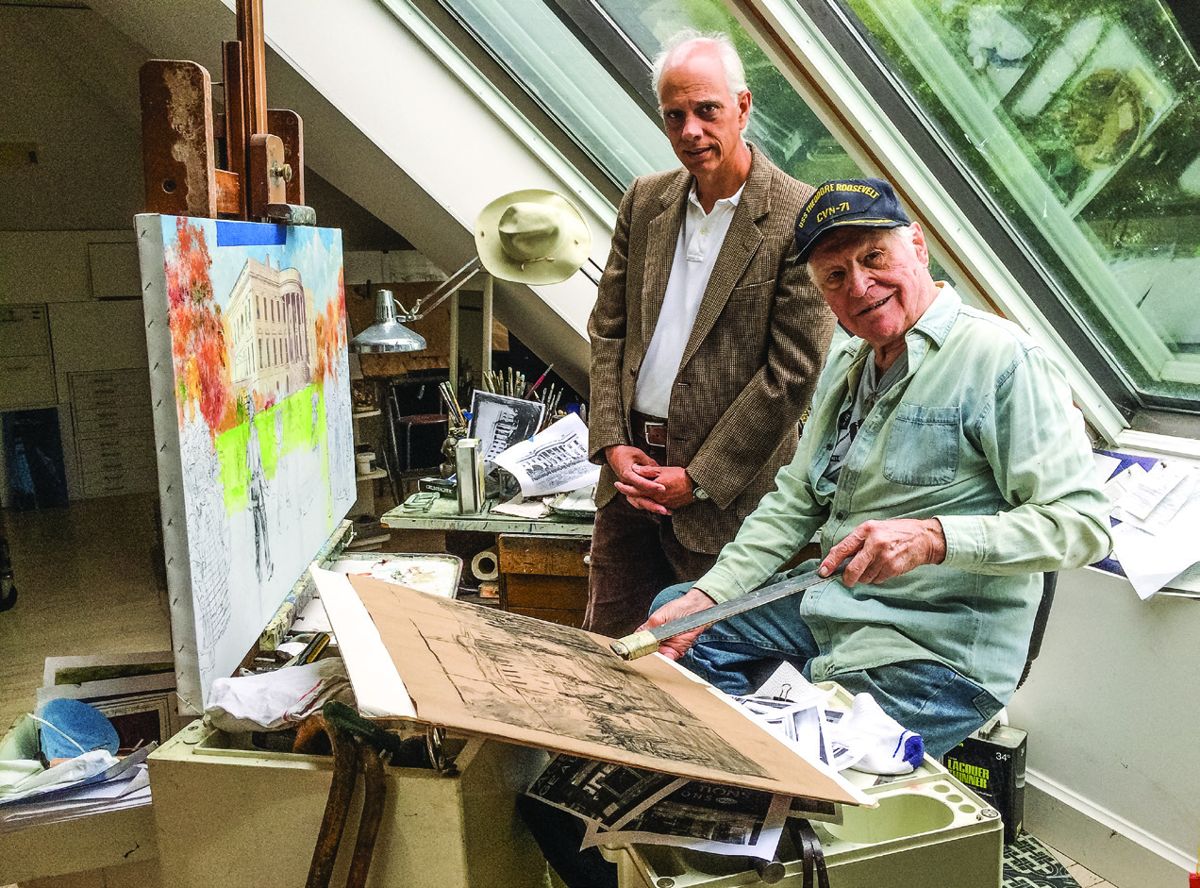
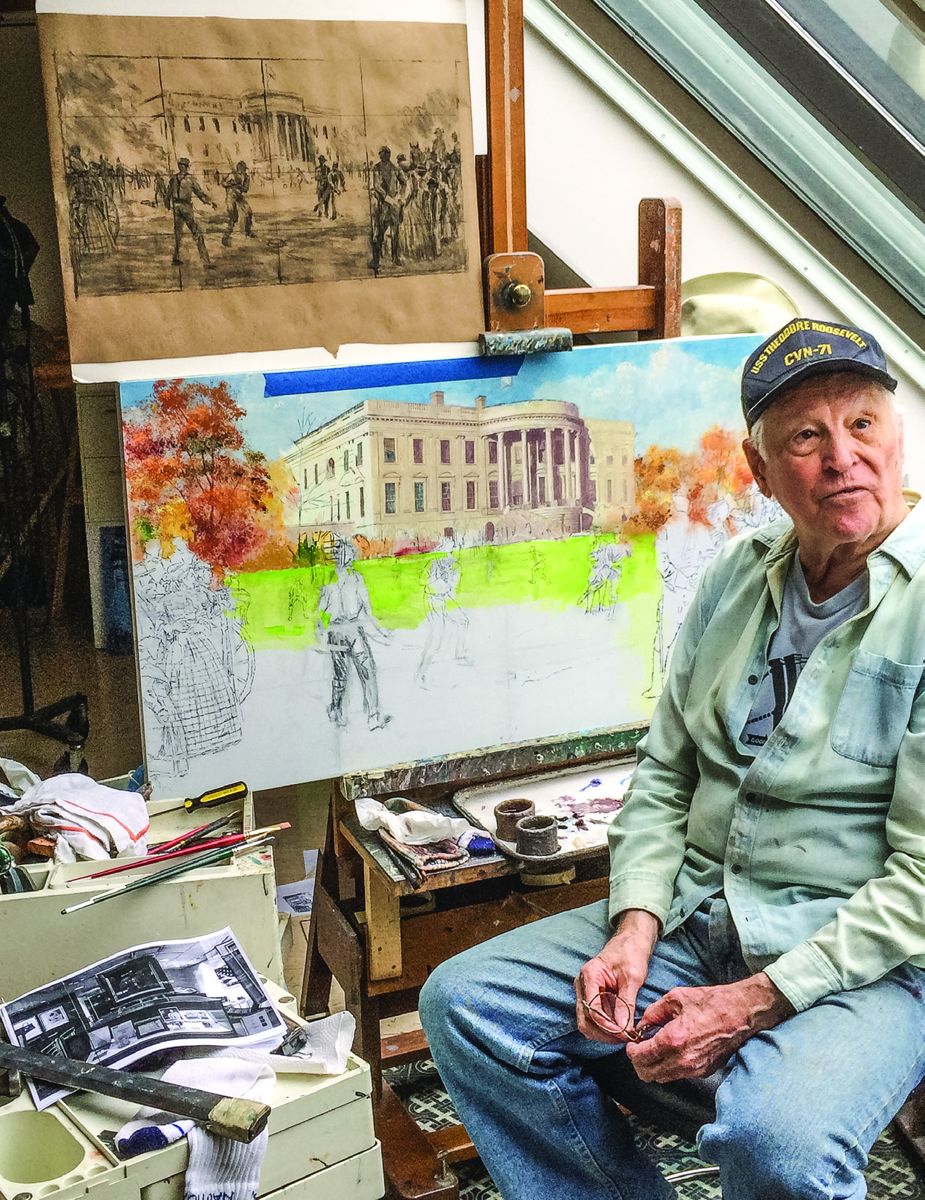
Mort Künstler’s family and friends questioned whether he would stick to his late 2014 decision to retire from painting major works. After all, while the famed historical artist may be 89, Künstler still exhibits the racing mind and hyper energy of his youth. So those who know him well predicted his semi-retirement, with him only doing more modest art projects, would not be sufficiently engaging. And now Künstler has validated those doubts – at least for one more large-scale oil painting. A collector from Muttontown, Long Island, proposed a subject that the artist from nearby Cove Neck found irresistible: a painting of baseball played during the Civil War. The image combined a scene of the war, images of which have made Künstler famed in historical and art circles, with sports, which has been a major interest since childhood. Künstler found the commission from Gary Pasquaretto too good to refuse. And he has almost completed the scene of Union soldiers playing baseball on the lawn of the White House. Since announcing his semiretirement after a six-decade career that made him one of America’s foremost painters of historical scenes, Künstler has kept up a schedule of personal appearances. He has also been working with an artists’ supply company to develop a line of paints and instructional videos. While he stopped doing large oils because he said it was taking longer and longer to paint them as he got older, the artist did go back to four early paintings he did about whaling for covers of men’s magazines in the 1950s and improved them. “That’s been keeping me very busy,” the artist said, “but Gary came along with an idea for the Civil War painting and said it would be my Mona Lisa. I said ‘Oh my, what a great opportunity!’ I just sort of lit up.” “I’m not surprised that he went back to painting because painting has always been his life and he loves it,” said Deborah Künstler, the artist’s wife of 66 years. Pasquaretto, who works in real estate management, said he owns a few original paintings, none historical in nature “Being able to work with Mort as it developed made it very exciting for me.” Both men declined to disclose the price of the commission, but larger Künstler original oils start at about $50,000. Pasquaretto said that his interest in baseball played in wartime is that they show “people still try to maintain a sense of normalcy in their lives” even in the worst of times.
The artist played in pickup baseball games growing up in Brooklyn. Künstler, who started drawing before age 3, said his uncle knew some Brooklyn Dodgers players. His uncle would take him to Ebbets Field and the budding artist painted members of the teams from 1940 to 1942, and the players signed the images. “I think that sports helped me throughout my whole life,” Künstler said. “It got me into schools that I couldn’t get into.” He attended UCLA on a basketball scholarship after starting at Brooklyn College for a season and then came back to New York because his father had a heart attack. “I couldn’t get into Pratt [Institute] at that point because I had poor high school grades.” But when the Brooklyn College basketball coach called his counterpart at Pratt, Künstler was admitted to study art. In college, he said, “I went from football in the fall to basketball in the winter and track in the spring.” He was a regional track star athlete in the hurdles and javelin while also a diver on the swim team. “I was the first four-letter man in Brooklyn College history” he recalled. Künstler “had aspirations” for a professional basketball career but abandoned the idea because he was prone to injury. “But I love baseball,” he continued. “I’m sorry I didn’t play it other than in pickup games.” He doesn’t root for any team, “but it’s sort of fun to see the New York teams win.” Künstler’s initial thinking was to set the painting in a Union prison camp with Confederate prisoners playing their Yankee guards. “At that time neither one of us had any idea that baseball was played on the White House lawn during the war,” Künstler said. But as he began the intensive research he always does before any painting, the artist discovered a book titled “Baseball in Blue and Gray” which described soldiers bivouacked in Washington playing the game at the White House. “I love to do paintings where there is a building that still exists and is recognizable in the background,” Künstler said. And while he has painted Abraham Lincoln inside the White House, he never depicted the exterior of the landmark structure in his previous 4,000 works. For the baseball painting, Künstler worked from the first known photograph of the White House taken in 1846. “Just to have baseball at the White House would’ve made a great picture,” he said. “But I’ve got an opportunity to have some civilians watching, which gives me an opportunity to paint pretty women in beautiful gowns and kids and add a lot of color to the scene. “The umpire will probably be an officer, and the baseball players will be soldiers with their coats off,” he related as he pointed to the unfinished canvas in his studio on the third floor of his home. “There will be civilians gathered around to watch. The rules were different then; no one really knows exactly. They may have pitched on a bounce. The books I researched said they used stakes 4 feet high originally in the 1830s as bases before they developed into real bases. I’m going to have folded up newspaper with a brick on it to keep it in place as the base. The pitcher is only 45 feet away from the batter, not 60 feet the way it is today. I’m going to have an upside-down plate for home plate because I believe that’s the way it was but no one really knows. Early indications are that the umpire would have been behind the pitcher rather than the catcher because they didn’t have any masks or protection.” Künstler started painting professionally in the early 1950s after he graduated from Pratt Institute. He started out doing book jackets for publishers and later covers for men’s adventure magazines. That led to an advertising career doing movie posters including “The Hindenburg,” “The Taking of Pelham 123” and “The Poseidon Adventure.” Then he started doing historical scenes for National Geographic and other magazines and in 1977 began doing paintings for sale by galleries. A 1982 a commission from CBSTV to do artwork for the miniseries “The Blue and The Gray” began his association with the Civil War. “The High Water Mark,” Künstler’s depiction of Pickett’s Charge, was unveiled at the Gettysburg National Military Park Museum in 1988 and led to his subsequent concentration on the war. But he also painted a 1992 United States postage stamp depicting the Buffalo Soldiers and several years ago did a series of Revolutionary War images. Künstler’s last large painting in 2014 was “LaGrange vs. LaGrange.” It depicted a militia unit made up entirely of women in LaGrange, Georgia, whose male relatives had gone off to fight for the Confederacy. They ended up confronting – without bloodshed – the 1st Wisconsin Cavalry, commanded in a strange coincidence by Col. Oscar LaGrange. Midway through the baseball painting, Künstler says his unretirement will probably be limited to this one artwork. “Frankly, I think this is going to take enough out of me that I won’t want to do another one,” he said. “There’s so much work involved. It’s getting to be like work. And that’s a scary thing for me because I’ve said I’ve made a very nice living but never worked a day in my life.”