The Watchdog
John Anderson Tobacco Emporium
By Craig L. Barry · Originally published December 2016 · p. 12
The John Anderson Tobacco Emporium of New York is an interesting story in and of itself, with both a famous clientele and a whiff of scandal in the form of the unsolved murder of a teen aged girl who worked at the tobacco shop in the late 1830s. Born in New York City in 1812, John Anderson first apprenticed as a wool-puller and later as a bricklayer. By his mid-twenties, he had saved enough capital to begin his own small tobacco business in Lower Manhattan. He opened his first shop at 319 Broadway, near Reade Street. The business, John Anderson & Company Tobacco Emporium continued to grow. His tobacco shop attracted some of New York City’s leading writers, journalists and politicians. At the time of the Mexican War in the late 1840s, the patronage of U.S. Commanding General Winfield Scott was to make Anderson’s fine-cut chewing tobacco “Solace” into a household name. Anderson was the first to introduce the practice of wrapping fine cut tobacco in foil. The foil wrapped tobacco was sold in a paper wrapper that fit easily into the pocket of a jacket. The largely male clientele of John Anderson & Company Tobacco Emporium were greeted by a statue of Sir Walter Raleigh as they entered the shop. More importantly, they were also met by an attractive young sales clerk. Mary Rogers was 17 when she began working at Anderson’s tobacco shop in 1838. Anderson hired her (allegedly) because her “dainty figure and pretty face” brought many admirers into the store. One customer wrote that he spent an entire afternoon at the store only to exchange “teasing glances” with her. Customers at the tobacco shop included some of the most famous writers in town, including Edgar Allan Poe, James Fennimore Cooper and Washington Irving. However, in 1841, Rogers mysterious disappearance and death resulted in national notoriety. Amy Gilman Srebnick, author of The Mysterious Death of Mary Rogers: Sex and Culture in Nineteenth-Century New York, states that on Sunday, July 25, 1841, Mary went out after church to visit her aunt, Mrs. Downings. That afternoon a severe thunderstorm hit the area and when Mary didn’t return that evening her mother assumed she had stayed with the Downings to wait out the storm. Later it was learned that the Downings had not seen Mary and further her aunt had not been expecting her. A few days later, the battered body of the young woman was found on the shore of the Hudson River. The coroner found finger marks had been found on her throat, suggesting she had been strangled. One of the first suspects was Daniel Payne, Mary’s boyfriend at the time of her death. Payne, however had a solid alibi, having spent the day with his brother. As time went on with few clues and no suspects, the New York papers put the blame on a poor investigation by the police. New York at the time had only an assortment of constables, night watchmen and magistrates but no real professional police force. The murder remains unsolved. Anecdotally, it was believed Edgar Allan Poe used the facts of the case as the basis for his short story The Mystery of Marie Roget. Anderson was brought in for questioning but subsequently cleared of suspicion. Whatever the case, the notoriety did not hurt the tobacco shop or diminish interest in the products. John Anderson sold a famous brand of tobacco called ‘Solace’ which was a very popular chewing tobacco and he also sold cigars and smoking tobacco. Besides the small paper wrapped foil packages, Anderson’s ‘Solace’ product was packed in distinct and eye-catching box which were blue with gold print. Inside the box lid was usually decorated with an historic scene. Some of these boxes still survive as collectible “Tobacciana” items.
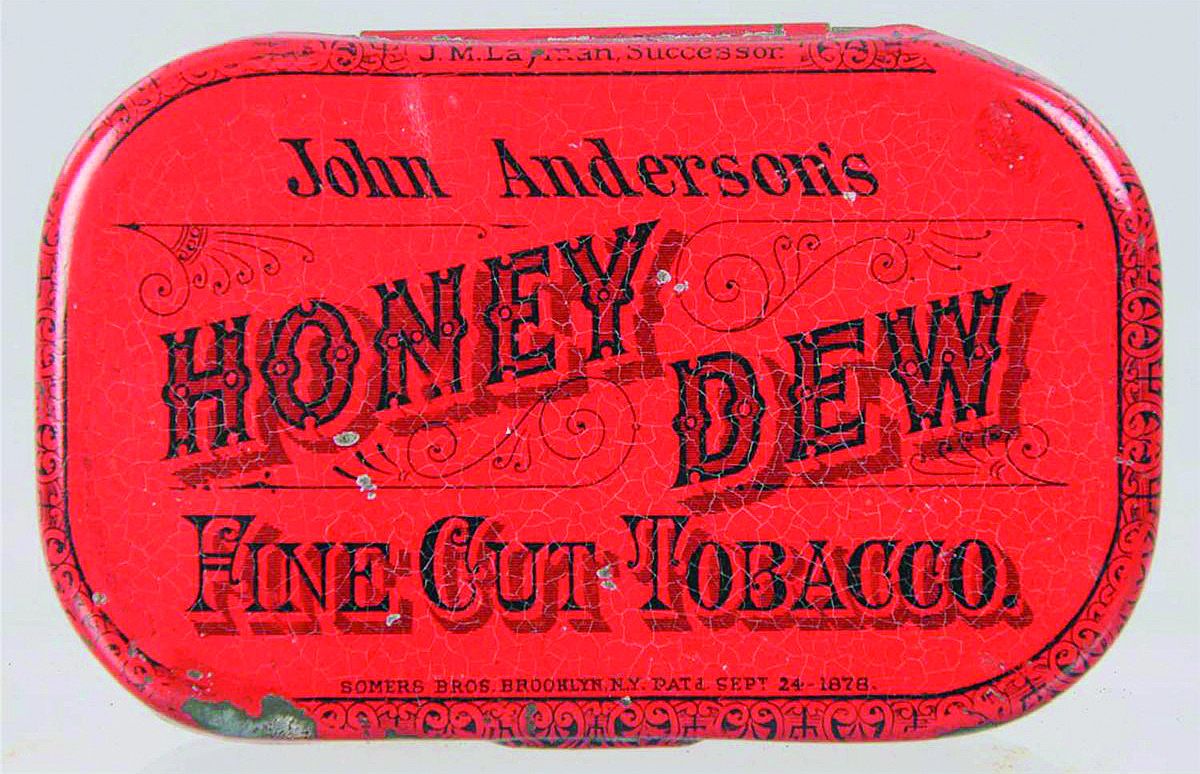
In addition to ‘Solace’ Anderson tobacco made ‘Honey Dew Fine Cut’, a product about which the Merchants’ Magazine and Commercial Review of 1846 (Volume 14) said: “Anderson has effected many valuable improvements in the machinery employed in his business. The advantage of knives, propelled by steam, for the cutting of tobacco, is obvious—the revolutions being performed with perfect regularity and precision, a long silken cord is produced, which the old, laborious, but unscientific method, could not effect. The manufactory is divided into fourteen apartments, each apartment being devoted to a distinct branch of the business. I was not a little surprised on learning the amount of labor required in depriving tobacco of its impurities, preparatory to cutting and curing. Mr. A. assured me that one great reason why so much inferior tobacco is offered for sale, is owing to inattention, or want of knowledge in the preparation… analyzed a quantity of Mr Anderson’s Fine Cut Honey Dew and certified it pure tobacco.” It likely that Honey Dew Fine Cut (like Solace) was made to be chewed, however it would not be out of place to either smoke or chew the tobacco from the same package.