
History, Competition And Camaraderie At The N-SSA 134th Nationals
By Bruce Miller · Originally published December 2016 · pp. 8–11
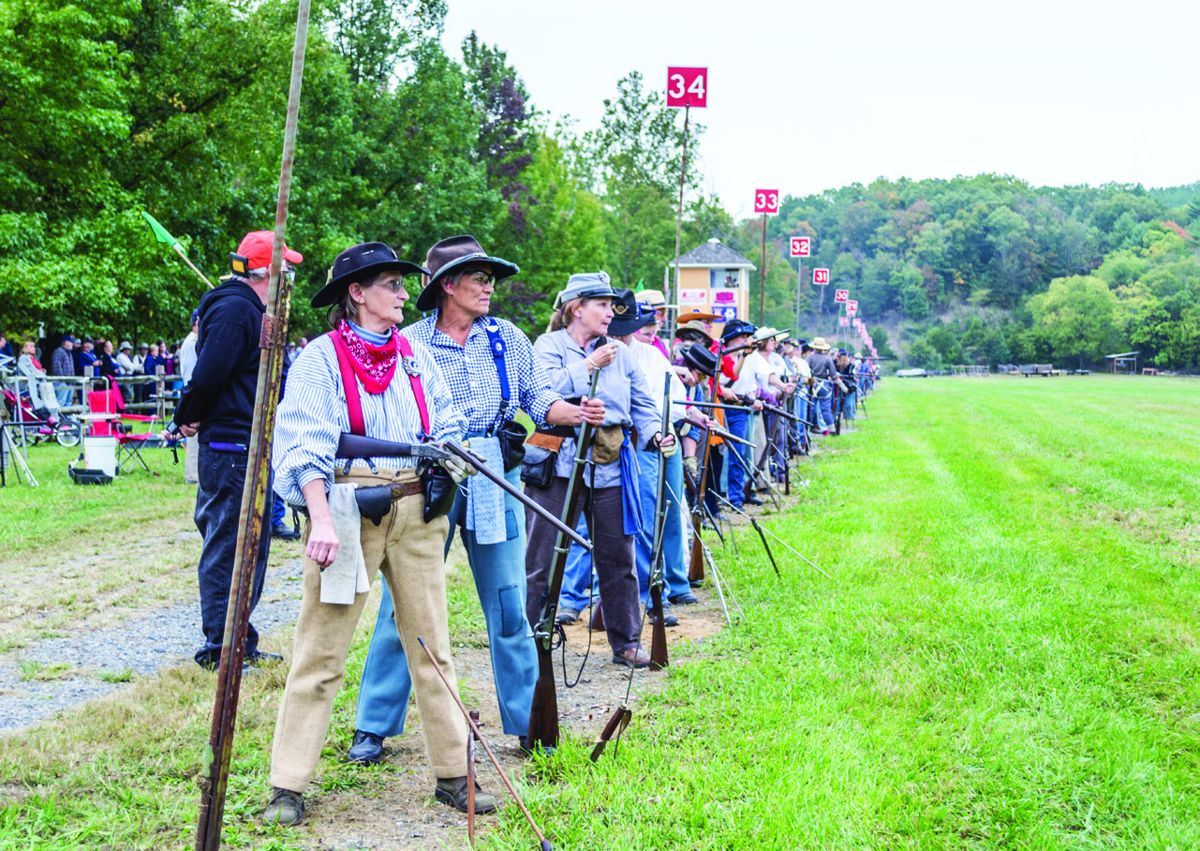
The North-South Skirmish Association held its 134th National Competition October 5-9, 2016, at Fort Shenandoah near Winchester, Virginia. Member units competed in live-fire matches with original or authentic reproduction Civil War period muskets, carbines, breech loading rifles, revolvers, mortars and cannons. It is the largest Civil War event of its kind. The N-SSA has over 3,200 individuals that make up its 200 member units. Each unit represents a Civil War regiment or unit and wears the uniform they wore 150 years ago. Competitions are called “skirmishes” where participating teams shoot at breakable targets in several timed events. The teams with the lowest cumulative times win medals or other awards. There are also competitions for authenticity of Civil War period dress, both military and civilian, as well as lectures on topics of interest.
(Ericka Hoffmann)
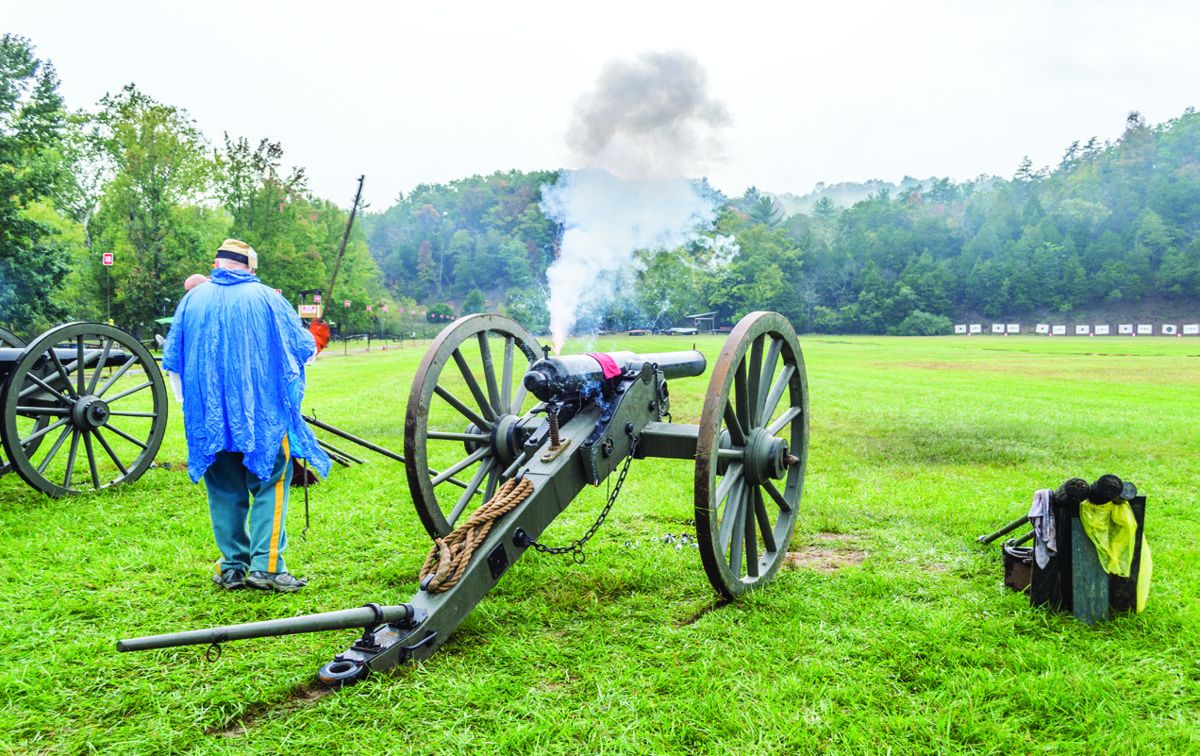
Despite the approach of Hurricane Matthew and its eventual torrential rain, the stalwarts who braved the storm competed with their usual gusto and enjoyed the competition and camaraderie. The competition began with individual matches which are available for all firearms used in the war from rifle muskets to single shot pistols. These are paper targets that the competitors have ordered well in advance of the Nationals. For example, a competitor can order one, and only one, 50 yard and one 100 yard target in the rifle musket match. They can also order a score for the aggregate of the two targets if they choose to. There is no warm up and after the targets are shot there is no reentry. Targets are retrieved by the host team staff and are taken to the Stat House where host team staff assigned there must score the targets. Over the Wednesday, Thursday and Friday morning of individual matches, they will score several thousand targets. Competitors are classified for each firearm they shoot based on the average of their previous three matches and are reclassified after each national in which they participate. On Friday morning the team matches begin. As with individual matches, each unit is classified based on prior performance: A-1, A-2, A-3. If they enter a second team, they are classified “B” and a third or more teams “C.” Set up for the revolver team matches begins bright and early at 7:30 a.m. with the first phase followed by a second phase immediately thereafter. The favored revolver is the Rogers & Spencer, but many prefer the Remington, and you will see Colt Army and Navy models too. Eighty-four person teams participated in the match of four events: 12 clay pigeons on a cardboard backer; eight hanging 6”x6” ceramic tiles; eight hanging clay pigeons and eight hanging 4”x4” ceramic tiles. With a terrific time of 121.2 seconds, McGregor’s 2nd Battery finished first and claimed the gold medals. With the completion of the revolver match, the team matches then moved to the main range. With over 60 shooting positions, each accommodating eight shooters, this range is over a quarter mile in length and controlled by the main control tower and three sub towers. Well trained host staff members man these important positions. On the ground, each team match relay requires a timer and safety officer to ensure that all proper procedures are observed. Safety is first in the N-SSA. The smoothbore musket team match was next on the schedule. This relatively new match has become increasingly popular and, as you can imagine, a great test of skill. Competitors participate with many different firearms including the U.S. Model 1842; Confederate Macon Arsenal conversions of the Model 1842; the Hewes & Philips conversion of the U.S. Model 1816 (which features a rear sight) and the occasional European Potsdam in .72 caliber. The match comprised four events, including the extra challenging silhouette of a tiny clay pot and the 110th Ohio Volunteer Infantry bested 108 other units to finish first with a total time of 193.5 seconds. Friday’s shooting adventure then continued with the concurrent breech loading rifle and Spencer team matches. Fifty-two teams competed in the breech loading match, primarily with Henry rifles. Competitors can load their magazine to capacity, but when empty, must then single load. You have to see this match to believe just how fast and accurately these rifles can be shot. The speedy Harlan’s Light Cavalry took just 166.6 seconds to claim the gold medals by the slim margin of .8 seconds. The 46th Illinois Volunteer Infantry won the Spencer match for the second consecutive national. The final shoulder arm matches of the day were the concurrent single shot rifle match and the traditional musket match. In the single shot match, most participants shoot a Sharps rifle or Ballard rifle or carbine. The winner of that 20 team match was the 149th Pennsylvania Infantry who beat out their closest competition by a hearty 43.0 seconds. While all firearms permitted in N-SSA matches must adhere to strict regulations regarding alterations from original issue, the traditional musket match is shot with rifle muskets as issued in the Civil War and with no alterations whatsoever. The teams use paper cartridges and dress authentically, right down to their footwear. The Union Guard, (Company A, 19th Indiana Infantry) won this match handily. Fifty-nine pieces competed in the mortar team match late in this beautiful autumnal Friday afternoon. We saw everything from ringing brass Coehorns to gigantic siege mortars again at this national. It is always great fun to watch this match because you can actually follow the flight of the projectile given the relatively low muzzle velocity. The mortar teams fire seven shots at a stake 100 yards down range. Officials then carefully measure the distance from the stake and tally the best five shots for score. The overall winner was the 14th Virginia Cavalry with a five shot aggregate score of 24 feet-11 ¾ inches, just 6.75 inches better than the runner-up 11th New Jersey Infantry. Hurricane Matthew’s rain arrived on Saturday, but it could not dampen the enthusiasm of the 100 units that prepared for the carbine matches. Many units staged “easy-up” covers on their position to keep their firearms and ammunition dry. Lots of towels were in use as the competitors tried to prevent rust forming before their very eyes. Smith carbines are a favorite in this match, and many are valuable originals. Skirmishers are also fond of Sharps’ carbines, and you will often see Burnsides’, Maynard’s and even muzzle-loading carbines and musketoons in this match of speed and accuracy. The program consisted of five events: four at 50 yards and one at 100 yards. When the smoke cleared, the 8th Virginia Infantry came out victorious with a nice time of 350.1 seconds and beating the next closest unit by 16.2 seconds. Saturday’s team matches then continued with a spectator favorite: the artillery matches. The range is reconfigured so that the cannons fire perpendicular to the regular firing line. Target frames and their paper targets are then set at a range of 200 yards for rifled guns and 100 yards for smoothbores and howitzers. Each cannon fires a solid shot at two targets; a bull’s eye and a silhouette of a cannon facing them that simulates counter battery fire. A maximum of 7 shots are fired on either target with a maximum point count of 25 per target. A perfect score is 50 points. Original or exact reproductions of Civil War artillery pieces may be fired. The term “Civil War” applies to any artillery piece whose model antedates April 26, 1865. Crews consist of no fewer than six registered artillery crew members for all The eight member musket team of the 9th Virginia Cavalry blaze away at ceramic tiles at 100 yards. All targets at the N-SSA Nationals are breakable. (All photos this page Ericka Hoffmann) class guns. The guns are classified by type: smoothbore, rifled, howitzer and rifled howitzer. Despite the rain and mud, the winning scores were terrific. In the smoothbore class, Hardaway’s Alabama Battery won with a 43-4V (“V” represents the dead center of the center ring). In the rifled class, four teams tied with the amazing score of 50-5V. When the tie-breaking rules were applied, the 1st Maryland Cavalry #1 emerged the winner. In the howitzer class, the 3rd U.S. Infantry shot a lights-out 50-7V. The 1st Maryland Cavalry won again in the rifled howitzer class with a 49-2V. The accuracy of these Civil War cannons is truly amazing. The sun finally broke through on Sunday morning, and 189 rifle musket teams were prepared to battle the clock in the N-SSA signature match. With so many teams competing, the match was staged in two phases; one at 8 a.m. and the next at 12:30 p.m. Both phases include impressive opening ceremonies where all participating units form up together with their colors flying. The band plays the National Anthem, “Dixie” and “The Battle Cry of Freedom” and non-shooting awards are presented to deserving N-SSA members who have done extraordinary service to the organization. With the ceremonies over, the five-event match commenced. All N-SSA targets are breakable, and the pieces certainly flew as clay pigeons, ceramic tiles and pot silhouettes were blasted by minié balls. When it was all over, the 149th Pennsylvania Infantry had claimed the biggest of all prizes for the second consecutive National with a time of 512.3 seconds for the five-event program. During this National, election of National Officers was held. New officers include National Commander Dave Booz; Deputy Commander Wade Huffman; Paymaster James Baird; Adjutant Melinda Shaw and Inspector General Wayne Shaw. This new leadership group assumes office on December 1, 2016, and will serve a two-year term. With the 134th National Competition in the record books, skirmishers cleaned their muskets, packed their gear and headed home, leaving the host units to put the range back in order (all units rotate non-shooting host duties). Winter can’t be over too soon as we eagerly anticipate next season. The 135th National Competition is scheduled for May 19-21, 2017 at Fort Shenandoah, just north of Winchester, Virginia. If you’re a Civil War enthusiast ready for the experience of period firearms competition, or just more information, visit our website at www.n-ssa.org. (Nikki Bethke)
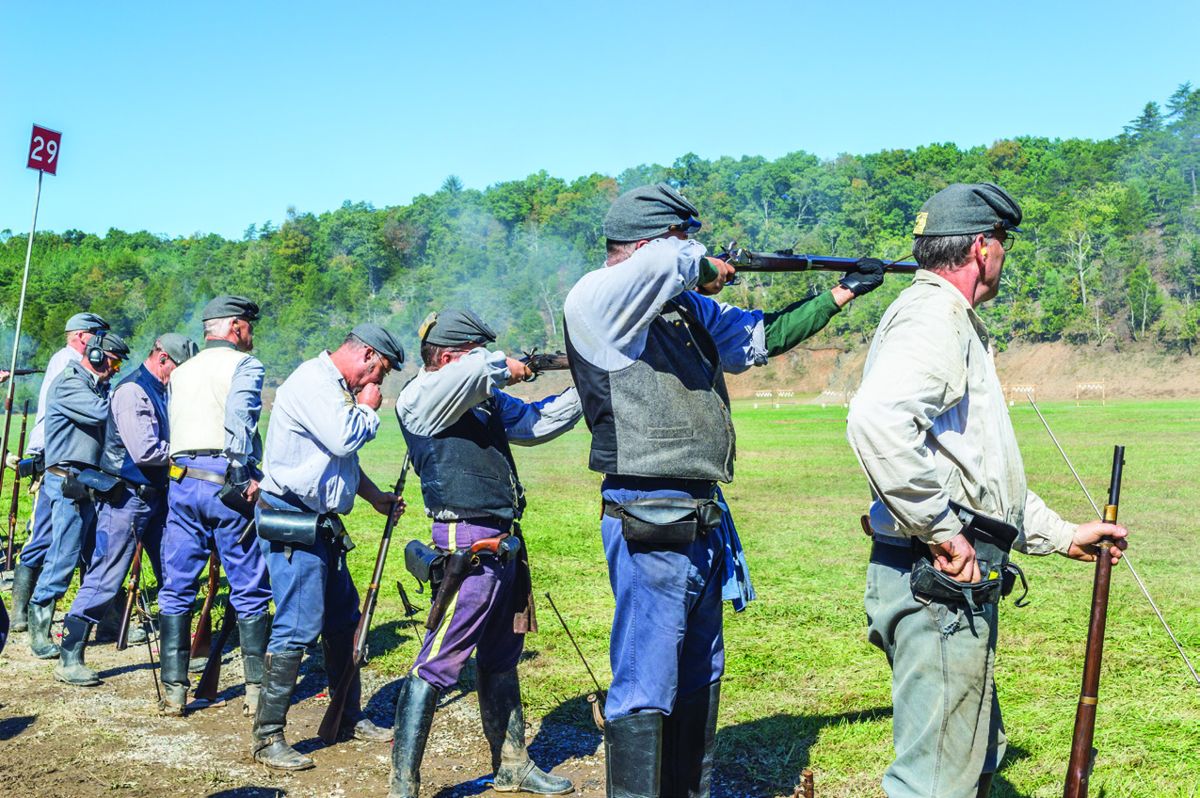
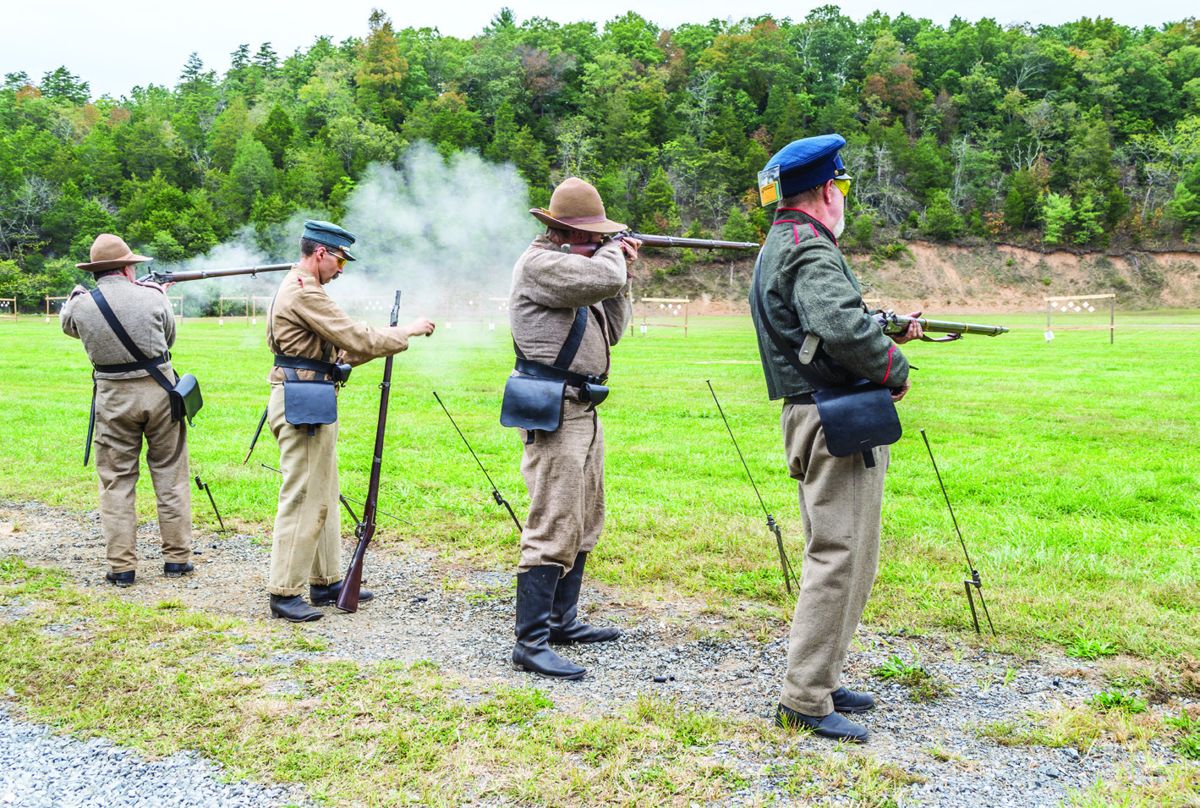
Authentically uniformed Confederates fire their smoothbore muskets at hanging 6” x 6” ceramic tiles at 50 yards.
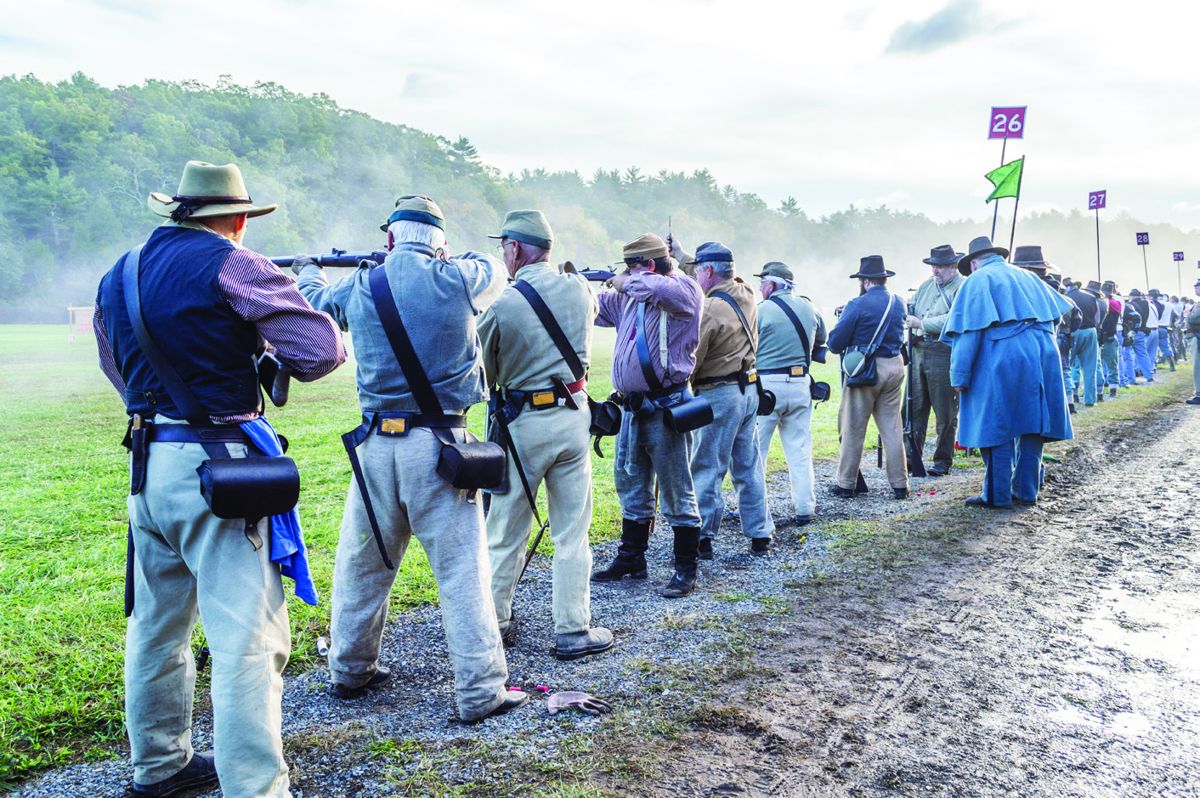
With 65 positions and eight shooters on each one, the firing line at Fort Shenandoah is over a quarter mile long.
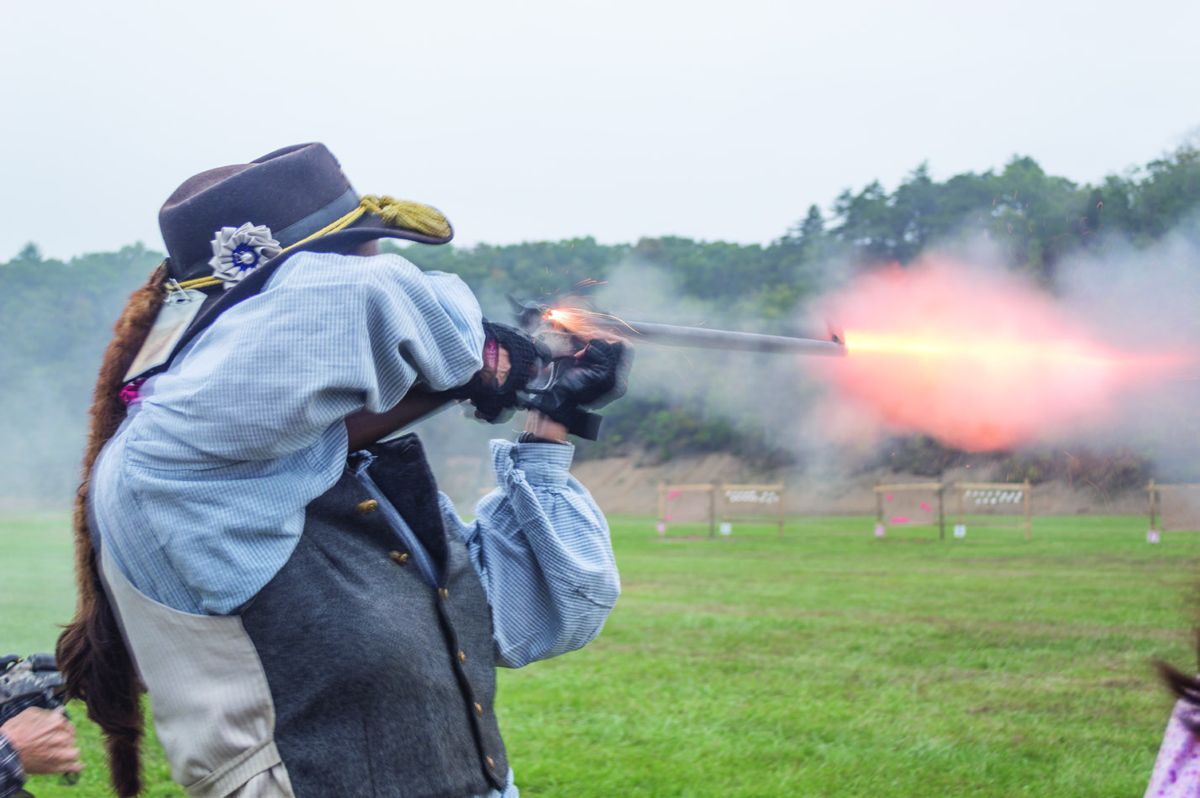
Muzzle flash lights up the evening as Judy Stoneburner fires her carbine in the 25th Anniversary Women in Skirmishing event.
The crew of the 3rd U.S. Infantry take careful aim with their Model 1861, 10-pounder Parrott Rifle.
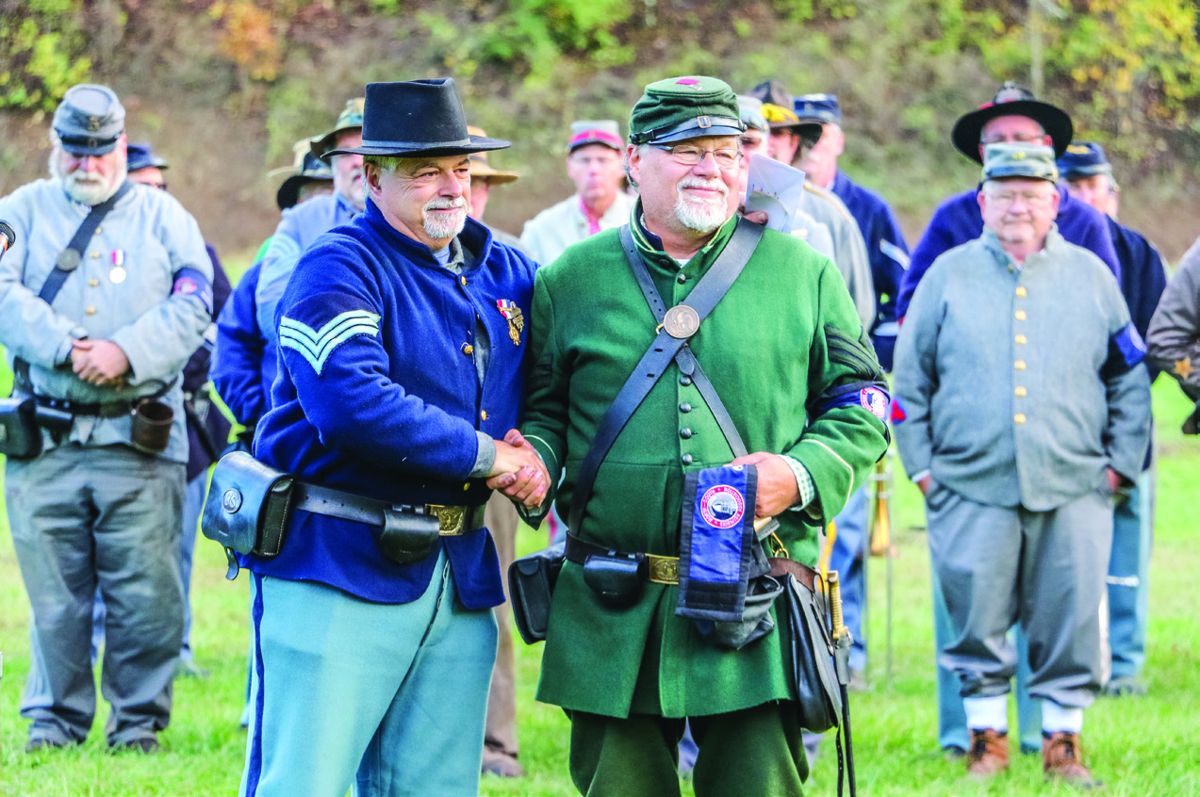
Sunday’s opening ceremonies commence with the playing of “The Star-Spangled Banner”, “Dixie”, and “The Battle Cry of Freedom” performed by the N-SSA All-Star Band. (Nikki Bethke) (Nikki Bethke)
Left: Firearm safety is of prime importance at all N-SSA competitions. Here a safety officer checks to see that each of the Union Guards’ muskets are cleared at the end of a relay. (Ericka Hoffmann)
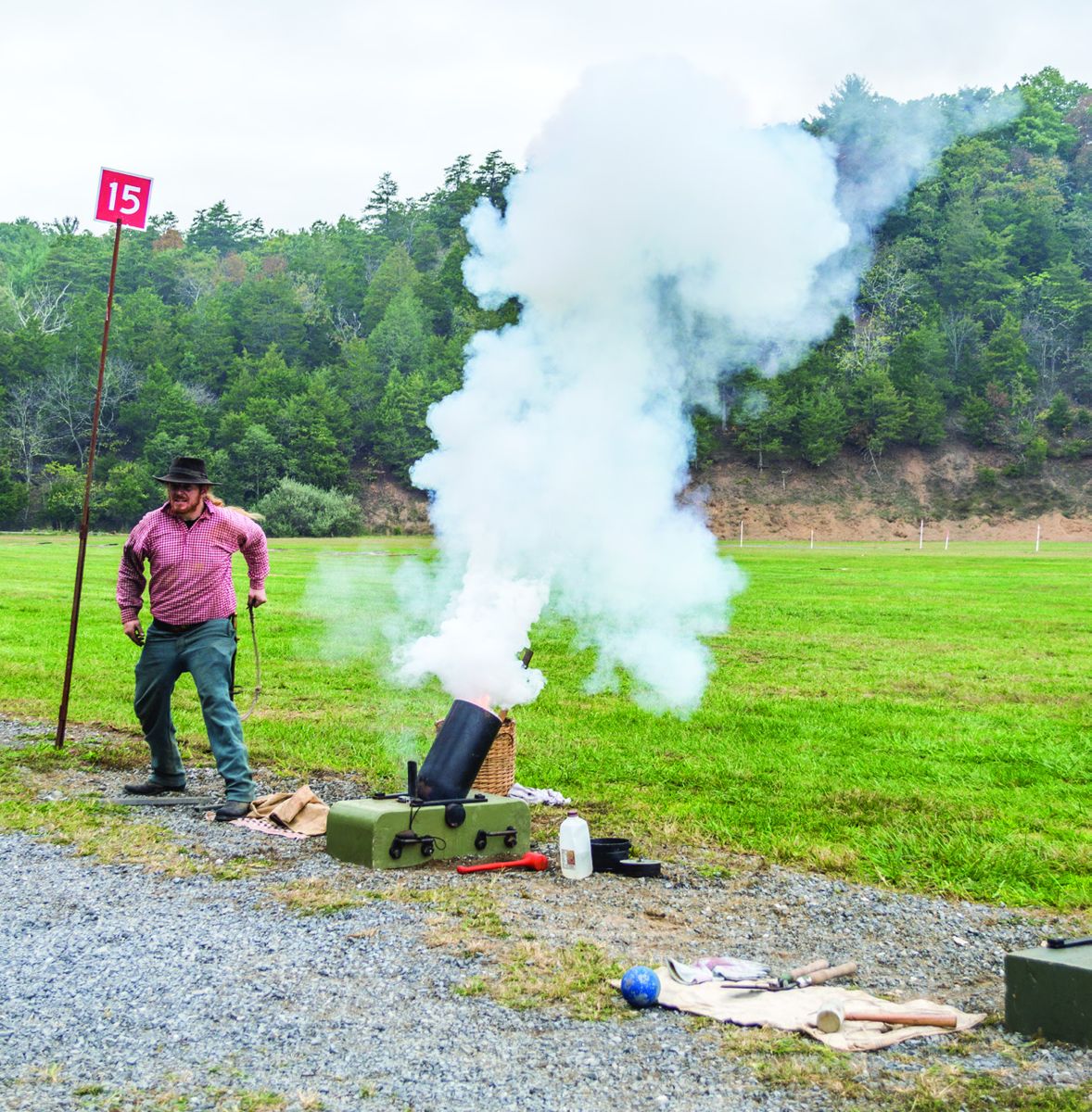
Right: The mortar ball and lanyard fly through the air as this N-SSA team fires at their target stake 100 yards away. Notice the mortar ball captured in flight. (Ericka Hoffmann)
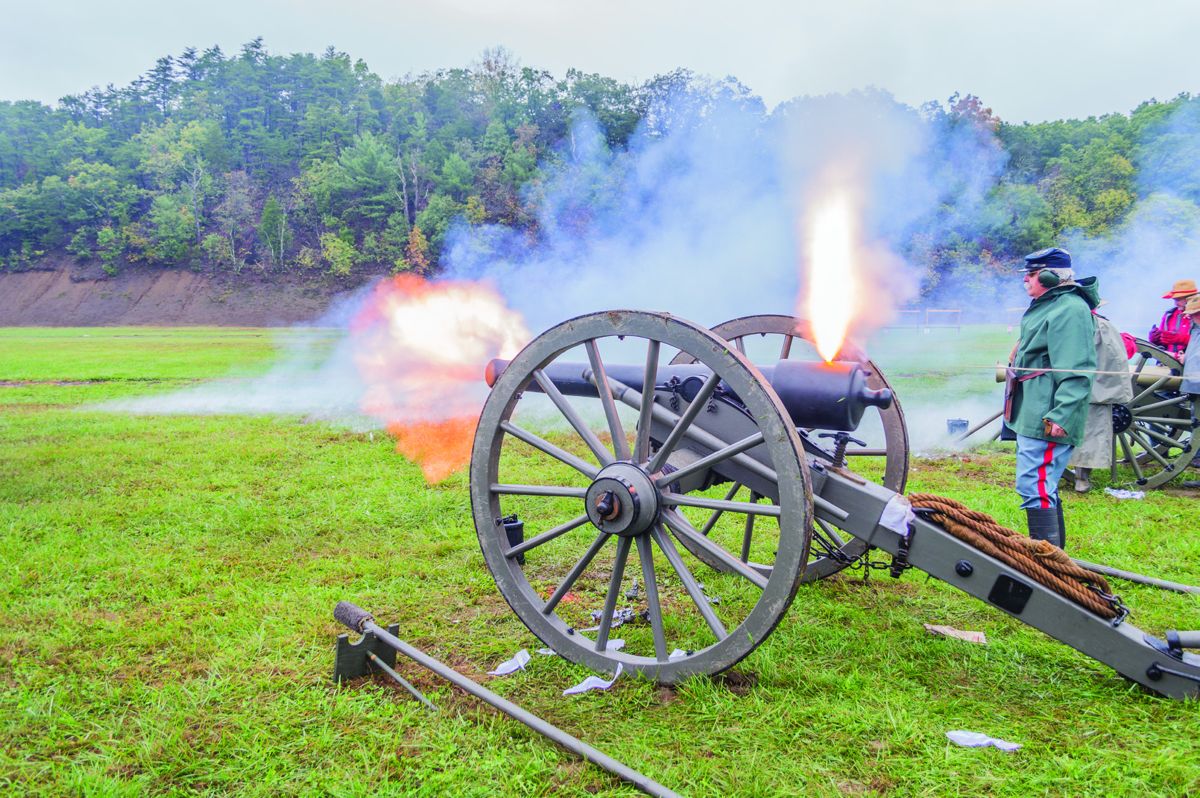
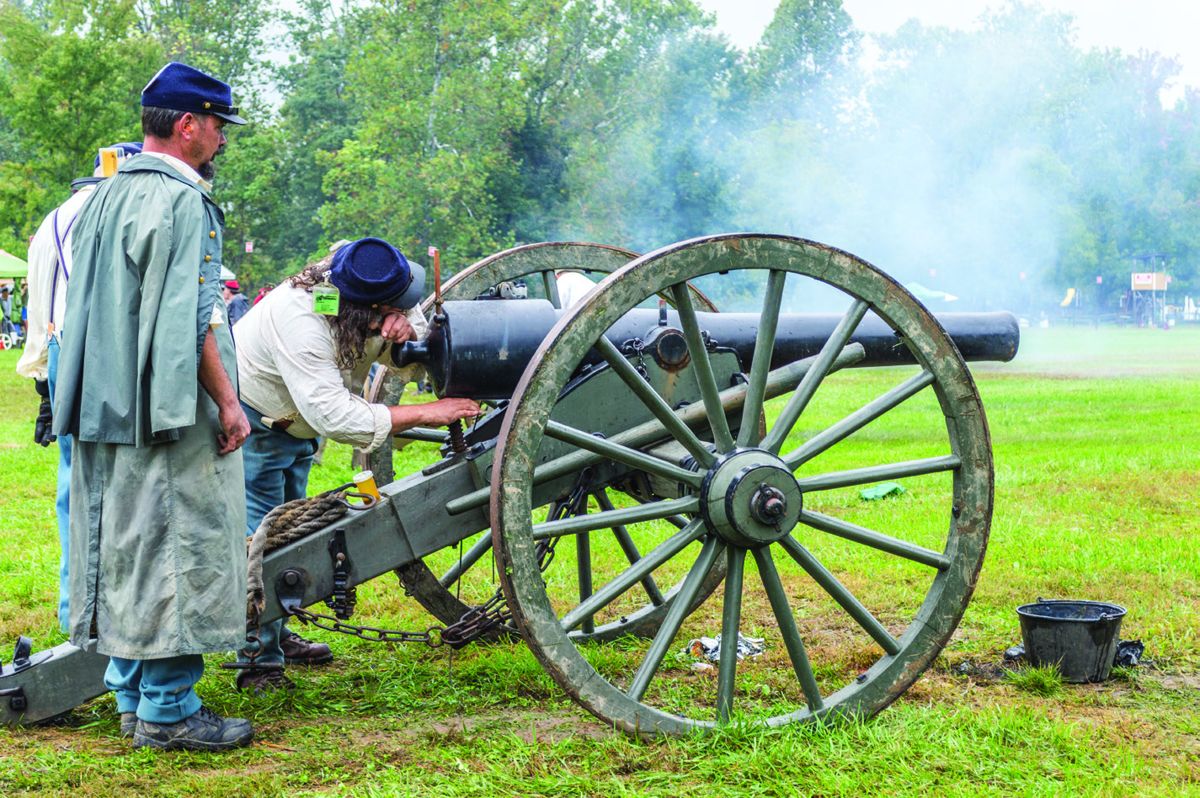
An Artillerist with the 3rd Maryland Artillery pulls the lanyard to fire their howitzer through a haze of black powder smoke. In the Nationals competition, smoothbore howitzers fire at bullseye targets at a distance of 100 yards. Rifled gun targets are placed at 200 yards.
The gunner pulls the lanyard to fire the 3-inch Ordnance Rifle of Hardaway’s Battery.
The Confederate fifes and drums lead their troops on to the field for the Sunday afternoon phase of the musket matches. (Ericka Hoffmann)
Even the rains of Hurricane Matthew couldn’t dampen the spirits or the gun powder of the thirty-nine cannon crews that competed during the soggy cannon matches. (Joe Pelot)
Clad in their distinctive green uniforms these U.S. Sharpshooters are on target at the Nationals. (Ericka Hoffmann)
Bright muzzle flash and vent flame shoot out as Dulany Troop, 6th Virginia Cavalry fires their Tredegar 12-pounder Field Howitzer. (Ericka Hoffmann)
“Girls just want to have fun” and these two young ladies find that skirmishing is certainly that.