
Inspection, ARMS!
Frémont’s Imported Austrian 1842 Muskets
By Tim Prince · Originally published December 2016 · pp. 16–17
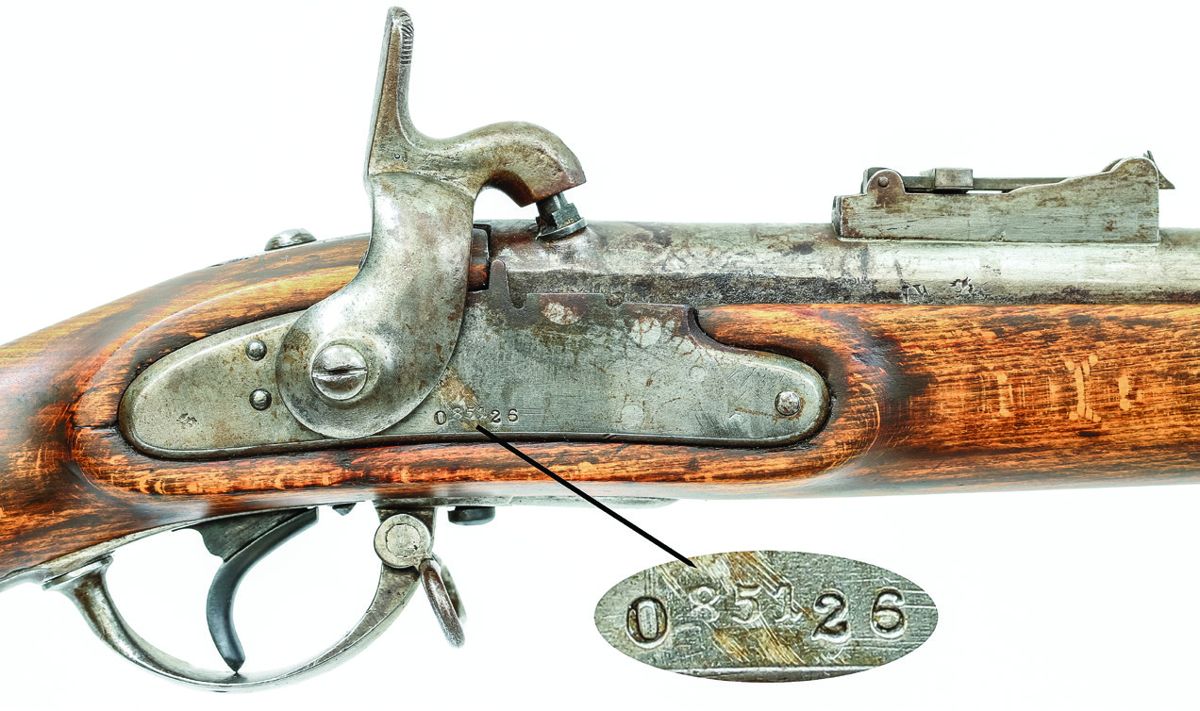
During the American Civil War, some 68,505 Austrian Model 1842 Muskets were imported for use by the United States military. It is most likely that not all of the muskets so designated were actually of the 1842 pattern, but some were likely older Austrian muskets including both Model 1828/40 and Model 1838/40 muskets. It is also possible that some even older flintlock arms, such as the Model 1807, which had been subsequently upgraded to the new Austrian standard by conversion to the Augustin Console lock ignition system (making them Model 1807/40 muskets) were included as well. The Austrian Model 1842 Musket was the standard infantry arm of the Austrian military prior to their adoption of the percussion ignition system (known as the “system Lorenz” in Austria) circa 1854. The musket was nominally 58” in overall length with a 42-½” long round barrel that was smoothbore and nominally .69 caliber. Current Austrian references specify the bore of these muskets at 17.6 mm or about .69 caliber. Period U.S. documents typically refer to the guns as being .71 caliber, with bore sizes varying considerably. The musket was stocked in the traditional beech of Austrian arms with a raised cheek piece on the reverse of the butt and was mounted in either iron (Mit Eisenbeschlägen) or brass (Mit Messingbeschlägen). Three barrel bands secured the barrel to the stock, along with a tang screw. The upper and lower barrel bands were spring retained, while the middle band that carried the upper sling swivel was secured only by friction. The iron mounted variant weighed in at 9.59 pounds (4,350 grams) and the brass mounted version was slightly heavier (by 200 grams), weighing 10.03 pounds. It appears that the majority of the Austrian Model 1842 muskets imported for use in the United States were iron mounted. A lower sling swivel was mounted on the front bow of the triggerguard. The guns were marked on the lock with a date consisting of a three-digit number, omitting the first digit, thus “1852” would be marked “852”. The Austrian Eagle was typically stamped to the rear of the lock indicating Austrian government ownership, and assorted Austrian proof marks are typically found on the barrels. In some cases, Austrian contractor names are stamped on the top of the breech of the guns, and sometimes Austrian regimental markings are found on the tang of the buttplates. The arms incorporated the unique Augustin Consol lock ignition system. The system had originally been devised by Giuseppe Consol, but was later improved upon by General Baron Vincent Augustin. The lock, known colloquially as either the “tube lock” or “pill lock” resembled a flintlock battery with a pan and cover, but with a percussion style hammer. To operate, the pan was opened and a detonator was inserted. This was essentially a percussion cap that was sealed with two hollow tubes extending from it
Greenwood altered Austrian M-1842 Musket, rifled & sighted. Musket courtesy Charles L. Foster collection.
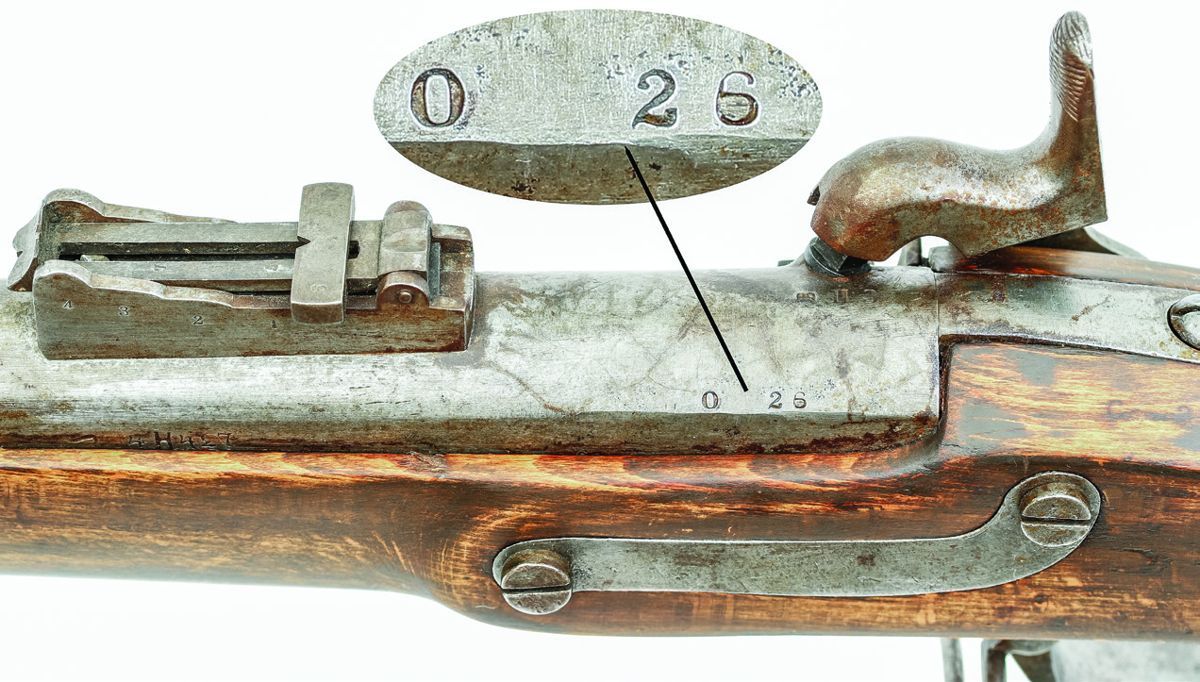
(All photos by Tim Prince) in opposite directions. One of the tubes was inserted into the touchhole of the gun, with the other extending beyond the pan in the opposite direction, providing an easy way for the soldier to handle the detonator. When the pan was closed, the offside tube was crimped down and sealed. The top of the pan contained a firing pin, which would detonate the primer when it was struck by the hammer. The spark from the primer would pass through the tube into the chamber of the gun and ignite the powder charge to fire the weapon. During the course of the American Civil War, the firm of Herman Boker & Company of New York (with additional offices in Liège, Belgium and Birmingham, England) delivered 39,038 Austrian Model 1842 muskets to the U.S. government. It appears that these muskets were altered to percussion prior to their importation into the United States. Some were no doubt Austrian military alterations to percussion and some had received upgrades including rifled bores and in some cases either fixed or adjustable rear sights. The firm of Kruse, Drexel & Schmidt of New York imported another 25,000 of these guns in their original Augustin Consol Lock (aka “Tube Lock” or “Pill Lock”) configurations. Of these guns, 13,000 were in “new” condition and 12,000 were “used,” although all of the guns were clearly quite obsolete. These muskets were sent to General John C. Frémont in the Trans-Mississippi Theater, operating primarily in Missouri. Frémont was
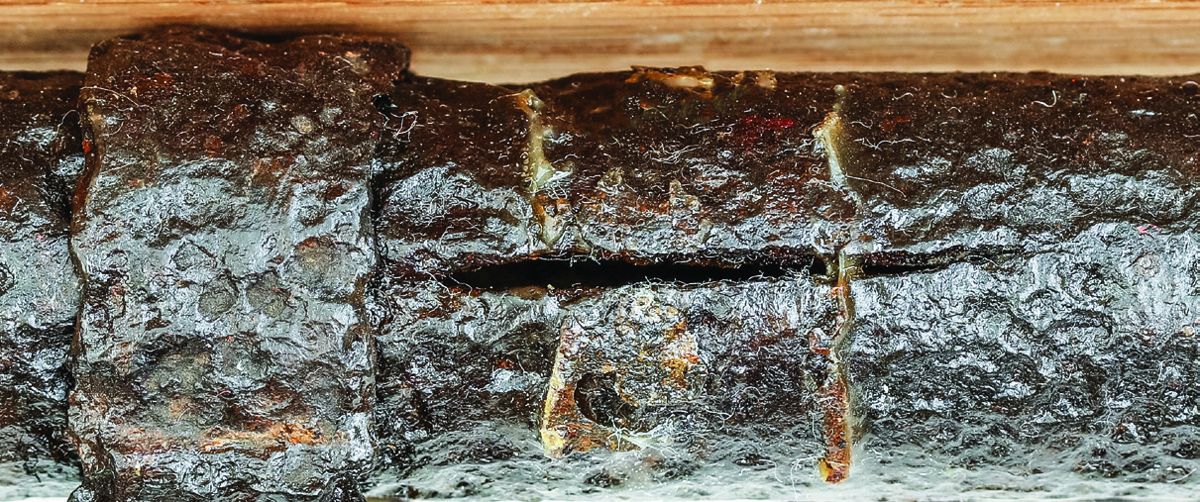
Dug example of an Austrian Model 1842 Musket in its original Consol Lock configuration. The gun has been mounted on a wood backing to help preserve the fragile metal. Mounted with the gun are its original Austrian bayonet dug with the musket. Musket & bayonet courtesy David Noe collection.
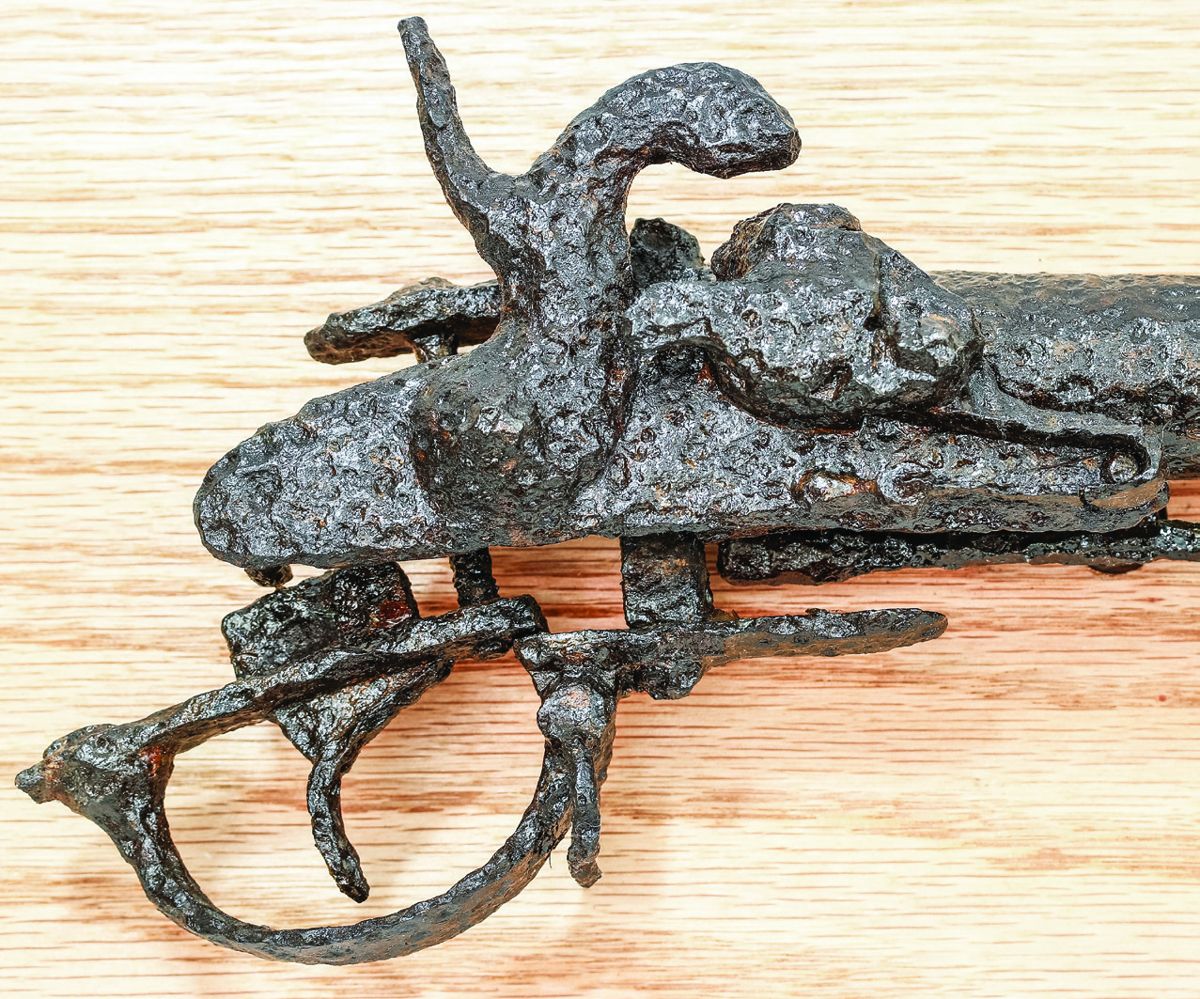
Leman altered Austrian Model 1842 Musket.
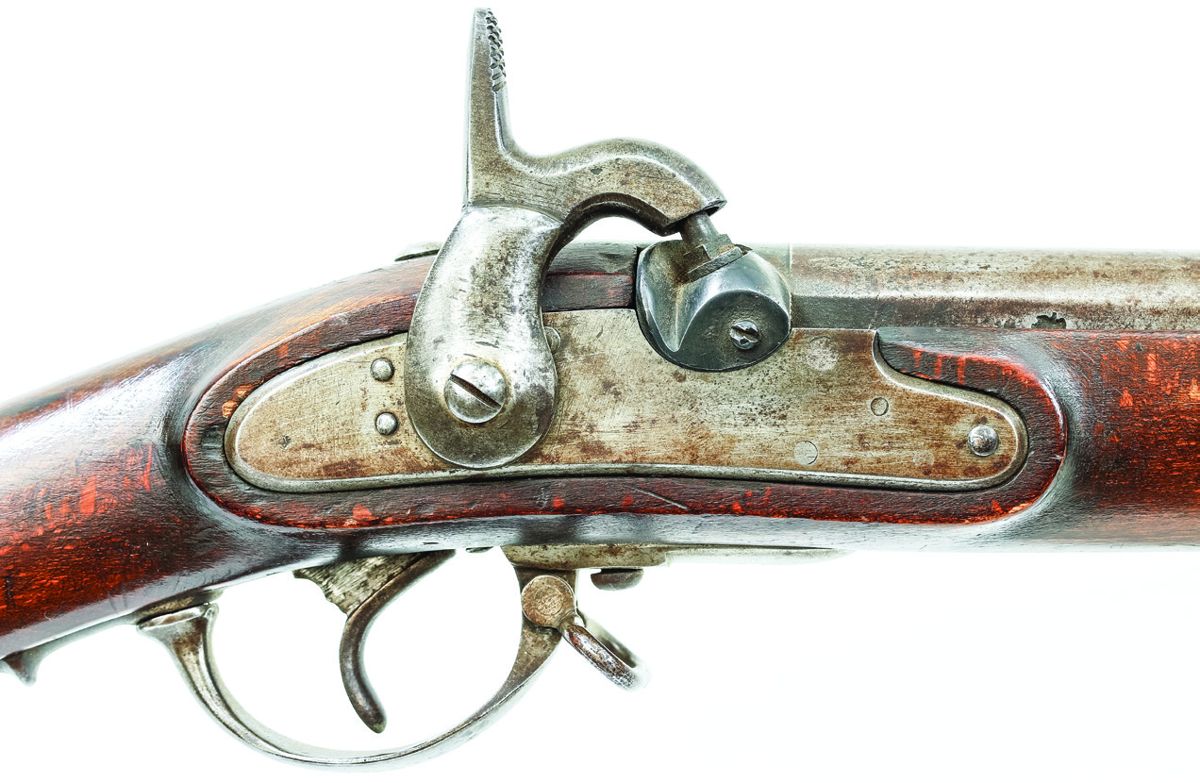
Close up detail of the alphanumeric bayonet mating code marks found on the Greenwood altered Austrian musket (top) and the Leman altered musket (bottom). The Greenwood example with rifled bore measures .70 caliber, while the Leman alteration remains in the original .69 caliber. Also clearly obvious is the modification to the front portion of the ramrod on the Greenwood alteration, while the Leman musket retains its original, unaltered Austrian ramrod. Greenwood musket courtesy Charles L. Foster collection. at least indirectly responsible for their purchase, having approved the acquisition at the price of $6.50 each, with the understanding that the necessary proprietary primers would be delivered with the muskets. Some reports suggest that Frémont profited from the purchase of the arms through Kruse, Drexel & Schmidt, with at least one report stating that he received some $30,000 in compensation as part of the deal, which would amount to about an 18% commission on the $162,500 purchase. Frémont would later be rather vague about the purchase when he was brought to testify before the Joint Committee on the Conduct of the War. When the Austrian muskets arrived in the United States, they were initially shipped to the Saint Louis Arsenal, where they were examined and it was found that the guns could be rifled for use with expanding base, elongated ball (Minié) style ammunition. The arsenal was in the process of altering U.S. muskets for Federal service and was not capable of performing the work at that time. The initial plan was to issue the “new” condition guns, in their original Consol Lock configuration, to the men in the field. Another 10,000 of the “used” guns were to be altered to percussion by the Belgian (cone in barrel) method, rifled and sighted. These 10,000 guns were sent to Cincinnati, Ohio, to be altered, rifled and sighted by Miles Greenwood & Company. Initially, Greenwood agreed to perform the percussion alteration, rifle the barrels and add rear sights for $4.50 per musket. New front sights were not installed on the guns. When it was decided to modify the ram rods by cupping the heads for use with elongated ball ammunition, the price was increased by $0.15 per gun. Greenwood soon found that his firm was unable to perform the work in a timely fashion, and sub-contracted half of the work (5,000 muskets) to Hall, Carroll & Company, also of Cincinnati. The Greenwood altered Austrian M-1842 Muskets were rifled with three grooves, while those that had been upgraded in Austria by being rifled for the Austrian military are found with four-groove barrels. The rear sight added by Greenwood was an adjustable ladder sight with a silhouette similar to that of the U.S. M-1855 long-range rear sight. Some Greenwood (or Hall, Carroll & Co) examples are found with an alphanumeric reassembly mating code stamped on the exterior of the lock plate and breech of the barrel. The example shown in this article has the mating code O 26 in those locations. Similar alphanumeric mating codes were also utilized by some of the U.S. arsenals during the alteration of U.S. flintlock muskets to percussion. Those imported muskets that were distributed through the Ordnance Department had been mated with a bayonet (the bayonets were not interchangeable) were marked on the off-side of the double-strapped upper barrel band with a second alphanumeric mating code that was used to mate the gun and bayonet, which had the same code stamped on the top of its socket. The Greenwood altered musket shown in this article has the mating code J 25 in this location. The balance of the guns were initially issued to Frémont’s troops with their original Augustin Consol locks. Due to most of the Consol lock primers detonating while in transit to Frémont, there were few available primers and the guns were of limited use to Frémont’s soldiers. It had generally been believed that these muskets saw little, if any combat use. However, an excavated Austrian M-1842 musket in its original Augustin Consol lock configuration has recently come to light. This gun was found at a Civil War Show in Illinois and the seller thought it might have been recovered in Missouri. The gun has a burst barrel with a tear about 1” long under the middle barrel band. This catastrophic failure is no doubt the reason the gun was discarded. It was dug with its original Model 1838 Austrian bayonet, which suggests the gun was being used in combat when it was abandoned. To date, this is the only example of an Augustin Consol Lock Model 1842 Austrian Musket that I am aware of that has concrete association with American Civil War use. As percussion altered arms were made available, they replaced the Consol Lock guns in the field and most of the Consol Lock muskets were eventually shipped to the
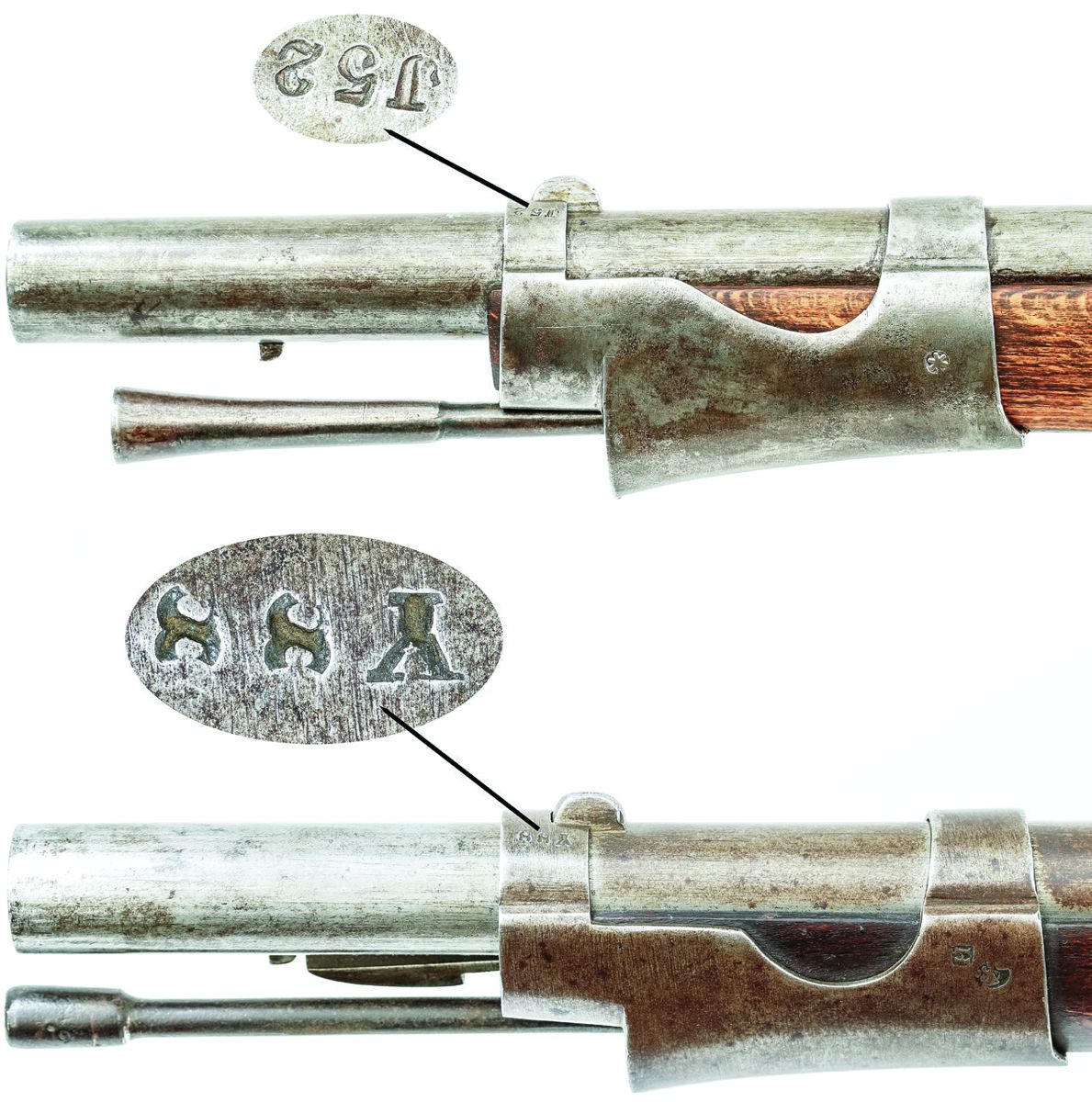
Frankfort Arsenal in Philadelphia, from which they were sent to Henry Leman of Lancaster, Pa., for alteration to percussion via the patent breech method. Leman removed the original Augustin lock parts from the lock and in many cases filed the locks, removing the original Austrian markings. The breeches of the Austrian barrels were also cut off and a new chambered breech with an integral bolster, which contained a clean out screw, was applied. This was the strongest method of altering a flintlock musket to percussion. Leman also used a mating code system for reassembly and numbered the inner neck of the new percussion hammer, the interior of the lock, the bottom of the barrel and the bottom of the new chambered breech. The example shown in this article is numbered 149 in each of these locations. As with the Greenwood alterations, if the gun was mated with a bayonet by the Ordnance Department, an alphanumeric mating code was applied to the upper barrel band, as described above. This example has the bayonet mating code Y 88. Although the troops of the Trans-Mississippi theater would continue to receive the lowest priority when arms and equipment were issued, it appears that the majority of the truly obsolete Austrian muskets were withdrawn from service by sometime in 1863. In many cases, their initial replacements were not technologically superior, but were at least American made conversion muskets, or high quality imported arms. Tim Prince is a full-time dealer in fine & collectible military arms from the Colonial Period through WWII. He operates College Hill Arsenal