
Through The Lens
The Devil And His Imps
By Stephanie Hagiwara · Originally published August 2016 · p. 6
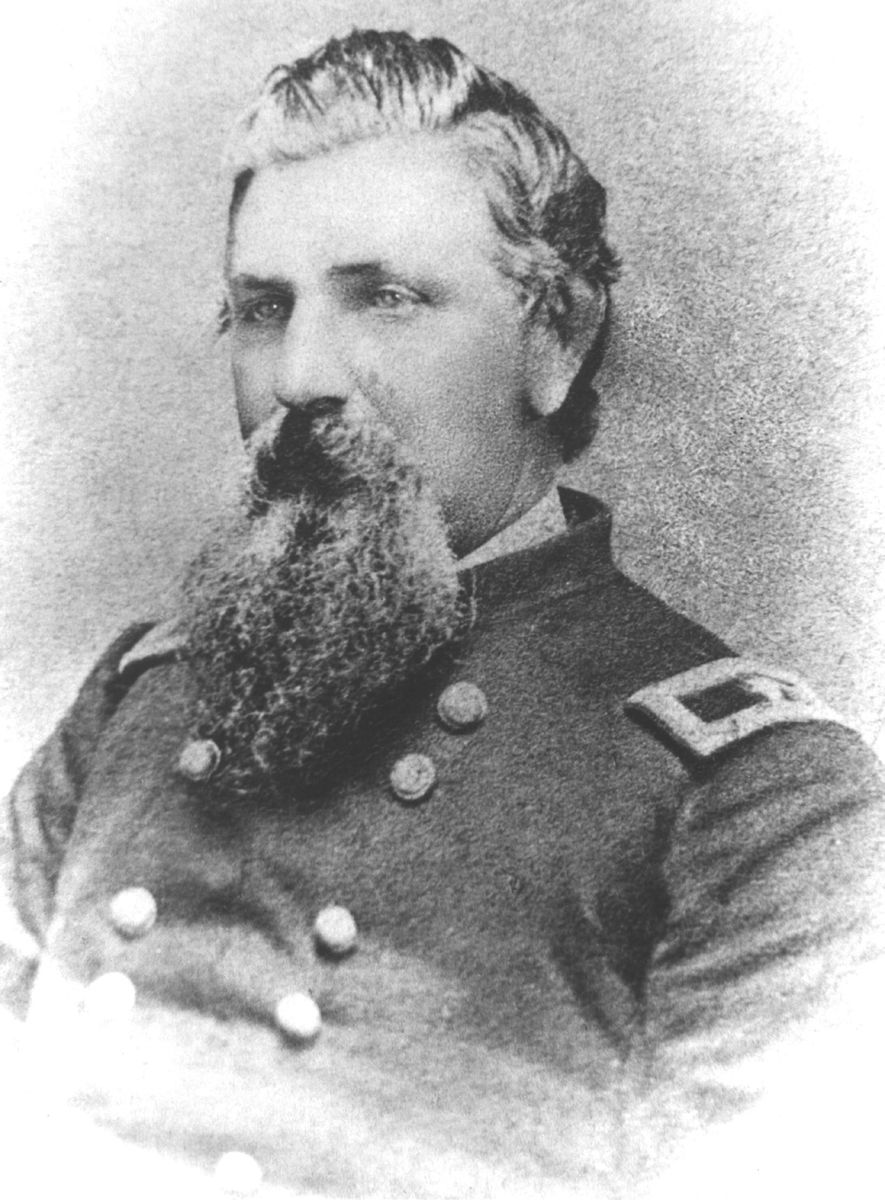
“General, I’ve got them! I haven’t counted them, but I have a ten acre lot full.” Confederate Col. John Scott In August of 1862, Confederate Gen. Edmund Kirby Smith invaded Kentucky. It was part of the Confederate’s plan to take control of central Tennessee and Kentucky. During the August 29 – 30, 1862, Battle of Richmond, Ky., the Confederates captured, killed or wounded nearly 7,000 Federal troops, while seizing an entire Union wagon train, 10,000 small arms and 9 guns. It was the most complete victory one side had over the other during the War. Kirby Smith’s departure from Knoxville, Tenn. had Indiana hastily recruiting volunteers to stem the rebel tide. U.S. Gen. William “Bull” Nelson was ordered to command the defense of his native state. Training the troops, drilling, or providing basic supplies such as knapsacks, guns or ammunition was secondary to getting the men to Richmond, Kentucky. Nelson, looking over his new recruits reported, “I find that there is no discipline among these troops. Straggling, marauding, plundering is the rule; good conduct the exception. I find this town literally overrun. I have ordered everybody to their camps, and shall enforce the strictest discipline.” Needing to communicate with his other troops, Nelson left Richmond for Lexington, Ky. Gen. Mahlon Manson was now in charge. Before the war, Manson was a druggist and Indiana politician. He was promoted to general based on his performance at the Battle of Mill Springs, Ky. seven months earlier in January. In the hot summer sun, Confederate Gen. Edmund Kirby Smith’s troops marched through land experiencing a drought with only the supplies on their back. A resident described them as, “ragged, greasy, and dirty, and some barefoot and looked more like bipeds of pandemonium then beings of this earth. …They surrounded our wells like the locusts of Egypt and struggled with each other for water as if perishing with thirst, and they thronged our kitchen doors and windows, begging for bread like hungry wolves.” Acquiring salt during a week of rest in Barbourville, Ky., they gathered apples and corn from the fields. Spirits high, the troops joked that C.S.A. stood for “Corn, Salt and Apples.” On the afternoon of August 29th, the Confederates reached the Bluegrass region, seven miles from Richmond. Manson was informed that approximately 4,000 Confederates were marching toward him. “…The only question for me now to determine whether I should allow the enemy to attack me in my camp or whether I should advance and meet him. It did not take me a moment to decide which course to pursue, as all the hills 1 1/2 miles south of me completely commanded my camp, and I did not think it was my duty to allow the enemy to obtain possession of them without a struggle.” Manson took off with his raw recruits to face the enemy. Leading the Confederate advance rode Col. John Scott’s cavalry ahead of Gen. Patrick Cleburne’s artillery. During the clash, the Federals captured a cannon before sundown. Overall, Kirby-Smith was pleased. He preferred to fight on the plain instead of the bluffs at the Kentucky River. Afterwards, Manson sent a message to Nelson and had his men “Rest on our arms and get some sleep.” Nelson receiving Manson’s message at 2:30 a.m. sprang out of bed and sent orders not to fight but to retreat. Fearing for his green troops he left for the battlefield. At dawn the fight renewed. Future Indiana congressman, Pvt. J. B. Cheadle of Company K, had heeded the call for troops to defend Kentucky. By afternoon, he wrote, “the firing of the enemy was terrific, and their first volley killed all our field officers on duty. The regiment was moving parallel to the line of battle, under a terrible fire without any one in command, when down the line rode General M. D. Manson, then in command, shouting with an oath, ‘Where is Colonel Topping?’ ‘Dead General’, came the reply. ‘Well then, where is Major Conklin?’ ‘He too, is dead, general,’ came the reply. ‘No one is in command.’ That was a moment of awful suspense. A full regiment moving along the line of battle under fire and no one in command; moving, no one could tell where; only blindly moving. The old soldier will say that was awful, and yet one had not told the half. Someone, somehow and somewhere, had commanded the head of the column to counter-march. Who gave that order I do not know; why such an order was given no sane man can ever tell, but it had been given and obeyed and here came Company A, marching past Company K, making our column eight men deep, marching through that carnival of death. Cold chills creep up my spinal column as I write this, thirty-two years after it occurred, as I recall those moment of torture when we had no chance to protect ourselves in the least, no chance to shoot, no opportunity to do anything but march through a snowstorm of bullets to the right, and then - and then - do double duty by marching back to the left, again to be put into battle faced to the rear.” Meanwhile, Cleburne, who had come up with the Confederate’s battle strategy, was shot while speaking to a wounded Colonel. The bullet entered his left cheek, knocking his teeth out on that side before exiting through his mouth - “which fortunately happened to be opened”, forcing his retirement, speechless, from the field. His men fought on, making the most of Cleburne’s tactics during the next two rallies. Nelson arrived to find his troops, “in a disorganized retreat or rather rout.” Between his forceful personality and his 300 pounds on a 6 foot 5 inches frame, there was a reason Nelson was called “Bull.” Nelson plunged into the melee to establish a line anchored by the town’s rock walls and tombstones of a cemetery. To rally his men, he paraded up and down before the enemy proclaiming, “If they can’t hit me they can’t hit anything!” The demoralized men might have been more impressed if he hadn’t been hit – twice. “Our troops stood about three rounds,” Nelson afterward reported, “when struck by a panic, they fled in utter disorder. I was left with my staff almost alone.” It was every man for himself. Nelson escaped despite the bullet in his thigh. Manson reported that while escaping, “my horse was killed and fell upon me, injuring me severely in the breast, and a short time afterward I was arrested by the enemy’s cavalry and made a prisoner.” Cheadle too, after 12 days in the army, became a POW.
Kirby Smith’s overwhelming triumph had succeeded in opening the path North for the Confederates; menacing Cincinnati, Ohio. Furthermore, the Battle of Richmond taught the Union that in a battle of numbers vs. experience – experience has the upper hand. On August 31, facing the potential of the Confederate horde coming his way, Union Gen. Jeremiah T. Boyle in Louisville Ky., directly telegraphed President Lincoln with his plea for trained troops – twice. “News grows worse from vicinity of Lexington. Many of our troops captured. Rebels on Lexington side of Kentucky River. Lexington will be in their possession to-morrow. We must have help of drilled troops unless you intent to turn us over to the devil and his imps.” Stephanie Hagiwara is the editor for Civil War in Color.com and Civil War in 3D.com. She also writes a weekly column for History in Full Color.com that covers stories of photographs of historical interest from the 1850’s to the present. Her articles can be found on Facebook, Tumblr and Pinterest.