
Proposal To Remove Confederate Monument Sparks Heated Debate
By Walt Albro · Originally published August 2016 · p. 11
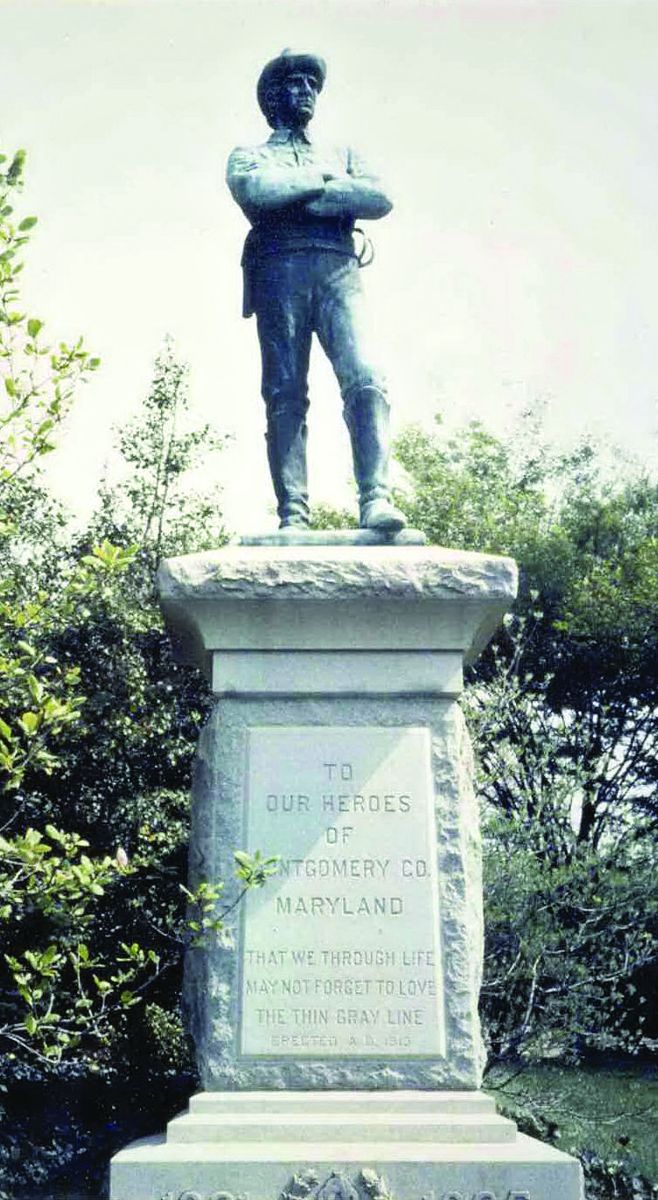
MONTGOMERY COUNTY, MD.—is having second thoughts about the Confederate soldier statue that has stood for 103 years near the old courthouse. Last year, County Executive Isiah Leggett called for the statue’s removal, saying that it was an improper symbol to display on public property. He directed that the monument, which is located in the county seat, Rockville, be moved to private land or some less prominent public spot. “Since the statue pays tribute only to Confederate and not to Union soldiers, the county executive feels that it is unbalanced, and not something that would be appropriate to display on county land,” said Patrick Lacefield, the county’s director of public information. Leggett was quoted in a local periodical, Bethesda Magazine, as saying that the statue is “a reflection of somewhat revisionist history.” He indicated that if the statue had honored both sides, it probably could have remained. Leggett’s action set off a controversy that is still simmering. Opponents of the move say that the monument is history and that it should not be censored or erased. They argue that the monument should be allowed to remain moreor-less in the same spot where it was originally erected in 1913. “Removal of the statue contributes to the stereotyping and demonization of the people who fought for the South in the Civil War,” said Susan Soderberg, a historian who has written a book about Civil War monuments in Maryland. The county initially hoped to move the statue a few blocks away to a historic property, the Beall-Dawson House, which serves as headquarters for the Montgomery County Historical Society. At first, the city supported the move but changed its mind in February after an open meeting in which a majority of the participants expressed opposition. Vandals later spray-painted graffiti, including the slogan, “Black lives matter,” on the statue’s pedestal. County Executive Leggett condemned the vandalism. The county then enclosed the statue behind a wooden barrier. Today, the county continues to seek an alternative site, although it has not yet found one. A lone cavalryman At the center of the contention is a life-sized bronze of a young cavalry private, wearing cavalry boots and with a sheathed saber at his side. His arms are folded, and he gazes into the distance. He stands on an 8-foot granite pedestal that is inscribed, “To our heroes of Montgomery County, Maryland, that we may through life not forget the Thin Grey Line. 1861-1865.” That such a monument had been constructed in the county is hardly surprising since, during the Civil War, the area was populated mostly by Southern sympathizers. In the 1860 presidential election, for example, only 2 percent of the electorate cast their ballots for Abraham Lincoln. Maryland itself, a border state, would probably have seceded and joined the Confederacy had it not been prevented from doing so by occupying Federal troops. During the war, several hundred county residents crossed the Potomac River into Virginia and joined the Confederate army. Despite their emotional affinity with the South, a roughly equal number of residents served in the Union Army. The idea of building a Confederate memorial in the county was first proposed in 1906 by Richard P. Hayes, who had served as a private in the 35th Virginia Cavalry Regiment. The plan was embraced by two local chapters of the United Daughters of the Confederacy and a chapter of the United Confederate Veterans, who raised the $3,600 necessary for the project. When the statue was dedicated on Confederate Memorial Day, June 3, 1913, the ceremony was attended by 3,000 residents, including an estimated 50 to 75 veterans, some of whom had traveled from as far away as Baltimore. A paper in the county historical society describes the dedication ceremony as one of reconciliation. In the beginning, the statue was shrouded in Maryland and Confederate flags. A band played “Maryland, My Maryland,” and “Dixie.” According to contemporary account, the Maryland and Confederate flags were removed, and a United States flag was hoisted in the background while the band switched to “The Star-Spangled Banner.” In the decades since then, the county has evolved from a predominately white rural community into a diverse suburban bedroom community of nearby Washington, D.C. Since World War II; the county has seen an influx of residents from other states or countries. Many of these new residents do not feel a strong connection to the county’s native Southern heritage. A supporter of relocation wrote in Bethesda Magazine’s online forum: “Montgomery County is today a very diverse place, and it insults our African-American neighbors and community members to maintain such a statue.” An opponent wrote: “Launching some nationwide crusade against ‘anything Confederate-related’ is like destroying a fly with an H-bomb. Enough is enough!” Reacting to the proposal to move the statue to the historical society, Soderberg said, “It would be an abrogation of history to remove to a historic property which represents the Union side in the Civil War, such as the Beall-Dawson House or the Jessup Blair House. What was built in Rockville should stay in Rockville.” She said the correct approach would be to keep the statue where it is while adding new interpretive signs explaining the statue’s meaning and putting it in context. “This is a relic of history,” she said. “To move it would be like tearing down a historic house.” Rockville declines to accept statue The statue was originally situated in front of the county courthouse, but in 1971 was relocated a few hundred feet away to make room for a downtown shopping mall. It was moved to the east side of the courthouse, which is no longer in government use. The statue was placed in an area with trees and shrubs, and it is not easily visible from the street. The county’s relocation effort came in the wake of a shooting at a black church in Charleston. S.C., and that state’s subsequent decision to remove the Confederate battle flag from where it had been displayed at the state house for decades. Since then, jurisdictions in several states, including Georgia, Texas, and Louisiana, have expressed an interest in removing certain Confederate symbols from public areas. When Montgomery County first proposed a relocation to the grounds of the historical society, The Rockville Historic District Commission voted 3-1 to approve the action, but only if the mayor and city council agreed. In February, the mayor and council voted 4-1 to reject the plan. The mayor was quoted as saying that if the statue was inappropriate for county property, it would also be inappropriate for city property. A poll about the statue taken in July 2015 by a Bethesda Magazine, drew 482 responses. Fifty-seven percent said they thought the statue should remain where it is. Thirty percent said it should be moved. And 13 percent said it should be destroyed. Director of Public Information Lacefield said the county is still searching for an alternative site. “We have been approached by several people with proposals involving private land. We’re optimistic that we will soon be able to find a new home for the statue.”