
Private Berry—A Long, Long Way From Gettysburg
By Thomas R. Pero · Originally published August 2016 · p. 22
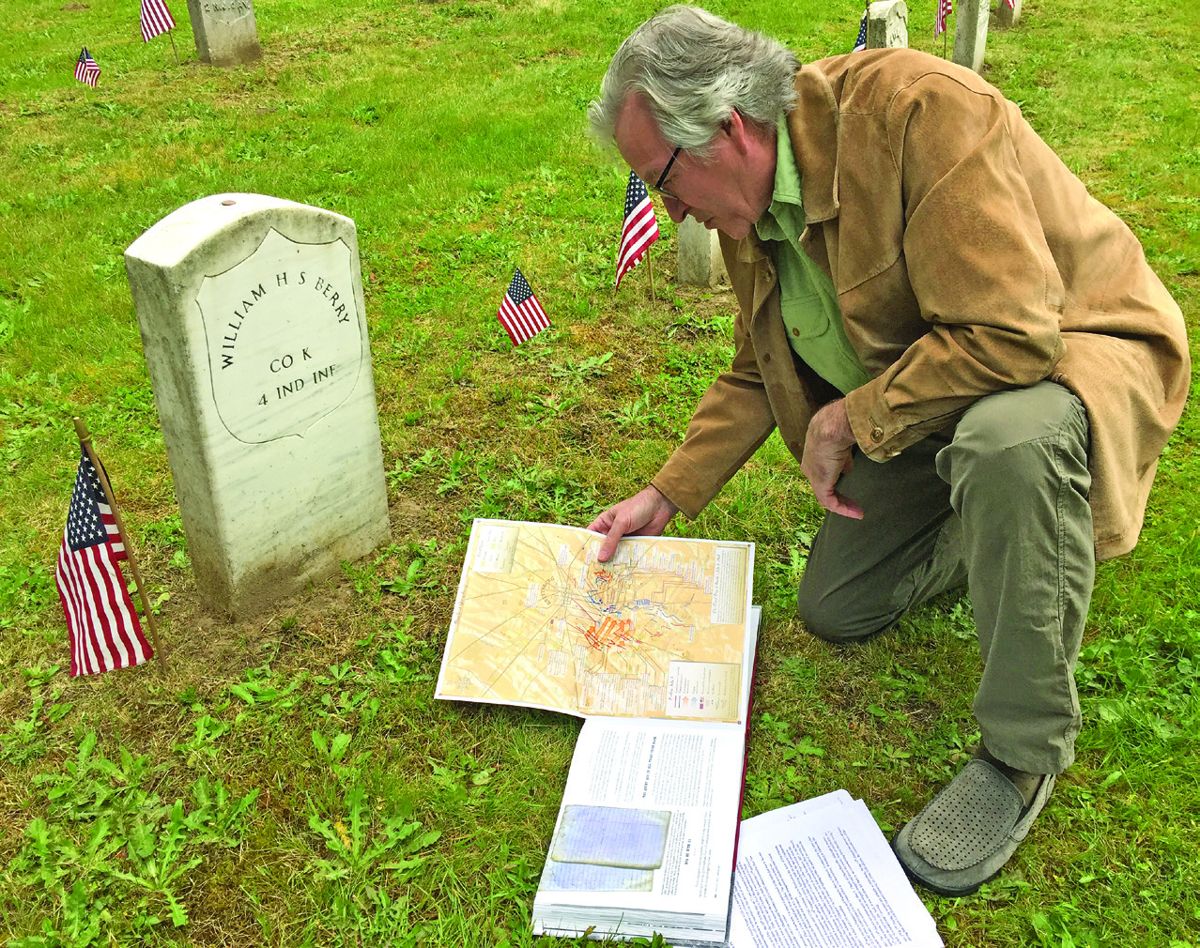
GETTYSBURG, Pa.—On Memorial Day I went looking for two soldiers who had fought for the Union at Gettysburg. I found them and a third, all in an improbable place, two hours south of Seattle just outside a rural village called Orting, Washington, surrounded by lush fields of hay and rows of strawberries. With snow-topped and spectacular Mount Rainer in the distance and tall Douglas firs straight as arrows standing sentry overhead, I searched gravestones fanning out in concentric circles on a quiet grassy hill, marking the final resting places of men from the nearby state soldiers home. I was looking for Albert O’Connor, one of only 32 Canadians of the 1,522 awarded the Medal of Honor for gallantry during the Civil War. I had come across his exploits while researching my book, Gettysburg 1863—Seething Hell. On the first day of battle on July 2, 19-year-old teamster O’Connor was ordered to lead ten mule-driven wagons loaded with 75,000 rounds of ammunition through cannon fire into the fields northwest of town where regiments of the Iron Brigade were in a smokefilled fury with North Carolina, Mississippi and Texas infantry. Wagons and mules were blown part. He survived. Known by his comrades for his derring-do, O’Connor once dressed in Confederate garb and prowled behind enemy lines for intelligence. Nearly two years after the Confederate disaster at Gettysburg, during the waning days of the collapse of rebel lines around Petersburg, at Gravelly Run, Virginia, Bert and his pal Bill Sickles, a distant relative of the notorious Tammany Hall general—both with the Seventh Wisconsin Volunteer Regiment, freed a Union officer from nine Confederates. The next day O’Connor killed a
Confederate officer single-handedly and captured his colors. O’Connor was immediately surrounded and taken prisoner. Two weeks later Lee surrendered. After the war, these two distinguished Medal of Honor comrades had ended up on the Pacific coast. When Sickles died in 1938, at age 93, he was the last living Medal of Honor recipient from the Civil War. And then I found the stone of an equally impressive individual named William H.S. Berry. Private Berry was a foot soldier in the 14th Indiana Regiment (his gravestone incorrectly says 4th). He enlisted days after his 20th birthday in Terra Haute, along with a younger brother. William was five foot three with gray eyes and dark hair. His record was not without blemish. In March 1862, while Berry was in his tent at camp in the Shenandoah Valley, fellow soldiers prodded an artillery shell with their bayonets. It exploded. The prank cut and bloodied his left forehead. “Who the hell shot one?” he yelled. Later that spring, Berry and a comrade were outside camp without permission and captured. He was jailed in a Richmond prison. When paroled he went absent without leave. He was captured for desertion by military police in Indiana, fined $25.97, and eventually sent back to his regiment in March 1863, still in winter camp in Falmouth, Virginia on the Rappahannock River. And then Chancellorsville, where a portion of Private Berry’s left index finger was shot off. And then later Gettysburg, where at twilight on July 2 the “Gallant Fourteenth” drove Confederates off the entrenched guns on Cemetery Hill in brutal hand-to-hand combat. After the war, William married Frances Viola Perkins of Ionia County, Michigan. They had six children, the first of whom they named William Tecumseh. William farmed and worked as a carpenter, over the years, hurt from a dislocated shoulder, a knee injury and a knife wound. He suffered from severe headaches from his 1862 head wound. In 1891 Berry applied for a war pension. He was repeatedly denied. In 1902 the 56-year-old broken-down and exhausted man had been reduced to working as a gate operator on the Pere Marquette Railroad. He wrote to the U. S. Army pension office that he had not done any manual labor in eight years: “I have tried to get a pension and get it honestly, but I have failed. I have used all my power and now I can’t do anymore so we will drop it and say no more. I can’t do anymore my memory is all gone.” The old soldier who as a young man had fought at Gettysburg said that tending railroad gates “pays enough to keep sole and body together and I hope my days on earth are few … I am so racked with pain all of the [time] and if I didn’t have this job I haft to go the soldier’s home or the poor house.” Into the 20th century, the Army finally granted William Berry a monthly pension of $8. This gave the Berrys an opportunity to homestead land in the West. He and Viola left Michigan and traveled to Yakima County, Washington, on the sunny side of the Cascade Mountains, where they cleared 50 acres of land, build a 10-by-18-foot home and planted eight fruit trees. In June 1908 William fell ill. He and Viola made the 265-mile trip to the Washington State Soldiers Home in Orting, where William joined some 400 veterans of the Civil War receiving food, care and companionship. Viola returned over the mountains to their home. She never saw him again. On the afternoon of October 25, 1908, he died. On the 148th anniversary of the first Memorial Day, I found him and his story. Thomas R. Pero is the author of Gettysburg 1863—Seething Hell: The Epic Battle of the Civil War in the Soldiers’ Own Words. The book was awarded the 2016 Bronze Medal for U.S. History by Independent Publisher at Book Expo America.