Gen. Sherman’s Blunder Led To McPherson’s Death
By Stephen Davis · Originally published August 2016 · pp. 18–19
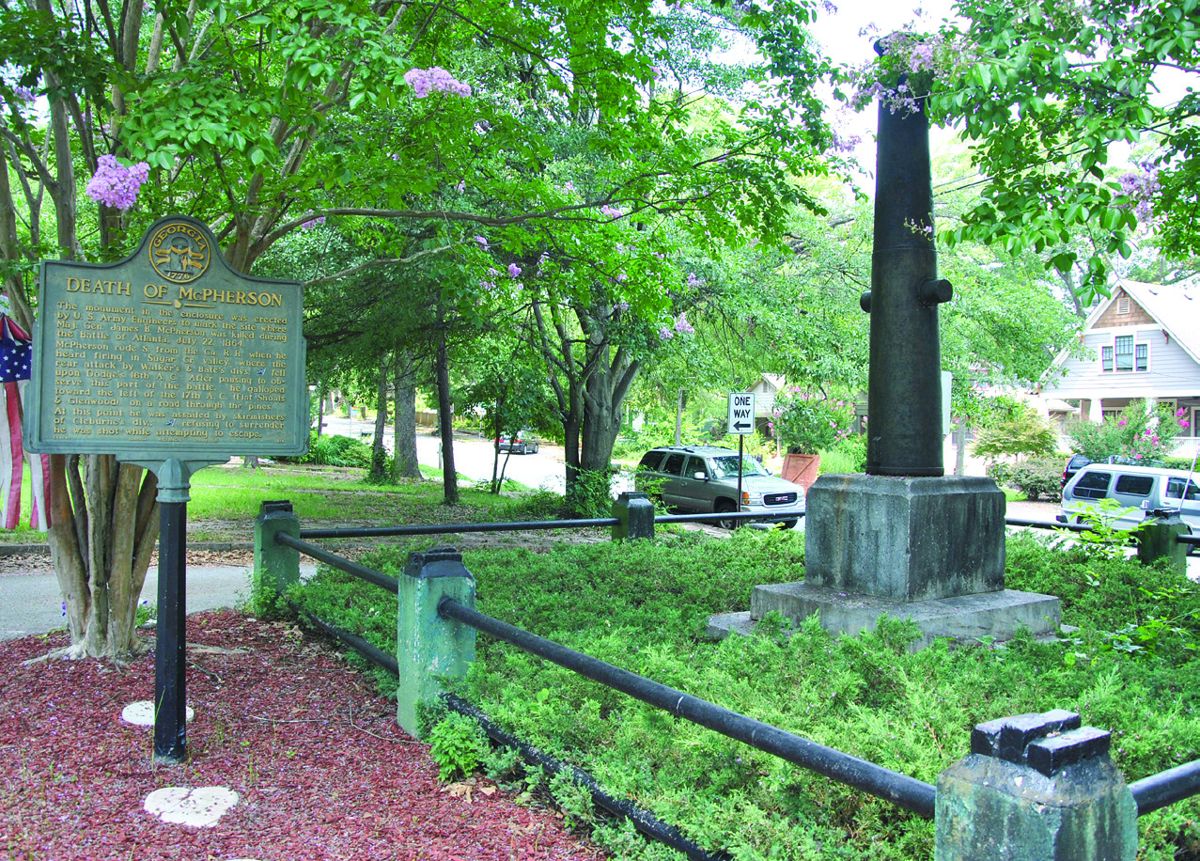
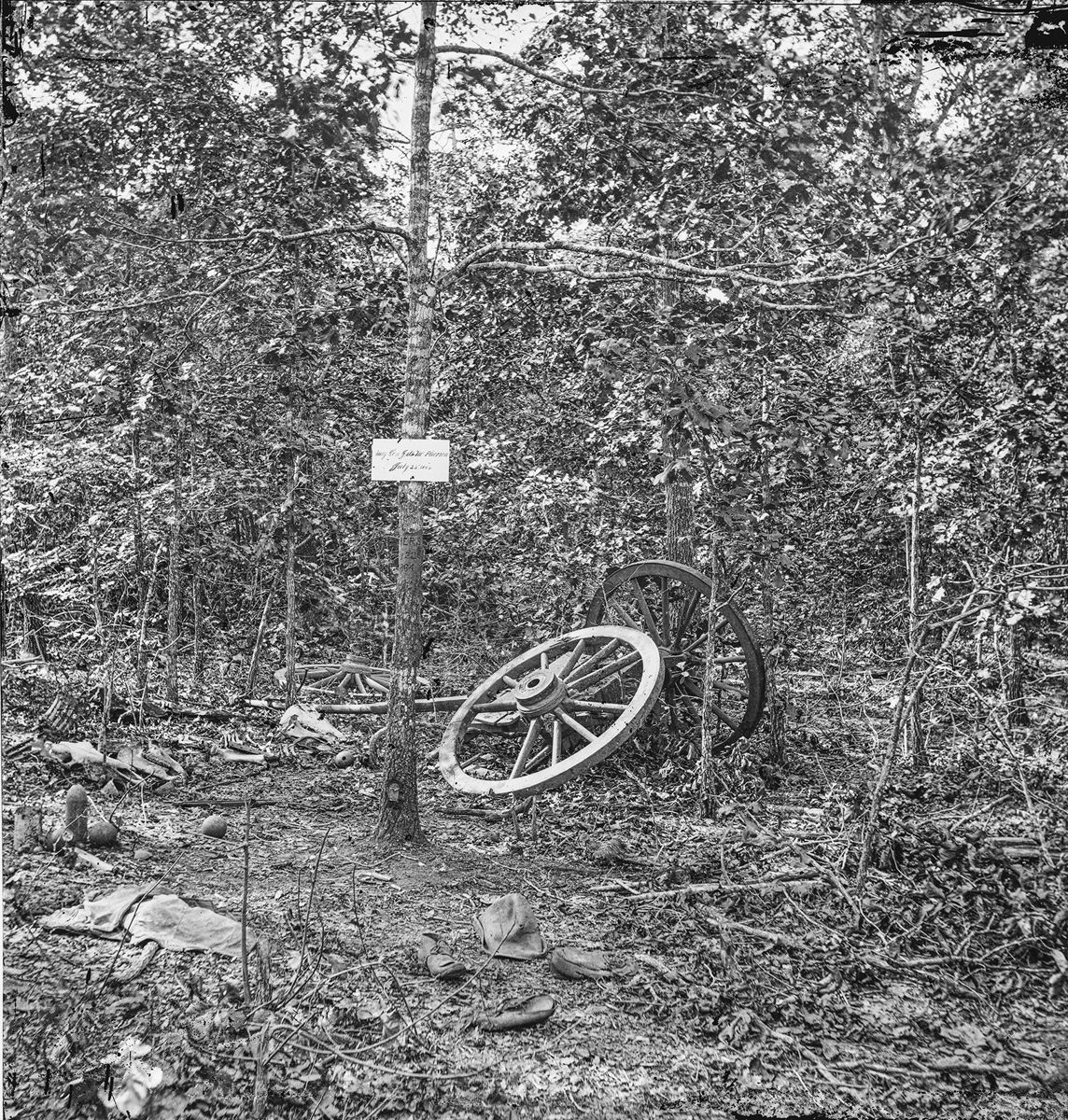
“McPherson dead!” Maj. Gen. William T. Sherman exclaimed on July 22, 1864, when officers told him that the commander of the Union Army of the Tennessee, Maj. Gen. James Birdseye McPherson, had been killed on the battlefield. “Can it be?” Sherman asked himself.1 He shouldn’t have been so incredulous. Although Sherman would not have realized it at the time, a command decision he personally made had brought on the Rebel attack in which his friend McPherson lost his life. Here’s how it happened. Two and a half months into his Georgia campaign, Sherman had pushed his army group from Chattanooga to the Chattahoochee. As his forces neared Atlanta in the third week of July, Sherman resolved not to attack Confederate Gen. John B. Hood’s Army of Tennessee in its fortified positions. Rather, he would force Hood out of Atlanta by cutting the railroads bringing supplies into the city and feeding the Rebels. There were three such iron lifelines. Atlanta’s rail link to Montgomery was severed in mid-July by Union cavalry raiding through east central Alabama. The two dozen miles of track wrecked by Maj. Gen. Lovell Rousseau’s troopers would not be repaired for more than a month. The Georgia Railroad, connecting Atlanta with Augusta, was broken on July 18 by Federal cavalry and infantry west of Stone Mountain. The infantry belonged to McPherson’s army, which was approaching
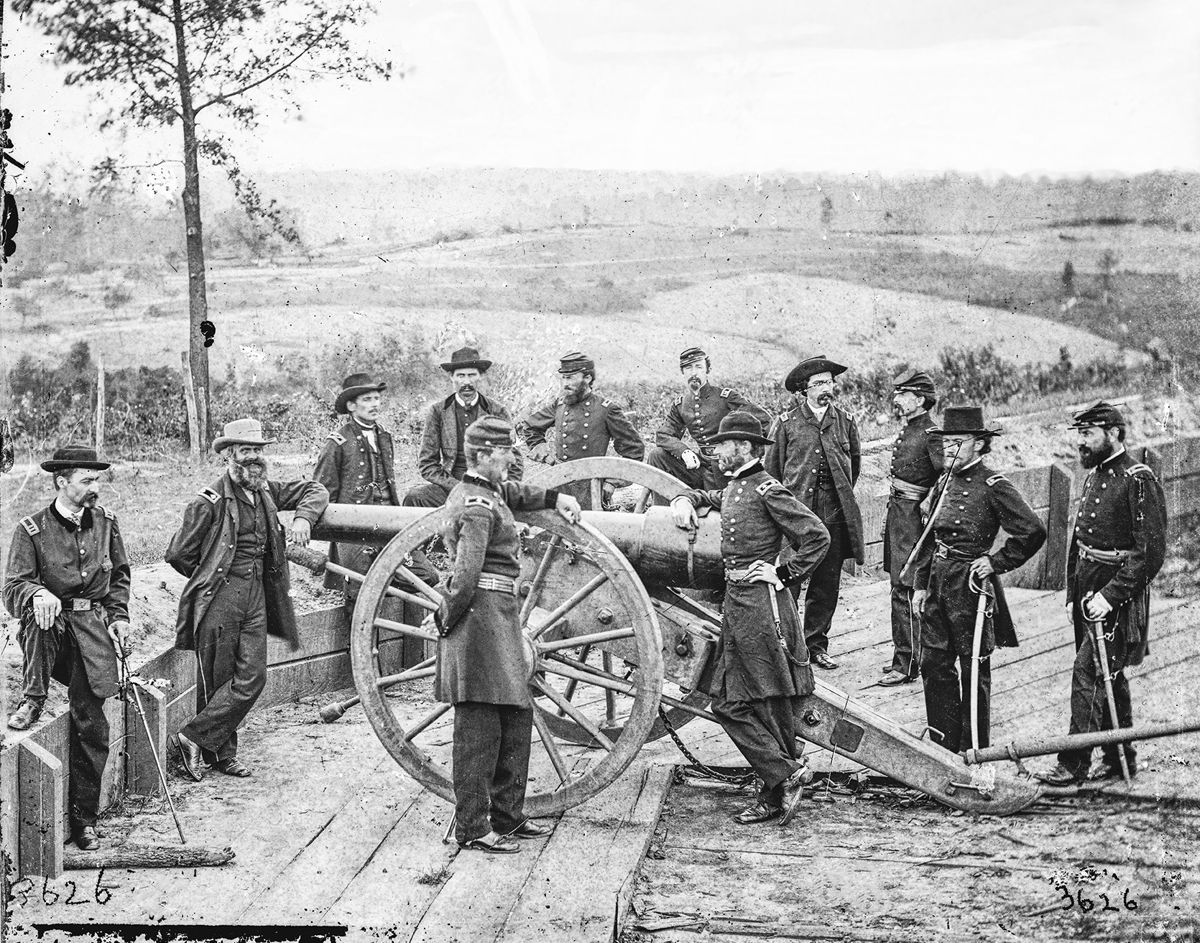
Atlanta from the east. For July 19, Sherman ordered McPherson’s troops to march along the railways, “tearing up track, burning the ties and iron, and twisting the bars when hot.”2 McPherson reported that on July 18 his men destroyed more than three miles of track. On the 19th they would have done more; the Georgia Railroad runs ten miles from Stone Mountain depot to Decatur alone. The breaking of Atlanta’s rail connections to Montgomery and Augusta left only one railroad supplying Hood and his army: the Macon & Western, which linked Atlanta to Macon, a hundred miles to the south. As McPherson approached Atlanta from the east, Maj. Gen. George H. Thomas advanced from the north. Hood attacked Thomas’ Army of the Cumberland on July 20 after the Federal infantry had gotten across Peachtree Creek. The Confederate assaults were repulsed. As his forces neared Atlanta’s defenses, Sherman turned his eyes again to the Georgia Railroad. During the night of July 20-21, he issued orders for Brig. Gen. Kenner Garrard to take his cavalry division off toward Covington, about thirty-five miles east of Atlanta, to burn railroad bridges and tear up more track. The problem for McPherson was that Garrard’s horsemen had been guarding his army’s left flank. When Sherman sent Garrard off toward Covington – the troopers set out about 1:30 p.m. on July 21 – Sherman was leaving McPherson’s flank unprotected and “in the air.” Mac pointedly informed Sherman of this fact, but the army group commander took no steps to better the situation. A worried McPherson sent warning to Maj. Gen. Frank Blair, whose XVII Corps held the far left, at 5:30 on the afternoon of the 21st. “Impress upon the command the importance of being on the alert at all times to repel an attack,” he ordered with great prescience, “especially about daybreak.” Blair complied. “Unusual precautions were deemed essential,” he later wrote, “from the absence of our cavalry force from this flank.”3 McPherson’s concerns extended to his army’s wagon trains, which were parked at Decatur, six miles east of Atlanta. Fearing Rebel cavalry might swoop down upon them; McPherson ordered XVI Corps commander Maj. Gen. Grenville Dodge to send an infantry brigade there to protect the trains. Sometime that afternoon Maj. Gen. Joseph Wheeler, Hood’s cavalry chief, brought in to headquarters the vital intel on the enemy’s exposed flank. Hood quickly formed a plan to exploit Sherman’s blunder. The Confederate army, then occupying an outer defensive line south of Peachtree Creek, would withdraw during the night of the 21st-22nd into the main perimeter of fortifications surrounding the city. Lt. Gen. Peter Stewart’s corps would hold the north front and Maj. Gen. Frank Cheatham’s corps the east. Lt. Gen. William J. Hardee’s corps, largest of the three, would march through the city in the night, then south of it before swinging northeast on a route intended not only to turn McPherson’s flank but get into his rear. Then, on the morning of July 22, Hardee would attack. Hood hoped that his assault would roll up the Yankee line just as Stonewall Jackson’s flank attack at Chancellorsville in May 1863 had routed Maj. Gen. Oliver O. Howard’s XI Corps. But the Federals’ lack of apprehension which favored the Southerners’ surprise attack in Virginia was not present in Georgia a year later. On the evening of the 21st McPherson ordered a brigade of Dodge’s XVI Corps to take position perpendicular to Blair’s line, refusing it so as to face south against a possible enemy attack. Sherman learned of McPherson’s precautions and about 7 or 7:30 a.m. sent him a note. “General,” it began. “Instead of sending Dodge to your left, I wish you could put his whole corps at work destroying absolutely the railroad back to and including Decatur.” “I want that road absolutely and completely destroyed,” Sherman added.4 (A quarter-century later, Lt. Col. William E. Strong, McPherson’s staff officer, published this letter, which was still in his possession. For this reason it does not appear in the Official Records.) That morning a Federal signal officer on a treetop observation platform saw dust clouds from enemy infantry – Hardee was getting in position. He reported this at 10 a.m. McPherson now knew what was coming and dispatched an infantry division (Brig. Gen. Tom Sweeny’s) to extend the refused line attached to Blair’s flank. McPherson then went to Sherman’s headquarters to try to talk him out of his order sending Dodge’s infantry to wreck the railroad. He apparently succeeded, then rode off toward the sound of unexpected musketry – Hardee was launching his attack. But then McPherson got another message, this one also in Sherman’s own hand, agreeing that Sweeny’s division could stay where it was, but that he wanted the rest of Dodge’s troops “back on the line of the railroad between here and Decatur to destroy it. In telling this part of the story, Union Capt. Rowland Cox later commented, “the importance of the destruction of the railroad more than the safety of his flank was still in General Sherman’s mind.”5 Taking off with his staff toward the sound of the firing, General McPherson rode right into Maj. Gen. Patrick Cleburne’s advancing infantry. Called to halt and surrender, Mac turned about and was shot in the back; the bullet exited his chest. He fell to the ground and died within minutes. Later, Federal officers retrieved his body and brought it to Sherman’s HQ. “McPherson dead! Can it be?” Sherman later wrote, “The country has lost one of its best soldiers, and I have lost my best friend.”6 Cump Sherman, blame yourself. Had you not sent off Garrard’s cavalry on a needless, redundant raid against the Georgia Railroad, Hood would not have had that flank “in the air” to attack on July 22. And that morning, when your fixation with railroad-wrecking hampered McPherson’s deployment for the attack he knew was coming, you sealed his doom. “Let no guilty man escape,” Ulysses S. Grant wrote after the war.7 Grant’s friend Cump Sherman, however, seems to have.
End Notes: 1. Albert Castel, Decision in the West: The Atlanta Campaign of 1864 (Lawrence KS, 1992), 400. 2. Special Field Orders No. 37, July 18, OR, vol. 38, pt. 5, 179. 3. McPherson to Blair, July 21 (5:30 p.m.), OR, vol. 38, pt. 5, 220; Blair report, [undated] 1864, OR, vol. 38, pt. 3, 544. 4. William E. Strong, “The Death of General James B. McPherson,” in Sydney C. Kerksis, comp., The Atlanta Papers (Dayton OH, 1980), 515. 5. Rowland Cox, “Snake Creek Gap, and Atlanta,” in Kerksis, comp., Atlanta Papers, 344. 6. Gary Ecelbarger, The Day Dixie Died: The Battle of Atlanta (New York, 2010), 211. 7. Ulysses S. Grant 3rd, Ulysses S. Grant: Warrior and Statesman (New York, 1969), 335.