
The Source
Dyer’s Compendium
By Michael K. Shaffer · Originally published August 2016 · p. 7
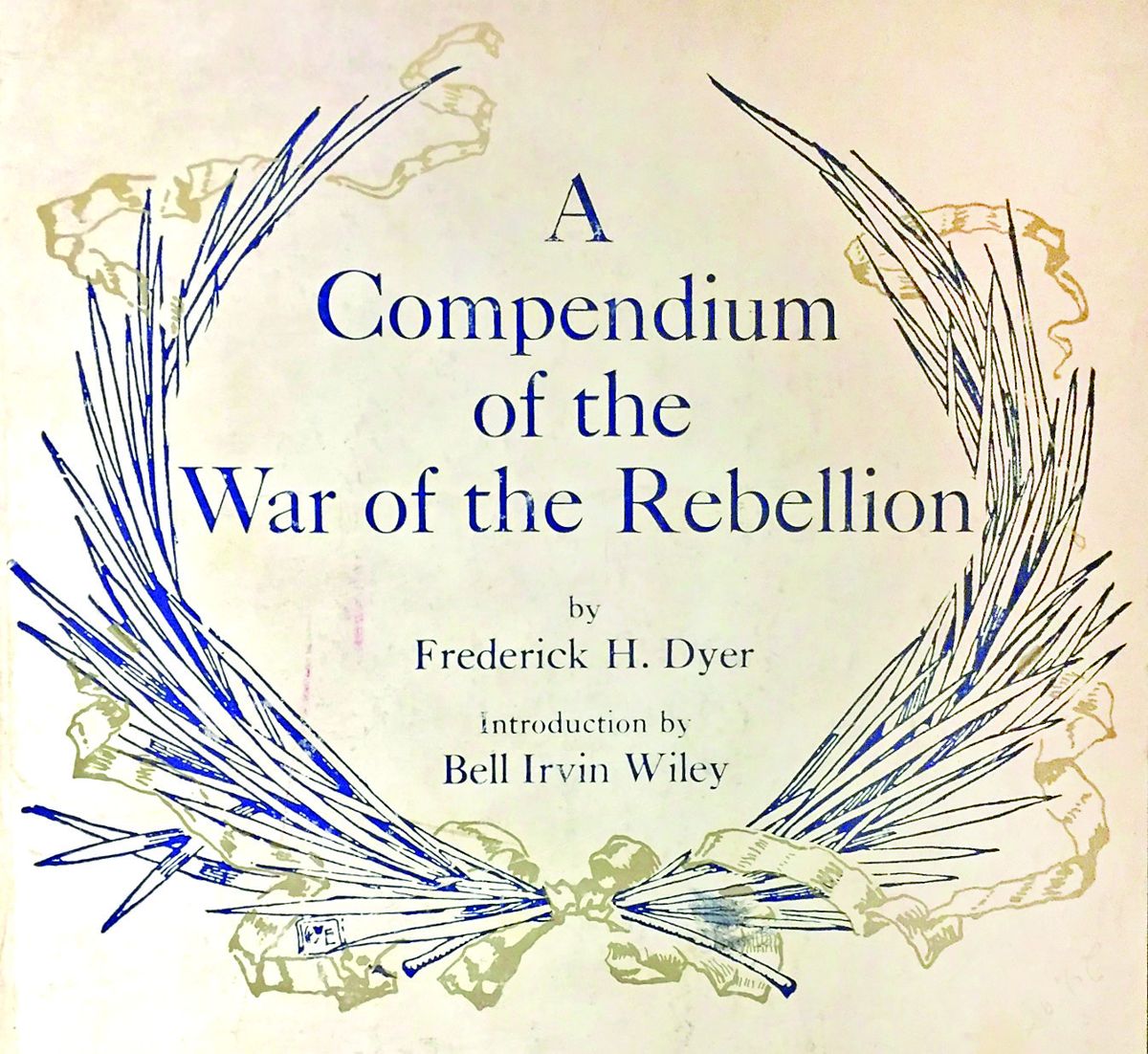
In last month’s column, we explored Selwyn Brant’s The Union Army. An equally helpful research tool exists in Frederick H. Dyer’s A Compendium of the War of the Rebellion. (The title proves somewhat deceptive, as the author focused almost exclusively on Federal information; little to no Confederate records.) Dyer, a veteran of the 7th Connecticut Infantry Regiment (he fought under the assumed surname of Metzger), began amassing various resource materials soon after the end of the war. He spent 40 years scouring the country, collecting regimental reports, gleaning newspaper accounts, consulting the Official Records, and talking with other veterans. Finally, Dyer began what resulted in a five-year writing project, even while working virtually around the clock to complete his compendium. When used in conjunction with Brant’s work, researchers can access much information on the various Federal armies and their actions during the conflict. Originally published in 1909, the work resulted in a massive tome of 1,796 pages; the single book weighed 10 pounds. In 1959, under the guidance of Bell Wiley, a three-volume reprint emerged just before the centennial; Morningside published another edition in 1978. This article references the 1959 version but remains applicable to any of the three versions in print. Volume one begins with various tables containing statistical information on troops each state provided, as well as causalities per state. A brief section on the National Cemeteries follows, then a listing of Federal regiments raised from each state. (See example page.) Following the segment mentioned above, Dyer provided a listing of all
Regiments by State page. regiments incurring 50 or more casualties. A full portion comes next and contains detailed histories on the various commanding officers. For example, with George Meade, researchers will see he served with the Second Brigade of McCall’s Division, and progressed to command the Army of the Potomac; Dyer provided seven other assignments for Meade before he replaced Joe Hooker. A helpful regimental index comes next; more on regimental histories in volume three, but this section in volume one serves as a quick-reference. Concluding volume one – a portion entitled ‘Military Divisions and Departments. One can trace the history, for example, of the Department of the Cumberland, from Brigadier General Robert Anderson’s assignment after Fort Sumter to Major General George Thomas taking the helm in October 1863. Volume two opens with a most useful index of military actions listed alphabetically. For example, under Gettysburg, one will see a skirmish on October 11, 1862; the campaign,
Sample page from Vol. Two.
June 3 – August 11, 1863; a June 26, 1863, skirmish; and finally, the battle of July 1-3, 1863. Dyer includes minor actions not found in most other sources, making this a beneficial addition to his work. The remainder of volume two contains, in alphabetical order according to state, an alphabetized/chronological listing of military action. (See example page.) Researchers will need to spend a little time getting acclimated to the layout of this section. Make sure to focus initially on the names of the various engagements (in alphabetical order) instead of the dates. In the middle of these battle listings, Dyer included 90 pages of photographs and maps – some familiar to researchers, others more obscure. Rounding out the compendium, volume three, ‘Regimental Histories;’ Bell Wiley considered this section “…so great no other justification would have been needed for republication of the Compendium than to make these unit histories available to the many persons who have the Civil War as a field of special interest.” Again, alphabetized according to state, researchers can obtain valuable information from this volume. As the shown example for the 9th Illinois Cavalry Regiment indicates, an A-to-Z synopsis of each regiment’s service contains much information. Finally, users can consult the index at the end of the last volume to find information in all three volumes. This writer will leave you with the words of Dyer as he completed his years of work. “Well, here’s my pile of manuscript – thousands of sheets, millions of words, involving the examination of 10,000,000 names and dates, every line of it prepared by myself without the aid of a secretary or even a stenographer. I hope that it is worth the while.” Mr. Dyer, job well done indeed; worth the while for anyone wishing to broaden their research into the American Civil War! Remember to check WorldCat http://www.worldcat.org/ for help in finding this work in a local library. Search: ‘Dyer’s Compendium,’ to locate this helpful source! Next month, we will continue to examine other primary source materials, and please keep suggestions for future ‘The Source’ columns coming! You may send them to the e-mail address shown below. Good luck in your research!
9th Illinois Cavalry page.
Michael K. Shaffer: a Civil War historian, author, lecturer, and instructor, remains a member of the Society of Civil War Historians, Historians of the Civil War Western Theater, and the Georgia Association of Historians. Readers may contact him at [email protected], or request speaking engagements via his website www.civilwarhistorian.net. Follow Michael on Facebook www. facebook.com/michael.k.shaffer and on Twitter @michaelkshaffer.