
Book Reviews
Book Reviews — August 2016
Originally published August 2016 · pp. 25–34
Fort Fisher: The Battle for the Gibraltar of the South. By Greg Ahlgren. Historical fiction. 194 pp., 2016, Pen-L Publishing, www. pen-L.com, $14.97 softcover.
In January 1865, the Union army and navy attacked Fort Fisher, the only obstacle between the Federals and Wilmington, N.C. Wilmington was the last port remaining open to blockade runners and was a major supply route for Robert E. Lee’s Army of northern Virginia. Greg Ahlgren’s historical novel tells the story of the battle for this fort, which was called the Gibraltar of the South. The story is told through the eyes of many observers. Among them is young Confederate artillery sergeant
SHARPSHOOTER
Caleb Cuthbait, a Wilmington native and part of the fort’s garrison. Another is a young Wilmington widow, Elizabeth Tuckerman, the woman Caleb loves. Other participants are some seamen on the Federal gunboat USS Iosco. They include Nat Davis, an escaped slave, and Irish immigrants Patrick Sheedy and Seamus Flanagan. Two more are privates Jim Jeffereds and William Carney of the 27th Regiment, U.S. Colored Troops. This volume admirably tells the story of the Battle of Fort Fisher. There are very few incongruities. One is a pair of references to a general, instead of a colonel, as a regiment commander. Another that struck me as odd are a few of the choices for messengers. It seems strange to select a 14-year-old drummer boy or a random stretcher-bearer for such important roles. I liked this book because it presents an excitingly told story. I do wish Ahlgren had spent more time on the back stories of the characters. It is difficult to feel much empathy toward some of the major characters when so little is known about them. Still, I enjoyed this volume and believe others will as well. Reviewer Robert L. Durham spent most of his career at the Defense Logistics Agency. He has written book reviews and articles for numerous historical blogs and publications.
The Half Has Never Been Told: Slavery and the Making of American Capitalism. By Edward E. Baptist. Illustrated, maps, photos, figures, tables, notes, index, 526 pp., 2014, Basic Books, www.basicbooks.com, $35.
This extensive study of American slavery is a “must-read” book for readers interested in that topic or the causation of the Civil War. In fact, it is so important that most Americans should read it. Edward Baptist demonstrates that slavery was a vital, perhaps the vital, driver of the United States economy in the antebellum period. The value of slaves represented a large proportion of the nation’s wealth – about 17 percent in 1790 and reaching 19 percent in 1860 (about $3 billion of the nation’s $16 billion total wealth). Millions of slaves were needed over time to start and expand the production (planting, weeding, harvesting, and shipping) of cotton from the Deep South. Northern and British banks made their purchase possible by extending credit to plantation owners and taking back mortgages on the slaves. The demand for slaves was so great that, with ups and downs, their per capita value doubled from 1800 to 1860. Because they were more valuable to produce cotton in the Deep South than they were in the earlier slavery regions, there was a massive involuntary movement of perhaps a million slaves from Virginia, Maryland and North Carolina to the cotton states. This huge human movement usually involved breaking up families to primarily move just ablebodied males and usually attractive young women suitable for rape and child-bearing. Since slave “marriages” had no legal standing and slaves’ other family relationships were not legally recognized, there was nothing to prevent their being taken from loved ones and sold as property. Many were initially sold to slave-traders, who marched or otherwise transported them hundreds of miles to their new workplaces. Baptist uses cotton-picking ledgers and other records to demonstrate how a “whipping-machine” system was developed on cotton plantations to impose ever-rising production quotas that were enforced by whippings and resulted in astounding production increases. The Deep South 10-foot cowhide whips tore through skin and flesh in a manner that constituted torture. Slavery was enforced, in part, by beatings, brandings, other punishments, torture, murder, rape, restrictions on activities of slaves and free blacks, and anti-runaway slave patrols. Cotton’s profitability made ending these practices most unlikely. In the 1850s Southern cotton production, says Baptist, increased from two to four million bales. By 1860, Southern U.S. slaves were picking two-thirds of the world’s cotton. There was no sign that slavery was becoming less profitable or that is was going away. In, fact, its U.S. expansion to Cuba and other areas was widely supported. Baptist writes that in 1860 the eight wealthiest states, in terms of wealth per white person, were South Carolina, Mississippi, Louisiana, Georgia,
Connecticut, Alabama, Florida and Texas. Seven were cotton states, and Connecticut was a large manufacturer of equipment used on cotton plantations. Not coincidentally, those seven Deep South states were the seven states that seceded from the U.S. between Abraham Lincoln’s 1860 election and his 1861 inauguration. Some errors appear in the book’s wrap-up chapter. The Union victory at Port Hudson did not precede the capture of Vicksburg. Congress passed the 13th Amendment in January, not March, 1865, and that amendment did not take effect until ratified by sufficient states in December 1865. It was the Freedmen’s, not Freedman’s, Bureau. These do not detract from Baptist’s fine study of the institution of slavery. In summary, Baptist makes a compelling case for the economic significance of slavery to the entire United States, particularly to the Deep South states, right up to the time of Southern secession. He also shows its cruel, degrading and family-destroying nature and the likelihood of its continuance in the absence of revolutionary societal developments – such as secession or a civil war. Baptist destroys many myths about slavery’s supposed beneficence and its alleged 1860 pending demise. His work is one of the classics on American slavery. Reviewer Edward Bonekemper is Civil War News Book Review Editor and author of six Civil War books, including The Myth of the Lost Cause: Why the South Fought the Civil War and Why the North Won.
Civil War Adventure. By Chuck Dixon and Gary Kwapisz. Map, timeline, graphics, 140 pp., 2015, Dover Publications, www.doverpublications.com, $9.95 softcover.
diplomat whose work strongly influenced the direction of future U.S. foreign policy and contributes substantially to the study of American international relations.
is a former U.S. Foreign Service officer who worked on several presidential visits and summit meetings during her years with the Department of State. After leaving the diplomatic service, she taught American foreign policy at the University of Virginia, was a professor of grand strategy at National Defense University, and retired in 2014 as a professor of national security studies at Air University. Since 1985 she has been a frequent practitioner of public diplomacy for the U.S. Information Agency and the Department of State. Campbell’s numerous publications include Germany’s Past and Europe’s Future: The Challenges of West German Foreign Policy and The Relevance of American Power: The Anglo-American Past and the Euro-Atlantic Future.
“Bringing to her subject impeccable credentials and keen insight as a former diplomat and as a professional historian, Edwina Campbell finally sets the record straight on the importance and meaning of Ulysses S. Grant’s 1877–79 world tour. In her lucid and fast-paced book Campbell makes clear that as his country’s ‘ambassador at large’ Grant pioneered the practice of public diplomacy. He was the first—and far from the last—former U.S. president to engage with people of other countries and cultures, from common people to businessmen to national leaders. This volume both adds to the growing revisionist scholarship on Grant and confirms that those who dismiss the contributions and legacy of the eighteenth president do so at their own peril.” —John David Smith, author of Lincoln and the U.S. Colored Troops “Campbell examines the world tour taken by former president Ulysses S. Grant in the context of changes that occurred both globally and within the United States rather than as a sunset experience for a diminished past president somewhat down on his luck. Grant and his contemporaries realized the Civil War and the political, economic, and social changes that paralleled and followed it had empowered the United States and its place in the world. They sensed, too, that the world around them was changing. Grant’s trip had elements of a vacation, but Campbell convincingly shows it was also a strategic assessment undertaken by one of a handful of Americans who had the necessary experience and perspective. This is an important book, not only for scholars of Grant but also for students of U.S. foreign policy, the latter part of the nineteenth century, and the evolution of the role of presidents in and out of office.” —Kenneth B. Moss, professor emeritus, National Security Studies, National Defense University
“Citizen of a Wider Commonwealth is the untold story of Grant’s postpresidential ‘world tour,’ a diplomatic mission that sought to position the United States for the power and influence it would wield in the twentieth century. Must reading for anyone interested in the forces shaping American foreign policy as the continental power took its place on the world stage.” —Charlotte Ku, Texas A&M University School of Law
$34.50 USD ISBN 978-0-8093-3478-0
Printed in the United States of America www.siupress.com
Campbell_jkt_mech.indd 1
Gettysburg, July 2:
The Ebb and Flow of Battle
Mercury Supply Company Sutler Uniforms • Accoutrements
Citizen of a Wider Commonwealth: Ulysses S. Grant’s Postpresidential Diplomacy tragedy even off the battlefield. These themes of humor, family Citizen of a Wider Commontragedy, lost loved ones, courage wealth: Ulysses S. Grant’s Postand pathos dominate the incidents presidential Diplomacy. By Edwiincluded. na S. Campbell. Illustrated, photos, Additional chapters include a bat- maps, appendix, notes, bibliography, tle of ironclads on the Mississippi, index, 278 pp., 2016, Southern Illithe death of a practical-joking sol- nois, www.siupress.com, $34.50. dier, and the primitive medical care that caused so many deaths during Campbell the war. Each story is followed by factual Citizen of a Wider Commonwealth data relevant to the incident, a time line of events, or data on casualties Edwina S. Campbell Ulysses S. Grant’s that assist readers in putting the story in historical context. Postpresidential Diplomacy A few historical and grammatical Edwina S. Campbell errors are evident. Trevilian Station is spelled three different ways. General Cocke commanded the 5th, not the 4th, Virginia Cavalry. Secession, not succession, was opposed in theory by Col. John S. Mosby. The Confederacy never flew an eight-star flag. George Armstrong Custer was promoted to brigadier general from This book is an illustrated antholo- first lieutenant (acting captain), not gy in cartoon format. Ten events are colonel. This book is recommended portrayed to acquaint young readers with significant, tragic or memorable for those 8-12 years old who could benefit from an illustrated events of the Civil War. The number of revisionist Ulysses Col. John Mosby’s capture of introduction to the Civil War. For S. Grant studies continues to grow. Union Gen. Edwin H. Stoughton il- readers desiring more than superficial This volume, the latest in The World lustrates the humor that can be found entertainment, this book provides no of Ulysses S. Grant series, covers new facts, interpretations or primary the often overlooked world tour by in a brutal war. The Shenandoah campaign of hard source material. Grant after his presidency. war brought home the savagery of As Edwina S. Campbell points battle to soldiers’ families and other Reviewer Wayne L. Wolf is out, historians often dismiss this pecivilians. Professor Emeritus at South riod as a sightseeing tour by Grant, Gen. George A. Custer’s “first Suburban College and the author his wife Julia and others in his party. stand” at Trevilian Station portrays of numerous books and articles Too many see their travels as merethe making of heroes from bold and on the Civil War including The Last ly a time for adulation, triumph and aggressive actions. Confederate Scout and Two Years curiosity. Gen. Philip St. George Cocke’s Before the Paddlewheel. He is past As the title indicates, however, suicide demonstrates how battlefield president of the Lincoln-Davis Grant used the trip as an exercise in horrors could result in personal Civil War Roundtable. diplomacy, a chance to meet with world leaders and observe varying cultures and societies as a measuring “A must-have reference tool for anyone wishing stick for the future United States role to understand the second day at Gettysburg” CWN in world affairs. Grant’s itinerary was extensive and expanded beyond his original plans. His first stop via water was England, and his last port was San BY JAMES A. WOODS Francisco, from which he traveled Follow the movements of each Union and Confederate by land to Philadelphia, his starting regiment and battery during the entire 24 hour period, often on a point. It was truly an around-theminute-by-minute basis. 164 full page maps with an additional 9 world trip. detailed maps depict the battle as never before attempted. Certainly all his time was not focused on conferences; there were Preview sample pages on our website: www.gettysburgjuly2.com touristy opportunities available and ORDER YOUR COPY TODAY: $38 (plus $3.99 s/h) taken advantage of by the Grants. Canister Publishing | P.O. Box 43 | Gillette, NJ 07933 In a brief review it is impossible Paypal • Amazon • B&N to cover the particulars of each Grant Hardcover 8.5” x 11” | 735 pages stop. It is more useful to sum up his Illustrations, Index, Appendices, Bibliography diplomatic acumen. Grant’s contributions to United States diplomatic history are the most significant aspect of his travels. The former president kept an ear open for political news; many of his supporters hoped to see him nominated by the Republican Party for a third term. That did not happen, but he did, for the first and only time in his life, campaign for the party’s nominee, James Garfield. He refused to accept any possible position that might be 101 Lee Street | Livingston, TX 77351 offered by Garfield. His mind was 936-327-3707 • mercurysutler.com • [email protected] still on the state of his country’s relations with other countries. Grant determined during his jourU.S. Made Uniform Combo 7 Items $235.00 ney that future positive relations with other countries depended on a new approach to diplomacy. He could see that American representatives to foreign nations needed to be better prepared and more professional in their work. They must not be mere political appointees accepting appointments as rewards for their political affiliations. They needed to inform themselves about the culture, politics and world views of whatever country they were assigned. Grant thought this was especially important regarding Middle East countries, as well as Japan and China. American legations with provincial outlooks could not deal with the growing complexities of relations with other countries. Many of the countries Grant visited had colonial status and were ready to break loose and seek a place for themselves in future international relations. Grant quickly understood that. He knew if the United States government focused solely on Europe, many problems would result with those emerging countries. Because many Americans were of German descent, positive relations with their native country were important. Nevertheless, Grant’s observations of German militarism had to make him nervous as he pondered the future. Yet, he kept his thoughts private rather than say or do anything that might damage relations between the two nations. Aside from the future ramifications of German militarism, Grant expressed concern over situations in Japan and China. Europe had mistreated both countries and looked at the two more as colonies than equals. China and Japan also had developed bad relations. Grant cautioned leaders in both governments to move slowly, to work with each other, to take small, positive steps forward to gain influence among nations. In 1877 former president Ulysses S. Grant, along with his family and friends, embarked on a two-year world tour that took him from Liverpool to Yokohama with stops throughout Europe and Asia. Biographies of Grant deal briefly, if at all, with this tour and generally treat it as a pleasure trip filled with sightseeing, shopping, wining, and dining. Far from an extended vacation, however, Grant’s travels in fact constituted a diplomatic mission sanctioned by the U.S. government. In this revealing volume, Edwina S. Campbell chronicles Grant’s journey—the first diplomatic mission ever undertaken by a former U.S. president—and demonstrates how it marked a decided turning point in the role of the United States in world affairs. Grant met with monarchs, ministers, and average citizens, creating the model for the summitry and public diplomacy practiced by future American presidents while articulating concepts of national self-determination, international organization, and the peaceful settlement of international disputes decades before Elihu Root’s advocacy of binding international arbitration and Woodrow Wilson’s proposal for the League of Nations. Campbell reveals Grant to be a skillful envoy who brought to his travels the deep interest in foreign policy issues he had shown during his administration. By illuminating the significance of Grant’s often overlooked postpresidential travels, Citizen of a Wider Commonwealth establishes the eighteenth president as a key
2/2/16 12:15 PM
He especially warned Japan about adopting policies of conquest. The leaders did not listen, and they led their countrymen into a 20th-century bloodbath. Grant had shown his visionary skills in diplomacy to be good ones, but he could not force anyone to listen. Some leaders welcomed Grant’s observations and counsel. Others ignored him, and, though he would not live long enough to see negative or positive results, he would not have been surprised. In many cases, he certainly would have been disappointed. Grant would have agreed with the words of future Secretary of State Elihu Root that progress in universal travel and communications made countries members of the community of nations. How nations reacted to that truth would be up to them. If Grant’s advice to world leaders had been handed down to future heads of state, perhaps many tragedies could have been avoided. The story of Grant’s diplomacy during his world tour is fascinating and certainly illustrates his ability to analyze situations and offer his views wherever possible. Despite damages from betrayals by men he trusted during his presidency, his skills as a leader were displayed many times during his world tour. Campbell provides insightful analysis as she explores the human sides of a story too long forgotten. Deeply researched in primary sources at the Ulysses S. Grant Presidential Library at Mississippi State University, this book shows that Grant’s abilities were not confined to the battlefield or the oval office. Reviewer Michael B. Ballard is Professor Emeritus of Libraries, Mississippi State University, and author and editor of 14 books.
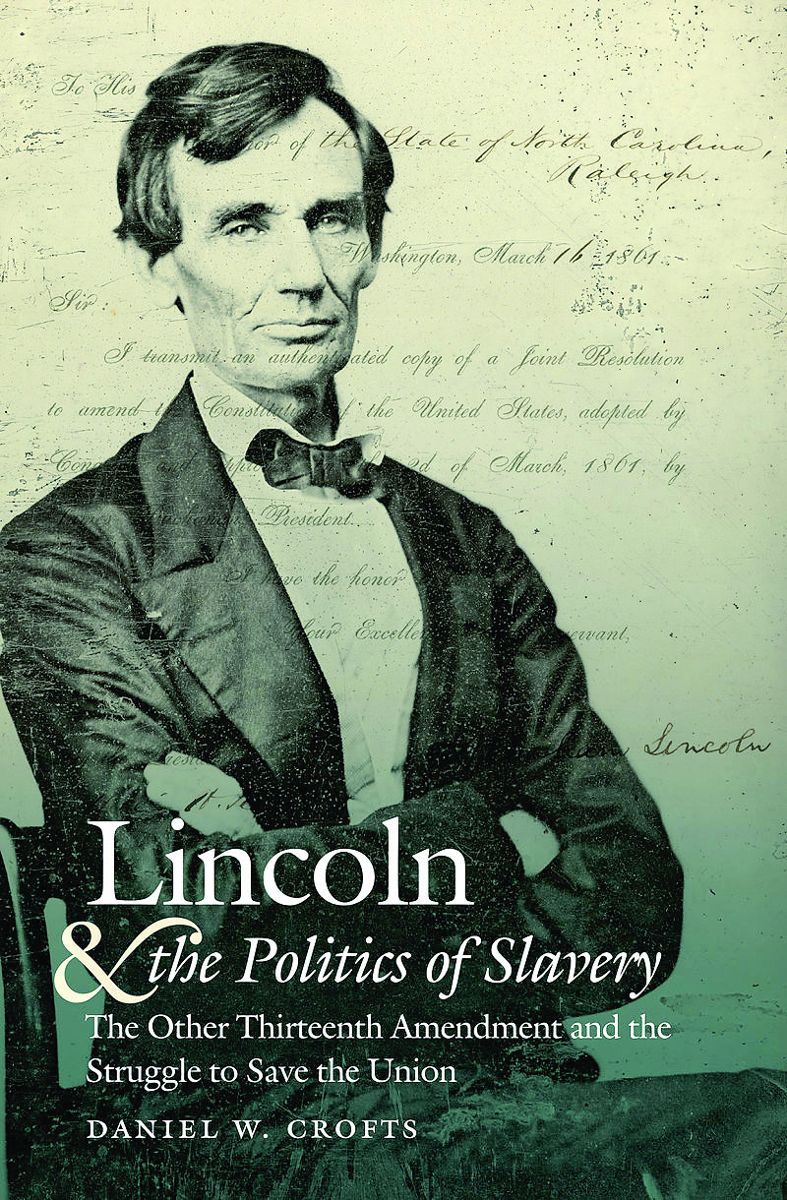
Lincoln and the Politics of Slavery: The Other Thirteenth Amendment and the Struggle to Save the Union. By Daniel W. Crofts. Illustrated, photos, table, bibliography, notes, index, 368 pp., 2016, North Carolina, www.uncpress.unc.edu, $35.
It is difficult enough to write about the events that happened; it is much more difficult to write about those that didn’t. This, however, is the task undertaken by Daniel Crofts, who is probably best known in Civil War circles for fingering William Henry Hurlbert as the author of the anonymous Diary of Public Man. With the same insouciance he showed in putting flesh on an author who hadn’t existed, Crofts now does likewise for a constitutional amendment that was never ratified. Croft examines the original 13th Amendment, the so-called “Corwin Amendment.” It was named for the chairman of the Committee of Thirty-Three who struggled in the interval between Lincoln’s election and inauguration to confect a constitutional amendment that would placate Southern secessionists and avert civil war. Squeaking past a bitterly-divided Senate just seven hours before Lincoln’s inauguration, the amendment provided that Congress would never be permitted to “abolish or interfere, within any State, with the domestic institutions thereof, including that of persons held to labor or service by the laws of said State.” Effectively, slavery in the slave states would have an iron-clad protection from Federal intervention and supposedly all reason for those states to secede from the Union would be removed. Not that this effort impressed many onlookers. Only one state – Kentucky – ratified the Corwin Amendment before Fort Sumter made moot the scramble for conciliating the South. What Croft finds remarkable in unwinding this path that headed nowhere is how many prominent anti-slavery people chose to walk down it while an equal number of pro-slavery Southerners fought it to the last vote. This misalliance occurred, Crofts explains, for two reasons. First, too many Southerners believed that the North had been captured by abolitionism and was using the amendment to sucker the South into laying aside its weapons. Second, too many Northerners could not believe that Southerners were serious about secession and thought the Corwin Amendment ought to make everyone happy. Chief among these gullible Northerners was Lincoln, who explicitly endorsed the Corwin Amendment in his inaugural address. Since we know that a very different 13th Amendment eventually became part of the Constitution, unearthing the history of the first 13th Amendment might seem purely an academic exercise. But Crofts has two larger, more wicked, points to make. First, the swapped sides of the Corwin Amendment allow Crofts to revive the early 20th-century Progressive argument that the Civil War was the fault of a “blundering generation” of politicians who failed to read each section’s motivations accurately and plunged the nation into catastrophe. Scoring that point allowed the Progressives to offer the outbreak of Civil War as evidence of the flaws in both popular democracy and the Constitution, and to justify the reorganization of both to promote more efficient and rational government. Second, Lincoln’s endorsement of the Corwin Amendment permits Crofts a “gotcha” moment that overthrows the “near-universal tendency to exalt Lincoln … as the Great Emancipator.” Promoters of “the Lincoln Legend … depict a farsighted Lincoln who … stood ready to fight a war so that he could abolish slavery.” But, says Crofts, such “infatuated historians … misunderstand the larger picture,” which was that in March 1861 Lincoln had “no intention of interfering with slavery in the states where it already existed.” Exploding this infatuation is a necessity, he says, not only for “understanding what actually happened,” but to correct “the American wish to have a history we can feel good about.” But in so doing, Crofts rushes us too quickly to the confessional. Both sides in 1861 understood quite clearly that the prevailing constitutional jurisprudence gave the Federal government no authority to intervene in state affairs. If it had, the Dred Scott decision’s appeal to substantive due process would have legalized slavery everywhere in the U.S., not just in the Western territories. Lincoln could embrace the Corwin Amendment because it seemed to give away a guarantee that the Federal government had no authority to claim anyway, while its public appearance would take the wind out of secessionist sails. It might even head off a second Supreme Court dictum extending Dred Scott’s legalization of slavery to the free states, something which was more than a vague possibility since a challenge to free state anti-slavery statutes in Lemmon v. New York was already working its way up the Federal court system. This approach was, as Lincoln’s legal associate Leonard Swett once observed, a favorite tactic of Lincoln’s: “what he was so blandly giving away was simply what he couldnt get & Keep”). Crofts makes no connection between Lincoln’s inaugural endorsement of a Federal hands-off policy and his proposal less than six months later to begin emancipation by buying out slavery through state legislative action. This realization calls into question Crofts’s first argument, since Southern hard-liners were actually quite correct in seeing that the Corwin Amendment offered them no guarantee they didn’t already have. They knew very well that the Constitution afforded no permanent protection for slavery, and had never been intended to; that slavery’s survival till that time depended entirely on Southern political dominance of the apparatus of the Federal government; and that Lincoln’s election signaled the passing of that dominance. No wonder Virginia’s James Murray Mason denounced the Corwin Amendment as a “bread pill.” There was no blundering about that. Crofts’s book can be read as a good political thriller, although there are long stretches in it that become little more than cut-and-pastes from opposing speeches in the Congressional Globe. The unhappiest role in the book is played by the Border States’ congressional leadership. They had to deplore secession on one hand but insist that the Federal government had no power to resist it. They had the dubious privilege of being wrong twice. I suspect that if Crofts’s sympathies lie anywhere, it is with them. Reviewer Allen C. Guelzo is the Luce Professor of Civil War Studies at Gettysburg College and the author of the New York Times best-seller Gettysburg: The Last Invasion.
Another Year Finds Me In Texas: The Civil War Diary of Lucy Pier Stevens. By Vicki Adams Tongate. Illustrated, map, notes, bibliography, index, 343 pp., 2016. www. utexaspress.com, $29.95.
A NO
THER YE A
finds me in
R 22222722222 the civil war diary of
Lucy Pier Stevens vicki adams tongate
In December 1859, 21-year-old Lucy Pier Stevens left her family’s home in Milan, Ohio, and journeyed to Texas to visit relatives in Travis, Austin County. She was still there when the war broke out since in those days family visits often lasted a long time. Stevens found herself trapped in the Lone Star State until April 1865, when she managed to secure passage out of Galveston on the blockade runner Owl. Going by way of Havana, New York, Buffalo and Cleveland, she made her way back to her family in Milan. She reached her parents’ home in May 1865. Lucy married in 1867 and lived until 1913. For the last 32 years of her life she was a widow. Beginning in January 1863, Lucy kept a diary and made almost daily entries. (Some fragments of what seems to have been an earlier diary also survive.) Lucy’s diary and supplementary material from the diaries of two of her Texas relatives make up this book. Although she got along well with her Texas relatives and friends during her involuntary sojourn, Lucy remained loyal to the Union cause. On Aug. 27, 1863, for example, she wrote, “That God will defend the right is my wish. No doubt there are a few who would agree with me in what I considered right though.” The diary contains nothing that will interest those who revel only in military history. Its value lies in the detailed picture it provides of Southern civilian life far behind the lines in general and in Texas in particular. Students of women’s history will also want to consult it. Reviewer Richard M. McMurry, an independent scholar in Dalton, Ga., is working on a study of Joseph E. Johnston’s role in the Confederate military history.
An Indispensable Liberty: The Fight for Free Speech in Nineteenth-Century America. Edited by Mary M. Cronin. Illustrated, notes, index, 310 pp., 2016, Southern Illinois, www.siupress.com, $35 softcover. CRONIN
THE FIGHT FOR FREE SPEECH AMERICA AN INDISPENSABLE LIBERTY IN NINETEENTH-CENTURY
AN INDISPENSABLE
LIBERTY
THE FIGHT FOR FREE SPEECH IN NINETEENTH - CENTURY AMERICA
EDITED BY MARY M. CRONIN
Most 21st-century Americans take it for granted that our cherished freedom of speech rights as interpreted today have existed in that fashion since the nation’s founding. After all, the U.S. Constitution’s First Amendment, the bedrock of those rights, was passed in 1791 and forms an integral part of the Constitution’s initial Bill of Rights. In the 11 original essays in An Indispensable Liberty, editor Mary M. Cronin and the essays’ authors show how that modern conviction is not entirely accurate. Despite the First Amendment’s prized ideal, the 19th century’s cultural and social customs often led to legal decisions that offered minimal protection to those whose divisive speech might destabilize peaceful society. Those customs often reflected such local issues as law, gender and racial stereotypes, religion, and the perceived responsibilities of a citizen to the nation in time of conflict. Simply put, pragmatism often trumped legal idealism and contributed to what Cronin describes as “the dueling traditions of dissent and suppression.” These fresh essays span almost the entire century from the beginnings of the abolitionist movement in the 1820s to the end of the century, when the physical spaces where speech was allowed were debated as much as the words themselves. The essays collectively illustrate how the 2/11/16 1:35 PM abstract idea of “free speech” was often subjugated during the century’s various crises. No issue generated more controversy in the first half of the century than slavery. As the book’s first essay, “A Press Ablaze,” shows, the anti-slavery editorials of abolitionist editors earned them more social enmity than previously supposed. In 1835, President Andrew Jackson urged Congress to outlaw such “incendiary publications.” Congress complied, and in short order, Southern postmasters were organizing huge bonfires of abolitionist newspapers. Of the three essays devoted to the Civil War years, the first examines four examples of seemingly random newspaper suppression in the North. The first of two essays devoted to the Confederacy takes a top-down approach to look at a slave society at war and whether or not the Confederate central government engaged in press suppression. The second takes a ground-level perspective and examines the free speech concerns faced by Southern newspapers under Union occupation. Those essays are followed by one that discusses how radical and conservative editors in the Reconstruction South attempted to deliver their respective messages without disturbing free speech landmines. The book’s second half presents six essays that demonstrate how First Amendment protections were often little more than words on paper. Libel laws, workingmen’s speech rights, and protections for women are all presented as early examples of the evolutionary legal process that led to the substantial speech rights Americans enjoy today. In this compelling fusion of social, legal and cultural history, the authors offer a unique prism into the past where we can examine crises that led to rationales both for and against free speech. Examining those conflicts and how they were ultimately settled reminds us of the constant threats arrayed against this precious ideal and the vigilance required to maintain it. Reviewer Paul Taylor is the author of six Civil War era books. His latest is the award-winning Old Slow Town”: Detroit during the Civil War, published by Wayne State University Press. His website is www.paulrtaylor.com.
Astride Two Worlds: Technology and the American Civil War. Edited by Barton C. Hacker. Illustrated, photos, notes, bibliographies, table, 288 pp., 2016, Smithsonian Institution Scholarly Press, www. scholarlypress.si.edu, $37.95.
Great ideas don’t always produce great results. This book required lots of research and hard work but yields very little new information or revised ideas based on in-depth analysis. During a three-day international symposium, Barton Hacker and others presented 18 essays on the role that technology played in the American Civil War. Eight of the presentations were selected for this book. On a positive note, the book addresses a subject that has not been adequately researched. It is factually sound and contains a wealth of information about many different logistical topics. Readers with little or no knowledge about military logistical operations will find it enlightening and reasonably priced. The symposium addressed: “How did nineteenth-century industrialization and rapidly changing technology affect the course and conduct of the Civil War?” The broad scope of this question implies that discussion should focus on three main points: (1) various technologies created; (2) how these innovations were logistically employed; and (3) any lessons learned for future military training. Unfortunately, most of the essays do not adequately address either the second or third point. This is a significant flaw because how a new technology is employed is almost as important to its success as the technology itself. Part of the problem may be that, as Hacker states, the Civil War was the first conflict in which technological advancements outpaced the military strategies used. In the absence of a description how a new technology was used, readers are left with two conclusions: (1) erroneously thinking a technology was a success or failure when the real culprit may have been how it was implemented or (2) incorrectly concluding that the Union won the Civil War simply because it had a larger and more developed industrial base at the start of the war. Readers who come to the second conclusion would likely miss out on some innovations the Confederacy created while losing the war. It is fairly easy to argue that Confederate innovations had a direct impact on the war’s duration. How the book is constructed is an additional drawback. Hacker divides it into two sections examining those technologies that succeeded and those that failed. This subjective classification magnifies the absence of adequate “use” and “lessons learned” analyses. A technology may have succeeded in spite of itself by the way it was employed or failed because of incorrect employment. Had these analyses been done, many valuable lessons learned could also have been documented. Veterinary medicine innovations were placed in the success category, but the closing remarks of the essay indicate the program was largely a failure. This essay only discussed Union innovations. Although the Confederate government did not issue horses or mules to its caval-
rymen, Southerners’ experiences in caring for animals and managing veterinary needs would be enlightening. Since many Southerners used personal horses or mules, their livelihoods depended on taking good care of these animals, underscoring the importance of what lessons might have been learned and what medical practices were employed. Those with an average or above-average knowledge of logistics will find that the research did not go far enough to adequately address the symposium’s purpose. Reviewer Richard J. Blumberg has a master’s degree with honors in Civil War studies. He is past president of the Houston Civil War Round Table and is a speaker for that group and the Society of Women in the Civil War. He also reviews books for the Blue and Gray Education Society.
Battle Lines: A Graphic History of the Civil War. By Jonathan Fetter-Vorm and Ari Kelman. Drawings with text, 224 pp., 2015, Hill and Wang, www.fsgbooks.com, $26.
One wonders what became of the once-popular Classic Comics that in very brief form reduced major literary works to graphic form. More recent graphic histories relating to the Civil War, like the Gettysburg Address, have taken their place. Battle Lines is a fine addition to the graphic library. Although this book is not in full color, the shades used provide a nuanced picture of the Civil War’s devastation and impact on life and the economy. Through images and words, actual stories provide a fresh and vivid account of the country’s most severe conflict. The images are truly “graphic” and, for example, depict damage done by the Minie ball. Writer and artist Jonathan Fetter-Vorm and historian Ari Kelman present a series of separate strips with single pages of text that include historical background. While the book is not a sweeping narrative, readers view partial glimpses of the whole war. In one, field hands leave a plantation owner who was unable to escape or to buy food with credit. Another depicts a gruesome sequence of a photographer taking pictures of a battle’s aftermath. Fortunately, the simplistic “Lost Cause” myth of gallant fighting by Confederates is not foisted upon readers. Instead, the creators offer a unique portrait of the most defining era in United States history. While the Civil War’s main events and battles are reduced to a single-page format, there is coverage of less-known aspects of the war – POW camps, African Americans coming to terms with the Emancipation Proclamation, and draft riots. The authors succeed in conveying the emotional experiences of Americans during the war. They effectively synthesize a complex story through the use of a comic book format. Reviewer Frank J. Williams is founding chairman of the Lincoln Forum and author of Lincoln as Hero.
Books for Review can be sent to:
CWN Review Editor, Edward H. Bonekemper III 814 Willow Valley Lakes Dr., Willow Street, PA 17584 Send cover image to [email protected]
Two Civil Wars: The Curious Shared Journal of a Baton Rouge Schoolgirl and a Union Soldier on the USS Essex. Edited by Katherine Bentley Jeffrey. Illustrated, family tree, photos, maps, notes, appendices, bibliography, index, 296 pp., 2016, LSU, www.lsupress.org, $38.
This is a capably edited volume that profiles the journal of teenager Celeste Repp, a Baton Rouge resident who attended St. Mary’s Academy, and William Little Park, a Scottish-born quarter gunner who served aboard the USS Essex. Due to a curious quirk of fate, Repp and Park ended up sharing the same journal, which was summarily preserved by Park’s relatives in Quebec. Repp was the first to own the journal, and she used it between the years 1859 and 1861 to write poetry. Sometime in the summer of 1862, one of Park’s shipmates who was being treated for illness at St. Mary’s probably filched the journal and brought it back to the ship. There Park appropriated it and used it for his “abstract journal,” a record of his service between September 1861 and July 1864. The unique way this journal changed hands provides a bit of fascination for editor Katherine Jeffrey, who emphasizes the providential circumstances that put the writings of these two vastly different personalities adjacent to each other. She writes, “Between two covers one finds, side by side, two distinct, emphatically different versions of the American experience in the middle of the nineteenth century. Self-evident contrasts (female/male; Confederate/Union; child/adult; native-born/foreign-born) are immediately apparent.” Readers should be aware that these contrasts, although interesting, are rather lopsided. Repp’s portion of the journal is extremely short and uninformative. Her section consists of nine pages of prose and poetry, and half of that segment is dedicated to her original French translations. Although Jeffrey has done thorough research into Repp’s family history and the type of education she received at her Catholic academy, her segment of the journal offers nothing concrete about the Civil War in Baton Rouge. Researchers hoping to find some insight into the Louisiana home front will be disappointed. Two Civil Wars’ strongest element is the journal of sailor Park, whose descriptions of life in the Western Gunboat Flotilla are exceptional and vivid. Park served aboard the USS Essex, a 1,000-ton ironclad gunboat famous for its participation in the Battle of Fort Henry and its Aug. 6, 1862, confrontation with the enemy gunboat CSS Arkansas. Park’s journal offers a colorfully descriptive account of a typical Union gunboatman’s rough-andtumble career. In addition to memorable descriptions of the various campaigns and engagements in which he participated, Park cataloged the dayto-day activities aboard his vessel. He described frictions between shipmates, the prevalence of disease, skirmishes with Confederate guerrillas, delicate anti-torpedo operations, controversial opinions of Northern political and military leaders, and encounters with Confederate citizens and freed-people. Also, Jeffrey’s footnotes are thick and informative, doing much to enhance the spell-binding nature of Park’s narrative. Although several themes stand out, Park’s fondness for his ship is especially striking. Initially, the Essex had weak defenses. At Fort Henry, 29 shots penetrated its hull, wounding or scalding 38 crewmen, many of whom died. After the battle, Park wrote, “The scene on the Quarter deck was sickening to look at. I shall not attempt to describe it.” In spring 1862, without any authorization, Capt. William D. Porter upgraded Essex in St. Louis, lengthening it and adding new engines and thicker armor. In subsequent battles, Confederate shot proved largely ineffective. Although Essex was still hot and malodorous, Park enjoyed the protection it gave him and the reputation it gained. On Feb. 16, 1863, Park gloated: “I think the Essex is getting rather obnoxious to the Rebels, by what the deserters report. They say the Confederate Government has offered 100,000 dollars to any one that will capture or destroy the Essex.” If any criticism is to be made of this book, Two Civil Wars does not include Park’s undated postwar memoir. Although Park based it on his abstract journal, he added additional details. Jeffrey mentions the memoir in an eight-page appendix and explains some of the key differences between it and Park’s wartime account. Two Civil Wars would likely have been enhanced by including the postwar narrative. In short, Two Civil Wars is a valuable piece of Civil War history, that provides an excellent window into the lives of the largely inaccessible sailors of the Union’s gunboat navy.
Reviewer Timothy J. Orr is an assistant professor of history at Old Dominion University in Norfolk, Va. For eight years, he worked as a ranger at Gettysburg National Military Park.
Chattanooga 1863: Grant and Bragg in Central Tennessee. By Mark Lardas. Illustrated, photos, maps, chronology, orders of battle, bibliography, index, 96 pp., 2016, Osprey, www.ospreypublishing. com, $24 softcover.
When Ulysses Grant is remembered by Civil War scholars, the first thoughts are usually of his stunning rise to fame after victories at Forts Henry and Donelson, his comeback from near-catastrophe at Shiloh, his organizational skills and intellect on display in the Vicksburg campaign, or his tenacity that drove the Union to victory through the Overland Campaign and siege of Petersburg. Often overlooked is the brilliance of Grant in a pivotal Western struggle – the Chattanooga campaign of 1863, covered nicely in this slim history by Mark Lardas. Following the debacle at the Battle of Chickamauga, the Union Army of the Cumberland was pinned inside Chattanooga. It was semi-besieged by Rebels holding the tactical advantage of the high ground of Lookout Mountain, Missionary Ridge and Tunnel Hill.. Lardas, an opinionated and lively writer, writes, “It is hard to say which army was in greater turmoil … While the Army of the Cumberland had just suffered its worst loss of the Civil War, the Army of the Tennessee suffered Braxton Bragg, its commander.” Bragg proved to be indecisive and squandered a chance to overwhelm a stranded Union Army, itself under the ineffective command of Maj. Gen. William Rosecrans. Bragg’s idleness would ultimately demoralize his
ACE p yro forces, leaving them unprepared to fight when Union strength and fighting spirit returned. The contrast to Bragg was Major General Grant. Bold, decisive, certain in his goals but without a definite plan in place, Grant was brought in by Abraham Lincoln and Edwin Stanton to save the trapped army. He swiftly accomplished that goal. First, Grant replaced Rosecrans with Maj. Gen. George Thomas, one of the few Union officers to remain unsullied from the Chickamauga defeat. He ordered Thomas to hold Chattanooga at all costs. Grant’s next step was establishing a supply line to the soldiers trapped in Chattanooga. The logistics were skillfully managed by Brig. Gen. William F. “Baldy” Smith. Grant’s ultimate aim was to decisively assault Bragg and destroy his Army of Tennessee. After receiving massive reinforcements, Grant ordered several assaults. These included the well-known “battle above the clouds” at Lookout Mountain and the knockout punch at Missionary Ridge by exuberant Union troops. Grant’s troops drove the Confederates back into Georgia. Lardas shows that the campaign’s significance went beyond simply rescuing a trapped Union army. The campaign had ripple effects in both the Eastern and Western theaters. Eastern Tennessee became the launching point for Sherman’s Atlanta Campaign and ultimately his March to the Sea. From the campaign, Grant gained confidence and experience that served him well as commander in the East. Far from merely launching costly assaults for which he is often unfairly criticized, Grant proved to be a man of strategy and maneuvers. This book, like many others in the Osprey Civil War series, is well illustrated. It has detailed maps, including topographical ones, augmenting the lucid text. This is a succinct but sufficiently detailed look at a crucial campaign in the Western theater.
Bluff, Bluster, Lies and Spies: The Lincoln Foreign Policy, 1861-1865. By David Perry. Illustrated, photos, notes, glossary, bibliography, appendices, index, 336 pp., 2016, Casemate, www.casematepublishing.com, $32.95.
This is another effort to describe and explain the many disputes about President Abraham Lincoln’s foreign policy during the Civil War. While the Confederacy scored victories during the first years of the war, President Jefferson Davis
The Voyage of the Slave Ship Hare: A Journey into Captivity from Sierra Leone to South Carolina. By Sean M. Kelley. Illustrated, maps, tables, appendices, notes, bibliography, index, 304 pp., 2016, North Carolina, www.uncpress.unc. edu, $30.
Reviewer David A. Galli is a private practice physician in St. Louis, Mo., and Instructor of Medicine at St. Louis University Medical School. He has a degree in history from St. Louis University and a long-time interest in the Civil War.
Prime Minister Palmerston decided that the significant growth of the Union navy was a potentially powerful threat to Britain’s interests. It could have seized British possessions in the Western Hemisphere, including Canada. Challenging it could have been too risky. His failure to break the Union blockade of the Confederacy was an example of his reticence to engage U.S. naval forces. Perry relates many stories of the naval arms race between Britain and France. Europe was filled with arms dealers, spies and detectives who were tasked with purchasing armaments and influencing European public opinion. But in the end, as he demonstrates, it was left to Confederate defeats or victories to determine the relationship between the old world and the new. Ultimately, the old world declined to intervene overtly in the American Civil War. This book is highly recommended for those interested in Civil War diplomacy or possible European intervention. Reviewer Frank J. Williams is founding chairman of the Lincoln Forum and author of Lincoln as Hero.
This book might seem to be an odd choice for a Civil War News book review. University lecturer Sean Kelley has written an account of the voyage of one ship at the height of the international slave trade in 1754-55, more than a century before secession and the firing on Fort Sumter. The relevance is obvious, however. Slavery, and the perceived threat to that institution from Abraham Lincoln’s 1860 election, was the direct cause of war. Kelley’s book is instructive for Civil War readers in two respects – how slave populations came to these shores and how they managed to nurture a common culture from their African heritage that survived a century of bondage in a distant land. Kelley’s extensive research and use of deductive reasoning has crafted a remarkably detailed narrative of the voyage from beginning to end. The Hare was a single-masted sloop owned by the Vernon brothers of Newport, R.I., a center of the slave trade. The ship was skippered by Caleb Godfrey. Kelley traces the raising of the crew and all aspects of the voyage from Newport to the West African coast; the ship’s exchanging its cargo, primarily rum, for 72 captives from the interior; its return across the Atlantic first to Barbados and then to Charles Town (Charleston), S.C., where its human cargo was sold; and finally its return to Newport. Kelley’s primary topic is the establishment by slaves from this region of a distinctive culture in their new domicile despite the disruption resulting from brutal captivity and removal from their homeland. While these captives spoke different languages, the fact that these were all sub-languages in the Mande group allowed basic communication among the slaves. In addition, for those captives who ended up on rice plantations, Kelley attributes some credit to the “task” system used at the time in South Carolina. It afforded slaves more “free” time to engage in communal activities and greater contact with others than was possible under the usual “gang” system. Kelley’s book yields much more that will interest readers. His account covers virtually all aspects of a slave trade voyage. Among many factors, he delves into the method of raising a crew, the sometimes fractious relations between ship owners and their captains, the complicated financial elements of slave transactions, and the methods and tools of 18th-century navigation. It also describes the role of local Muslim jihads in procuring captives from the interior; how slaves were then obtained by ships’ captains from private traders; the horrific shipboard conditions for captives during the trans-Atlantic voyage; how rebellions were prevented by small crews; and the logistics of sale once the human cargo reached Charleston. While it is impossible to trace the fates of specific captives, Kelley has thoroughly mined the records regarding their South Carolina buyers and has insightfully deduced facts about the slaves’ lives after arriving in America. Kelley’s book includes three very useful maps and extensive endnotes. He has also provided three excellent appendices relating to the various Mande languages, how he reconstructed the details of the voyage from available sources, and the distribution of the captives after sale. Any reader who has an interest in the actual operation of the slave trade and how slaves created and maintained a distinctive culture will find this book well worth the purchase. It is very strongly recommended.
Reviewer John Foskett is a practicing attorney in Boston, Mass., and has a life-long interest in the Civil War.
The Collapse of Price’s Raid: The Beginning of the End in Civil War Missouri. By Mark A. Lause. Notes, index, 270 pp., 2016, Missouri, www.upress.missouri.edu, $32.95.
Often seen as a last gasp by Confederate forces in the Trans-Mississippi in late 1864, Sterling Price’s raid into Missouri proved to be the last major offensive operation against Federal forces west of the Mississippi river. Price, a former Missouri governor, led a significant force into Missouri from Arkansas and recruited more troops during the campaign. The invasion of Missouri brought more men into the Confederate ranks and was designed to influence the United States presidential election that fall. After the repulse of the raid, Confederate forces generally remained in southern Arkansas for the war’s duration and never threatened Missouri again. This second work by Mark Lause on the raid begins on Oct. 8, 1864. The campaign’s planning and opening stages are covered in his earlier work, Price’s Lost Campaign: The 1864 Invasion of Missouri. After failing to capture either St. Louis or Jefferson City, Price led his army west across the state. While the bulk of the army moved together, cavalry units probed ahead of the main body and participated in numerous small-scale engagements. Union officers in Missouri and surrounding states scrambled to organize enough troops to meet the threat posed by Price. Missouri militia aided Federal units in pursuing the Confederates across the state, but much time was lost before an effective defense was put together. At the same time, guerrilla bands loosely attached to the raid committed atrocities against both civilians and soldiers. Battles followed at Booneville, Sedalia and Mine Creek, among other locations. Lause follows the raid as it struggled across the state and tells the reader about each attempt by Price to gain a victory after his plans to take St. Louis and Jefferson City were thwarted. Side expeditions to capture supplies and inflict damage on Federal forces are described with as much detail as Price’s pursuit of his main objectives. The work is well written and extensively researched. Lause used numerous primary and secondary sources to complete his research, and detailed endnotes accompany the text. The work could be improved, especially for non-Missouri readers, by including several maps to better show the raid’s route. Additionally, the inclusion of a bibliography would have been useful to researchers who use the work as a starting point for their own projects. The detailed narrative might not be suitable for casual readers who simply wish to learn a bit more about the raid. Overall, The Collapse of Price’s Raid is a solid recounting of the 1864 Missouri Campaign. Taken with the companion work, this book is a good examination of Price’s attempt to reclaim his home state for the Confederacy.
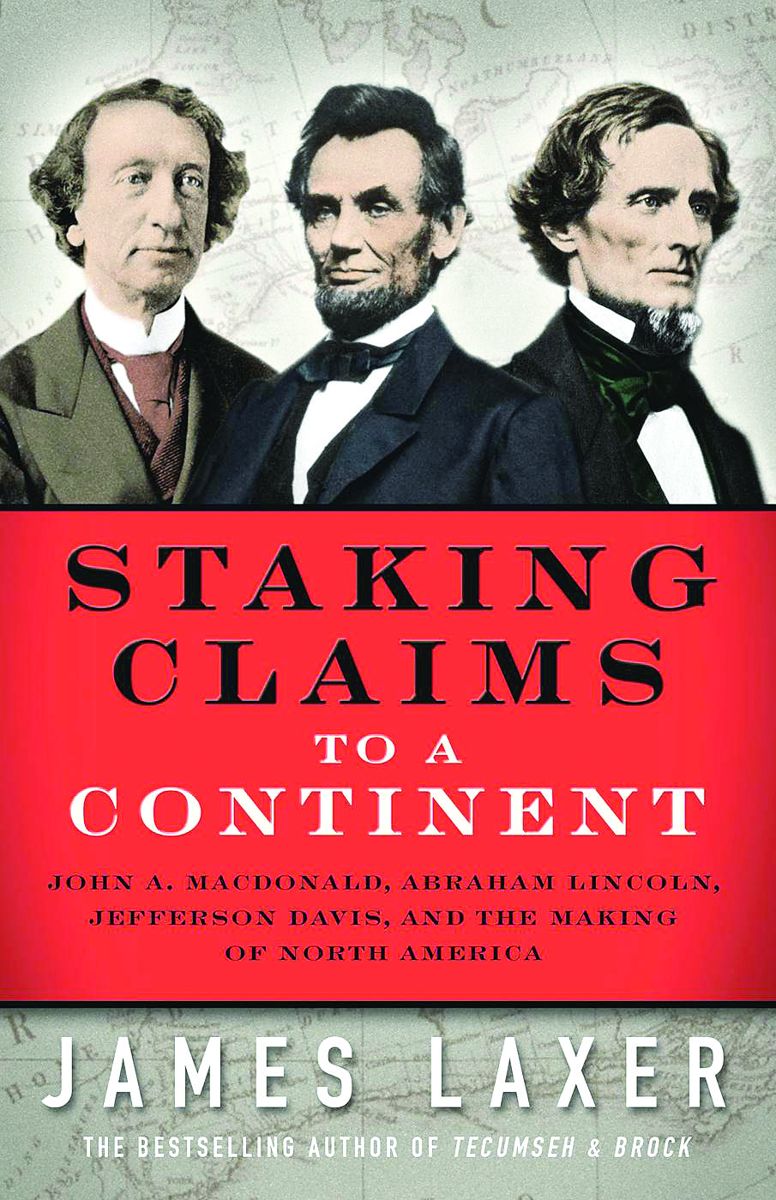
Staking Claims to a Continent: John A. MacDonald, Abraham Lincoln, Jefferson Davis, and the Making of North America. By James Laxer. Notes, bibliography, index, 352 pp., 2016, House of Anansi, www.houseofanansi.com, $32.95.
The American Civil War was more than a war between the rural South and the industrializing North. James Laxer contends it was also a war among the United States, the Confederate States and Canadian provinces for control of the North American continent. Due to its loss of the war, the Confederate States of America lost its bid to control part of North America. At the end of the war, the United States resumed control of the seceded states. In 1867 it added Alaska to its North American territory.
During its brief existence, the Confederacy had extensive territorial possessions and aspirations. Its Congress included representatives from the 11 seceded states plus Missouri and Kentucky. It had diplomatic relations with the Indian Territory and launched a military expedition that sought to bring Arizona, New Mexico and California into the Confederacy. Laxer examines what happened on Civil War battlefields and within the Confederate and Union governments that affected international relations, specifically north of the United States. Laxer contends that Canada’s birth resulted from Civil War battles, resolutions and acts passed or not passed by the United States Congress, and actions taken or not taken by President Abraham Lincoln and his cabinet. He argues that in 1860 the area that today makes up Canada was but a collection of various colonies quarreling among themselves and having no national identity. The area that today makes up Western Canada was a land mass waiting to be gobbled up by the United States as it implemented its Manifest Destiny policies. However, by 1866 Canadian provincial political leaders had perceived the growing power of the United States. They had moved to put aside their regional differences to form a country with its own identity separate from the United States. Thus, the British territories north of the United States created the Dominion of Canada. Those familiar with the conflicting regional demands that plagued the creation of the United States will see many parallels with the Dominion’s formation. After Canadian Confederation, there were other parallels between Canada and the United States. Both built transcontinental railroads whose builders used unethical financial methods. Both purchased new lands, the Hudson Bay area by Canada and Alaska by the United States. Also, both countries broke promises with indigenous peoples concerning land ownership, forced them to yield their lands to white settlers moving west, and fought wars with native peoples living in the Great Plains. In summary, this book takes a very interesting look at the relations between Canada and the United States during and shortly after the American Civil War. Two interesting questions not directly raised by the author but hidden in his text are: “If there had not been an American Civil War, would there have been a Dominion of Canada?” and “Without the American Civil War would the boundaries of the United States have eventually embraced the four western provinces of Canada?” For anyone interested in United States-Canadian relationships, this book is a great introduction to the subject. Reviewer Charles H. Bogart has a B.A. in history from Thomas More College and an MA in urban planning from Ohio State University. He is the historian for Frankfort, Kentucky’s Fort Boone Civil War Battle Site.
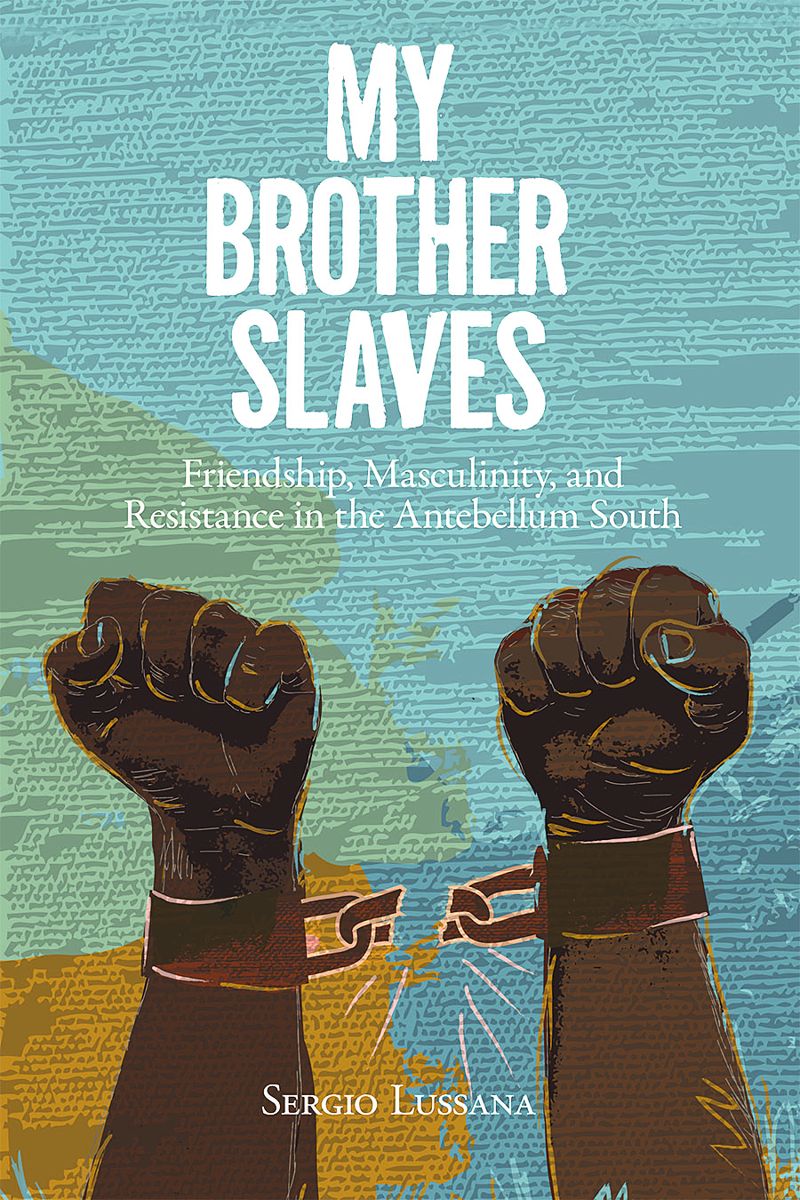
Owners of nothing, not even themselves, slaves endured an unimaginably horrific existence. For male slaves that grueling life was fraught with frequent emasculating humiliation. Aside from freedom, what all male slaves wanted – according to this splendid volume – was a way to assert masculinity in an environment that repeatedly challenged normal conceptions of manhood. Like any study related to slavery, a paucity of source material presents challenges. However, Sergio Lussana produces a careful analysis of Works Progress Administration slave narratives, autobiographies, folklore and plantation records. He also creatively uses anthropological studies of West African communities. Thereby he has created a vivid depiction of the world in which male slaves worked, lived and tried to overcome. At the book’s core is the author’s quest to understand how male slaves in the antebellum South dealt with their daily tasks in fields, factories, or mines; kept their wits about them; asserted their manhood and resisted slavery. One of the ways male slaves asserted their manhood was by making the most of their leisure time. While Lussana notes that slaves enjoyed “little leisure time,” he presents compelling evidence to show how male slaves made the most of that time —customarily Saturday nights and Sundays. Activities such as drinking, gambling and wrestling afforded them the chance for “self-respect and personal empowerment.” Additionally, Lussana lucidly shows how these activities, coupled with relationships established in workplaces, created seemingly unbreakable friendships. For male slaves, he notes, friendship proved a cornerstone of existence and hope. Friends not only provided someone to lean on at the most difficult times, but someone to assist when a male slave made the decision to engage in the ultimate form of resistance to bondage, running away. The book contains numerous accounts of friendships that helped some slaves, such as South Carolinian William Summerson, escape. Summerson successfully fled to Union boats on the Stono River thanks to help from his friend. But Lussana presents substantial evidence that shows “friends” sometimes did not turn out to be what they seemed. He reminds us that it was not uncommon for slaves “to betray one another” if that betrayal might prove personally beneficial. He also provides excellent insight into how slaves communicated with those on other plantations, the operations of slave patrols, and the ways slaves “dodged” the patrols. While there is much to read in the growing historiography of slave studies, Lussana’s is among the first to exclusively study male slaves. Beyond his originality, Lussana is a gifted writer. The author’s beautifully crafted narrative flows like water through the study’s five chapters. For anyone desiring a more profound understanding of how male slaves lived, functioned, coped with chattel slavery, and resisted that abominable institution, Lussana’s engaging, powerful and provocative study is essential reading. Reviewer Jonathan A. Noyalas is assistant professor of history and director of the Center for Civil War History at Lord Fairfax Community College in Middletown, Va., and is the author or editor of 11 books on Civil War history, including the recently released Civil War Legacy in the Shenandoah: Remembrance, Reunion, and Reconciliation.
William Tecumseh Sherman: In the Service of My Country: A Life. By James Lee McDonough. Maps, photos, notes, index, 832 pp., 2016, W.W. Norton, www.wwnorton.com, $39.95.
James Lee McDonough’s major interest in the Civil War has always been military. His earlier books have centered on battles in the Western Theater. So, when he decided to branch out into the field of biography, it made perfect sense for him to write about the most intriguing Western Theater general, William T. Sherman. As also expected, he concentrated on his subject’s military activity, attempting to place it within the context of his entire life. McDonough entered a crowded field. Modern books on Sherman began with the publication of B.H. Liddell-Hart and Lloyd Lewis’s books nearly 90 years ago and then James Merrill’s 1971 biography. I followed suit with a Sherman biography in 1992, and then came others by Stanley P. Hirshon, Lee Kennett, Michael
Fellman, Steven Woodworth and John Eisenhower. These were followed by the Simpson and Berlin edition of Sherman’s Civil War letters and a host of other books on various aspects of Sherman’s military career. Albert Castel produced an important study of Sherman in the Atlanta campaign. In summary, there has been no dearth of writing on the controversial red-headed general in modern times. McDonough thus took on a difficult task. His job was to produce a book that provided information and insight on Sherman not already available. To his advantage, he also had the benefit of a great deal of earlier research on the man. He indicated that he wanted to provide a “biography [which] presents and analyzes Sherman’s generalship … in greater detail, and sometimes with different interpretations, than previous biographies” He does indeed spend more time on Sherman in battle than do most other biographers, but there is still the question of providing the reader with more insight into Sherman the general and the man than has been previously known. This book demonstrates that McDonough has done excellent research in the many sources on Sherman available to historians. The text also displays clear and detailed writing. The author’s knowledge of military history is evident. Where the book falls short is in the area of providing new insight into the man and his lifetime of personal and professional conflict. Particularly missing are McDonough’s learned insights into this complicated man. He presents many sides but then does not tell the reader, based on his many years of study, what his own conclusions are. He also does not always explain the “why” of events in Sherman’s life. A reader with a thorough background in the Civil War can decide for himself or herself, but one with less knowledge will be hard pressed to make that decision. To his credit, however, McDonough echoes the more objective perception of Sherman that now dominates the field. Lost Cause exponents still do not understand Sherman and his role in the Civil War, but McDonough’s objective text continues the march to a better understanding of a most complicated man. Reviewer John F. Marszalek’s latest book is The Best Writings of Ulysses S. Grant, the first volume in Southern Illinois University Press’s new book series, “The World of Ulysses S. Grant.”
The Rivers Ran Backward: The Civil War and the Remaking of the American Middle Border. By Christopher Phillips. Illustrated, photos, map, notes, bibliography, index, 528 pp., 2016, Oxford, www. oup.com, $34.95.
When the Civil War erupted in 1861, many in the North and South were fighting for what appeared to be the same objective, a return to the American society of early 1860 – as it existed in their minds. Many Southerners saw secession and war as the only way to preserve their slavery-based way of life. Meanwhile many Northerners fought to preserve a united nation that had existed for over 80 years. As the war continued, this idea of returning to the remembered 1860 began to fray in both the North and the South. Communities and families were torn apart, and friends and relatives turned on each other. Christopher Phillips examines the effects of the war on American society by looking at two slave states, Kentucky and Missouri, and four bordering free states, Ohio, Indiana, Illinois and Kansas. Disparate loyalties within this region reflected the turmoil of ideas within the Confederacy and the Union. Both Confederate and Union adherents were found in all six states. Kentucky and Missouri had senators and representatives sitting in both the Confederate and U.S. congresses. The Northern pro-Confederate Copperhead movement had its strongest adherents in Ohio, Indiana and Illinois. This book’s title refers to the three great rivers that tied these six states together – the Ohio, Mississippi and Missouri. Most important cities in those states were on rivers and used them as their main transportation links with each other. Not only did commerce move by these rivers, but they were used to exchange ideas and social norms. Phillips notes that at the war’s start these six states considered themselves as one geographic area since those living in the area had extensive family ties. While slavery was not allowed in Illinois, Indiana and Ohio, these states enforced laws that disenfranchised and limited the movement of African Americans. Thus an outsider would have observed little difference in the economic and social position of African Americans throughout the area. Using the words of individuals and groups in the region before, during and after the Civil War, Phillips shows how the idea of extended white-family kinship was destroyed. Also, the concept that these six states formed their own unique region was superseded by the idea that they belonged to three different regional groups. The Civil War in these six states consisted of terrorism, not pitched battles. It was a war fought not only with guerrilla weapons, but with propaganda from the pulpit, on the courthouse steps and in newspapers. Women found their lives traumatized as unsettled economic, political and social events threatened their home lives. All residents of the area recognized that the Civil War was being fought over slavery, and the daily recognized symbol of slavery was the African Americans living in their midst. The heart of this book is how the Civil War changed the way Kansas, Illinois, Indiana and Ohio looked at Kentucky and Missouri, and how Kentucky and Missouri looked at each other. I found the book fascinating. It compelled me to contemplate new issues and to consider exploring fresh topics. Readers living near the Ohio River will better understand the cultural issues that both bind and divide the area. Readers will understand why, before 1860, the University of Kentucky would have been in the Big Ten Conference but after 1866 could only have played in the Southeast Conference. I highly recommend this book.
Reviewer Charles H. Bogart has a B.A. in history from Thomas More College and an MA in urban planning from Ohio State University. He is the historian for Frankfort, Kentucky’s Fort Boone Civil War Battle Site.
Novel About Young Mississippi Woman Leveraging Lincoln. By Stephenia McGee. Novel. 352 pp., 2016, Stephenia McGee, www.stepheniamcgee.com, $14.99 softcover.
I was in my easy chair reading this book when my wife walked by, glanced at the cover and did a double-take. “That looks like ‘chick lit,’” she said, with a hint of sarcasm in her voice. “Yes, it may not be the usual cup of tea for Civil War News,” I responded. “But we pride ourselves in reviewing a wide variety of books on many, many topics related to the
Civil War – including the occasional ‘chick lit.’” In this case the protagonist, Annabelle Ross, is a not-quite-20-year-old Southern belle who is trying to hold on to Rosswood, the family’s small Mississippi plantation. However, both Union and Confederate troops had sacked it and used it as a field hospital. After the healthy troops left, she had to bury several deceased patients herself, but two wounded Confederates remained under her care. Also in the house were her ailing, conniving grandfather and “Peggy,” who was a mother figure but had been her slave. Her only surviving blood relative was her father’s brother Michael, who was in the Confederate army. The time was early 1864, and even in Mississippi it was cold, especially for five people shivering in a large but almost empty home. Her grandfather had just moved in and was legally in charge because he was a male and Mississippi law forbade women from owning real estate. Grandfather had his own plans for Rosswood, and they involved a compelled marriage for Annabelle. At that moment, Annabelle knew she had to get a message to her uncle Michael asking that he request a furlough to return to Mississippi and take control of Rosswood. She sought help from one of the recovering Rebel soldiers and thereby became involved in Confederate military operations. The plot thickens as a result of Confederate Gen. Nathan Bedford Forrest skirmishing with Yankees led by Gen. Benjamin Henry Grierson. Within a few days Annabelle was detained by Confederates who thought she was a spy. That was a mere prelude to her becoming swept up in the Abraham Lincoln kidnapping plot. Annabelle and Confederate soldier Matthew Daniels found themselves developing a love-hate relationship that apparently is a major theme of the second book in this series, Losing Lincoln, which is now available. The third, Labeling Lincoln, is to be published later this year Assuming Annabelle’s adventures in the other books are as exciting and detailed as in this first one, the trilogy should be enjoyed by young women of middle school age and older. Reviewer J. Lee Bailey won an Emmy for a series of television news reports on lax security at a major American airport. His greatgreat-grandfather, Alexander Sutherland, served in the 16th Pennsylvania Cavalry. He working on a novel loosely based on Gen. John Hunt Morgan’s career.
Hell Itself: The Battle of the Wilderness, May 5-7, 1864. By Chris Mackowski. Illustrated, photos, maps, appendices, 168 pp., Savas Beatie, www.savasbeatie.com, $14.95 softcover.
Hell Itself is one of a number of new books in the Savas Beatie “Emerging Civil War Series.” This volume is a guide for touring the Wilderness battlefield, but it is much more than that. For each stop on the tour, Chris Mackowski provides a detailed account of the present appearance of the site and of what battle action transpired on that location. These accounts, along with the excellent photographs and maps, afford a full overview of the Battle of the Wilderness. On May 4, 1864, Union generals Ulysses S. Grant and George G. Meade opened the Overland Campaign, which would be the first matchup between Grant and Confederate Gen. Robert E. Lee. Their hope was to march safely through the Wilderness before Lee could block their path. Lee had other ideas and launched a brutal attack while they were still entangled in the wild, dense, second-growth forest called one of the “waste places of nature.” Fighting a battle in the Wilderness negated much of the Union army’s numerical superiority. It would also deny the Federals the advantage of having a greater quantity of artillery. Artillery was useless in the tangled underbrush of the Wilderness. There were only a few clearings where cannon could be used effectively. Maneuverability of troops was also affected. It was impossible to maintain formations. Regiments, and even companies, became hopelessly separated and lost. Visibility was often only a few feet. To make a dreadful scenario worse, fires broke out and wounded men caught between the lines were burned to death. To complete the series on the Overland Campaign, Savas Beatie offers the following books: A Season of Slaughter: The Battle of Spotsylvania Court House, May 8-21, 1864; Strike Them a Blow: Battle Along the North Anna River, May 21-25, 1864; and Hurricane from the Heavens: The Battle of Cold Harbor, May 26 – June 5, 1864. For a view of the entire campaign, there is No Turning Back: A Guide to the 1864 Overland Campaign, from the Wilderness to Cold Harbor, May 4 - June 13, 1864. This is a great book, and I highly recommend it. It is an indispensable guide for touring the Wilderness battlefield. Reviewer Robert L. Durham spent most of his career at the Defense Logistics Agency. He has written book reviews and articles for numerous historical blogs and publications.
Virginia Iliad: The Death and Destruction of “The Mother of States and Statesmen.” By H.V. Traywick Jr. Notes, bibliography, 308 pp., 2016, Dementi Milestone, www.dementimilestonepublishing. com, $20 softcover.
Virginia Iliad is thinly veiled Neo-Confederate propaganda. Mainly, this book is a collection of excerpts drawn from postwar writers who defended the “Lost Cause” interpretation of the war. H.V. Traywick’s passages include selections from George W. Bagby’s “Bacon and Greens,” Sara Agnes Rice Pryor’s Reminiscences of Peace and War, J. William Jones’s Personal Reminiscences of Robert E. Lee, John Sergeant Wise’s End of an Era, Constance Harrison’s Recollections, Grave and Gay, Edward Pollard’s Southern History of the War, Joseph Waddell’s Annals of Augusta County, Myrta Lockett Avary’s Dixie After the War, and John Scott’s Partisan Life with Colonel John S. Mosby. Most students of Confederate history will recognize this list as something of a “who’s who” of the Lost Cause generation. They were all skilled writers who carped endlessly against the way the Federal invasion of Virginia was carried out and the way the U.S. Congress directed Reconstruction. Moreover, many of Traywick’s authors did their best to promote the idea that the war had nothing to do with slavery. For instance, John S. Wise’s book, The End of an Era (1899), contained a shameless tableau of the ubiquitous “happy slave” myth. Attempting to impress upon the reader that white Virginians had constructed an unblemished slave society, Wise wrote: “Near at hand, or far away upon the hillsides, one beheld the working-bands of slaves, well clothed, well fed, and differing from other workmen, as we see them now, chiefly in their numbers and their cheerfulness and their comfortable clothing. “Remarkable as the statement may seem, those slaves, over whose sad fate so many tears have been shed, went about their work more joyously than any laboring people I ever saw.”
Traywick’s book is rife with similar hallmarks of the Lost Cause, and, taken together, these selections paint a vivid picture of white Virginians’ attempt to win the war of historical memory. He might have justified his book as a document collection, that is, as a sampling of Lost Cause writings from Virginia. However, the organization and prose of his book appear to be intended to dupe the reader into believing the Neo-Confederate perspective. For instance, the 15-page selection from Wise’s book contains no introduction, no explanation of Wise’s background, what biases he possessed, or even when his book was published. Instead, Traywick introduces the selection with the sarcastic, prejudiced title, “How the ‘Slave-Drivers’ Lived.” Another suspicious example is Joseph Waddell’s history of Augusta County, which Traywick uses to profile the Virginia Secession Convention. Waddell’s narrative tended to avoid the uncomfortable issue of slavery and race, saying specifically that he wished to avoid discussing which side was to blame for the war – a passage that Traywick redacts. Had Traywick selected the speeches delivered by Virginia Secession Convention delegates, instead of a postwar county history, he would have emphasized how the need to defend white supremacy formed the crux of secessionists’ arguments. To give Traywick the benefit of doubt, it is entirely possible that Virginia Iliad is flawed by poor research methodology or by consulting postwar writings at the expense of wartime sources. However, his book contains a hint that Traywick has his own ax to grind. He seldom reveals his own opinion, but when he does his Neo-Confederate bias becomes patently obvious. For instance, in his introduction, Traywick offers a highly dubious and pretentious estimation of Abraham Lincoln and the Secession Crisis. He says, “Lincoln did not listen to the counsel of ‘The Mother of States and of Statesmen.’ He listened to the manufacturers and industrialists, the bankers and financiers, the railroad builders, the mercantilists, and all the other constituents of the industrializing North who had gotten him elected, and whose interests would suffer or even collapse if the agricultural South – and particularly the ‘Cotton States’ – were allowed to leave the Union.” In short, Virginia Iliad is a badly edited collection of postwar Lost Cause writings interesting only to those who want to imagine the Civil War through the lens of NeoConfederate mythology.
Reviewer Thomas A. Horrocks is an independent scholar who has written, edited and co-edited seven books, including Lincoln’s Campaign Biographies (2014) and The Annotated Lincoln (2016).
The Legacy of St. George Tucker: College Professors in Virginia Confront Slavery and the Rights of States, 1771-1897. By Chad Vanderford. Index, notes, 272 pp., 2015, Tennessee, www.utpress.org, $49.95.
Virginia’s secession convention opted to cast its lot with the Confederacy in April 1861. Its members made their decision based not only on such things as Lincoln’s election and his call for 75,000 volunteers after the Fort Sumter attack. They also were moved by the ideas and philosophies inculcated into them during their days as college students. While historians have written much about why Virginia seceded, few have offered any history of Virginia’s intellectual life to more completely explain the mindset of Virginia’s secessionists.
Chad Vanderford’s book fills that void. He reminds historians to judge those decision-makers in the context of the time in which they lived. At the epicenter of Vanderford’s impeccably written and convincingly argued volume are three figures: St. George Tucker, his son Henry Tucker, and St. George’s grandson John Randolph Tucker. St. George Tucker enjoyed a successful career as one of the nation’s first political theory professors. He taught at the College of William and Mary. Vanderford examines how St. George Tucker, as professor and author, viewed slavery, the one institution that proved a constant wedge between North and South after the American Revolution. Many scholars have interpreted St. George’s writings, particularly A Dissertation on Slavery, as simple expressions of the “necessary evil” argument for slavery. But Vanderford’s close reading of St. George’s Dissertation reveals that the highly regarded political theorist believed that slavery defied the Declaration of Independence’s principles. St. George cautioned that slavery could not be eradicated swiftly because immediate abolition would pose a threat to master and slave. Vanderford shows that St. George’s perspectives on slavery and states’ rights – the belief that the rights granted to states should be the same as those granted to “humans writ large” – lived on through his writings and his students. He argues that St. George’s beliefs thrived most vigorously through his offspring, notably his son Henry and his grandson John Randolph, who served as Virginia’s attorney general between 1857 and 1865. Vanderford not only examines St. George’s long shadow over political theory in Virginia. He also explores the origins of St. George’s views. These included events such as the slave revolt in St. Domingue in 1791 and careful reading of political philosophers, such as Thomas Hobbes and John Locke. Vanderford also offers glimpses into Southern concepts of honor, as well as antebellum university life. Additionally, he gives insights into individuals who played a prominent role in Virginia’s antebellum intellectual and political life, such as George Junkin and John Letcher. Vanderford’s thoroughly researched study, while written for an academic audience, offers an excellent analysis of how St. George Tucker’s ideas on slavery and states’ rights thrived for generations and influenced many as war approached. This book reminds us that interpreting the past is not always about just examining a chain of events. It also involves understanding the intellectual influences on and of the individuals who played a part in those events. Reviewer Jonathan A. Noyalas is assistant professor of history and director of the Center for Civil War History at Lord Fairfax Community College in Middletown, Va., and is the author or editor of 11 books on Civil War history.