
An Old Veteran Returns To Pickett’s Mill Battlefield
By Judd Smith · Originally published August 2016 · p. 19
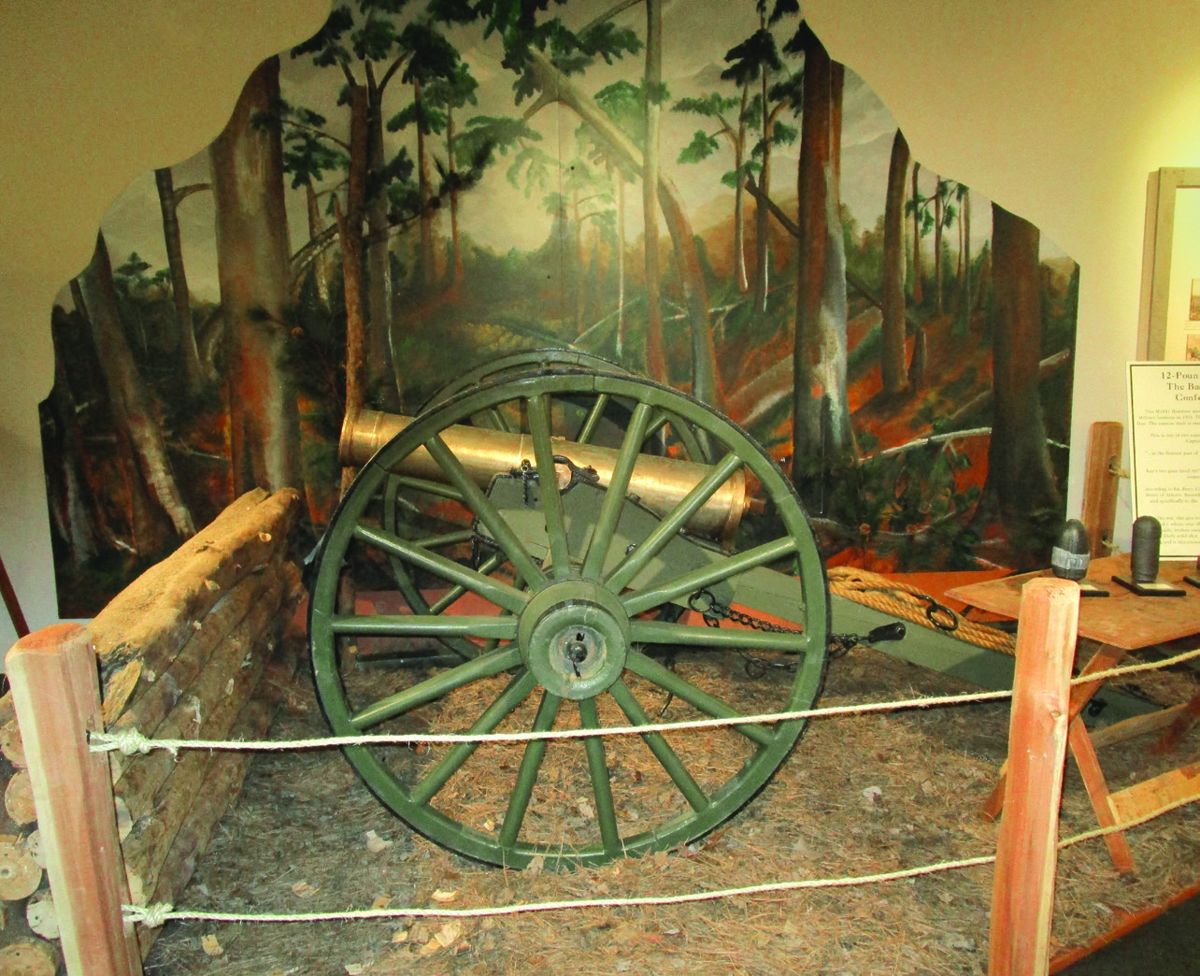
DALLAS, GA.—On June 1, 2016, staff and volunteers from Pickett’s Mill Battlefield State Historic Site met with personnel from the Atlanta History Center to transport a historic cannon to Pickett’s Mill for display. The cannon is a Model 1841 Howitzer, which has a long and rich history worthy of preservation and interpretation. In 1851 the cannon tube was cast by the firm of Cyrus Alger and Company at the behest of the State of Arkansas, destined for the Arkansas Military Institute. After the outbreak of the Civil War in 1861, the howitzer, a smoothbore cannon designed to fire twelve-pound projectiles, shells and other ordnance, was pressed into Confederate service. By 1864, during General William T. Sherman’s campaign to capture Atlanta, the howitzer was part of a battery of artillery commanded by Captain Thomas J. Key. At the battle of Pickett’s Mill on May 27, 1864, elements of Key’s Battery were moved to within sixty yards of the Union lines and opened a devastating fire of canister and spherical case shot (anti-personnel rounds) into the enemy. This howitzer, identified by the unique eagle and globe design on the top surface and the gun number stamped on the muzzle face, was in Key’s Battery at the battle. On July 25, 1864, Key’s battery was re-equipped with new guns and Key had to turn in his howitzers to the Confederate Ordnance Bureau. In his diary, Key wrote that he regretted having to give up this veteran of so many battles. After the Civil War, as monuments sprang up throughout the country, the howitzer was first displayed by the City of Atlanta at Grant Park (Fort Walker) in the 1880s. It remained there for many years suffering vandalism that defaced and broke pieces off the tube until the 1980’s when it was removed and later stolen. The tube was recovered by the City of Atlanta in 2010 and was housed at the Cyclorama.
As plans moved forward in 2015 to relocate the famous painting and other artifacts from the Cyclorama to a new wing currently under construction at the Atlanta History Center, the gun was placed in storage, out of public view. At that time, the Department of Natural Resources State Parks, Recreation and Historic Sites Division and the Friends of Pickett’s Mill Battlefield reached out to the History Center to see if it would be possible to house the cannon temporarily. It was a win for all parties. Pickett’s Mill Battlefield will display the piece and share its incredible story with the public until sometime in 2017 when the howitzer will return to its permanent home at the Atlanta History Center. This partnership of preservation and interpretation will allow the citizens of Georgia and visitors from around the world access to this unique piece of military history and incredible story of its 165-year history. Plan Your Visit: Pickett’s Mill Battlefield State Historic Site is located in Dallas, Georgia and is one of the best-preserved Civil War battlefields in the nation. Visitors can travel roads used by Federal and Confederate troops, see earthworks constructed by these men and walk through the same ravine where hundreds died. An authentic 1800s pioneer cabin is furnished and open for tours during certain events. Open Thursday–Saturday 9 a.m.– 5 p.m. Admission is $3-$5.50. 770-443-7850 http://gastateparks.org/PickettsMillBattlefield Address is 4432 Mount Tabor Church Road, Dallas, GA 30157 References: Thomas J. Key, Robert J. Campbell, Two Soldiers: The Campaign and Diaries of Thomas J. Key, and Robert J. Campbell (Literary Licensing, LLC, 2011) http://gastateparks.org/PickettsMillBattlefield http://www.atlantahistorycenter. com/cyclorama-atlanta-history-center-fact-sheet