
Through The Lens
Through The Lens — April 2016
By Stephanie Hagiwara · Originally published April 2016 · p. 8
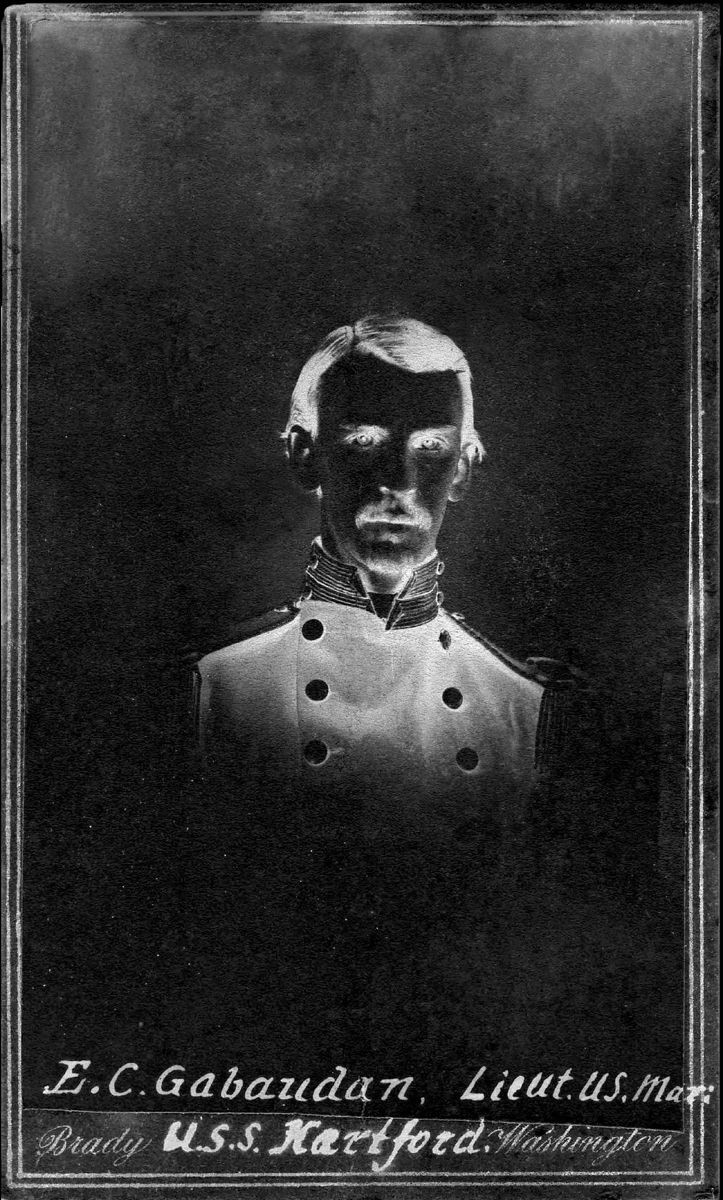
“Heavy shells were falling fast and thick” a Confederate later wrote. “It seems as if the whole heavens were ablaze with thunder and lightning.” As part of the Union’s campaign to capture Vicksburg, Mississippi, on March 14, 1863, Adm. David Farragut’s ships ran the gauntlet of 19 guns protecting Port Hudson. Port Hudson defended the mouth of the Red River, which emptied into the Mississippi River. The Confederates used the Red River to supply, not only Port Hudson, but Vicksburg. Of the seven vessels making the attempt, only Farragut’s flagship, the U.S.S. Hartford and the U.S.S. Albatross made it passed Port Hudson. The deck of both ships were covered in blood and smashed wood from the ordeal. But what happened to Farragut’s missing ships? Repeated attempts to signal his fleet below Port Hudson were blocked by tall trees. Needing to leave, Farragut sent a note nailed to a raft downstream to let the lower fleet know the two ships had survived. Farragut’s top priority was to get in touch with Gen. Ulysses Grant, who was over 200 miles upriver at Vicksburg. It wasn’t a fun trip. The ships had to fight both the swelling waters of the Mississippi and the Confederates on the bluffs above the river. It was at Vicksburg, that Farragut got hold of a New Orleans newspaper that told the tale of his five missing ships turning around under Port Hudson’s guns. From Gideon Welles, Secretary of the Navy, Farragut was surprised to find that instead of focusing on the ships that didn’t make it passed Port Hudson, the nation was thrilled that two ships were now able to block the Confederates use of the Red River. As part of that mission, Farragut needed to return to the Red River and establish communication with his fleet below Port Hudson. But how to do it? An overland attempt to establish communication with the lower fleet would be improbable. The Confederate cavalry was watching from both sides of the river. Some of the horsemen would ride to the river’s bank to water their horses as the Union ships passed. The Confederates were making it clear, any landing party would be fired upon. Farragut tried signal flags, signal rockets, timed gun fire to communicate with the lower fleet and failed. On April 7th, “some men were seen on shore making signals with a flag. Thinking it to be some parties from the lower fleet wishing to communicate with us, we ordered our army signal officer to exchange signals with them, but he found that it was impossible to do so, as they used different signals from ours. The gunboat Albatross then got under way, and found them to be some of the enemy, and shelled them off”, wrote William C. Holton. It was at this point, Farragut reluctantly agreed to a plan proposed by his secretary, 20 year old Edward Carrol Gabaudan. Gabaudan, a linguist who spoke five languages, had been with Farragut on the U.S.S. Brooklyn in Haiti and Vera Cruz, Mexico before the war. In one instance, Gabaudan had undertaken a perilous journey of nine miles on foot and on a mule to deliver a dispatch. After five years working together, “if there was a delicate and grave matter to be handled, he entrusted it implicitly to Gabaudan.” Gabaudan’s plan was to drift down the Mississippi, past Port Hudson, in a dugout canoe draped in branches and twigs to reach the Federal fleet. It was not uncommon for logs to float down the river. Hopefully, the Confederates would ignore the “log” and not use it for target practice. At 8 p.m. that evening, the canoe was lowered into the water. Gabaudan had his watch, pistol and several dispatches for the fleet and one for Gen. Nathaniel Banks. A runaway slave, who had volunteered to serve as an oarsman, went with him. At 8:30 p.m. another canoe with two runaway slaves with dispatches was also lowered into the water as a distraction. With any luck, both skiffs would make it. The ruse seemed to be working until the canoe began to drift towards the east bank. Gabaudan and his companion could hear men discussing the large object floating down the river. They heard a small boat being pushed into the river as a group of men got in to check them out. As they rowed closer to Gabaudan, he clutched his pistol to his chest determined to fight. Luckily, the soldiers had decided they had gotten close enough to have done their duty and called out to their brethren on shore that it was “only a large log”. The pair waited two hours before pushing aside the branches and revealing their presence to the first boat they saw. To their surprise, they had drifted past the gunboats patrolling the river below Port Hudson and had reached Baton Rouge. They were picked up by the U.S.S. Richmond. At 10:20 p.m. two rockets from the U.S.S. Essex signaled the safe passage of both canoes. Gabaudan immediately hopped on a steamer to deliver the dispatch to Banks. The staff of the U.S.S. Richmond focused on how to communicate with Farragut. It was determined that if they built “a light platform … supported by an iron frame, and placed upon the royal masthead and the top gallant, signal flags could be seen between the two ships. Everything being ready on the day indicated, all ears were strained to catch the sound of the signal gun of our gallant commander in chief. At 10:00 a.m. it was heard, and immediately answered by us. The mastheads of the Hartford too, were discovered from our crow’s nest. Communication was at once established by the army signal officers, which were on board the two vessels, and a party sent with mails and dispatches.” On April 15th, Gabaudan, the runaway slaves who participated in the canoe adventure and their army escort boarded the Hartford. “He brought cheering army news. Gen. Christopher Augur, with a force of Bank’s men, was in the rear of Port Hudson, cutting off their possibilities of receiving supplies from that quarter, while we had blockaded the mouth of the Red River, keeping them from transporting provisions or stores from Texas out of this stream.” The Union strategy of closing Vicksburg’s supply chain was in place.
For Gabaudan, it was time to change jobs. He had served first as Farragut’s clerk and then as his secretary since he was 15 years old. At his request, Farragut recommended Gabaudan for a situation in the Marine Corps. On March 18, 1864, Gabaudan became a 2nd Lt. After the Civil War, Gabaudan returned to duty on the Hartford. As part of the Asiatic Squadron, he spent two years off the coast of China before returning to the United States. Gabaudan may have survived the Civil War but his dare devil actions caught up with him in the form of health issues. It was believed that the root of his chronic ill health came from sleeping in wet clothes while delivering dispatches to Grant and Gen. Tecumseh Sherman. At his father’s home in New York City, 26 year old Gabaudan died of consumption on March 25, 1868. He left a wife and a two year old daughter. Stephanie Hagiwara is the editor for CivilWarinColor.com and CivilWarin3D.com. She writes a weekly column for HistoryinFullColor.com that covers stories of photographs of historical interest from the 1850s to the present. Her articles can be found on Facebook, Tumblr and Pinterest.